

Supplier Relationship Management (SRM) is a key aspect of effective supply chain management. By building strong and collaborative relationships with Suppliers, companies can ensure reliable and high quality delivery of products and services.
This article will guide you through the key concepts, strategies and best practices of Supplier Relationship Management. From understanding the importance of Supplier segmentation to implementing effective communication and performance measurement systems, you will gain the knowledge and tools necessary to optimise your Supplier relationships.
Whether you are a procurement professional looking to improve Supplier performance or a business owner looking to strengthen your supply chain, this guide will provide valuable insights and practical steps to improve SRM practices. Get ready to transform your Supplier relationships and achieve sustainable business success. Read more 8 Supplier Management best practices any business can implement.
👤 Supplier Relationship Management – definition 👤
Supplier Relationship Management (SRM) is a systematic approach to managing and optimising the relationship between a company and its Suppliers. It involves developing and maintaining strong relationships with Suppliers to ensure mutual benefit and long-term success.
SRM encompasses various strategies and activities such as Supplier selection, contract negotiation, performance measurement and continuous improvement. The aim of SRM is to create collaborative and strategic partnerships with Suppliers to increase efficiency, reduce costs, mitigate risks and drive innovation.
Take advantage of our supply chain management services now!
🏅 Supplier Relationship Management (SRM) objectives 🏅
The main objectives of Supplier Relationship Management (SRM) include:
🤝 Developing relationships with Suppliers 🤝
Cooperation and relationships with Suppliers are a key component of Supplier Relationship Management (SRM). Creating personal relationships and cooperative partnerships with key Suppliers has a positive impact on the reliable and efficient sourcing of critical raw materials or services for the organisation.
Collaboration based on trust and a shared understanding of business needs and goals allows for the establishment of a strong working relationship between Suppliers and the organisation. Such a relationship not only provides better control over the supply cycle, but also enables access to high quality products and services.
Having a personal relationship with Suppliers also gives you the flexibility to approach procurement and meet Customer needs in a dynamic business environment. Through strong relationships with Suppliers, the organisation receives preferential commercial terms, which results in cost savings and improved efficiency of operations.
💥 Risk management 💥
Risk management is extremely important in managing relationships with Suppliers. It allows companies to effectively minimise potential risks and improve the quality of products and services. Risk management includes:
📌 Identifying and assessing potential risks that may affect the business. Then develop strategies and actions to help minimise these risks and improve supply chain security.
📌 Diversify the Supplier base: This means having multiple Suppliers to minimise the risks associated with reliance on a single supplier. In the event that one supplier suffers a problem, the company can still use other suppliers, which minimises supply disruptions and ensures business continuity.
📌 Establish clear communication channels with Suppliers: adequate and regular communication is key in minimising risks and resolving problems. This ensures that Suppliers are fully aware of the company’s expectations and requirements, which helps avoid potential problems and ensures effective collaboration.
⛓️ Value chain optimisation ⛓️
Value chain optimisation is about considering the wider context of Suppliers within the business. In order to optimise the value chain effectively, it is crucial to understand how Suppliers affect the business and the potential benefits of better managing this process. Here are the following steps in this process:
⚙️ Identify strategic Suppliers: Identify those Suppliers who have the greatest impact on the business and who can bring the greatest benefits. Then, consider seeking alternative Suppliers, thus diversifying the risks associated with dependence on one Supplier.
⚙️ Collaborate with Suppliers for product innovation: These collaborations can lead to the creation of unique products or services that can provide a competitive advantage in the market. In addition, optimising the value chain can help to reduce costs through price negotiations with Suppliers.
⚙️ Wykorzystanie existing resources more efficiently: Instead of looking for new Suppliers, consider extracting more value from existing Suppliers through e.g. contract negotiations, simultaneous procurement. Optimising the value chain brings many benefits, such as product innovation, price reduction and risk reduction. By implementing the right strategies, the company can increase its efficiency and achieve a competitive advantage in the market.
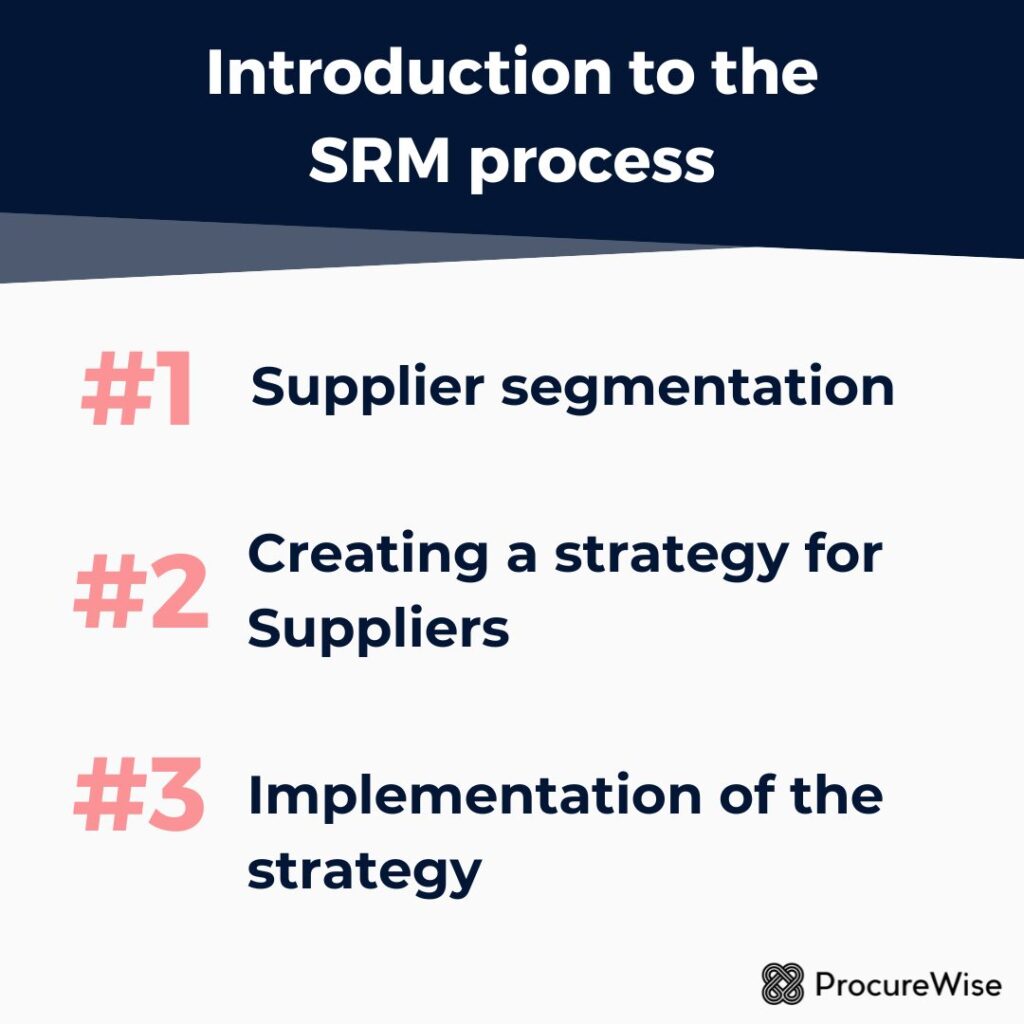
📦 Introduction to the Supplier Relationship Management (SRM) process 📦
The Supplier Relationship Management (SRM) process is an essential element of effective supply chain management. SRM focuses on establishing and maintaining beneficial relationships with Suppliers, which contributes to achieving a competitive advantage in the market by improving quality, reducing costs and ensuring continuity of supply. In this guide, you will learn about the key steps and strategies that will help you effectively manage your supplier relationships, as well as the benefits that can be achieved by implementing an SRM process. We invite you to read the complete guide.
🗃️ Supplier segmentation 🗃️
Supplier segmentation is a key element of effective Supplier Relationship Management. It involves segmenting suppliers into groups in order to focus relationship management efforts on those that matter most to the business. Here are ways to segment Suppliers:
📄Kraljic matrix, which is based on two dimensions: impact on the company and product availability in the market. Once the key Suppliers have been identified, it is useful to identify their individual needs and strategic objectives. This allows you to focus on building strong relationships and negotiating for greater benefit to the company.
📄The Pareto Principle, or the 80/20 rule. According to this principle, 20% of Suppliers generate 80% of the value for the company. By segmenting Suppliers based on their impact and value, it is possible to redirect the majority of efforts to those strategic Suppliers that are most relevant to the company’s business.
Segmenting Suppliers enables the company to focus on those Suppliers that matter most to the achievement of business objectives. It enables better management of Supplier relationships by tailoring strategies and approaches according to individual Supplier needs and values. By segmenting Suppliers, we can use resources effectively and achieve greater benefits for our business.
📑 Creating a strategy for Suppliers 📑
Creating a Supplier Strategy is a key element of successful Supplier Relationship Management. This process requires the consideration of several steps to help develop a Supplier Relationship Management plan.
➡️ Identify key Suppliers: It is important to identify those Suppliers who have the greatest impact on the business. This may include Suppliers who provide the most important products or services, or those who have a significant impact on cost or product quality.
➡️ Setting targets and budgets: It is useful to identify what objectives we want to achieve within our relationship with Suppliers. This may include achieving better commercial terms, increasing delivery efficiency, or improving product quality. In addition, setting budgets allows you to control and track the expenditure associated with your Supplier relationships.
➡️ Include analytical tools to monitor progress towards targets: This could include analysing Supplier performance, tracking costs, or analysing product quality. This will enable us to monitor progress and take appropriate action where necessary.
➡️ Adapting the strategy to the role and importance of individual Suppliers in the supply chain: Not all Suppliers have the same impact on our business, so it is important that the strategy takes into account such variation. This may mean different approaches and priorities in managing relationships with different Suppliers.
➡️ Aligning the organisation’s internal processes with the Supplier Relationship Management strategy: This means that we need to ensure that the right resources and procedures are in place to implement the strategy effectively. This may include aspects such as staff training, implementation of new systems or procedures, or changes to the organisational structure.
Creating a Supplier Strategy requires a multidimensional approach that takes into account different factors and needs. It is important to continuously monitor progress and adjust the strategy in order to achieve greater efficiency and benefits from Supplier Relationship Management.
👓 Implementation of the strategy 👓
The implementation and monitoring of a Supplier Relationship Management (SRM) strategy is a key element of effective Supplier management. There are several steps that need to be taken to achieve this.
👉 Adapt the plan to the individual needs and characteristics of the Suppliers: Not all Suppliers are the same, so the SRM strategy must be flexible and adapted to different situations. It is also important to prioritise based on the segmentation of Suppliers. Some Supplies may be more business critical than others, so it is worth setting priorities to focus on key Suppliers.
👉 Leverage collaborative relationships with Suppliers: collaboration and a common goal are key to success in managing Supplier relationships. Regular meetings and communication with Suppliers are essential to maintain strong relationships and develop partnerships.
👉 Monitor progress in strategy implementation: It is advisable to appoint a team member to regularly monitor progress, track success metrics and adjust tactics as necessary. This will keep us in control of the achievement of the goals and allow us to take appropriate corrective action.
👉 Identify and track relevant metrics of success: This could be aspects such as costs, product quality, on-time delivery or other key indicators. It is important to have a concrete knowledge of progress in these areas and to be able to react when necessary.

📋Benefits and examples of using Supplier Relationship Management (SRM)📋
Using a Supplier Relationship Management (SRM) strategy can bring many benefits to companies. It allows you to focus on getting the most out of your Suppliers, resulting in improved financial performance for your business.
✏️ Cost reduction: By focusing on strategic Suppliers and working well together, companies can negotiate more favourable pricing terms and obtain better settlement terms (e.g. longer payment terms for purchased goods). As an example, a company in the retail industry achieved supply chain simplification through SRM and obtained more favourable prices from its Suppliers, which translated into higher sales margins.
✏️ Achieving continuity in the supply chain: By building strong relationships, companies can better manage possible risks, such as unpredictable supply disruptions or natural disasters. An example of this is a car manufacturer that, through SRM, maintained a dialogue with its Suppliers and, through joint efforts, ensured continuity of supply during difficult situations such as earthquakes or floods.
✏️ Managing and mitigating Supplier Risks: By systematically monitoring and evaluating Suppliers, companies can identify potential risks and take appropriate preventive action. An example is a pharmaceutical company that, thanks to SRM, has increased its control over the quality of its supplies, reducing the risk of defective products in the market.
✏️ Enables improved flexibility and responsiveness of Suppliers: By understanding their capabilities and resources, companies can better align their orders and expectations, resulting in a faster response from Suppliers to Customers. An example is an electronics manufacturer that, through SRM, has increased communication and collaboration with Suppliers, allowing it to respond quickly to changing market demands and deliver new products on time.
⛔ Challenges of Supplier Relationship Management (SRM) ⛔
Supplier Relationship Management (SRM) challenges are inevitable, but there are effective ways to confront and resolve them.
❌ Managing risks and continuity of supply during pandemics or environmental disasters: In case of such unpredictable events, the company must be prepared with risk management strategies that include alternative supplies and contingency plans.
❌ Lack of transparency about Suppliers and their strategic value: Companies often lack insight into Suppliers’ processes and systems, leading to a loss of control over their operations. To address this issue, SRM introduces systematic monitoring and evaluation of Suppliers, which enables a more flexible response to irregularities and a focus on strategic Suppliers.
❌ Focusing on cost reduction instead of leveraging strategic relationships: Many companies focus on cost reduction, but this approach limits opportunities for growth and innovation. SRM prompts companies to build long-term and partnership relationships with Suppliers, which contributes to achieving greater business value.
❌ Lack of alignment between SRM and business objectives: There is sometimes a lack of alignment between SRM and the company’s strategy, which makes it difficult to achieve the intended results. Therefore, it is important that SRM is integrated into the whole company and has clear business objectives.
❌ Lack of a broad Supplier base: Too much concentration of supply on one or a few strategic Suppliers can increase the risk of supply disruption and hinder business growth. The answer to this challenge is to segment Suppliers and develop relationships with more Suppliers.
🖥️ Supplier Relationship Management (SRM) software 🖥️
Supplier Relationship Management (SRM) software offers many benefits and capabilities that contribute to effective Supplier management. With interactive analysis dashboards, real insight into the Supplier base, automated risk management notifications, sustainability and diversity assessment capabilities and intelligent Supplier adoption processes, greater control and efficiency in Supplier management can be achieved.
Summary
Having an excellent Supplier Relationship Management system in place is key to success in the marketplace. There are many benefits of effective Supplier management, such as reducing costs, increasing competitiveness, ensuring continuity of supply and achieving better product quality.