

Effective supplier management is crucial for any company relying on external suppliers of goods or services. Successful supplier management can help ensure operational smoothness, reduce costs, and maintain strong relationships. However, it can be a complex and demanding task that requires careful planning and execution. To assist you in navigating the world of supplier management, we have prepared a list of eight best practices that can guide you to success. Whether you are just starting or looking to improve your current supplier management processes, these practices will provide valuable insights and strategies. Read on to learn more about optimizing supplier management and growing your business. Read more What is Supplier Relationship Management (SRM)?
❓What are the consequences of poor Supplier Management?❓
Poor supplier management leads to:
❌ Loss of savings and weak negotiation power
❌ Poor supplier performance and inability to adapt to market changes
❌ Increased workload due to complex processes
To minimize these threats, a successful company must build an excellent supplier management process to ensure an uninterrupted and complex supply chain and meet key performance indicators.
Take advantage of our supply chain management services now!
📊 Supplier Relationship Management (SRM) Maturity Analysis 📊
SRM – Supplier Relationship Management – is crucial for identifying potential gaps in a company’s strategy, people, technology, and processes. This analysis assesses five main elements: strategy, people, technology and processes, and business outcomes. It includes evaluating a company’s SRM strategy, the knowledge and skills of employees, the tools and systems used, and the achievement of business goals.
By identifying these gaps, a company can develop and implement strategies, training, and procedures to improve its effectiveness in supplier relationship management and achieve better business results.
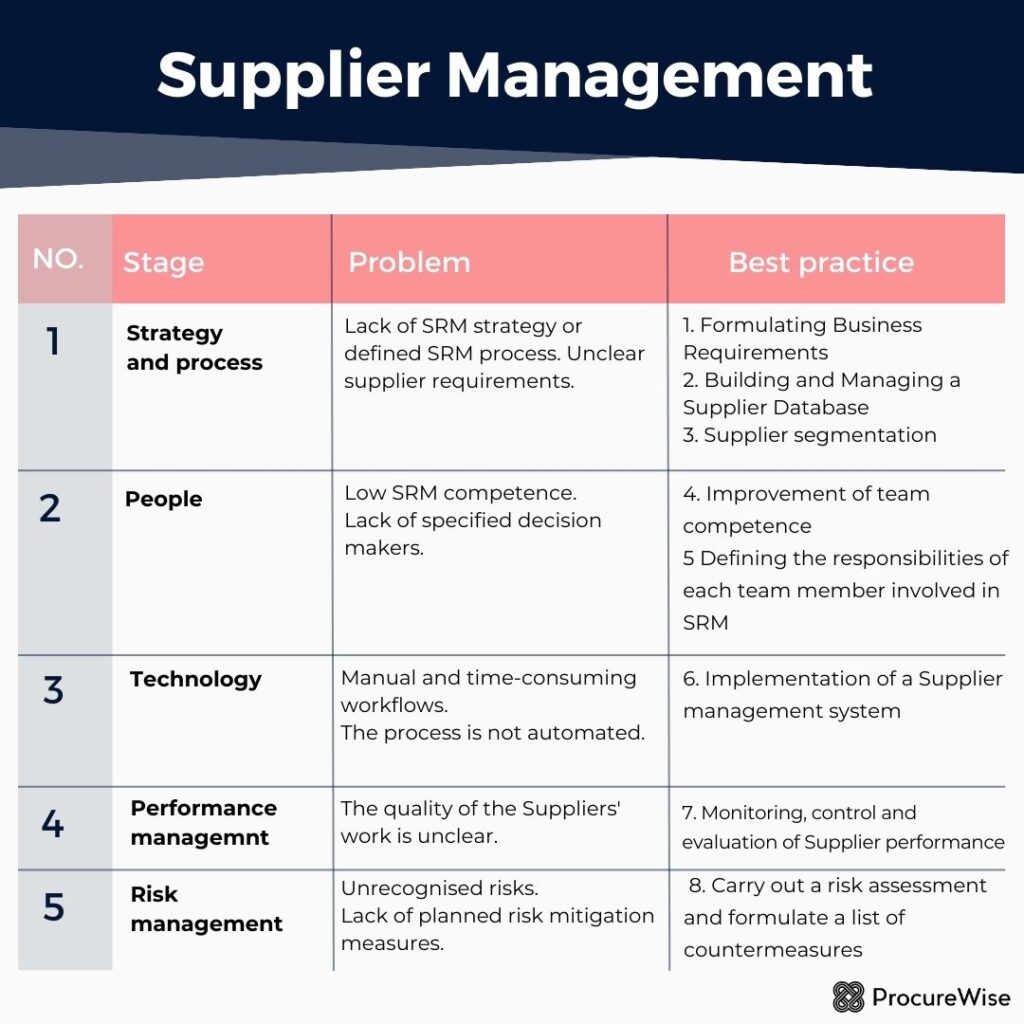
🏆 8 Best Supplier Management Practices for Every Stage of the Process 🏆
1. Formulating Business Requirements 📃
Purchasing involves more than just cutting costs and finding cheap deals. It should align with the company’s strategy by efficiently using resources, managing risks, maintaining consistent supplies, and contributing to revenue growth. This requires good communication and shared goals among teams. Understanding the company’s needs allows the purchasing team to make informed decisions and avoid strategic mistakes in supplier selection and negotiations. Aligned goals also help set priorities and measure supplier performance.
2. Building and Managing a Supplier Database 🗂️
Having a detailed and up-to-date supplier base with it’s data is beneficial for planning, saving money, selecting new suppliers, and maintaining good relationships. It’s helpful to store information such as:
📌 Contact details
📌 Proposals and contracts
📌 Supplier capabilities
📌 Invoices and transactional data
📌 Shipping scope and supplier locations
📌 Supplier performance and feedback
📌 Any other criteria crucial to your busines
3. Supplier segmentation 📝
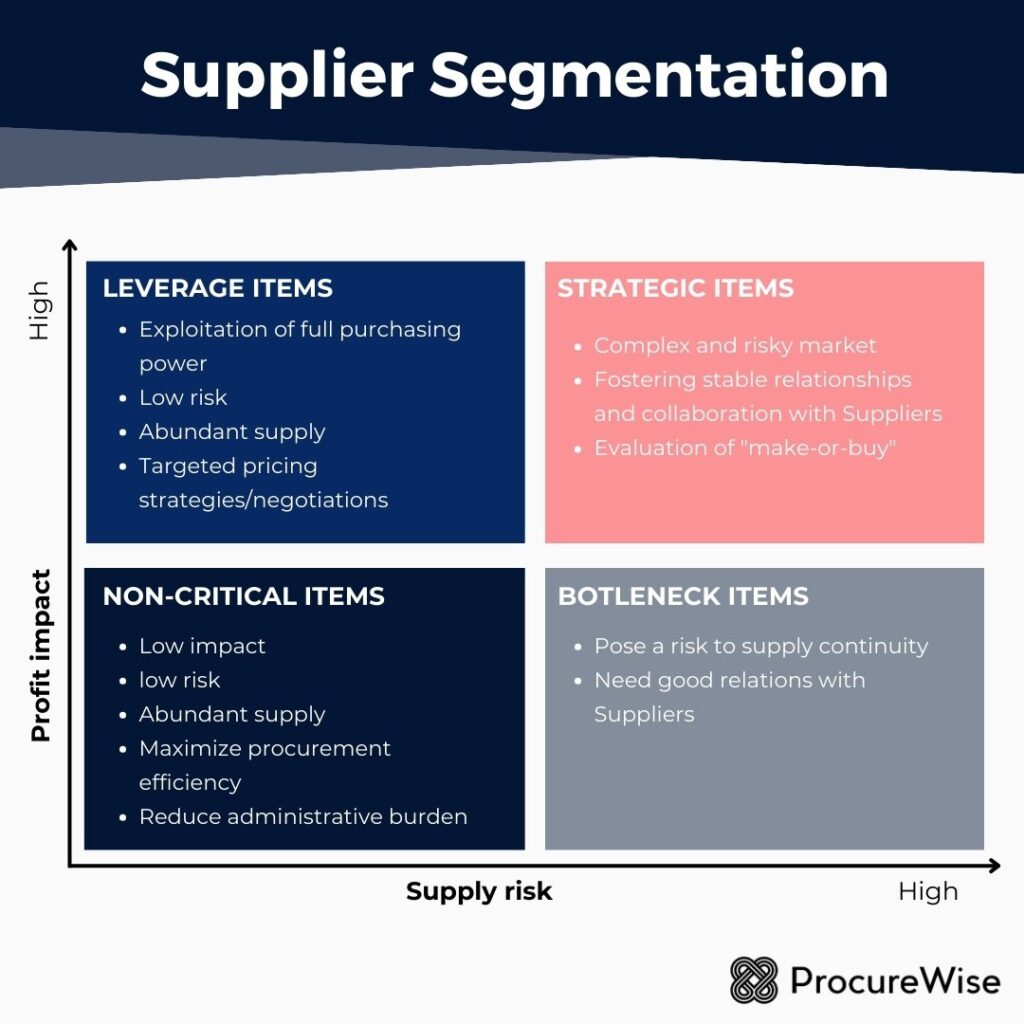
Supplier segmentation is a vital Supplier Relationship Management (SRM) tool that helps companies better understand and tailor their collaboration methods with suppliers. It enables more efficient management, decision-making, and a realistic assessment of their value as strategic partners. Various criteria, such as strategic suppliers, bottleneck suppliers, financial leverage suppliers, or non-critical suppliers, can be used for segmentation. It’s essential to note that an increasing number of suppliers increases the risk of delivery control complications and higher delivery control costs.
One tool used for precise supplier segmentation is the Kraljic Matrix, categorizing suppliers based on market availability and cost impact. Supplier segmentation is crucial for effective supplier management, allowing companies to focus their resources and attention on key suppliers and manage risk effectively.
4. Enhancing Team Competencies 📈
Developing the team’s competencies in supplier management is crucial for effective business operations. Identifying areas that need improvement in the procurement team brings benefits to both employees and the company. It improves supplier management efficiency, contributes to career development, increases employee satisfaction, and reduces delivery risks.
Hiring experienced procurement specialists is also important for effective supply processes and supplier management. By focusing on improving competencies, a company can gain a competitive advantage through effective supplier management and strong supplier relationships, leading to better financial results, higher service quality, and minimized delivery risks.
5. Defining Responsibilities of Each SRM Team Member ☑️
Defining responsibilities for each team member involved in supplier relationship management (SRM) is crucial for effective and efficient company operation. This allows for clear task definition and understanding each team member’s role in the supplier management process. Additionally, SRM involves tasks such as monitoring supplier performance, negotiating contracts, managing supplier relationships, and coordinating orders.
Assigning specific responsibilities for each task ensures transparency and effectiveness in supplier management. Transparent reporting and information exchange are also important for effective supplier management, allowing for monitoring, issue identification, and quick corrective action.
6. Implementing a Supplier Management System 🖥️
Implementing a supplier management system is crucial for effective and efficient supply chain management. A platform centralizing all supplier management-related data and processes is a straightforward solution. Such a solution enables companies to effectively monitor and manage all aspects related to suppliers, such as orders, payments, deliveries, and business relationships.
This optimization helps streamline procurement process, increase control over deliveries, and minimize the risk of delays or delivery issues. Implementing such a system also ensures better collaboration and communication with suppliers, contributing to improved quality and timeliness of deliveries and increased customer satisfaction.
If you are looking for a supplier management system – schedule a free discovery call today!

7. Monitoring, Controlling, and Evaluating Supplier Performance 🔎
Monitoring, controlling, and evaluating supplier performance are crucial for effective supplier management. This process allows companies to effectively monitor the quality of supplier services, compliance with business requirements, and minimize delivery-related risks.
By implementing a transparent and organized evaluation system, such as a Supplier Scorecard, companies can objectively measure supplier performance and reduce potential threats. It’s essential to choose appropriate evaluation methods and focus on key elements that impact service quality.
These elements include:
✔️ Alignment with business goals
✔️ Compliance with company policies
✔️ Measurable performance indicators
✔️ Communication and support services
✔️ Financial risk
✔️ Timeliness of deliveries and collaboration with the supplier
Monitoring, controlling, and evaluating supplier performance is essential for effective supplier management and achieving business success.
8. Conducting Risk Assessment and Formulating Remedial Measures 📜
Effective supplier management involves conducting a risk assessment to identify potential threats to business operations. This assessment helps companies make informed decisions and understand key aspects of supplier relationships. It includes identifying disruptions in the supply chain, ensuring suppliers have risk management strategies, and identifying critical suppliers and potential threats to them. This allows the implementation of mitigating measures to minimize risks and impact on business operations.
Developing a list of counteractive actions is a key element of the supplier risk assessment process. All risks should be presented with proposed actions, including risk-minimizing strategies such as:
➡️ Diversification of suppliers
➡️ Establishing clear delivery contracts
➡️ Regular supplier audits and management
➡️ Preparation of contingency plans
➡️ Conducting regular supplier reviews
➡️ Staff training
➡️ Performance monitoring
Regularly updating and monitoring these actions is also crucial to ensure they remain effective and relevant to changing circumstances.
Summary
Effective supplier management contributes to optimizing supply chain operations. By properly monitoring and managing suppliers, companies gain competitiveness, reduce the risk of supply disruptions, minimize costs, and build lasting relationships with suppliers.