
Implementing AI in your supply chain can revolutionize your operations and streamline processes for better efficiency and cost savings. With the right strategies and tips, you can successfully integrate AI into your supply chain management.
From demand forecasting to inventory optimization, AI can help you make smarter decisions and stay ahead of the competition. In this guide, we’ll explore the best tips for implementing AI in your supply chain and maximizing its benefits. Let’s dive in! Read more 10 best AI tools for procurement
✅ Business advantage of AI in supply chain managment ✅
The advancement of artificial intelligence (AI) has been transforming various industries, and the supply chain industry is no exception. AI technology has brought numerous benefits and advantages that have significantly improved efficiency, reduced costs, enhanced customer service, increased agility, and improved resilience.
✔️ AI in supply chains is its ability to enhance efficiency. AI-driven systems can analyze large amounts of data and make accurate predictions or recommendations, allowing for optimization of processes, such as excess inventory, demand forecasting, and route optimization. This means that companies can minimize waste, reduce lead times, and improve overall operational efficiency.
✔️ The integration of AI technology in supply chains helps to reduce operational costs. By automating various tasks and processes, AI can eliminate the need for manual labor and thereby reduce labor costs. Additionally, AI can identify cost-saving opportunities by analyzing data and identifying areas where resources can be better allocated.
✔️ AI in supply chains is the enhancement of customer service. With AI, companies can better understand customer preferences and behaviors, allowing for more personalized and targeted marketing strategies. AI-powered chatbots and virtual assistants can also provide round-the-clock customer support, improving overall customer satisfaction and loyalty.
✔️ AI enables greater agility in supply chain management. By utilizing AI algorithms, companies can quickly adapt to changing market conditions, respond to customer demands more efficiently, and make data-driven decisions in real-time. This flexibility and adaptability can give a competitive edge to businesses, enabling them to remain agile in dynamic market environments.
✔️ AI contributes to the improvement of resilience in supply chains. By analyzing historical data and potential risk factors, AI-powered intelligent systems can identify potential disruptions and provide recommendations to mitigate those risks. This proactive approach to risk management enhances supply chain resilience by minimizing the impact of disruptions and ensuring business continuity.
AI has made modern supply chains by providing significant advantages and impacts. From improving efficiency and reducing costs to enhancing customer service, increasing agility, and improving resilience, AI technology has proven to be a valuable asset for businesses. As the capabilities of AI continue to evolve, it is clear that its potential in supply chain management is vast and promising.
Take advantage of our services AI in procurement now!

❓How to implement AI in your supply chain❓
Implementing AI in your supply chain can revolutionize operations, enhance efficiency, and outpace competitors. This section provides a comprehensive guide to successfully integrating AI, covering key considerations, best practices, and practical steps. Discover how AI can improve demand forecasting, warehouse management, order fulfillment, and overall operational speed and accuracy.
Step 1: Initiation phase🚪
The initiation phase of AI implementation in the supply chain is crucial for success. Organizations must define clear objectives, assess readiness, seek stakeholder buy-in, conduct cost-benefit analysis, and develop a detailed roadmap.
Defining objectives involves identifying pain points AI can address, such as inventory management or customer service enhancement. Assessing readiness entails evaluating existing infrastructure and workforce skills. Seeking stakeholder buy-in ensures support and resources. Conducting a cost-benefit analysis weighs investment against expected benefits. Developing a roadmap outlines steps, timelines, and milestones.
By carefully addressing these steps, organizations can effectively integrate AI into their entire supply chain, improving efficiency, reducing costs, and enhancing customer service. The initiation phase sets the foundation for a successful implementation process, unlocking a range of benefits.
Step 2: Data checking 📋
Data checking is vital for implementing AI in the supply chain, ensuring accurate insights and reliable decision-making. It involves verifying, validating, and cleansing data to maintain its integrity.
Verification confirms data accuracy and consistency, crucial for preventing faulty insights. Validation assesses data quality and relevance, identifying any missing or incomplete information. Data cleansing removes errors, inconsistencies, or outliers, enhancing data reliability.
Thorough data checking ensures AI algorithms utilize accurate data, leading to improved decision-making. Investing in data checking is essential for harnessing AI’s full potential and optimizing warehouse operations.
Step 3: Metric selection 📚
Incorporating artificial intelligence (AI) into the supply chain can streamline operations and enhance efficiency. However, success relies on selecting the right metrics to measure performance and evaluate AI’s impact. These metrics act as benchmarks aligned with strategic goals, shedding light on areas like inventory management and customer satisfaction.
To choose relevant metrics, businesses must assess supply chain objectives and data availability. Metrics should be SMART—specific, measurable, achievable, relevant, and time-bound. They should also reflect organizational values and be regularly reviewed to adapt to changing dynamics.
By prioritizing actionable metrics, aligned with long-term goals, businesses can effectively track AI’s impact. This systematic approach ensures AI initiatives contribute to overall success, guiding decision-making and optimizing supply chain operations.
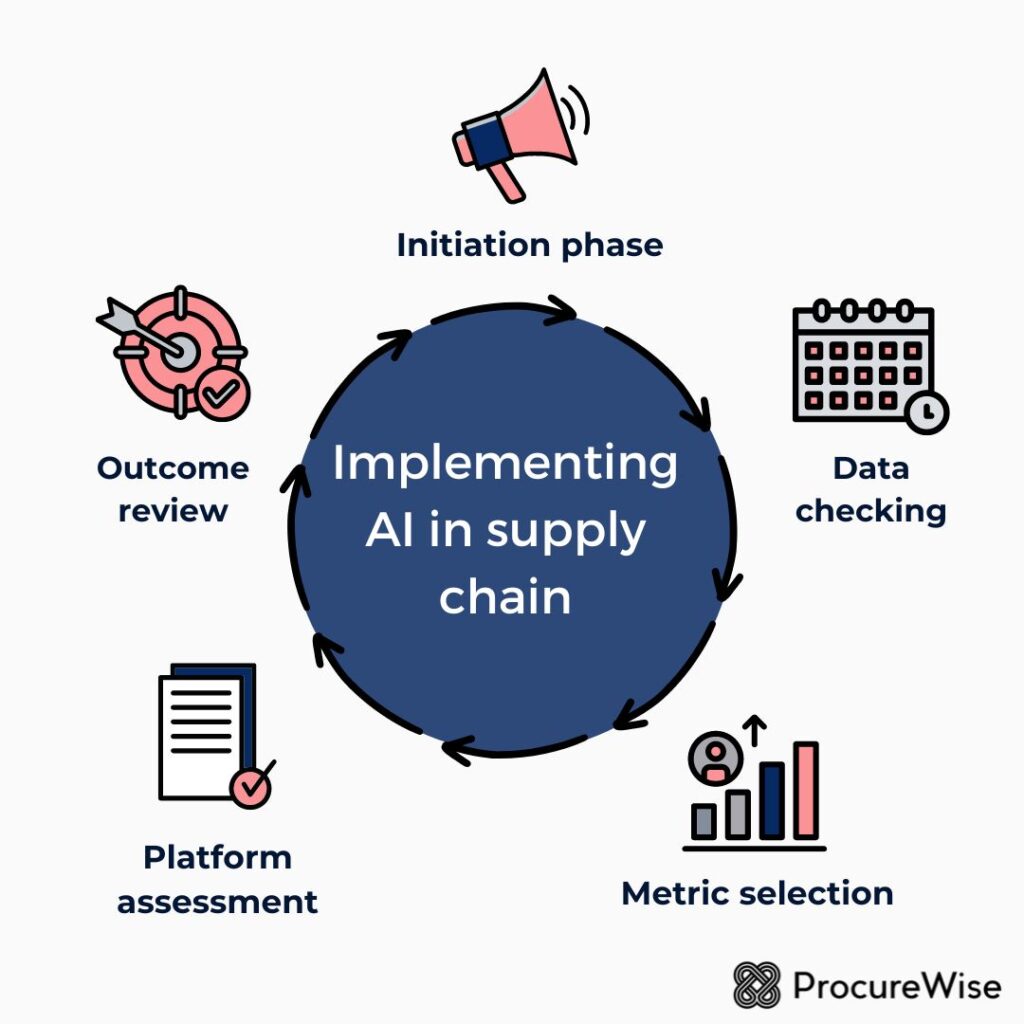
Step 4: Platform assessment 📝
Implementing AI in your supply chain requires a thorough platform assessment to choose the right solution. Start by defining objectives, such as optimizing inventory or enhancing demand forecasting. Identify key factors like scalability, integration, and cost-effectiveness for evaluation.
Develop criteria based on these factors, considering functionalities, performance, and support. Compare platforms through research, recommendations, and vendor engagement, involving stakeholders from IT, operations, and procurement. After evaluation, select the most suitable platform aligned with objectives and stakeholder feedback.
Conducting a platform assessment ensures AI integration that improves supply chain efficiency and drives growth. By considering factors like scalability and integration and following a structured evaluation process, you can select a platform that meets your needs and aligns with business objectives.
Step 5: Outcome review 📊
In today’s dynamic business environment, adopting artificial intelligence (AI) in supply chains is common for gaining a competitive edge. Yet, merely implementing AI isn’t sufficient. A thorough outcome review is crucial to assess its impact on desired outcomes like resilience, agility, and sustainability.
📌 Firstly, such a review enables a comprehensive evaluation of AI’s impact. By processing vast data sets in real-time, AI enhances operational efficiency and decision-making. This assessment identifies improvement areas and measures AI’s contribution to resilience, agility, and sustainability.
📌 Secondly, it helps in identifying risks associated with AI implementation. Despite its potential, AI has limitations and ethical considerations. A detailed review uncovers unintended consequences and mitigates any negative impacts on desired outcomes.
📌 Moreover, the review determines the return on investment (ROI) of AI implementation. Given the substantial upfront costs, evaluating outcomes helps assess if anticipated benefits justify the investment, guiding future AI strategies.
Conducting an outcome review is essential for successful AI integration in supply chains. It evaluates AI’s performance, addresses risks, and ensures alignment with organizational goals, fostering a sustainable and efficient supply chain.
💡 Best tips to implement ai in your supply chain 💡
Implementing AI in your supply chain can bring numerous benefits to your business, such as increased efficiency, cost savings, and improved decision-making. However, it is essential to consider certain key factors to ensure successful implementation. Here are the best tips to implement AI in your supply chain.
👉 Thoroughly analyze your supply chain processes and identify areas that can benefit from AI integration. This evaluation will help prioritize AI implementation and focus on areas with the highest potential for improvement.
👉 Select the right AI technology that aligns with your specific supply chain requirements. Consider factors such as the complexity of your supply chain, the volume of data generated, and the level of automation needed. This will ensure that the AI technology chosen is capable of handling your unique business challenges.
👉 Scalability and adaptability: Scalability ensures that the AI system can handle increasing amounts of data as your business grows. This is crucial to avoid bottlenecks and maintain smooth operations. Additionally, the AI technology should be adaptable to evolving business needs, allowing for customization and integration with other systems.
👉 Strong data foundation: Ensure that you have accurate and reliable data, as this is crucial for AI-driven decision-making.
👉 Involve your employees throughout the implementation process. They possess valuable domain knowledge and must be trained to work with AI systems effectively. Collaborate with your teams to identify pain points and understand how AI can automate tasks or enhance decision-making.
When implementing AI in your supply chain, consider factors such as process analysis, selecting the right AI technology, scalability, adaptability, data quality, and employee involvement. Following these best tips will help ensure a successful integration of AI technology into your supply chain, leading to improved efficiency and future business growth.
🤝 Collaborate with partner to navigate your AI-driven evolution 🤝
Supply Chain Partner who has great experience in implementing AI supply chain can bring numerous benefits to your company. These benefits range from simplifying the integration of AI into the supply chain process to unlocking unprecedented efficiencies, elevating decision-making, and enhancing operational agility.
➡️ A technology leader has the expertise and knowledge to navigate the complexities of integrating AI into the supply chain. They understand the intricacies of the technology and can provide guidance on how to seamlessly incorporate AI-powered solutions into existing processes. By partnering with a technology leader, you can avoid potential pitfalls and ensure a smooth transition to an AI-enabled supply chain.
➡️ Integrating AI into the supply chain can unlock unprecedented efficiencies. AI-powered algorithms can analyze vast amounts of data and identify patterns or trends that humans might miss. This enables organizations to optimize their inventory management, reduce stockouts or overstock situations, and streamline the overall supply chain operations. As a result, organizations can minimize costs, improve productivity, and deliver products more efficiently to customers.
➡️ Partnering with a technology leader can elevate decision-making in the supply chain. AI-powered solutions can provide real-time insights and predictive analytics, enabling organizations to make data-driven decisions quickly. By leveraging AI’s capabilities, organizations can improve demand forecasting accuracy, optimize production schedules, and enhance supplier management. These enhanced decision-making capabilities can have a significant impact on overall supply chain performance and competitiveness.
➡️ AI integration facilitated by a technology leader can enhance operational agility. In today’s dynamic business environment, organizations need to respond quickly to changing customer demands, market trends, and supply chain disruptions. With AI-powered solutions, organizations can identify risks, detect anomalies, and adapt their operations accordingly. This agility can help organizations mitigate risks, ensure business continuity, and remain competitive in the market.
Partnering with a technology leader to guide your AI-powered transformation in the supply chain holds significant advantages. Their expertise can simplify the integration of AI into the supply chain process, unlock unprecedented efficiencies, elevate decision-making, and enhance operational agility. By embracing AI, organizations can gain a competitive edge in the rapidly evolving business landscape.