

In the world of procurement, making informed decisions is crucial to the success of your business. One way to improve decision-making is by using AI-enhanced risk assessment tools.
These tools can help you identify potential risks in your procurement processes, suppliers, and contracts, allowing you to take proactive measures to mitigate them. By leveraging AI technology, you can make smarter procurement decisions that are based on data-driven insights rather than just intuition.
In this guide, we’ll explore how AI-enhanced risk assessment can revolutionize your procurement strategy and help you navigate the complex landscape of supply chain management. Let’s dive in and discover the power of AI in procurement risk assessment. Read more Leveraging AI for global procurement success
❓Why do you need AI in Risk Management❓
The need for AI in risk management arises from the numerous benefits it brings to the table. First and foremost, AI improves efficiency and accuracy in risk management processes. Traditional risk management methods are often time-consuming and prone to errors. Humans may struggle to handle vast amounts of data and make accurate decisions in a timely manner. AI, on the other hand, can quickly analyze and process large volumes of data, enabling faster risk identification and response.
📌 Moreover, AI enhances predictive capabilities in risk management. By utilizing machine learning algorithms, AI systems can identify patterns and trends in data that humans may not be able to detect. This allows for a more accurate assessment of risks and a better understanding of their potential impact.
📌 AI also enables proactive risk mitigation. Traditional risk management tends to be reactive, with actions taken after a risk event has occurred. However, AI-driven risk management systems can identify potential risks beforehand and take proactive measures to mitigate them. This not only helps prevent potential losses but also saves time and resources that would have been required to recover from a risk event.
📌 Furthermore, AI improves decision-making in risk management. AI systems can provide decision-makers with real-time insights and recommendations based on accurate analysis of data. This enables more informed and data-driven decision-making, reducing the likelihood of errors and allowing for more effective risk management strategies.
Overall, the introduction of AI-driven risk management systems represents a shift towards a more proactive approach to handling risks. By leveraging AI’s capabilities, businesses can navigate challenges with more efficiency, accuracy, and confidence. The potential for revolutionizing risk management is immense, as AI opens up new possibilities for identifying, assessing, and mitigating risks in a dynamic and rapidly changing business environment.
Take advantage of our services AI in procurement now!
⚠️ Risk Management AI ⚠️
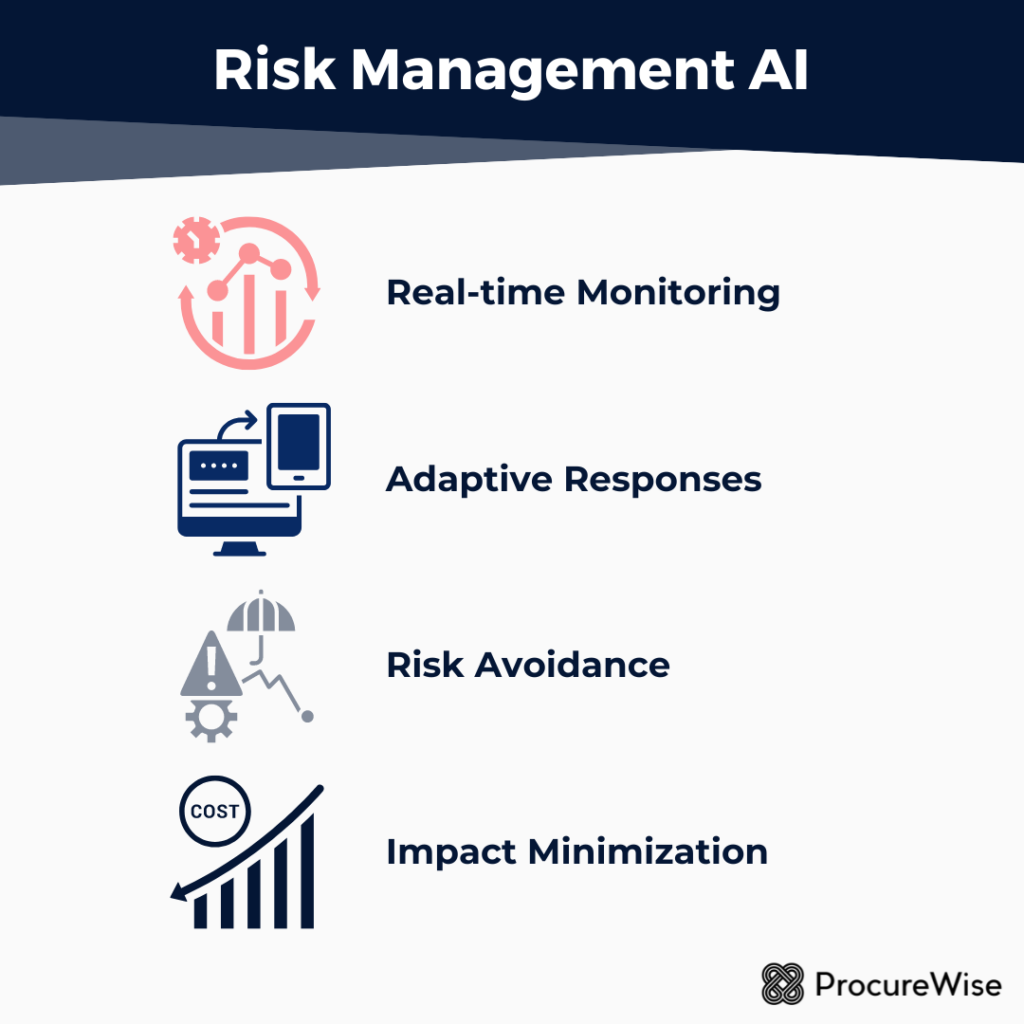
AI-driven risk mitigation is revolutionizing risk management by transforming predictions into actionable strategies. Leveraging advanced algorithms and machine learning, AI systems provide real-time monitoring and adaptive responses, enabling organizations to proactively address potential risks and opportunities. Here are key ways AI enhances risk management:
👉 Real-time Monitoring: Traditional risk management relies on historical data and periodic assessments. AI systems continuously process vast data from sources like social media, news, and financial reports to identify emerging risks and trends in real-time, allowing prompt detection and response to potential threats or opportunities.
👉 Adaptive Responses: AI analyzes various risk scenarios and outcomes, offering insights into strategies to mitigate risks. For example, AI can simulate the impact of market changes or regulatory updates and suggest adaptive measures to minimize effects. This flexibility helps organizations quickly adjust to changing circumstances.
👉 Risk Avoidance: By analyzing past data and patterns, AI identifies high-risk areas, enabling proactive avoidance of potential risks. For instance, AI helps financial institutions flag fraudulent transactions for further investigation, preventing losses and mitigating risks.
👉 Impact Minimization: AI uses advanced analytics and predictive modeling to estimate the potential impact of risks on an organization’s performance. By quantifying financial and operational impacts, organizations can prioritize resources and implement targeted risk mitigation strategies, effectively minimizing overall risk impact.
AI-driven risk mitigation transforms predictions into strategies through real-time monitoring, adaptive responses, risk avoidance, and impact minimization. As AI technology advances, it will play a crucial role in shaping effective risk management strategies.
💼 Use cases of AI in Risk Management 💼
Artificial Intelligence (AI) is transforming risk management by enhancing traditional assessment and control processes. By leveraging advanced algorithms and machine learning, AI can analyze vast amounts of data in real-time, helping organizations proactively identify and mitigate risks. Here are key AI use cases in risk management:
➡️ Fraud Detection: AI detects fraudulent activities by analyzing transaction data patterns and anomalies. It learns from past experiences to identify irregularities such as unusual spending patterns or unauthorized access attempts.
➡️ Credit Scoring: Traditional credit scoring relies on historical data and may not assess creditworthiness in real-time effectively. AI improves credit scoring models by using a wider range of data sources and predictive analytics to evaluate credit risk more accurately.
➡️ Market Risk Analysis: AI helps financial institutions manage market risk by analyzing market trends, news, and data in real-time. Natural language processing allows AI to summarize insights from unstructured data, aiding risk managers in decision-making.
➡️ Anti-money Laundering (AML) Compliance: AI enhances AML efforts by automating the analysis of large transactional data volumes. It identifies suspicious patterns and flags potentially fraudulent activities, helping organizations comply with AML regulations.
➡️ Cybersecurity Threat Detection: AI is crucial in identifying and mitigating cybersecurity threats. By monitoring network traffic, AI detects unusual behavior indicative of cyber attacks. AI-powered systems analyze data from network logs, user behavior, and threat intelligence feeds to proactively identify and respond to threats.
AI is revolutionizing risk management by automating and augmenting traditional processes. From fraud detection and credit scoring to market risk analysis, AML compliance, and cybersecurity threat detection, AI provides real-time insights and proactive risk mitigation, enhancing organizations’ risk management strategies and ensuring long-term success.
📋 Artificial intelligence in logistics 📋
Artificial intelligence (AI) is transforming logistics by enhancing transportation and supply chain management. AI’s ability to analyze vast amounts of data and make informed decisions is crucial for improving efficiency, optimizing routes, and streamlining operations.
✏️ AI augments human capabilities by improving decision-making processes. AI algorithms analyze historical data to identify patterns, predict demand, and optimize inventory levels. This helps professionals make informed decisions on procurement, stock replenishment, and distribution, leading to cost reductions and efficient resource allocation.
✏️ Automation is another significant AI benefit in logistics. Machine learning algorithms automate route planning by considering factors like traffic conditions, fuel consumption, and delivery deadlines. This eliminates manual route optimization, saving time and resources.
✏️ Predictive analytics is essential in logistics, leveraging historical data to anticipate future events and behaviors. By analyzing factors like weather conditions, supplier performance, and customer demands, AI-powered predictive analytics enable proactive decision-making, ensuring timely deliveries, minimizing delays, and preventing disruptions.
Machine learning also plays a key role, processing large data sets to identify patterns and make accurate predictions. For example, machine learning algorithms analyze delivery data to find the most efficient routes and optimize delivery schedules, reducing costs and improving customer satisfaction.
AI in logistics enhances efficiency and optimizes operations by augmenting human capabilities and automating key processes. As the industry evolves, AI’s role in streamlining processes and improving performance will become increasingly vital.

📉 How artificial intelligence reduces supply chain disruption costs? 📉
Artificial intelligence (AI) is transforming supply chain management by analyzing vast data sets to mitigate disruption costs and enhance risk management strategies. AI algorithms efficiently process diverse data, like weather forecasts and market trends, to identify potential risks and disruptions preemptively. This capability empowers supply chain professionals to anticipate issues and take proactive measures.
🪙 AI algorithms continuously learn and adapt, refining their analyses over time to improve risk identification and response effectiveness. This adaptive learning process enables organizations to maintain proactive risk management practices and minimize disruption costs.
🪙 Expert analyst oversight remains crucial in AI-driven risk management. Human analysts interpret AI-generated insights, leveraging their domain expertise to make informed decisions and ensure appropriate risk mitigation measures are implemented effectively.
🪙 AI-driven risk management offers numerous benefits. Firstly, AI algorithms reduce response times by promptly alerting to emerging risks, enabling swift actions to mitigate potential disruptions. Secondly, AI minimizes errors by automating tasks and eliminating human-induced inaccuracies, thereby enhancing data reliability and freeing resources for strategic initiatives.
🪙 Moreover, AI enhances supply chain visibility by integrating and analyzing data from various sources, facilitating comprehensive insights into operations. This visibility enables proactive identification of bottlenecks, inefficiencies, or vulnerabilities, empowering organizations to strengthen overall supply chain resilience.
AI is revolutionizing supply chain management by leveraging powerful algorithms and expert oversight to reduce disruption costs. By identifying patterns, predicting risks, and enabling real-time decision-making, AI empowers organizations to proactively manage potential disruptions and enhance supply chain resilience effectively. AI’s benefits in reducing lead times, minimizing errors, and improving process visibility underscore its critical role in optimizing supply chain operations and mitigating disruption costs.