

In the fast-paced world of business, having access to real-time data and insights is crucial for strategic decision-making. Executive dashboards have long served as essential tools for visualizing key performance metrics, but what if you could elevate these dashboards with the power of AI?
Imagine a dashboard that not only displays data but also analyzes trends, predicts future outcomes, and offers actionable insights—all in one place. This is where AI-driven executive dashboards step in, revolutionizing the way leaders visualize their businesses’ performance, identify growth opportunities, and make informed decisions.
With AI insights integrated into executive dashboards, organizations can harness vast amounts of data and translate it into meaningful, strategic actions. From understanding customer behaviors to optimizing operational efficiencies, the potential is limitless. In this guide, we will explore how to unlock the strategic growth that AI insights can provide, discuss key features to look for in these advanced dashboards, and share best practices for implementation to ensure you maximize your investment.
Are you ready to transform your decision-making process and drive your organization toward unprecedented levels of success? Let’s dive into the world of AI-enhanced executive dashboards and discover the possibilities that lie ahead.
❔What Are AI Insights❔
AI insights are transforming decision-making processes across industries by enhancing data visualization and leveraging predictive analytics. These advancements enable organizations to quickly interpret complex datasets and derive actionable insights, allowing users—from executives to operational staff—to make informed choices with confidence.
At the core of these innovations are AI dashboards, which integrate sophisticated machine learning algorithms and natural language processing capabilities. Machine learning analyzes historical data to identify trends and patterns, providing predictive insights that guide future actions. Meanwhile, natural language processing simplifies interactions with data, enabling users to query datasets using conversational language, making data more accessible and understandable.
By employing AI dashboards, organizations can swiftly visualize critical metrics, monitor performance in real-time, and uncover hidden opportunities or risks. This democratization of data empowers all levels of staff, fostering a culture of data-driven decision-making. Ultimately, AI insights help businesses remain agile and competitive, ensuring they are well-equipped to navigate the complexities of modern markets.
⚠️ The Importance of Data-Driven Decision-Making ⚠️
Data-driven decision-making (DDDM) is essential in today’s fast-paced, competitive environment. By relying on quantitative data rather than intuition or experience, organizations can enhance their performance and achieve better outcomes. DDDM enables businesses to identify trends, forecast future scenarios, and make informed choices that align with their strategic goals.
➡️ One of the main advantages of DDDM is its ability to minimize risks. Analyzing historical data helps organizations foresee potential challenges and devise strategies to navigate them effectively. Additionally, leveraging data can lead to improved operational efficiency; businesses can uncover inefficiencies and streamline processes, thus saving time and resources.
➡️ Moreover, DDDM fosters a culture of accountability within organizations. When decisions are backed by data, employees are more likely to take ownership and strive for improvement, knowing that their contributions are measurable. This transparency encourages collaboration as teams work together to interpret data and implement solutions.
➡️ Data-driven decision-making is not just a trend; it is a necessity for organizations aiming to thrive in a data-rich world. By embracing DDDM, companies can unlock valuable insights, enhance their strategic planning, and ultimately drive sustainable growth and success.
💡 Understanding Executive Dashboards 💡
Executive dashboards serve as vital tools for facilitating data-driven decision-making within organizations. By consolidating key performance indicators (KPIs) into a visually intuitive interface, they enhance business performance through real-time insights. Corporate officers can quickly identify trends, assess risks, and discover opportunities, enabling timely responses to emerging challenges.
These dashboards allow leaders to monitor performance against strategic objectives, facilitating strategic alignment and promoting informed resource allocation. Through visual representations of data, executives can easily discern patterns and anomalies, leading to more effective strategy refinement. This holistic view empowers organizations to pivot as necessary, ensuring that resources are directed toward the most impactful initiatives.
Executive dashboards are integral to successful management practices, enabling data-driven decisions that bolster business performance and enhance overall organizational agility. By leveraging these tools, corporate officers can strategically navigate complex business landscapes, optimizing their operations and achieving sustained growth.
🧩 Components of an Effective Dashboard 🧩
An effective executive dashboard is crucial for organizational success, combining three essential components: intuitive design, real-time integration, and performance metrics.
👉 An intuitive design ensures that senior management can easily navigate the dashboard, allowing for quick access to critical information without overwhelming complexity. This fosters user engagement and encourages consistent use, making it easier for decision-makers to identify trends and anomalies swiftly.
👉 Real-time integration with existing systems enhances the dashboard’s relevance, ensuring that data is up-to-date and reflective of current organizational performance. This capability eliminates the lag often associated with outdated reports, facilitating informed decision-making.
👉 Performance metrics serve as the backbone of the dashboard, offering a comprehensive overview of key indicators that drive organizational success. By visualizing these metrics effectively, senior management can monitor performance, gauge progress against goals, and initiate necessary strategic adjustments.
Together, these components promote informed decision-making and foster collaboration among senior management teams. When stakeholders can easily access timely, relevant data, they are better equipped to align their actions and strategies, ultimately leading to a more cohesive and effective leadership structure.
🤖 The Role of AI in Executive Dashboards 🤖
AI plays a transformative role in executive dashboards by analyzing vast datasets to deliver predictive insights that enhance decision-making at the executive level. Through sophisticated algorithms, AI dashboards process and interpret complex data, enabling executives to forecast trends and make informed choices based on future scenarios rather than just historical data.
🦾 Machine learning is integral to this process, as it identifies patterns and trends within the data that may not be immediately apparent. By continuously learning from new information, these algorithms improve accuracy over time, allowing executives to adapt strategies in real-time.
🦾 Additionally, natural language processing (NLP) enhances the effectiveness of executive dashboards by extracting valuable consumer insights from unstructured data sources, such as social media and customer feedback. This capability enables executives to gain a comprehensive view of market sentiment and consumer behavior, leading to more effective decision-making.
Incorporating AI, machine learning, and NLP into executive dashboards revolutionizes how organizations visualize data, paving the way for informed strategic initiatives that drive business success.
⚡ How AI Enhances Data Visualization? ⚡
AI significantly enhances data visualization by improving the clarity and effectiveness of data presentation. Through advanced algorithms, AI can analyze complex datasets and highlight meaningful patterns, making it easier for users to understand intricate analytics. By providing real-time insights, AI empowers organizations to quickly react to changing business conditions across various platforms, including cloud and on-prem technologies.
AI-driven dashboards serve as dynamic tools that streamline decision-making processes and resource management. These dashboards can be tailored to meet the specific needs of different teams within an organization, ensuring that stakeholders receive relevant information at their fingertips. As a result, teams can access customized visualizations that simplify complex data, facilitating faster and more informed decisions.
Overall, the integration of AI in data visualization not only enhances user experience but also fosters a culture of data-driven decision-making, allowing organizations to thrive in an increasingly competitive landscape.
📢 Why do You Need AI Insights in Executive Dashboards? 📢
Incorporating AI insights into executive dashboards is crucial for several reasons:
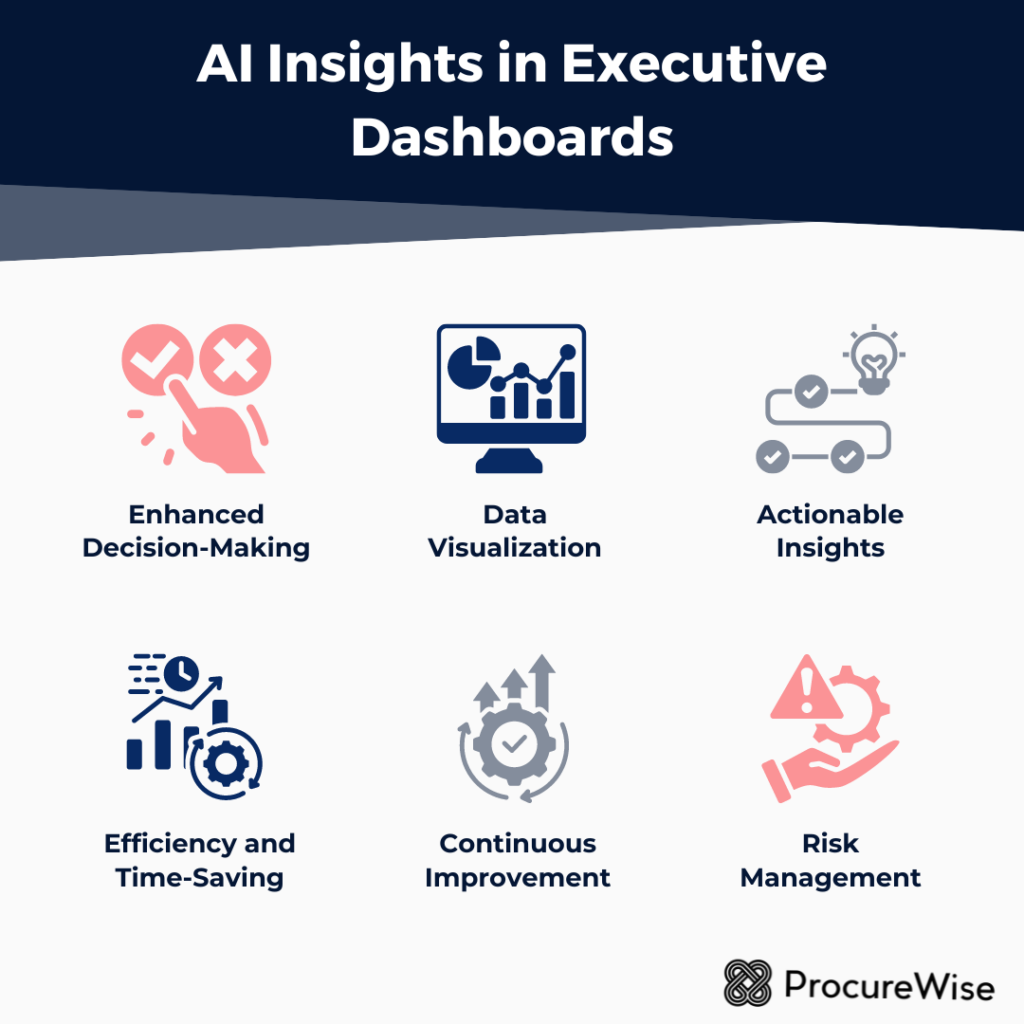
👉 Enhanced Decision-Making: AI insights help executives make data-driven decisions by providing real-time analysis and predictive analytics. This allows leaders to anticipate market trends and respond proactively rather than reactively.
👉 Data Visualization: AI can process and analyze vast amounts of data, translating complex information into intuitive visualizations. This makes it easier for executives to grasp key metrics and identify patterns quickly.
👉 Actionable Insights: AI can highlight relevant insights from data that may not be immediately apparent, enabling executives to focus on strategic initiatives that drive growth and efficiency.
👉 Efficiency and Time-Saving: By automating data analysis, AI reduces the time executives spend on gathering and interpreting data, allowing them to focus on higher-level strategy and leadership.
👉 Continuous Improvement: AI systems can learn and adapt over time, refining their predictions and insights as more data becomes available, which helps organizations stay agile and competitive.
👉 Risk Management: AI can identify anomalies or potential risks in real time, allowing executives to address issues before they escalate, thereby enhancing overall organizational resilience.
Integrating AI insights into executive dashboards empowers leaders with comprehensive, clear, and actionable information, fueling informed decision-making for sustainable business success.