

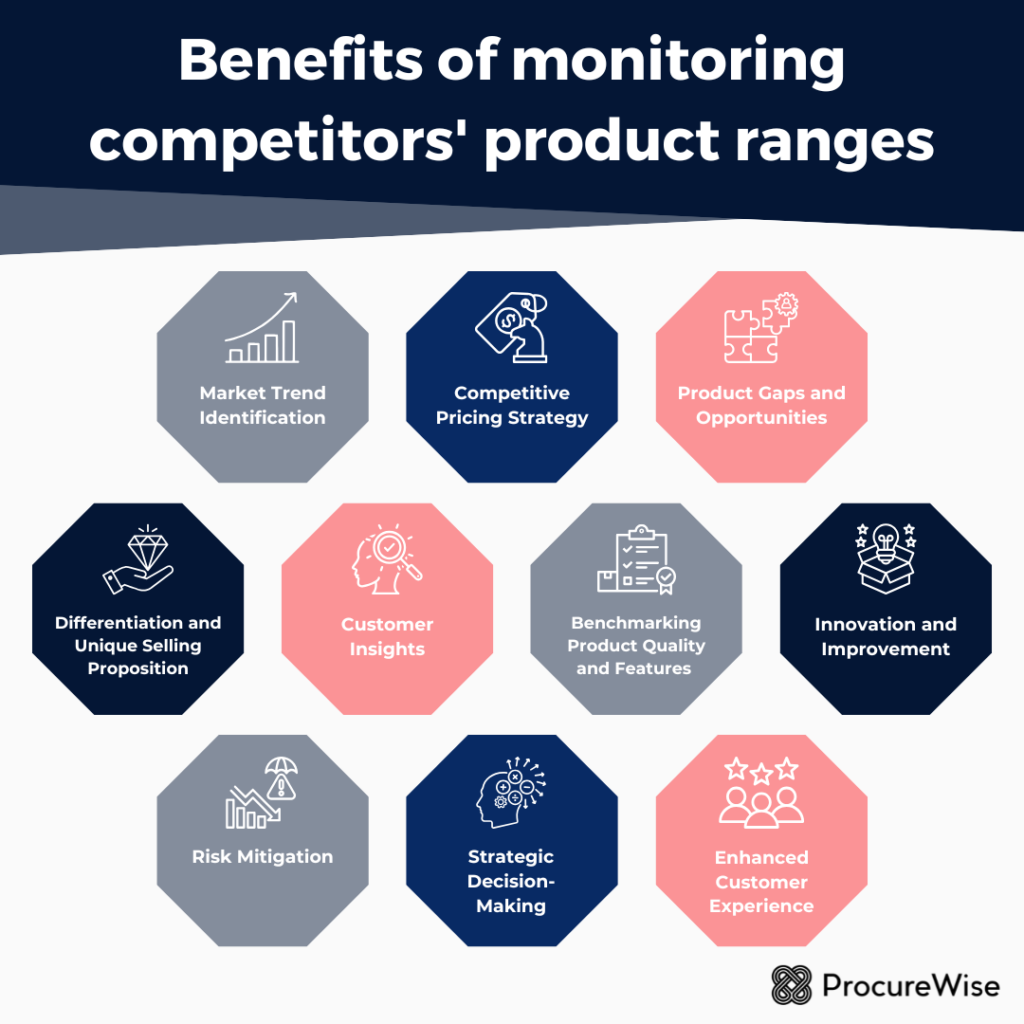
In the fast-paced world of e-commerce, staying ahead of the competition is crucial for success. One way to ensure your business remains competitive is by closely monitoring your competitors’ product ranges. This strategy offers numerous benefits that can help you make informed decisions, optimize your offerings, and ultimately increase your market share.
Incorporating competitor product range monitoring into your e-commerce strategy can provide a robust competitive advantage, ensuring your business remains agile, informed, and poised for growth.
📈 Market Trend Identification 📈
In e-commerce, staying ahead of trends is key. Monitoring competitors’ product ranges helps identify emerging trends and consumer preferences. By analyzing competitors, shops can find market gaps, target underserved niches, and attract new customers. This strengthens brand positioning. Understanding competitors’ strategies also informs pricing decisions, ensuring competitiveness and maximizing profit margins.
Competitors’ offerings reveal popular features influencing buyer behavior, allowing shops to enhance product appeal. Competitor analysis acts as an early warning for market shifts, enabling quick adaptation. In summary, monitoring competitors is vital for spotting trends, uncovering differentiation opportunities, and staying agile in the digital market.
🏷️ Competitive Pricing Strategy 🏷️
In the fast-paced e-commerce space, gaining a competitive edge is key. Monitoring competitors’ product ranges helps refine pricing strategies and market positioning. By analyzing competitors, e-commerce shops can identify market gaps and differentiation opportunities, tailoring products to meet customer needs. Regularly checking competitors’ prices aids in dynamic pricing, crucial for staying attractive to price-sensitive customers and maximizing profits.
It also informs inventory management by predicting demand and managing stock to avoid overstock. Monitoring competitors fosters innovation, enabling shops to better align offerings with consumer expectations, reinforcing their competitive stance and ensuring growth.
💡 Product Gaps and Opportunities 💡
In e-commerce, identifying product gaps is critical for success. Monitoring competitors provides insights into unmet consumer needs, helping businesses refine and optimize their offerings. Analyzing rival product lines highlights market gaps, enabling unique product introductions and improvements that address customer desires. Observing competitors aids in spotting trends and adapting successful strategies to capture new markets.
Additionally, understanding competitors’ pricing and tactics helps businesses refine their strategies for better positioning. Ultimately, monitoring competitors leads to actionable insights, fostering innovation and growth, enhancing customer satisfaction, and securing long-term success in the digital marketplace.
💰 Differentiation and Unique Selling Proposition 💰
In e-commerce, differentiation is vital for success. Monitoring competitors’ product ranges helps e-commerce shops create a unique selling proposition (USP) to stand out. By observing competitors, shops can find market gaps and opportunities, addressing unmet demands. Understanding rivals’ strengths and weaknesses allows for strategic product, pricing, and marketing adjustments to better appeal to target audiences.
A distinct product range enhances customer satisfaction and loyalty. A strong USP, derived from competitor analysis, boosts search engine visibility and can increase traffic and conversions. Ultimately, this strategic monitoring facilitates growth and success in the digital marketplace.
👤 Customer Insights 👤
In the fast-paced world of e-commerce, understanding competitors’ product ranges can offer invaluable insights into market trends and customer preferences. Monitoring what competitors are offering allows e-commerce businesses to identify gaps in their own product lineup, helping them to innovate and adapt quickly. By analyzing competitors’ best-selling items, companies can gauge market demand and tailor their inventory to meet customer needs more effectively.
Moreover, staying informed of competitors’ pricing strategies, promotional tactics, and product innovations enables e-commerce businesses to optimize their own offerings and enhance competitive positioning. This proactive approach is crucial for quickly responding to market shifts and consumer demands, ensuring that the business remains relevant and appealing to its target audience. By leveraging these insights, e-commerce shops can drive customer engagement, increase brand loyalty, and ultimately boost sales performanc .
🌟 Benchmarking Product Quality and Features 🌟
In e-commerce, competitiveness requires understanding the market, not just offering products. Monitoring competitors is crucial. Firstly, it helps identify product gaps; comparing features reveals competitors’ strengths, enabling improvements. Secondly, understanding competitors’ strategies uncovers trends and preferences, allowing proactive market responses and first-mover advantages.
Additionally, it informs pricing strategies; by analyzing competitor pricing, stores can attract cost-conscious customers without losing profit. Lastly, it enhances customer satisfaction; adopting competitors’ desirable features boosts retention and can convert their customers. In essence, benchmarking is vital for innovation, product optimization, and thriving in a competitive landscape.
🏆 Innovation and Improvement 🏆
In e-commerce, monitoring competitors’ product ranges is crucial for innovation and market relevance. By observing competitors, e-commerce shops gain insights into market trends and customer preferences, identifying gaps to refine their offerings. Understanding competitors’ strengths inspires improvements in product features and diversification. It also enables preemptive responses to threats from innovative competitor products.
This vigilance aids in optimizing pricing strategies to balance profitability and competitiveness, reducing customer loss risk. Moreover, it encourages continuous improvement in stock management, supply chains, and customer service by adopting best practices. Ultimately, monitoring competitors empowers e-commerce businesses to dynamically adapt, meet market demands, and maintain a competitive edge.
⛔ Risk Mitigation ⛔
Monitoring competitors’ product ranges is a strategic practice for e-commerce businesses seeking to mitigate risks that may threaten their market position. By vigilantly tracking competitors, businesses can anticipate market trends, identify gaps in their own offerings, and adjust their strategies proactively. This foresight helps in averting potential financial losses caused by investing in products that could soon become obsolete or be overshadowed by more innovative offerings from competitors.
Additionally, understanding competitors’ price points and promotional strategies enables e-commerce shops to remain competitive without engaging in detrimental price wars. Companies can optimize their supply chain and inventory management strategies by gauging demand for certain products, avoiding overstocking issues, and ensuring timely product launches that align with consumer expectations. Furthermore, competitor analysis can reveal emerging consumer preferences and new market opportunities, allowing e-commerce businesses to pivot their focus and diversify their product range before the competition does.
In essence, systematic competitor monitoring allows e-commerce shops to stay agile, informed, and resilient in a rapidly evolving digital marketplace, effectively reducing the risk of being outmaneuvered or left behind.
⚖️ Strategic Decision-Making ⚖️
In e-commerce, staying competitive requires strategic decisions informed by competitors’ product ranges. Monitoring these ranges allows businesses to gain insights for growth and innovation. By identifying market gaps, e-commerce shops can launch unique products to capture market share. Understanding competitors’ pricing helps refine pricing strategies and guide promotions without harmful price wars. Observing competitors also aids in adapting to market trends, ensuring relevance and customer loyalty.
Competitor analysis informs strategic partnerships and supply chain management to maintain a leading edge. In essence, monitoring competitors’ products aids in market positioning, pricing, adaptability, and strategic management, enhancing competitiveness in e-commerce.
💎 Enhanced Customer Experience 💎
In the ever-evolving landscape of e-commerce, staying attuned to competitors’ product offerings can significantly enhance the customer experience. By keeping a vigilant eye on rivals’ product ranges, e-commerce shops can identify gaps in their own inventory, ensuring they meet diverse customer demands. This proactive approach facilitates a dynamic selection, driving customer satisfaction as shoppers encounter products that precisely address their needs and preferences.
Moreover, understanding competitors’ pricing strategies and promotional tactics allows for strategic pricing adjustments and competitive offers, adding value to the customer’s purchase journey. When a shop offers competitive prices and attractive deals, customers feel confident they are receiving the best possible experience, fostering loyalty and repeat business.
Additionally, monitoring competitors aids in the identification of emerging trends. E-commerce businesses can swiftly adapt to consumer shifts and introduce innovative products in response to market demands. This agility not only keeps existing customers engaged but also attracts new ones, positioning the business as a leader in adapting to modern retail trends.