

In the digital marketplace, price is a primary battleground. Consumers can compare dozens of options in seconds, making competitive positioning more critical and volatile than ever. For businesses still relying on manual spreadsheets or basic alerts to track competitor pricing, the race is already lost. This reactive approach is no longer sufficient in an era where market dynamics shift by the minute. The only way to gain and sustain a competitive edge is to move from simply watching prices to intelligently anticipating and shaping them.
The explosive growth of artificial intelligence provides the necessary toolkit for this transformation. With the global AI market projected to grow from $184 billion in 2024 to over $826 billion by 2030, its application in commerce is not a future trend but a present-day imperative. This article explores how AI-powered real-time price monitoring is reshaping eCommerce, moving businesses from a defensive stance to a position of strategic command.
🌍 The Dynamic Market and the Urgent Need for a New Approach 🌍
The Ever-Shifting eCommerce Landscape and Aggressive Competition 💥
The modern eCommerce environment is defined by its relentless pace and transparency. Platforms like Amazon and eBay have conditioned consumers to expect competitive prices, creating a landscape where even minor pricing missteps can lead to significant losses in sales and market share. The sheer volume of products and competitors makes manual tracking an impossible task. Market changes—driven by supply chain fluctuations, seasonal demand, and competitor promotions—occur with a speed and complexity that demand a more sophisticated response.
Limitations of Traditional Price Monitoring: A Reactive Stance 🕒
Traditional price monitoring methods, such as manual website checks or simple scraping scripts, are fundamentally flawed. They are slow, labor-intensive, and prone to human error. More critically, they are reactive. By the time a price change is manually identified and a decision is made, the market may have already shifted again. This constant state of catching up leaves businesses vulnerable, unable to proactively identify opportunities or mitigate threats. These methods lack the scale to provide a comprehensive market view, often focusing only on a handful of top competitors while missing crucial data from the wider market.
Introducing AI: The Shift from Monitoring to Strategic Price Intelligence 🤖
Artificial intelligence (AI) transforms this paradigm entirely. It elevates the practice from simple price monitoring to strategic price intelligence. Instead of just collecting data on competitor prices, AI systems analyze, interpret, and predict market movements. This shift allows businesses to move beyond a reactive posture. By leveraging AI, companies can automate data collection at an unprecedented scale, gain deeper insights into pricing patterns, and implement dynamic pricing strategies that respond to market conditions in real time — securing a decisive competitive advantage.
💡 What is AI-Powered Real-Time Price Monitoring? 💡
AI-powered real-time price monitoring is much more than an automated version of traditional data scraping. It involves the application of machine learning (ML) and other AI techniques to not only gather pricing data but also to understand its context. While basic automation can simply pull a price from a webpage, an AI-driven system can identify the product, match it against competitors’ offerings, detect promotional language, and analyze historical data to forecast future trends. It’s the difference between having a list of numbers and having actionable intelligence.
The Core Components of an Advanced AI Price Intelligence System 🧠
A robust AI price intelligence system is built on several key components working in concert:
- It begins with an intelligent data acquisition engine capable of navigating complex websites.
- This is followed by a data processing and enrichment layer, where AI algorithms cleanse the data and perform essential tasks such as product matching.
- The analytics and prediction core then applies machine learning models to identify trends and generate forecasts.
- Finally, an action and integration layer delivers insights through dashboards, automated price change notifications, and API connections that can power dynamic pricing engines.
Real-Time Gathering: Capturing Market Pulse Instantly ⏱️
The “real-time” aspect is crucial. In the online shopping world, prices can change multiple times per day, especially on major eCommerce platforms. AI price monitoring tools are designed to capture these market fluctuations as they happen, providing an up-to-the-minute market view. This capability ensures that strategic decisions are based on the most current data available, preventing businesses from reacting to outdated information and missing fleeting opportunities to optimize sales and margins.
🤖 How AI Transforms Price Data Collection and Analysis 🤖
Intelligent Data Acquisition: Leveraging Advanced Web Scraping and Extraction Technology 🧩
Modern websites are complex, often using JavaScript to load content dynamically. Standard scrapers frequently fail to capture this data correctly. AI-powered systems employ sophisticated “headless browser” technology that renders pages exactly as a user’s browser would, ensuring complete and accurate data collection. These intelligent agents can understand page structures, navigate through categories, and handle interactive elements, making them far more resilient and effective than their predecessors.
Overcoming Anti-Bot Measures and Ensuring Data Integrity at Scale 🛡️
As eCommerce sites become more protective of their data, they implement advanced anti-bot measures like CAPTCHAs and IP blocking. AI-powered price monitoring systems counter these challenges by using intelligent proxy rotation, user-agent simulation, and AI-driven CAPTCHA-solving techniques. This ensures uninterrupted, large-scale data flow, maintaining the integrity and reliability needed for dependable price intelligence.
Precision Through AI Product Matching and Image Recognition 🧠
One of AI’s most significant contributions is accurate product matching. Manually matching identical products across different websites — each with unique titles, descriptions, and SKUs — is nearly impossible at scale. AI uses Natural Language Processing (NLP) to analyze product attributes and even leverages image recognition technology to compare product photos, achieving a level of matching accuracy that is crucial for true competitive pricing analysis.
Unifying Diverse Data Sources for a Holistic Market View 🌐
An effective pricing strategy requires a comprehensive market view that extends beyond direct competitors. AI systems can unify data from a vast array of sources, including:
- competitor websites,
- marketplaces like Amazon,
- price comparison engines, and
- supplier data feeds.
The ability to integrate and analyze this diverse information allows businesses to understand the broader ecosystem, identifying how supply chain costs and channel-specific pricing impact their competitive position. This aligns with the rapid growth in AI for supply chain management, a market projected to reach $11.73 billion by 2025.
Monitoring Across a Spectrum of eCommerce Platforms and Websites (e.g., Amazon, eBay, Etsy, Zara, AliExpress, Newegg) 🛒
AI-powered price monitoring isn’t limited to a few major players. These systems are adaptable, capable of collecting data from global giants like Amazon and AliExpress, niche marketplaces like Etsy, and direct-to-consumer brand websites like Zara. This versatility ensures that businesses can track their specific competitive landscape, regardless of where their rivals operate, providing a truly tailored and comprehensive intelligence feed.
🧭 The Strategic Advantage: AI for Proactive Price Intelligence 🧭
Instant Insights: Automated Price Change Notifications and Alerts ⚡
The most immediate benefit of an AI system is speed. Instead of discovering a competitor’s price drop days later, businesses receive automated price change notifications within minutes. These alerts can be customized based on specific competitors, product categories, or price change thresholds, enabling teams to respond swiftly to threats and opportunities, protecting margins and market share.
Predictive Analytics: Anticipating Market Shifts and Competitor Moves 🔮
AI excels at moving beyond historical data to forecast future events. By analyzing past pricing behavior, promotional cycles, and market trends, predictive analytics models can anticipate a competitor’s next move. This foresight allows a business to act proactively — for instance, by adjusting inventory before an expected competitor sale or optimizing pricing ahead of a predicted demand surge.
Leveraging Machine Learning Frameworks and Tools for Predictive Insights 🧮
The predictive power of these systems is driven by sophisticated machine learning frameworks like TensorFlow and PyTorch. These tools enable data scientists to build and train complex models that can identify subtle patterns in vast datasets — patterns that would be invisible to human analysts. This technological foundation allows AI price intelligence tools to deliver forecasts with a high degree of accuracy.
Decoding Promotional Patterns and Understanding Demand-Based Pricing 📈
AI algorithms are adept at cutting through the noise to identify strategic patterns. They can recognize when a competitor’s price change is part of a broader promotional strategy, a clearance event, or a response to fluctuating demand. This deeper understanding prevents knee-jerk price matching and informs a more nuanced competitive pricing strategy that considers the “why” behind a price change.
💰 Powering Dynamic Pricing Automation for Optimal Revenue 💰
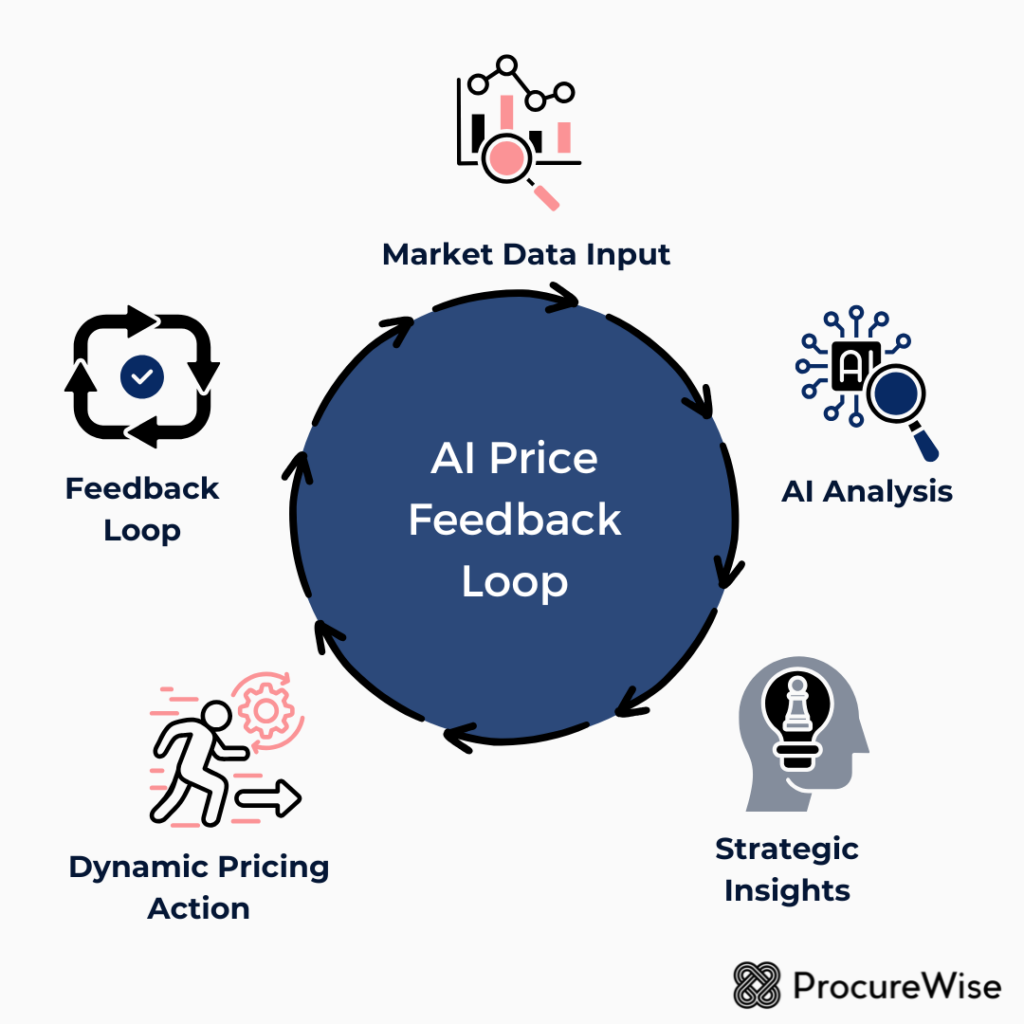
The ultimate goal of price intelligence is to inform action. AI-driven insights can be fed directly into dynamic pricing engines, which automatically adjust product prices based on a set of predefined rules and real-time market data. This automation optimizes pricing for revenue and profit goals 24/7. In fact, companies that effectively use real-time data for pricing decisions see an average profit margin increase of 15%.
🧩 From Monitoring Competitor Prices to Shaping Your Own Competitive Pricing Strategy 🧩
Effective AI price monitoring is not about blindly following competitors. It’s about using superior intelligence to lead the market. By understanding the full context of competitors’ prices, businesses can make strategic decisions — whether to match, hold firm and emphasize value, or undercut selectively. This empowers them to shape their own competitive pricing strategy from a position of strength and knowledge.
🌐 Gaining a Comprehensive Market View and Informing Market Share Analysis 🌐
Consistent monitoring of prices across the market provides invaluable data for strategic analysis. By correlating price points with sales velocity (where available) and stock levels, businesses can estimate competitor performance and market share. This comprehensive market view informs higher-level decisions about product positioning, market entry, and long-term growth strategies.
🧠 Implementing AI Price Monitoring: Key Considerations 🧠
Seamless Integration with Existing Systems: The Power of API Integration 🔗
For price intelligence to be actionable, it must integrate seamlessly with a company’s existing technology stack. The best price monitoring tools offer robust APIs (Application Programming Interfaces) that enable smooth data flow into eCommerce platforms, Enterprise Resource Planning (ERP) systems, and Business Intelligence (BI) dashboards. This integration ensures that insights are available exactly where and when strategic decisions are made.
Ensuring Data Accuracy, Scalability, and Reliability for Big Data 📊
The value of any analytics system depends entirely on the quality of its data. When choosing a solution, it’s essential to verify its:
- commitment to data accuracy,
- ability to scale to monitor thousands or millions of products, and
- reliability in providing consistent data feeds.
A system must be built to handle the demands of big data without compromising precision or performance.
Building a Robust Price Intelligence System: From Raw Data to Actionable Strategy 🏗️
Implementing an effective system involves a clear, structured process. It begins with defining the competitive landscape and identifying key products to monitor. From there, the system handles the complete data pipeline:
- Acquiring raw data
- Cleansing and matching it
- Applying analytical models to generate insights
- Presenting results in an accessible format that drives strategic action.
Utilizing Price Watch and Comprehensive Price Change History for Deeper Insights 📆
A critical feature of any advanced price intelligence tool is the ability to store and access historical pricing data. This price change history is the foundation for predictive analytics, allowing AI models to learn from past market behavior. A comprehensive “price watch” archive enables businesses to perform deep-dive analyses on seasonality, competitor reactions, and the long-term effects of their own pricing strategies.
⚖️ Navigating the Ethical and Regulatory Landscape of AI Pricing ⚖️
As AI becomes more powerful, ethical considerations are paramount. Ethical AI price monitoring focuses exclusively on analyzing publicly available data from websites — not on collecting or using personal data from consumers. This distinction is crucial. The goal is to understand market dynamics, not to engage in discriminatory pricing based on an individual’s profile.
Adherence to data protection regulations such as GDPR (General Data Protection Regulation) and CCPA (California Consumer Privacy Act) is non-negotiable. It ensures that the pursuit of competitive intelligence respects consumer privacy and builds trust — both with customers and with partners in the digital marketplace.