
In the relentless pursuit of market dominance, pricing isn’t just a number; it’s a strategic battleground. Every price point is a message to your customers, a challenge to your competitors, and a direct lever on your bottom line.
In a digital marketplace where price comparisons are instant and customer loyalty is fluid, navigating this landscape without precise intelligence is like flying blind. This is where the Competition Price Index (CPI) becomes your most powerful reconnaissance tool, transforming raw data into a decisive competitive advantage.
⚖️ The Imperative of Competitive Pricing in Today’s Market ⚖️
Today’s commercial environment is defined by intense competition and informed consumers. A recent study highlights this reality, showing that 64% of companies now report higher price pressure compared to previous years.
Simply guessing at the right price point is no longer a viable option. A price set too high can alienate your customer base and surrender market share, while a price set too low can cripple profit margins and devalue your brand.
Effective market positioning requires a data-driven approach that balances profitability with competitiveness, and the CPI is the foundational metric for achieving that balance.
🎯 What You’ll Learn: From Understanding to Strategic Action 🎯
This article moves beyond simple definitions to provide a comprehensive guide for leveraging the Competition Price Index.
We will dissect its core components, walk through its calculation, and most importantly, uncover the strategic insights that enable you to optimize your pricing strategy.
You will learn how to use the CPI to not only react to market dynamics but to proactively shape them, securing your market position and paving the way for sustained growth and dominance.
💡 Defining the Competition Price Index (CPI) 💡
Before deploying the CPI as a strategic asset, it is essential to grasp its fundamental meaning and significance. It is a simple yet profound metric that quantifies your price positioning relative to your competitors.
What is a Price Index? A Foundational Understanding 📘
At its core, a Price Index is a normalized average of price relatives for a given class of goods or services in a specific region, during a given interval of time.
It’s a standardized measure that shows how prices have changed over time or how they compare across different locations or brands.
In business, it removes the noise of individual price points to provide a clear, comparative benchmark.
The Competition Price Index (CPI) Explained 📊
The CPI calculation compares your price to the average of your competitors, resulting in a single score that benchmarks your market position.
The Competition Price Index (or Competitor Price Index) adapts this concept specifically for competitive analysis. It measures your product’s or category’s price point against the average price of the same or similar products offered by your competitors.
The result, typically expressed as a number around 100, provides an instant snapshot of your market positioning.
- CPI of 100 → Your price is, on average, the same as your competitors’.
- CPI > 100 (e.g., 110) → Your price is 10% higher than the competition.
- CPI < 100 (e.g., 90) → Your price is 10% lower than the competition.
This single metric offers a powerful, at-a-glance understanding of where you stand in the market.
Why the CPI is Crucial for Market Position and Market Share 📈
The CPI is more than just a number; it’s a critical diagnostic tool. It directly informs your market position by showing whether you are perceived as a premium, value, or mainstream option.
This price positioning has a direct impact on customer perception and purchasing decisions.
By strategically managing your CPI, you can influence brand perception, attract your target segment, and execute a pricing strategy designed to capture or defend market share.
Perfect 👍 Here’s Part 2 of 4, formatted with:
- Bold highlights for key phrases
- Matching emojis around each
h2 - Right-side emojis for each
h3 - No changes to your text content
🧮 Mastering the Calculation of Your Competition Price Index 🧮
Accurate calculation is the bedrock of a reliable CPI strategy. While the concept is straightforward, precision in data collection and application of the formula is critical to generating trustworthy insights.
The Core Price Index Formula: A Step-by-Step Guide 🧾
Calculating the CPI for a single product against a single competitor is simple. The core Price Index Formula is:
CPI = (Your Price / Competitor’s Price) x 100
To get a comprehensive view, you must calculate this across multiple competitors and products to find an average.
- Identify Like-for-Like Products: Select a specific product you offer and find the identical or most comparable product from each key competitor.
- Gather Price Data: Collect the current selling price for your product and each competitor’s product.
- Calculate Individual CPIs: For each competitor, apply the formula.
- Example: if your product is $50 and Competitor A’s is $48, your CPI relative to them is ($50 / $48) x 100 = 104.2.
- Determine the Average CPI: To understand your overall market position for that product, calculate the average price of all competitors’ offerings. Then, use that average in the formula.
- Example: if the average competitor price is $49, your overall CPI is ($50 / $49) x 100 = 102.
This process should be repeated for all key products within a specific category to determine your CPI at the category level.
Beyond the Basics: Advanced Calculation Methods for Accuracy ⚙️
For a more sophisticated analysis, businesses often use weighted CPI calculations. A simple average treats all competitors equally, but in reality, some competitors have a greater market impact.
Advanced methods include:
- Weighting by Market Share: Assign a higher weight to competitors with a larger share of the market.
- Weighting by Sales Volume: Give more significance to competitors who sell more units of a product.
- Weighting by Assortment Overlap: Prioritize competitors whose product categories most closely mirror your own.
These nuanced calculations provide a more realistic picture of your competitive landscape.
Data Collection for Reliable CPI Calculation 🧠
The adage “garbage in, garbage out” is especially true for CPI. Reliable data is non-negotiable.
The significant investment in market intelligence, with the global market research industry forecasted to generate $140 billion in 2024, underscores the value businesses place on accurate data.
Methods for collecting competitor prices include:
- Manual Web Scraping: Suitable for small-scale operations but time-consuming and prone to error.
- Automated Pricing Intelligence Tools: Software platforms that automatically scrape competitor websites, marketplaces, and promotional materials to provide real-time, accurate data.
- Third-Party Data Providers: Services that specialize in collecting and aggregating market data across various industries.
🚀 Strategic Insights for Market Dominance: Leveraging Your CPI 🚀
Calculating your CPI is only the first step. The true value lies in translating that number into actionable business intelligence that drives market dominance.
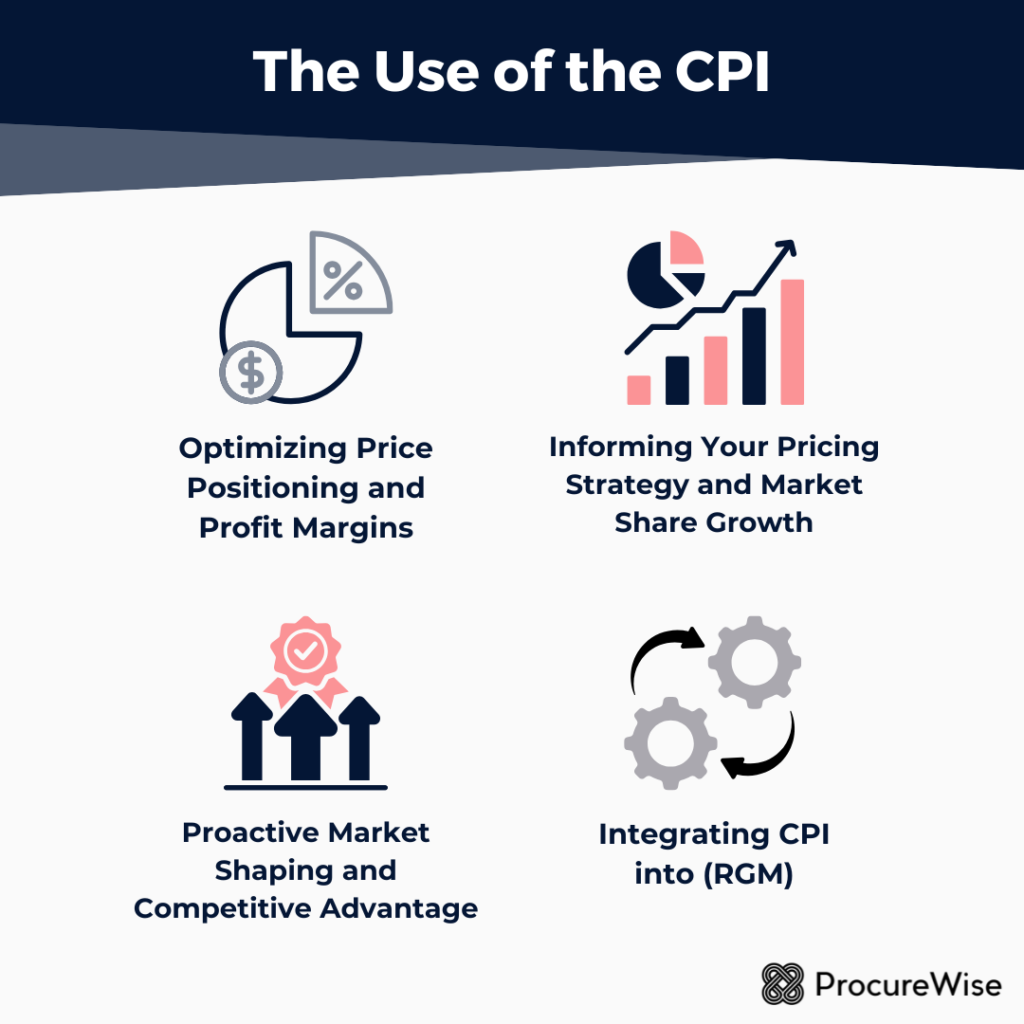
Optimizing Price Positioning and Profit Margins 💰
Your CPI is a direct lever for managing your price positioning. A consistent CPI of 115 across a product category firmly establishes you as a premium brand, while a CPI of 95 signals a value proposition.
This clarity allows you to align your pricing with your brand identity.
By monitoring CPI, you can identify opportunities to adjust prices without sacrificing volume. If the market average price for a category rises but your prices remain static, your CPI will drop — potentially leaving profit margins on the table.
Informing Your Pricing Strategy and Market Share Growth 📊
CPI data provides the context needed for informed strategic decisions. Instead of reactive price matching, you can develop a proactive pricing strategy.
For example:
- If your CPI is consistently low but your brand carries a premium reputation, you may have an opportunity to raise prices and capture more revenue.
- Conversely, if a key competitor lowers their prices (and your CPI rises), you can make a calculated decision — hold your position, trusting in your brand’s value, or adjust prices to protect market share.
Proactive Market Shaping and Competitive Advantage 🧭
True market leaders don’t just react to trends — they create them.
By understanding your CPI and its relationship with market dynamics, you can make strategic pricing moves that influence competitor behavior.
For instance, a controlled price reduction in a key category can pressure competitors with thinner profit margins, potentially forcing them out of a segment and allowing you to capture a larger market share.
Integrating CPI into Broader Revenue Growth Management (RGM) 📈
CPI should not exist in a silo. It is a critical input for a holistic Revenue Growth Management (RGM) strategy.
When combined with data on promotions, trade spending, assortment, and customer price elasticity, CPI insights help build a complete picture of revenue drivers.
This integrated approach ensures that pricing decisions support broader business objectives — from maximizing long-term customer value to optimizing promotional effectiveness.
🏗️ Implementing and Managing Your CPI Strategy 🏗️
A successful CPI strategy requires a systematic approach supported by the right tools and processes. It is a continuous cycle of monitoring, analysis, and adjustment.
Choosing the Right Competitor Price Monitoring Tools 🧰
Manual tracking is unfeasible in a dynamic market. Automated tools are essential for real-time data collection and analysis.
When selecting a solution, look for features such as:
- High-frequency data updates (daily or even hourly)
- Accurate product matching capabilities
- Coverage of all relevant channels (websites, marketplaces, etc.)
- Historical data tracking to identify trends
- Customizable dashboard and reporting features
Building a Price Management Dashboard for Real-time Insights 📊
Data is only useful if it’s accessible and understandable.
A centralized dashboard should visualize key CPI metrics for different product categories, brands, and competitors.
This allows stakeholders to quickly assess the competitive landscape, spot anomalies, and drill down into the data behind the numbers.
Effective dashboards translate complex pricing data into clear signals for action.
Establishing a Continuous Price Monitoring and Adjustment Cycle 🔁
The market never sleeps — and neither should your pricing intelligence. A successful CPI program operates on a continuous loop:
- Monitor: Continuously collect competitor price data.
- Analyze: Calculate CPI and compare it against your targets and historical trends.
- Strategize: Decide on necessary price adjustments based on your analysis and strategic goals.
- Execute: Implement price changes across your sales channels.
- Measure: Track the impact of your changes on sales, profit margins, and market share — then repeat the cycle.
🧱 Common Challenges and Best Practices for CPI Success 🧱
Implementing a CPI strategy is not without its hurdles. Awareness of common pitfalls is the first step toward overcoming them and ensuring your pricing intelligence is both accurate and actionable.
Ensuring “Like-for-Like” Comparisons 🧩
One of the most significant challenges is ensuring you are comparing apples to apples.
Mismatched products — for example, comparing a base model to a premium version, or products with different bundle components — will produce a skewed and misleading CPI.
Best practice: Use sophisticated product matching logic, often aided by AI, that considers attributes like SKUs, MPNs, and key features to ensure true comparability.
Dealing with Data Volatility and Inaccuracy ⚡
Competitor prices can change frequently, and data feeds can contain errors.
Dealing with this volatility requires robust systems. Best practices include:
- Using pricing tools that offer data validation and cleansing.
- Instead of reacting to every single fluctuation, focus on sustained trends over a period of days or weeks to avoid knee-jerk reactions to temporary promotions or pricing errors.
Overcoming Resistance to Price Changes Internally 🧠
Pricing decisions can be contentious within an organization.
- The sales team may resist price increases for fear of losing customers.
- The finance team may oppose price decreases that could impact profit margins.
Overcoming this requires making CPI data transparent and accessible to all stakeholders.
By demonstrating the data-driven rationale behind pricing decisions and their expected business impact, you can build consensus and alignment behind a unified strategy.
Best Practices for Actionable Insights 🧭
To ensure your CPI program delivers maximum value, follow these best practices:
- Segment Your Analysis: Analyze CPI not just overall, but by category, brand, and even individual products.
- Define CPI Tunnels: Establish acceptable upper and lower CPI limits for each category to trigger alerts when pricing falls out of alignment.
- Contextualize with Qualitative Data: Don’t rely solely on numbers. Understand the “why” behind competitor price changes by monitoring promotions, product launches, and public announcements.