

In today’s market, keeping competitive is a challenge. Regularly reviewing competitors’ prices and products is key to staying ahead. The review frequency depends on your industry, market changes, and strategy. Fast-changing fields like tech or fashion may need weekly checks, while stable industries might suffice with quarterly assessments.
Regular evaluations help spot pricing trends and product gaps, enabling strategic adjustments. An efficient review process can boost your market position and profits. Explore this guide for strategies and tools to streamline competitor analysis.
🌍 The Dynamic Retail Landscape and the Need for Agility 🌍
Today’s digital market moves fast: global competition, algorithm-based repricing, and highly sensitive customers mean yesterday’s price strategy can fail today. Agility becomes your competitive fuel—and the cadence of your monitoring determines how fast you can respond to shifts in pricing, promotions, and product availability.
🎯 From “If” You Monitor to “How Often” You Monitor 🎯
Monitoring too rarely leads to missed discounts, outdated intelligence, and lost sales. Monitoring too often creates data overload, analysis paralysis, and wasted resources.
Your goal is to find the optimal frequency—a balance between insights, cost, and actionability.
⚙️ Core Drivers of the Right Monitoring Frequency ⚙️
Choosing how often to track competitor prices isn’t guesswork—it’s a decision built on several key drivers.
Market Volatility and Industry Dynamics 🌀
Fast-moving categories (electronics, fashion, marketplaces) often require daily or real-time monitoring. Stable sectors (industrial, B2B) can work with weekly or bi-weekly cadences.
Product Characteristics and Lifecycle Stage 📦
Hero products, new launches, or items near end-of-life require faster monitoring. Long-tail or low-velocity items can be checked less frequently.
Competitor Landscape and Aggressiveness ⚔️
If competitors use dynamic pricing or launch frequent promotions, you need higher frequency tracking.
Business Objectives and Pricing Strategy 🎯
Your cadence must match your goals:
- Price leadership → high frequency
- Value or premium positioning → moderate frequency
- Margin optimization → balanced, insight-driven frequency
⏱️ The Spectrum of Monitoring Frequencies: Choosing Your Cadence ⏱️
Competitor price monitoring and product range tracking exist on a spectrum—there’s no single right approach. Your ideal cadence depends on industry speed, competitor behavior, and how fast you want (or need) to react.
Real-Time Price Tracking ⚡
Real-time or near–real-time updates (every few minutes or hours) are crucial in hyper-competitive markets like online travel or marketplaces with constant price swings. They support dynamic pricing engines, enabling instant reaction to competitor moves or stock shifts.
Daily Monitoring 📅
Daily monitoring is the standard for active e-commerce. It captures daily deals, availability changes, and competitor promotions—giving your team fresh insights every morning. For most brands, this is the ideal balance between accuracy and cost.
Weekly or Bi-Weekly Monitoring 📆
For stable categories or brands focused less on price competition, weekly cycles reveal big-picture trends without unnecessary noise. It’s efficient and still delivers strong strategic intelligence.
Event-Driven Monitoring 🎉
Triggered during product launches, Black Friday, or a new competitor entering the market. It’s targeted, resource-efficient, and perfect for critical moments where timing matters most.
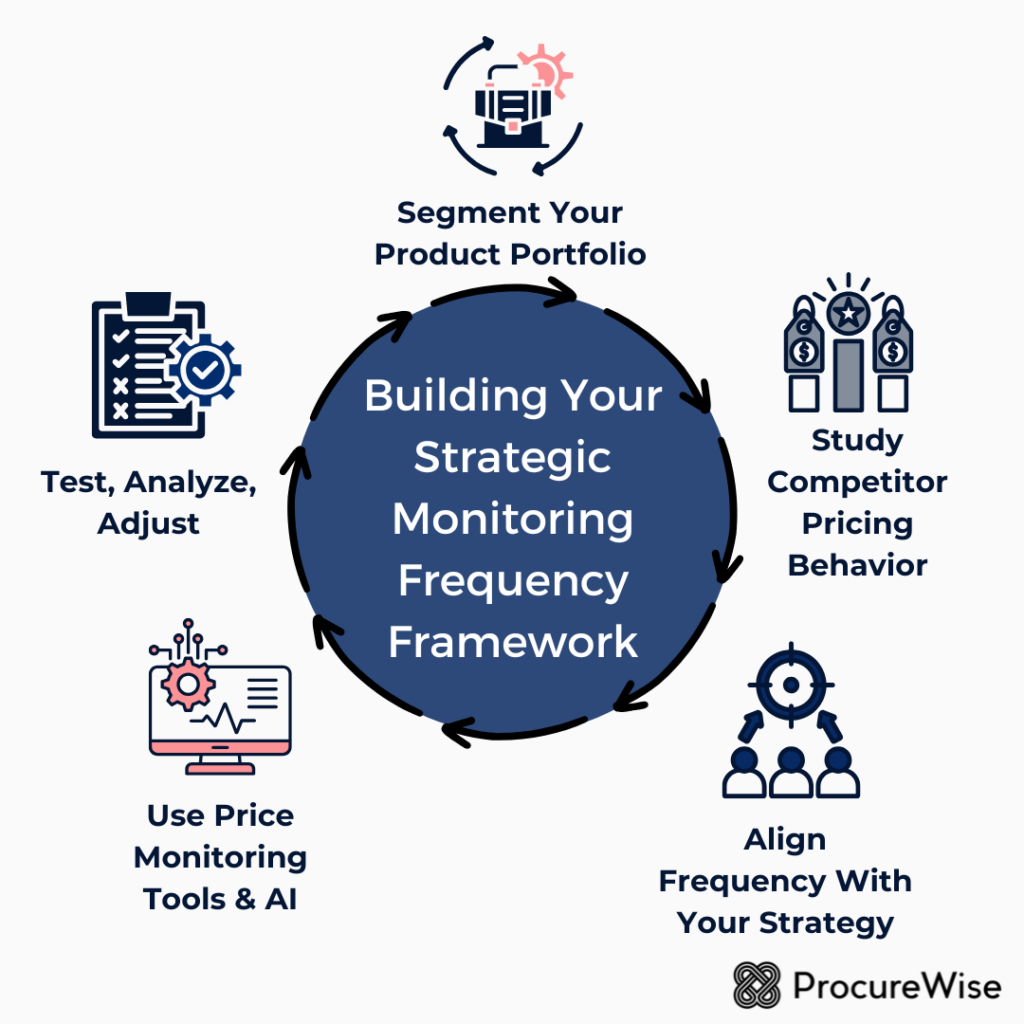
🧭 Building Your Strategic Monitoring Frequency Framework 🧭
A strong strategy uses multiple frequencies across your catalog instead of one generic cadence.
Step 1: Segment Your Product Portfolio 🧩
Group items by volatility, lifecycle stage, and competitive sensitivity.
- Best-sellers → daily or real-time
- Stable long-tail → weekly
This ensures the right level of attention where it actually matters.
Step 2: Study Competitor Pricing Behavior 🔎
Analyze how often your competitors adjust prices or update their product range. If rivals reprice several times a day, weekly checks put you permanently behind.
Step 3: Align Frequency With Your Strategy 🎛️
Your monitoring cadence should directly support your goals:
- Market share growth → faster frequency
- Margin maximization → targeted insights
- Premium positioning → consistency checks over speed
Step 4: Use Price Monitoring Tools & AI 🤖
Automation solves the scale problem. Modern tools let you:
- Set flexible frequencies by product segment
- Track competitor prices and assortments automatically
- Predict trends with AI Brands using AI-driven pricing saw significant sales growth compared to those who didn’t.
Step 5: Test, Analyze, Adjust 🔄
Your ideal frequency evolves over time. Markets change, new competitors appear, and strategies shift—so your cadence must adapt too.
📈 The Benefits of a Well-Tuned Monitoring Frequency 📈
Choosing the right cadence for competitor price monitoring and product range analysis delivers advantages that go far beyond knowing who’s cheaper.
Enhanced Responsiveness and Agility 🚀
With the right pace, you can react quickly to price drops, flash promotions, and sudden market trends. This prevents margin erosion and protects your position before competitors gain ground.
Optimized Margins and Revenue Growth 💰
Monitoring at the right rhythm helps you avoid unnecessary price cuts and spot opportunities to increase prices strategically. Many sectors show notable margin boosts when pricing is managed with timely, data-driven adjustments.
Stronger Market Intelligence 🔍
Consistent, well-timed monitoring builds a rich data stream that reveals:
- Competitors’ pricing patterns
- Seasonal and promotional cycles
- Product availability shifts
- Market movements that impact demand
This intelligence fuels long-term strategic planning and forecasting.
Sustainable Competitive Advantage 🏆
A precise cadence helps you stay one step ahead—defending your customer base and capturing market share from slower competitors.
Better Inventory Management 📦
Price and assortment data help predict demand. Matching pricing movements with sales velocity can improve:
- Stock planning
- Replenishment accuracy
- Supply chain efficiency
⚠️ Common Monitoring Frequency Mistakes (and How to Avoid Them) ⚠️
Understanding the risks helps you avoid costly errors in your price tracking and product range monitoring.
Too Infrequent Monitoring: Outdated Insights 🕰️
If your market changes daily but you check weekly, you’ll miss critical shifts—leading to:
- Lost sales
- Uncompetitive prices
- Slow reaction to market signals
The fix: match your cadence to your market’s true volatility.
Over-Monitoring: Too Much Data, Too Little Value 📉
Real-time tracking for slow categories creates data overload. This leads to:
- Wasted resources
- Analysis paralysis
- Teams stuck in insights instead of action
The fix: prioritize frequency based on product importance, competition intensity, and price volatility.
🧩 Conclusion: Finding Your Optimal Monitoring Rhythm 🧩
Choosing how often to review competitors’ prices and product range data isn’t a routine task—it’s a strategic decision that shapes your market position, margin health, and long-term competitiveness. The right cadence depends on your industry speed, product lifecycle, competitor behavior, and business goals. There is no single standard; the power lies in segmented, data-driven monitoring.
Your Path to a Smart, Effective Monitoring Cadence 🧠
By following the framework outlined earlier, you can transform price and assortment monitoring from a passive activity into a proactive growth engine:
- Audit your current monitoring approach
- Segment your product portfolio by volatility and sensitivity
- Analyze competitor behavior and repricing habits
- Use modern tools & AI for scalable automation
- Continuously test and refine your monitoring pace
What This Achieves for Your Business 🚀
A finely tuned monitoring rhythm gives you:
- Faster reactions to market changes
- Stronger pricing decisions backed by fresh data
- Better margins without sacrificing competitiveness
- Improved demand forecasting and stock efficiency
- A sustained competitive edge in fast-moving markets