
The retail landscape in 2026 is evolving at an unprecedented pace. Inflationary pressure, rapidly shifting consumer expectations, and the maturity of AI-driven pricing strategies are pushing retailers to fundamentally rethink how they manage prices. Traditional pricing models are no longer sufficient — success now depends on speed, data intelligence, and customer-centric decision-making.
Modern retail price management in 2026 goes far beyond static price setting. It integrates dynamic pricing, real-time data analytics, and ethical pricing principles to protect margins while strengthening long-term customer trust. Retailers that adapt early gain a decisive competitive advantage.
🎯 Why Price Management Is a Strategic Priority in 2026 🎯
In 2026, pricing strategy directly influences profitability, brand perception, and customer loyalty. An incorrectly optimized price can reduce conversion rates or erode trust, while a well-executed pricing model can significantly increase revenue, margin, and customer lifetime value.
Key benefits of advanced price management in retail include:
- Margin optimization in volatile economic conditions
- Consistent omnichannel pricing across all touchpoints
- A stronger, more reliable customer experience
Pricing is no longer a back-office task — it has become a strategic pillar of retail growth.
📊 Key Pricing Trends Shaping Retail in 2026 📊
AI-Driven Dynamic Pricing 🤖
Retailers increasingly rely on artificial intelligence and machine learning to adjust prices in real time. These technologies analyze demand signals, competitor pricing, inventory levels, and consumer behavior, enabling faster and more precise pricing decisions at scale.
🎯Personalized Pricing and Promotions: Consumers now expect relevance. Personalized pricing and targeted promotions, powered by customer data, improve conversion rates and foster loyalty — provided transparency and fairness remain central to the strategy.
💰 Rising Value Consciousness: Ongoing economic uncertainty has made shoppers more price-sensitive than ever. Retailers must balance competitive pricing with perceived value, particularly when competing with private labels and the growing second-hand economy.
⚠️ Early Pricing Pitfalls Retailers Must Avoid in 2026 ⚠️
🧠 Over-Reliance on Automation: While AI enhances efficiency, excessive automation without strategic oversight can damage brand positioning. Human control is essential to ensure pricing aligns with business goals and ethical standards.
🔄 Inconsistent Omnichannel Pricing: Price discrepancies between online and offline channels quickly erode trust. In 2026, unified commerce pricing is a baseline expectation, not a competitive advantage.
🧠 Technology Transforming Retail Pricing in 2026 🧠
In 2026, technology is no longer a support layer for pricing — it is the engine behind effective retail price management. The growing complexity of markets, channels, and customer behavior makes manual or static pricing approaches ineffective. Retailers that invest in advanced technology gain speed, accuracy, and strategic clarity.
At the center of this transformation are AI, machine learning, and real-time data platforms, enabling retailers to respond instantly to market changes while maintaining margin control and customer trust.
🤖 Artificial Intelligence as the Core Pricing Engine 🤖
Real-Time Price Optimization at Scale ⚡
AI-powered pricing systems continuously analyze demand fluctuations, competitor prices, inventory levels, and elasticity models. This allows retailers to implement dynamic pricing strategies that react instantly to market signals — something impossible with traditional tools.
As a result, retailers can:
- Protect margins during cost volatility
- Capture incremental revenue during peak demand
- Reduce markdown dependency
Predictive Analytics and Demand Forecasting 📈
Machine learning models help retailers anticipate demand, not just react to it. By forecasting sales trends, retailers can plan promotions more effectively, optimize inventory, and avoid margin erosion caused by overstock or stockouts.
Predictive pricing turns uncertainty into actionable insight.
Generative AI and Pricing Automation 🧩
🧪 Smarter Pricing Rules and Scenarios: Generative AI enables pricing teams to simulate “what-if” scenarios, test pricing strategies, and automatically generate pricing rules based on business objectives. This supports faster decision-making without sacrificing strategic control.
📝 Automating Insights, Not Just Tasks: Instead of producing raw data, generative AI delivers interpretable insights — explaining why a price change is recommended and how it impacts margin, revenue, and customer perception. This bridges the gap between data science and business strategy.
Unified Data Platforms for Pricing Excellence 🗂️
Effective retail price management in 2026 depends on integrated data. Pricing systems must connect seamlessly with ERP, CRM, inventory management, and omnichannel commerce platforms.
Without unified data:
- AI models lose accuracy
- Pricing decisions become fragmented
- Customer experience suffers
Retailers that eliminate data silos gain a holistic view of performance, enabling consistent pricing across channels and faster reaction to cost or demand shifts.
Why Technology Alone Is Not Enough ⚙️
Even the most advanced pricing platforms require human judgment. Ethical pricing, brand positioning, and long-term customer trust cannot be fully automated. The winning model in 2026 is human + AI collaboration, not replacement.
🧭 Strategic Pricing Models for Retail Success in 2026 🧭
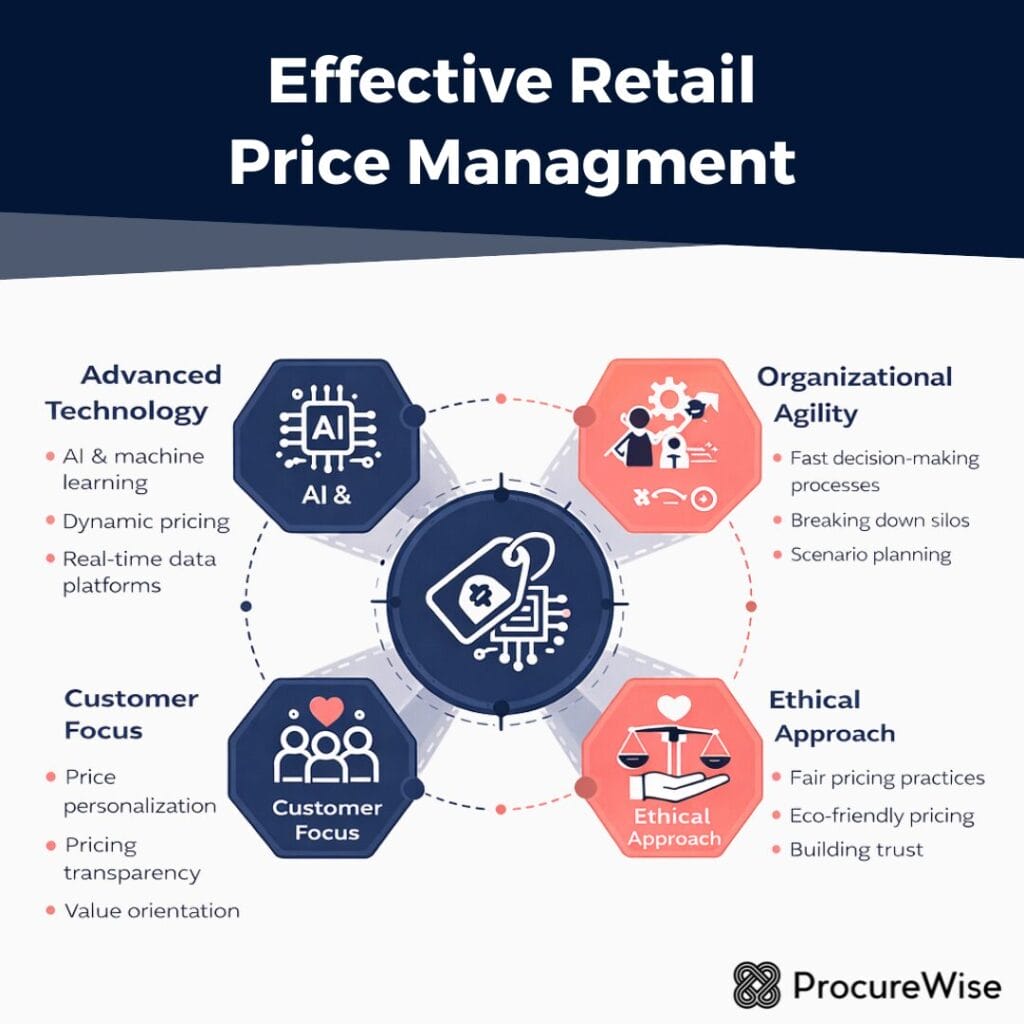
In 2026, retailers can no longer rely on static or intuition-based pricing. Competitive advantage comes from agile, adaptive pricing models that respond to demand, costs, and customer expectations in real time. Strategic price management now combines technology, governance, and customer insight.
Retailers that adopt modern pricing frameworks gain resilience in volatile markets while strengthening long-term profitability.
🔄 Moving Beyond Traditional Pricing Approaches 🔄
Why Cost-Plus Pricing No Longer Works?
Traditional cost-plus pricing ignores demand elasticity, competitive dynamics, and customer willingness to pay. In fast-moving retail environments, these static models often lead to margin leakage or lost sales opportunities.
Modern retailers shift from reacting to competitors toward predictive and scenario-based pricing, using data to anticipate market changes before they occur.
Agile and Adaptive Pricing Frameworks ⚡
🔁 Continuous Price Optimization: Agile pricing relies on frequent, data-driven adjustments rather than periodic price reviews. Prices evolve based on real-time demand signals, inventory exposure, and cost changes, keeping margins protected.
🧪 Scenario Planning and Simulation: Retailers increasingly test pricing strategies through simulations and “what-if” scenarios. This reduces risk and ensures that price changes support both short-term revenue and long-term brand value.
Private Label as a Strategic Pricing Lever 🏷️
📦 Margin Growth Through Control: Private label products allow retailers to control cost, quality, and pricing, making them a powerful tool for margin expansion in 2026. They also reduce dependency on national brands and price wars.
💡 Meeting Value-Conscious Demand: As consumers remain price-sensitive, private labels offer high perceived value at competitive price points, strengthening customer loyalty without eroding brand equity.
Aligning Pricing With Brand and Ethics 🌍
🤝 Fair and Transparent Pricing: Modern consumers closely monitor pricing fairness. Transparent pricing policies and consistent execution across channels are essential for maintaining trust and brand credibility.
🌱 Sustainability as a Pricing Dimension: Retailers increasingly reflect sustainability efforts in pricing. When communicated clearly, ethical pricing can justify premiums and differentiate brands in crowded markets.
Cross-Functional Pricing Governance 🧩
🏗️ Breaking Organizational Silos: Pricing cannot operate in isolation. Strong results require alignment between pricing, marketing, supply chain, and finance teams to ensure coherent execution.
⏱️ Speed as a Competitive Advantage: Retailers with fast decision-making structures can respond quickly to market shifts, cost volatility, and competitor moves, turning pricing agility into a strategic weapon.
🚧 Common Pricing Pitfalls Retailers Must Avoid in 2026 🚧
Even the most advanced pricing technologies cannot guarantee success if retailers fall into common strategic traps. In 2026, price management failures most often stem from organizational, ethical, and execution gaps rather than lack of tools.
Avoiding these pitfalls is essential to protect margin, brand equity, and customer trust.
🤖 Over-Automation Without Strategic Control: AI-driven pricing delivers speed and scale, but unchecked automation can produce prices that conflict with brand positioning or customer expectations. Algorithms optimize numbers — not relationships.
Successful retailers combine automation with human oversight, ensuring pricing decisions support long-term strategy and ethical standards.
🔍 Ignoring Customer Perception and Trust: Customers are increasingly aware of price fluctuations. When dynamic pricing lacks transparency, it risks being perceived as unfair or manipulative — eroding brand loyalty.
Reducing product size or quality while keeping prices unchanged may protect short-term margins, but it often damages trust and long-term customer relationships.
🧱 Data Silos and Fragmented Pricing Decisions: Pricing strategies are only as strong as the data behind them. Disconnected systems lead to inaccurate forecasts, inconsistent prices, and missed optimization opportunities.
Retailers must invest in unified data platforms to ensure pricing decisions reflect the full commercial reality.
🐢 Lack of Organizational Agility: Retail markets move quickly. Rigid approval processes and siloed teams delay responses to cost volatility, demand shifts, and competitor actions, reducing competitiveness.
Agile organizations empower pricing teams to act swiftly within clear governance frameworks.
🌐 Underestimating Emerging Channels: Social commerce, marketplaces, and DTC channels introduce new pricing complexities. Inconsistent pricing across these platforms fragments the customer experience and weakens trust.
Unified omnichannel pricing is critical for coherence and scalability.
🛡️ Building a Resilient Pricing Strategy for the Future 🛡️
❤️ Customer-Centric Pricing as a Foundation: In 2026, winning pricing strategies put the customer at the center — balancing value, fairness, and personalization to strengthen loyalty and lifetime value.
🔮 Scenario Planning and Risk Mitigation: Retailers that proactively model pricing scenarios are better prepared for supply chain disruptions, geopolitical shifts, and economic uncertainty.
🧩 Pricing as a Strategic Capability:
Price management is no longer a tactical function. Treated as a strategic capability, it becomes a long-term driver of sustainable growth and differentiation.
🎯 Conclusion: Mastering Retail Price Management in 2026 🎯
Retail success in 2026 depends on mastering the art and science of price management. Hyper-personalization, omnichannel consistency, AI-driven optimization, and ethical pricing are no longer optional — they are prerequisites.
Retailers that combine advanced technology, organizational agility, and customer trust will not only survive volatility but turn pricing into a lasting competitive advantage.