

Conducting supplier audits is a critical aspect of supply chain management, but traditional manual audits can be time-consuming and resource-intensive. In today’s fast-paced business environment, finding efficient alternatives to manual supplier audits is essential for maintaining a competitive edge and ensuring the smooth operation of your supply chain.
With advancements in technology, there are now several innovative approaches to optimizing supplier audits without compromising quality or compliance. By leveraging digital tools, data analytics, and automated processes, businesses can streamline their audit processes, reducing costs and minimizing disruptions.
In this guide, we explore some of the most effective alternatives to manual supplier audits. You’ll discover how integrating technology into your audit strategy can lead to faster decision-making, enhanced collaboration with suppliers, and improved risk management. Whether you’re looking to enhance the accuracy of your audits or simply make the process more efficient, these modern solutions will help you transform your supply chain management approach. Dive in to explore smart alternatives that can revolutionize how you conduct supplier audits.
✨ Rethinking Supplier Oversight: Why Move Beyond Manual Audits? ✨
In today’s volatile global landscape, traditional manual audits are no longer enough. Supply chains face rising cybersecurity threats, geopolitical instability, and operational disruptions—risks that demand faster, smarter, and more proactive oversight methods.
Manual audits remain useful, but they’re slow, labour-intensive, and often reactive. Modern supply chain leaders increasingly rely on technology-driven, continuous, and collaborative alternatives that deliver better visibility and performance.
The Shift From Compliance to Intelligence 📊
Manual audits focus on checking compliance. Modern alternatives focus on predicting risks, monitoring performance in real time, and strengthening supplier partnerships. Instead of asking “Are you compliant today?”, organisations now ask:
“How can we ensure long-term resilience, innovation, and continuous improvement?”
Why This Matters for Optimization 🚀
These new approaches help companies:
- Improve quality with continuous data rather than periodic snapshots
- Mitigate risk early through predictive analytics and ongoing monitoring
- Boost performance by identifying trends and strategic improvement areas
- Reduce audit costs while increasing coverage and depth
- Build more collaborative, future-ready supplier relationships
✨ The Core Elements Behind Modern Supplier Oversight ✨
Before we list alternatives, it’s essential to understand what effective supplier oversight must still achieve—just without manual-heavy audits.
Quality Assurance as a Continuous System 🏅
Instead of inspecting products during periodic audits, companies now use digital quality monitoring, shared dashboards, and automated alerts that make quality transparent and ongoing, not episodic.
Risk Detection Through Always-On Monitoring ⚙️
With most companies experiencing supply chain disruptions recently, leading organisations now rely on:
- real-time risk scoring,
- financial health monitoring,
- cybersecurity tracking, and
- ESG performance signals
These tools detect issues long before a traditional audit would spot them.
Performance Optimization Through Data 📈
Modern alternatives provide quantifiable baselines and predictive analytics, allowing companies to benchmark suppliers and drive joint improvement plans more efficiently than manual audits ever could.
🔧 Modern Approaches That Replace or Enhance Manual Audits 🔧
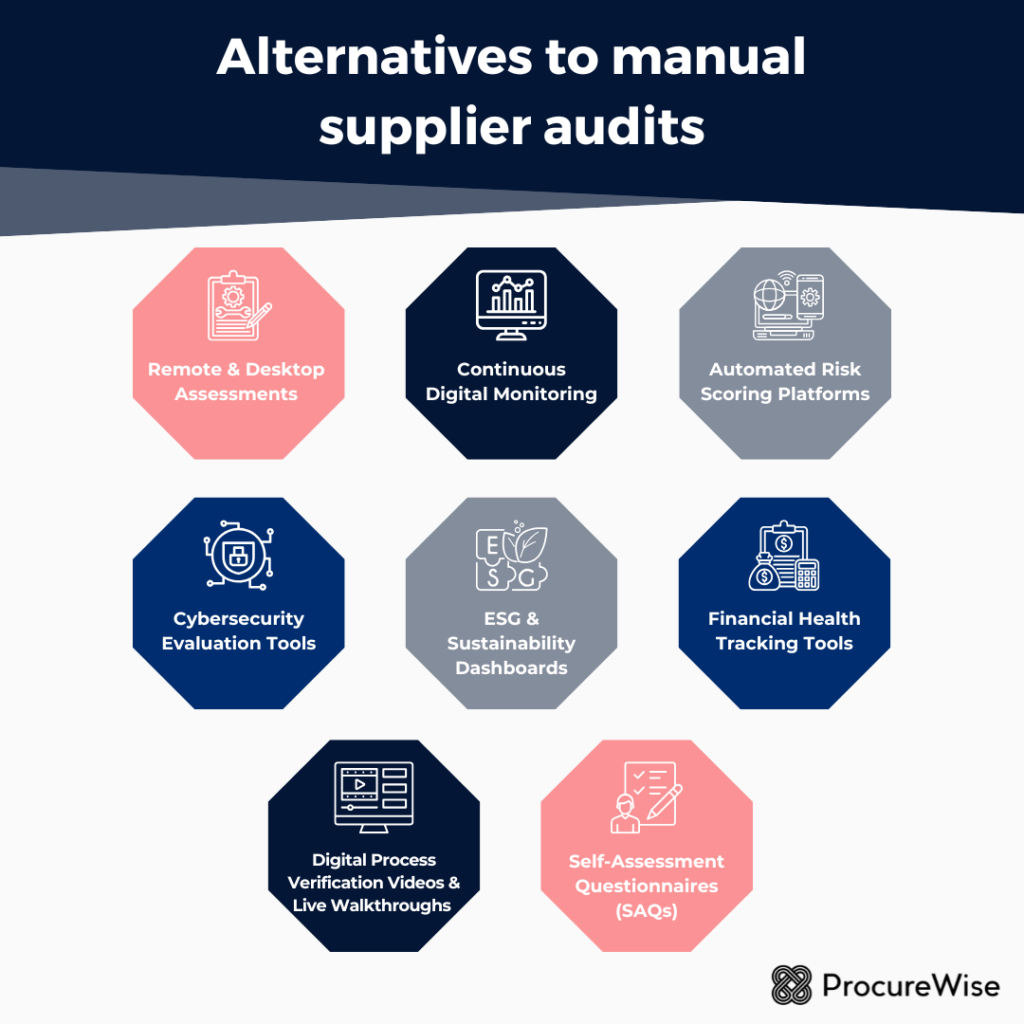
To optimise supply chains, organisations are shifting from labour-intensive, on-site audits to digital, remote, and intelligence-driven alternatives. These methods expand visibility, reduce costs, and support faster decision-making.
1) Remote & Desktop Assessments 🖥️
A fast, low-cost alternative where suppliers share digital documentation, process evidence, and certifications remotely. Benefits: quicker screening, easy prioritisation, reduced travel, scalable for global suppliers.
2) Continuous Digital Monitoring 🌐
Real-time tools track quality metrics, delivery performance, complaint trends, and process KPIs without needing physical audits. Benefits: ongoing transparency, early-risk detection, instant alerts.
3) Automated Risk Scoring Platforms 📊
AI-driven systems evaluate suppliers using financial data, geo-risk indicators, ESG signals, and cybersecurity posture. Benefits: predictive analytics, proactive risk mitigation, dynamic supplier ranking.
4) Cybersecurity Evaluation Tools 🔐
Instead of periodic IT audits, companies use continuous cyber-risk scanning, penetration-test reports, and monitoring of supplier vulnerabilities. Benefits: protects data, prevents supply chain breaches, supports regulatory compliance.
5) ESG & Sustainability Dashboards 🌱
Modern platforms assess environmental impact, labour conditions, and governance practices through self-assessment frameworks and automated data collection. Benefits: strong brand protection, regulatory alignment, simplified reporting.
🎯 Tailored Audit Replacements for Higher Strategic Impact 🎯
Not all suppliers require the same depth of oversight. These alternatives offer scalable options that go beyond manual audits while maintaining control and improving relationships.
6) Financial Health Tracking Tools 💰
Instead of occasional financial audits, third-party platforms monitor:
- credit risk
- liquidity
- bankruptcy probability
- payment behaviours
Benefits: reduced supply disruption risk, better sourcing decisions.
7) Digital Process Verification Videos & Live Walkthroughs 🎥
Suppliers record process demonstrations or conduct live virtual factory tours, showing real operations without full on-site audits. Benefits: transparency at lower cost, flexible scheduling, instant evidence capture.
8) Self-Assessment Questionnaires (SAQs) 📑
Modern SAQs are digital, structured, and analytics-enhanced. Suppliers provide:
- evidence uploads
- compliance statements
- maturity-level scoring
Benefits: efficient screening, scalable across hundreds of suppliers.
🚀 Supplier Oversight Methods Built Into the Daily Workflow 🚀
These approaches provide continuous supplier control without the need for frequent on-site audits.
9) KPI-Driven Supplier Scorecards 📈
Automated scorecards collect data from:
- logistics systems,
- quality platforms,
- ERP systems,
- complaint management tools.
Suppliers are evaluated on timeliness, quality, flexibility, and cost performance. Benefits: objective comparisons, faster decision-making, real-time visibility.
10) Collaborative Supplier Improvement Programs 🤝
Instead of auditing suppliers, companies run RCA workshops, training sessions, joint improvement projects, and structured development roadmaps. Benefits: deeper collaboration, faster capability growth, fewer long-term quality issues.
🧭 When Do These Alternatives Work Better Than Manual Audits? 🧭
Not every situation requires a physical audit. In many cases, alternatives are faster, more scalable, and more effective.
When the environment is dynamic and high-risk ⚠️
Digital monitoring and risk scoring identify issues early, long before a periodic audit would catch them.
When the supplier base is large 🌍
SAQs, scorecards, and remote tools allow companies to evaluate hundreds of suppliers at once, reserving on-site audits only for critical partners.
When the organisation is scaling fast or entering new markets 🚀
Remote assessments and virtual walkthroughs speed up supplier onboarding and reduce delays.
When the relationship is innovation-driven 💡
Collaborative improvement programs strengthen long-term capabilities far better than cyclical inspections.
🌍 Turning Alternative Methods Into Strategic Advantage 🌍
Modern supplier oversight isn’t just about replacing manual audits—it’s about building a more resilient, predictive, and collaborative supply chain.
Transforming Data Into Intelligence 🧠
When insights from scorecards, monitoring tools, and risk platforms are combined, companies gain:
- trend visibility across suppliers
- early warning signals for disruptions
- smarter sourcing decisions
- stronger long-term planning
The shift moves supplier management from reactive correction to proactive optimisation.
Building Trust-Based Partnerships 🤝
When suppliers see oversight as collaboration instead of inspection, they are more willing to:
- share process data
- adopt improvements
- invest in capability growth
This creates a supply base that is not only compliant, but mature, innovative, and aligned with strategic goals.
🔒 Common Challenges & How These Alternatives Solve Them 🔒
Even advanced methods can face obstacles—yet they often overcome issues that manual audits struggle with.
Global Complexity & Cultural Barriers 🌏
Remote tools reduce travel and language barriers, while standardised scorecards and SAQs maintain consistency across regions.
Resource Constraints & Limited Audit Capacity 🧮
Digital alternatives scale effortlessly, enabling broad coverage without large internal teams or constant on-site presence.
Supplier Resistance & Engagement Issues 💬
Collaborative programs and transparent KPIs encourage suppliers to participate rather than resist—turning oversight into a shared improvement journey.
Data Consistency & Integrity Challenges 📊
Centralised platforms ensure uniform checklists, better evidence tracking, and clean data for benchmarking and risk analysis.