

As artificial intelligence (AI) continues to revolutionize various industries, its impact on procurement is becoming more prevalent. While AI offers numerous benefits in terms of automating processes, improving decision-making, and enhancing efficiency, there are also several challenges that organizations may face when implementing AI in procurement.
From data security and privacy concerns to potential job displacement and the need for upskilling employees, there are various obstacles that organizations need to address in order to successfully integrate AI into their procurement operations. Understanding and overcoming these challenges is crucial for organizations looking to leverage AI to optimize their procurement processes and drive value for their business.
In this article, we will explore some of the key challenges of AI in procurement and discuss strategies for mitigating these challenges to maximize the benefits of AI technology in the procurement function. Read more AI and ML procurement applications
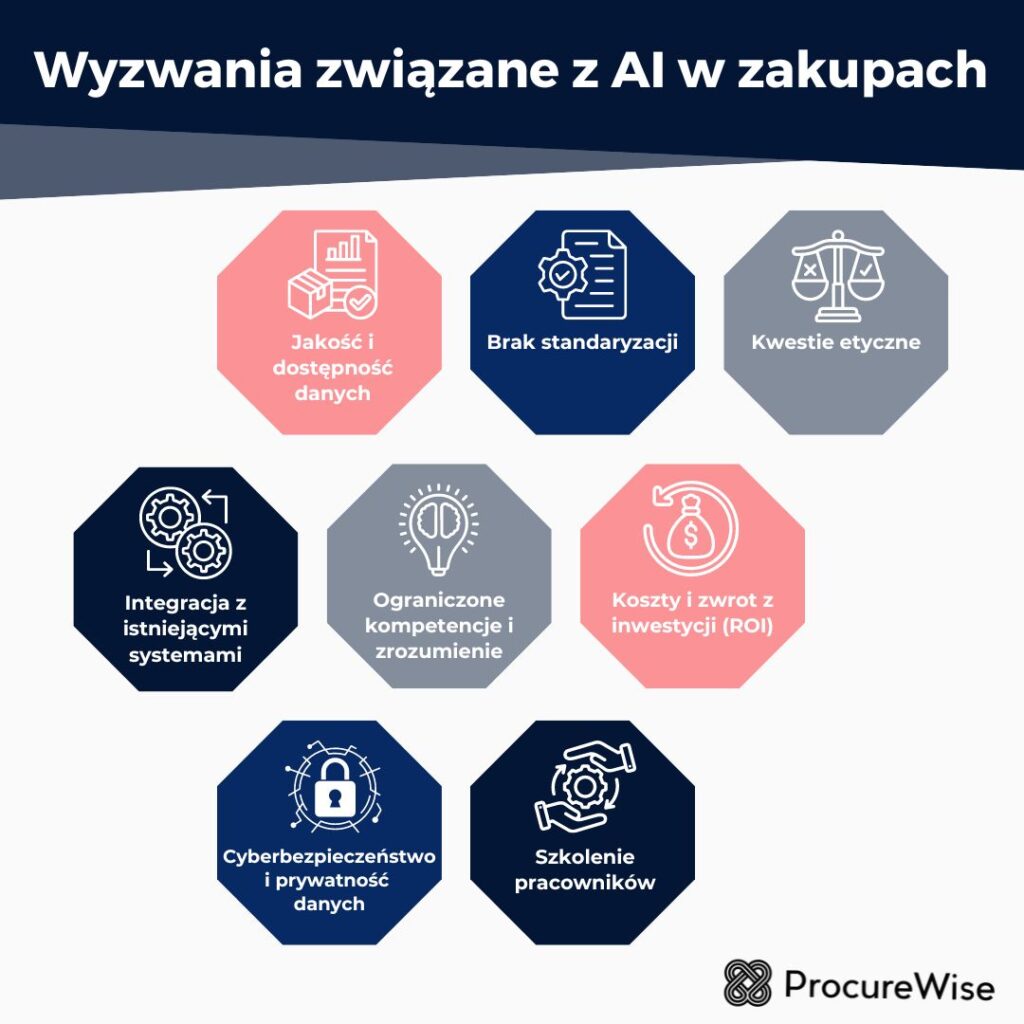
1. Data quality and availability 📄
To address this challenge, organizations should focus on improving data quality and availability by implementing data governance practices, establishing data standards, and investing in data cleansing and enrichment tools. It is important to prioritize data quality initiatives to ensure that AI algorithms are making decisions based on accurate and reliable information.
Additionally, organizations can consider implementing data integration solutions to streamline the procurement process of gathering and consolidating data from various sources for use in AI applications. By addressing data quality and availability challenges, organizations can enhance the effectiveness of AI in procurement and achieve better outcomes.
Take advantage of our services AI in procurement now!
2. Lack of standardization 📑
To address this challenge, organizations should work towards creating standardization in their procurement processes. This can involve implementing common data formats and structures, as well as encouraging collaboration and alignment with other organizations in the industry. By establishing standards and guidelines for data management and procurement practices, organizations can make it easier for AI systems to analyze and optimize procurement processes effectively.
Additionally, working with AI vendors that understand the importance of standardization and have the capability to adapt to different data formats can also help overcome this challenge.
3. Ethical considerations 🎭
To address these ethical considerations, organizations must prioritize diversity and inclusion in their procurement processes. This includes actively monitoring and evaluating AI algorithms to ensure they are not perpetuating bias, as well as providing training and education on ethical AI practices for procurement professionals.
Additionally, implementing transparency and accountability measures in AI systems can help mitigate potential risks and ensure fair and equitable decision-making. By being proactive in addressing these challenges, organizations can harness the benefits of AI in procurement while upholding ethical standards.
4. Integration with existing systems 🖥️
To overcome this challenge, it’s crucial to have a clear understanding of your organization’s current procurement systems and processes. Work closely with your IT team and AI provider to ensure a smooth integration. Communication is key during this process, so make sure all stakeholders are on the same page and understand the benefits of integrating AI into procurement.
Invest time and resources into training and support for your team to effectively utilize the new technology and maximize its potential within your existing systems. By taking a systematic approach and addressing any potential roadblocks proactively, you can successfully integrate AI into your procurement processes.
5. Limited expertise and understanding 👓
To overcome this challenge, organizations can invest in training and development programs to upskill their procurement professionals in AI technologies. Additionally, creating cross-functional teams with experts in both procurement and AI can help bridge the gap and ensure successful implementation of AI in procurement processes.
It’s important to educate and involve procurement professionals in the decision-making procurement process to address any resistance and skepticism towards AI technology. By fostering a culture of continuous learning and collaboration, organizations can overcome the limited expertise and understanding challenge in implementing AI in procurement.
6. Cost and Return on Investment (ROI) 💵
One of the main challenges of AI in procurement is determining the cost and return on investment (ROI). Implementing AI technology in procurement can come with substantial upfront costs, such as investments in technology, infrastructure, and employee training.
Additionally, calculating the ROI of AI in procurement can be complex, as the benefits may be difficult to measure and quantify accurately. It is essential for organizations to carefully assess the costs and potential benefits of implementing AI in procurement to ensure a successful and cost-effective integration.
7. Cybersecurity and data privacy 🔒
To address these challenges, organizations must invest in robust cybersecurity measures, including encryption, firewalls, and secure access controls. Regular security audits and updates are also essential to stay ahead of potential threats. Additionally, organizations should establish clear data privacy policies and procedures to ensure compliance with regulations and build trust with suppliers and customers.
Training staff on cybersecurity best practices and implementing AI solutions with built-in security features can also help mitigate risks. By prioritizing cybersecurity and data privacy in AI-powered procurement processes, organizations can harness the benefits of AI while safeguarding sensitive information.
8. Change management 👥
Organizations must focus on effective communication, training, and support to help employees understand the benefits of AI in procurement and alleviate any concerns they may have about job security. Emphasizing the ways in which AI can enhance their work, improve efficiency, and drive better outcomes can help employees overcome resistance and embrace the changes that come with incorporating AI into their procurement processes.
Additionally, providing ongoing education and training opportunities can help employees build their skills and confidence in working alongside AI technologies. By addressing change management challenges head-on, organizations can successfully integrate AI into their procurement practices and unlock the full potential of this cutting-edge technology.
⚠️ Fundamentals of AI/ML in procurement ⚠️
AI/ML (Artificial Intelligence/Machine Learning) has reshaped procurement, streamlining processes and bolstering decision-making. Here, we delve into its fundamentals, spotlighting its broad scope and impactful applications like task automation, spend analysis, and risk management.
👉 The scope of AI/ML in procurement is expansive, involving data analysis to glean insights and predictions, empowering professionals to optimize processes and drive cost savings. AI/ML algorithms adapt to changing needs, continuously refining decision-making through learning from historical data patterns.
👉 Task automation is a key application, freeing up procurement professionals from repetitive tasks like purchase order processing and supplier onboarding. AI-powered procurement systems handle transactions efficiently, allowing focus on strategic activities.
👉 Spend analysis benefits greatly from AI/ML, sifting through data to identify patterns, anomalies, and future expenditure predictions. This holistic view aids in cost-saving, contract negotiation, and compliance assurance.
👉 Risk management is enhanced as AI-powered procurement systems monitor factors like supplier performance and market conditions, offering early warnings and aiding in proactive risk mitigation.
👉 Real-world examples illustrate AI/ML’s efficacy. A global manufacturer automated contract review, reducing time by 90% while ensuring compliance. A retail giant utilized AI algorithms for spend analysis, yielding significant cost savings and improved efficiency. Automotive companies leveraged AI for supply chain risk management, enabling proactive issue resolution and supply chain resilience.
AI/ML optimizes procurement by automating tasks, enhancing spend analysis, and fortifying risk management. Its application across various procurement facets boosts efficiency, accuracy, and compliance. Real-world successes underscore its transformative impact, promising further evolution and organizational excellence in procurement.
✅ Benefits of AI in procurement ✅
✔️ Improved data analysis and decision-making: AI technologies, such as machine learning, can analyze large volumes of procurement data quickly and identify patterns and insights that humans may miss. This enables organizations to make more informed and data-driven procurement decisions, leading to improved efficiency and cost savings.
✔️ Enhanced supplier management: AI can help in supplier selection and evaluation by analyzing supplier performance data, including delivery times, quality, and pricing history. AI-powered systems can identify and recommend the most suitable suppliers based on specific criteria, ensuring better supplier management and fostering stronger relationships.
✔️ Automated and streamlined processes: AI can automate repetitive and time-consuming tasks in procurement, such as invoice processing, purchase order generation, and contract management. By reducing manual work, organizations can streamline their procurement processes, enhance efficiency, and free up valuable time for procurement professionals to focus on strategic activities.
✔️ Demand forecasting and inventory optimization: AI algorithms can analyze historical data and market trends to forecast demand accurately. This helps organizations optimize their inventory levels, avoid stockouts or excess inventory, and improve overall supply chain management.
✔️ Enhanced risk management: AI can analyze supplier data, industry news, and market trends to identify potential risks or disruptions in the supply chain. This enables organizations to proactively manage risks, identify alternative suppliers, and mitigate potential disruptions to ensure continuity of supply.
✔️ Cost savings and negotiation optimization: AI-powered systems can analyze historical pricing data, market trends, and supplier profiles to support strategic sourcing and negotiation efforts. Procurement professionals can leverage these insights to optimize negotiations, achieve cost savings, and secure more favorable contract terms.
✔️ Increased compliance and reduced fraud: AI can help detect and prevent fraudulent activities in procurement, such as duplicate invoices or suspicious supplier behavior. By analyzing data and patterns, AI systems can flag potential fraudulent transactions, improving compliance and reducing financial risks.
✔️ Continuous improvement and optimization: AI systems can learn from past procurement data and user feedback to continuously improve their performance and recommendations. This enables organizations to iteratively optimize their procurement processes and leverage AI’s capabilities to drive continuous improvement.
Overall, AI in procurement offers the potential for greater efficiency, cost savings, enhanced decision-making, and improved supplier management, ultimately contributing to the overall effectiveness of the procurement function.
❓How procurement leaders can choose the right AI/ML technology❓
Procurement leaders are increasingly turning to AI/ML technologies to optimize operations, but selecting the right one amidst the array of options can be daunting. To make the best choice, leaders must first pinpoint their specific pain points and needs, focusing on areas like sourcing, contracting, risk management, and pricing.
➡️ In sourcing, effective AI/ML tools should excel at supplier identification, evaluation, and decision-making. Leaders should inquire about the technology’s data gathering and analysis methods, its ability to offer performance predictions, and its provision of real-time insights.
➡️ For contracting, AI/ML solutions should streamline contract creation, review, and negotiation processes. Leaders should assess how the technology simplifies drafting, identifies risks, and aids in negotiations to secure favorable terms.
➡️ In risk management, AI/ML tools should detect and mitigate potential risks by analyzing internal and external data. Leaders should evaluate the tool’s data analysis capabilities, its provision of real-time risk alerts, and its support for mitigation and compliance efforts.
➡️ In pricing, AI/ML solutions should optimize decisions by analyzing market data and historical trends. Leaders should examine how the tool utilizes data to inform pricing decisions, offers insights on market trends, and enables scenario analysis.
By addressing these key areas and asking relevant questions, procurement leaders can identify the most suitable AI/ML technology for their organization’s needs. Choosing the right technology can significantly enhance procurement operations, improve decision-making, and drive operational efficiency in today’s dynamic business environment.