

In the ever-evolving landscape of digital marketing, understanding the content marketing funnel is crucial for driving engagement and conversions. Whether you’re a seasoned marketer or just starting out, the funnel provides a roadmap for how to effectively nurture leads throughout their journey—from awareness to decision-making.
The content marketing funnel consists of several key stages: Awareness, Consideration, and Decision. Each stage requires tailored content strategies to address the specific needs and questions of your audience. By aligning your messaging and content formats—be it blog posts, videos, or webinars—with the stage in the funnel, you can engage your audience more effectively and increase the likelihood of conversion.
In this comprehensive guide, we will delve into each stage of the content marketing funnel, providing strategies, examples, and best practices to help you create impactful content that resonates with your target audience and leads them smoothly toward making a purchase. Whether you’re looking to generate brand awareness, educate your leads, or close sales, mastering the content marketing funnel is essential for achieving lasting success in your content marketing efforts. Get ready to unlock the full potential of your marketing strategy!
❓What Is a Content Marketing Funnel❓
A content marketing funnel is a strategic system that guides potential customers through a structured journey from awareness to purchase. It consists of three main stages: Discovery (TOFU), Consideration (MOFU), and Conversion (BOFU).
Delivering personalized content that adapts to users’ behavior and preferences at each stage of the funnel is essential for guiding them effectively through their customer journey, ultimately leading to more conversions and satisfied customers.
⚙️ How Does the Content Marketing Funnel Work? ⚙️
The content marketing funnel is a strategic framework that guides potential customers from initial awareness to making a purchase. It consists of three main stages: Top of the Funnel (TOFU), Middle of the Funnel (MOFU), and Bottom of the Funnel (BOFU).
1️⃣ In the TOFU stage, potential customers are introduced to your brand through awareness-building content like blog posts, infographics, and social media posts. This content attracts a broad audience and helps generate Marketing Qualified Leads (MQLs) by engaging those seeking information.
2️⃣ Moving to the MOFU stage, the focus shifts to nurturing these MQLs. Here, more targeted content such as eBooks, webinars, and case studies are used to educate and build trust, guiding prospects toward considering your product or service as a solution to their needs.
3️⃣ Finally, the BOFU stage is where conversion happens. Content like product demos, customer testimonials, and special offers are employed to persuade MQLs to become Sales Qualified Leads (SQLs), ready to make a purchase decision.
By nurturing leads at each stage of the content marketing funnel, businesses can effectively convert prospects into loyal customers.
📚 What Are The Levels of the Content Marketing Funnel? 📚
The content marketing funnel is a framework that describes the various stages a customer goes through from becoming aware of a product or service to making a purchase, and even beyond, in terms of engagement and loyalty. It helps marketers understand the customer journey and create targeted content that meets the needs and intentions of potential customers at each stage.
Here’s a breakdown of how the content marketing funnel works:
1. Awareness Stage
🎯 Goal: Attract potential customers and make them aware of your brand.
🎞️ Content Types: Blog posts, social media content, infographics, videos, eBooks, podcasts, and other educational resources.
📋 Strategy: Content in this stage should be informative and engaging, focusing on broad topics that relate to the pain points or interests of your target audience. You want to capture their attention and introduce your brand without being overly promotional.
2. Consideration Stage
🎯 Goal: Nurture leads and help them understand how your product or service can solve their problems.
🎞️ Content Types: Case studies, comparison guides, webinars, how-to guides, and detailed product descriptions.
📋 Strategy: In this stage, content should provide more depth, helping prospects evaluate their options. Content that highlights benefits, features, and real-life applications of the product or service can be effective. You may also consider lead magnets like free trials or demos to capture leads.
3. Decision Stage
🎯 Goal: Convert leads into customers by encouraging them to make a purchase.
🎞️ Content Types: Product demos, testimonials, reviews, special offers, and detailed pricing information.
📋 Strategy: Content should build trust and reduce hesitation. Emphasizing social proof, such as user reviews and testimonials, can help persuade potential customers. Clear calls-to-action (CTAs) and limited-time offers can also be effective to create a sense of urgency.
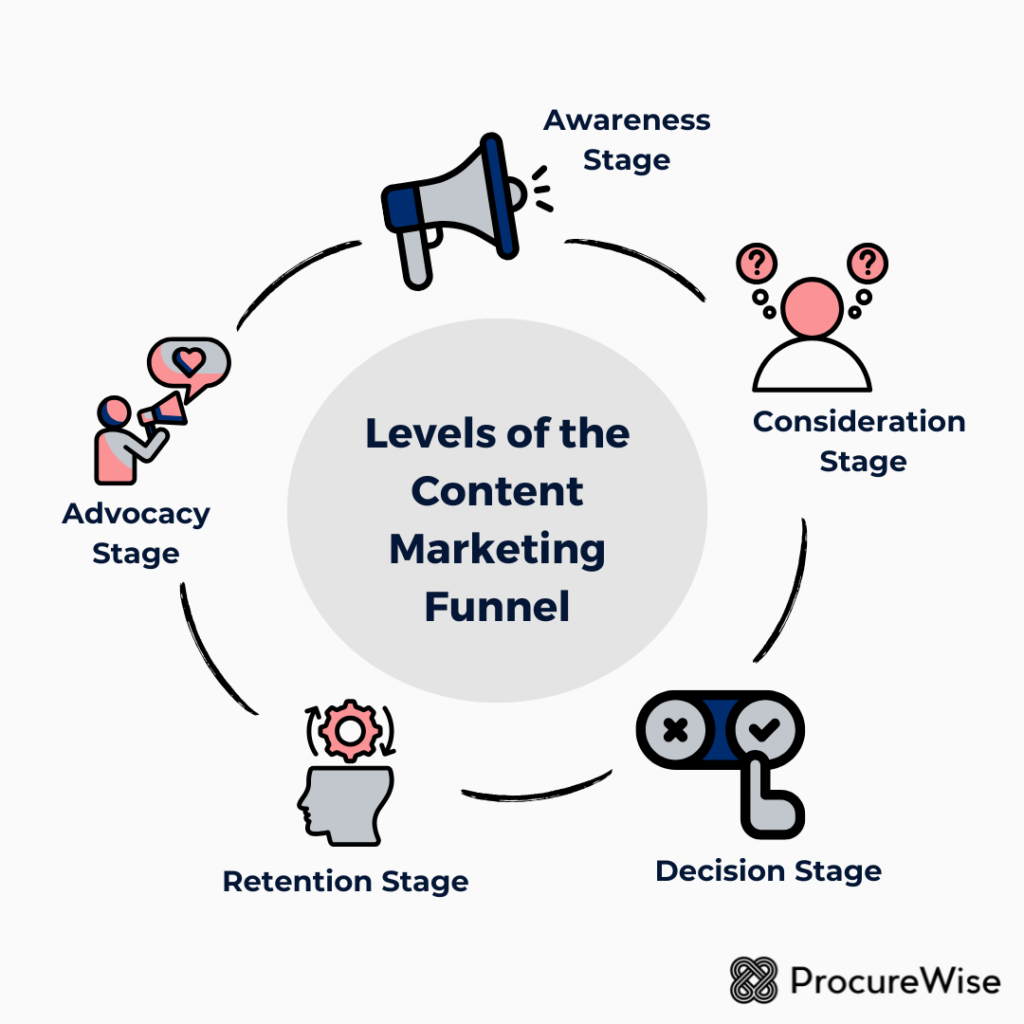
4. Retention Stage
🎯 Goal: Keep customers engaged after a purchase and encourage repeat business.
🎞️ Content Types: Email newsletters, customer loyalty programs, follow-up surveys, and tutorials on product usage.
📋 Strategy: Content should focus on educating customers about the product, providing value beyond the initial purchase. Encouraging customer feedback and engaging customers through personalized messages can strengthen their loyalty.
5. Advocacy Stage
🎯 Goal: Turn satisfied customers into brand advocates who will promote your brand to others.
🎞️ Content Types: User-generated content, referral programs, social media interactions, and loyalty rewards.
📋 Strategy: Engage with customers and encourage them to share their experiences. Highlighting customer stories and offering incentives for referrals can help create advocates.
Overall, the content marketing funnel is a strategic approach that aligns content creation with the customer journey. By understanding the different stages and what type of content is effective at each stage, marketers can create a cohesive strategy that nurtures leads, ultimately leading to conversions and long-term customer relationships. Monitoring and analyzing analytics at each stage also help refine and improve content marketing efforts over time.
🛠️ How to Build an Effective Content Marketing Funnel? 🛠️
Building an effective content marketing funnel involves a strategic approach that aligns your content efforts with the stages of the customer journey. Here’s a step-by-step guide to help you create a well-structured and impactful content marketing funnel:
1️⃣ Define Your Target Audience
👉 Buyer Personas: Create detailed buyer personas that represent your ideal customers. Understand their demographics, interests, pain points, and challenges.
👉 Customer Journey Mapping: Map out the customer journey for each persona, identifying key touchpoints and stages they go through before making a purchase.
2️⃣ Identify Your Funnel Stages
📌 Break down the funnel into the main stages: Awareness, Consideration, Decision, Retention, and Advocacy. Recognize that different types of content will be needed for each stage.
3️⃣ Develop a Content Strategy
Content Types and Formats
👉 Awareness: Use blogs, social media posts, infographics, and videos to attract attention.
👉 Consideration: Create in-depth guides, case studies, webinars, and comparison articles.
👉 Decision: Focus on product demos, testimonials, reviews, and product information.
👉 Retention: Implement newsletters, tutorials, customer surveys, and loyalty programs.
👉 Advocacy: Encourage user-generated content, referral programs, and community engagement.
Align Content with Customer Needs
📌 Tailor your content to address the specific needs and questions of your target audience at each stage. Use keyword research and feedback to ensure your content resonates with their interests.
4️⃣ Create High-Quality Content
👉 Ensure that your content is well-researched, valuable, and engaging. Use various formats (text, video, audio) to cater to different preferences.
👉 Incorporate strong visuals and storytelling elements to make the content more appealing.
5️⃣ Optimize for Search Engines
📌 SEO Best Practices: Use appropriate keywords, meta tags, and descriptions to enhance discoverability. High-quality content that is optimized for SEO can attract organic traffic to your funnel.

6️⃣ Use Compelling CTAs
👉 Incorporate clear and persuasive calls-to-action (CTAs) tailored to the specific stage of the funnel. For example, CTAs in the awareness stage may invite users to read more or subscribe, while CTAs in the decision stage should encourage purchases or sign-ups.
7️⃣ Promote Your Content
📌 Use multiple channels to promote your content, including social media, email marketing, paid advertising, and partnerships. Each channel may reach different segments of your target audience.
8️⃣ Monitor and Analyze Performance
👉 Implement analytics tools to track the performance of your content. Monitor key metrics such as traffic, engagement, conversion rates, and customer feedback.
👉 Use these insights to understand what works, and make adjustments based on data.
9️⃣ Nurture Leads and Build a Community
📌 Implement lead nurturing strategies, such as email marketing funnels, to move potential customers through the different stages. Provide relevant content at each touchpoint to encourage progression toward a purchase.
📌 Engage with your audience on platforms like social media and forums. Encourage discussions and interactions to foster a sense of community.
🔟 Iterate and Improve
👉 Continuously evaluate your funnel’s effectiveness, collect feedback from customers, and make necessary adjustments. Testing different content types, strategies, and formats can lead to improved results over time.
An effective content marketing funnel is a dynamic and ongoing process. By understanding your audience, creating targeted and valuable content, and systematically nurturing leads through the stages of their journey, you can enhance engagement, drive conversions, and build lasting customer relationships. Regularly refining and adapting your strategy based on insights and performance data will further enhance your funnel’s effectiveness.
⏱️ Measuring Content Marketing Funnel Success ⏱️
Measuring success in the content marketing funnel is crucial for understanding performance and optimizing strategies. Key metrics such as conversion rates, traffic sources, and on-site engagement provide insights into how effectively content drives users toward desired actions. High conversion rates indicate successful content that resonates with the audience, while analyzing traffic sources can reveal which channels are most effective in attracting visitors.
Engagement metrics, such as time on page and bounce rates, help identify drop-off points in the user journey. Understanding where users lose interest allows marketers to enhance user experience by refining content and layout, ensuring that potential customers remain engaged and are less likely to abandon the funnel.
Utilizing tools like Google Analytics is essential for comprehensive performance tracking. Google Analytics offers valuable data to assess user behavior, enabling marketers to make informed decisions and continuously optimize content strategies. By focusing on these metrics, businesses can ultimately drive more conversions and revenue, achieving greater success in their content marketing efforts.