

Cost efficiency refers to the ability of a company or organization to achieve desired results or goals while simultaneously minimizing expenses and maximizing the value of resources. It involves the identification and implementation of strategies and practices that reduce costs without compromising quality or performance.
In this article, we will discuss in more detail the concept of cost efficiency and present strategies and examples that can help companies achieve it. Whether you are a small startup or a large corporation, understanding and implementing cost efficiency measures can significantly contribute to your success. Read more How do you stay in control of your company’s finances with budgeting.
❓What is Cost Efficiency❓
Cost efficiency refers to the organization’s ability to maximize productivity while minimizing costs. Achieving cost efficiency is crucial for the success of a company, as it helps increase profits, improve competitiveness in the market, and meet Customer expectations.
Cost efficiency can be measured using various indicators, such as the cost efficiency ratio, energy consumption ratio, or labor cost per production unit. There are many factors that can affect cost efficiency, such as production scale, technology used in processes, quality of management, and market competition.
Take advantage of our procurement process review services now!
💵 Cost Efficiency vs. Cost Effectiveness 💵
The difference between cost efficiency and cost effectiveness can be explained by the fact that cost efficiency focuses on achieving specific goals within predetermined cost parameters, while cost effectiveness is a measure of the efficient use of resources to achieve a desired result.
This means that something can be cost-effective if it meets specific goals and is consistent with predetermined cost parameters. However, it may not be efficient if too many resources were used in the process compared to other available methods.
What makes us cost-efficient is the amount of resources we need to use to achieve our goals. The fewer resources we use to achieve the desired result, the more cost-efficient we are. Therefore, it is important to focus on optimal use of available resources and minimize waste to achieve higher cost efficiency.
❔How to Achieve Cost Efficiency❔
In today’s competitive business environment, achieving cost efficiency is crucial for company success. Cost efficiency involves achieving maximum results at minimum cost. This is achieved by identifying and minimizing cost inefficiencies and maximizing the use of available resources. In this article, we will discuss strategies that can be applied to achieve cost efficiency in a company. Understanding these strategies and implementing them can bring tangible financial benefits and strengthen the company’s market position.
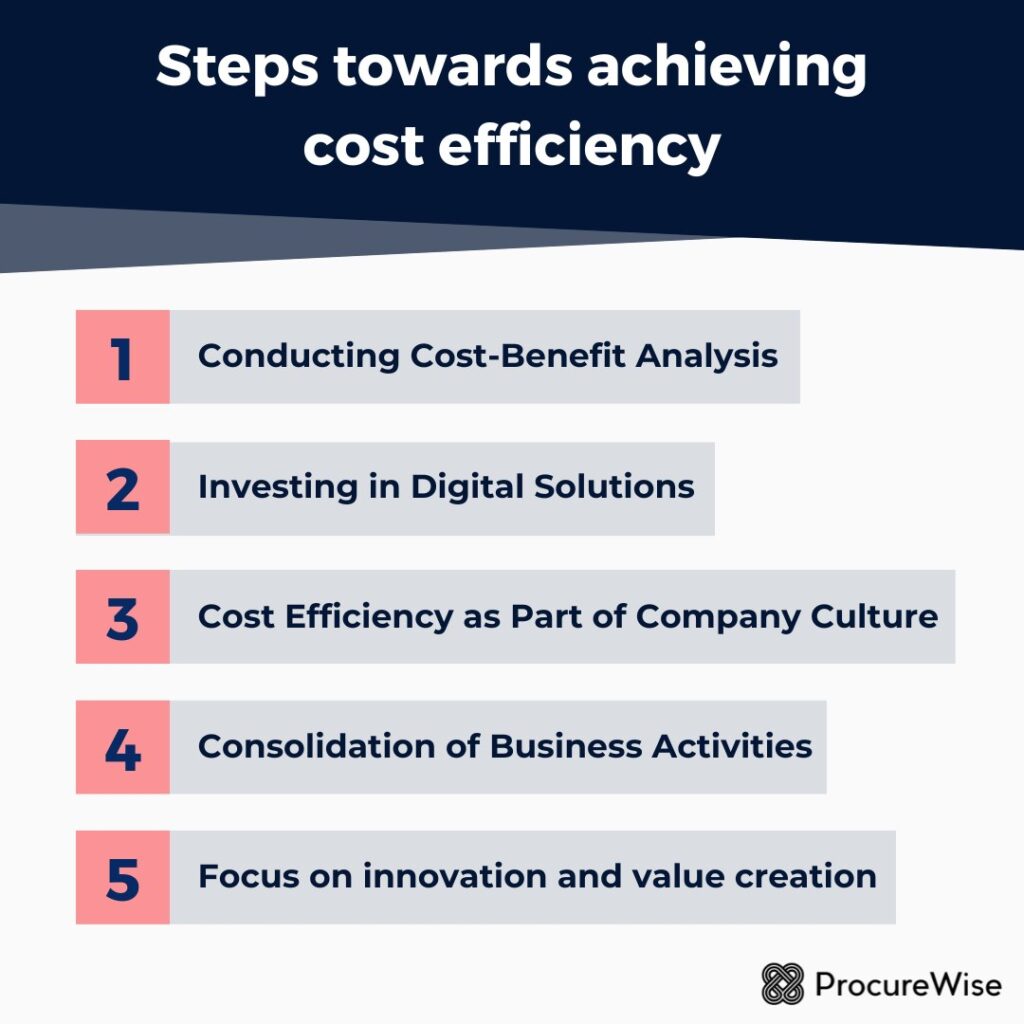
Conducting cost-benefit analysis ⚖️
It is important to conduct a cost-benefit analysis to assess whether cost efficiency will be achieved. At the beginning of the process, both direct and indirect costs related to the project or decision should be identified and quantified. Direct costs include items such as raw materials, labor, equipment, or technology costs. Indirect costs may arise from time loss, reduced productivity, or increased costs in other areas of operation.
Intangible costs, often overlooked in traditional cost analyses, should not be forgotten. These may include items such as loss of Customer satisfaction, damage to the company’s reputation, or negative impact on employee relations. Identifying and measuring these intangible costs is crucial for a comprehensive and accurate cost analysis.
There are also opportunity costs – necessary time commitments that may prevent the pursuit of other opportunities.
In addition to costs, potential benefits must also be considered. These can be both tangible benefits, such as increased revenue, savings, or new business opportunities, and intangible benefits, such as improved brand image, increased Customer loyalty, or improved operational efficiency.
Finally, the cost-benefit analysis must also consider the risk associated with the decision or investment. Risk can result in additional costs, such as costs associated with project non-completion or costs related to regulations or management errors. Including these risk-related costs is important for a complete understanding of the consequences of the actions taken.
Investing in digital solutions 🖥️
In today’s rapidly changing business environment, leveraging modern technologies is key to increasing a company’s competitiveness and achieving better financial results.
One way to achieve cost efficiency is to invest in procurement software, such as procure-to-pay and supply chain management systems. These advanced tools help automate procurement processes, from order to payment, leading to shorter cycle times and eliminating errors and paper waste. Procurement software also enables better Supplier management, demand forecasting, negotiation of favorable contract terms, and cost reduction in purchases.
It is also worthwhile to move solutions to the cloud, reducing infrastructure costs and maintaining in-house systems. The cloud allows companies to use flexible and scalable IT solutions, eliminates the costs of purchasing, installing, and maintaining hardware, and provides access to data and applications from anywhere and any device. Moving systems to the cloud also makes it easier to implement updates and increases their security.
Cost efficiency as part of company culture 🏛️
Motivating employees to work in a cost-saving environment can lead to better business results. There are many benefits to having cost efficiency as an internal company value.
➡️ Increased profit margins: By consciously managing costs and minimizing losses, a company can achieve higher profit margins. Often, these savings can be reinvested in the development of the company or increased investments.
➡️ Better resource allocation: Cost efficiency strategy allows focusing on the most critical areas of activity that generate higher profits. Improved resource allocation can lead to better utilization of the company’s potential and increased efficiency.
➡️ Increased competitiveness: Companies that can minimize costs can offer more attractive prices to their Customers. This, in turn, can attract more Customers and increase the company’s market share.
➡️ Sustainable development: Minimizing losses and efficient management of natural resources can contribute to the reduction of the negative impact on the environment. This, in turn, can affect how the company is perceived as socially and environmentally responsible.
➡️ Building Customer trust: A company that effectively manages costs can offer competitive prices and quality products or services. This, in turn, leads to greater Customer trust and the building of a positive brand image.
Consolidation of business activities 🧩
This involves combining and organizing various areas of activity into an integrated whole. This allows for the reduction of operating costs and an increase in the profitability of the enterprise.
One of the main aspects of business consolidation is the consolidation of administrative activities. Introducing a unified management system and centralizing administrative processes can result in significant savings. Transferring documentation and information to a cloud platform is another step towards increasing cost efficiency. Using cloud options allows for the reduction of costs related to IT infrastructure, such as purchasing servers or maintaining data centers.
Business consolidation can also be achieved through mergers and acquisitions. The combination of two or more companies can bring significant cost benefits. Greater production and distribution scale can lead to lower unit costs. Mergers can also lead to greater negotiating power with Suppliers and Customers, resulting in more favorable price terms.
Focus on innovation and value creation 💰
Innovation contributes to the introduction of new solutions that can reduce production costs, streamline operations, and improve the quality of products and services offered by the company. Value creation, on the other hand, involves providing Customers with products and services that meet their needs and expectations, exceeding their expectations at the same time.
Investing in information technology tools can enable the realization of economies of scale, leading to cost reduction and faster delivery of products and services. IT tools and infrastructure can support process automation, operation optimization, and improvement of communication and collaboration within the company. This allows for a shorter time needed to complete tasks, avoiding errors, and better cost control.
Innovation in the production process, such as manufacturing packaging materials in-house, can help reduce costs and improve Customer experience. By producing the necessary materials internally instead of purchasing them from external Suppliers, a company can save on procurement and delivery costs while maintaining greater control over quality and delivery times.
Summary
Cost efficiency is a key element in achieving business success. Through sustainable cost reduction, continuous improvement, and adaptation of strategies, companies can maintain competitiveness in the market and achieve financial stability. In today’s competitive business environment, cost efficiency is an integral part of business strategies and should be a priority for all companies.