
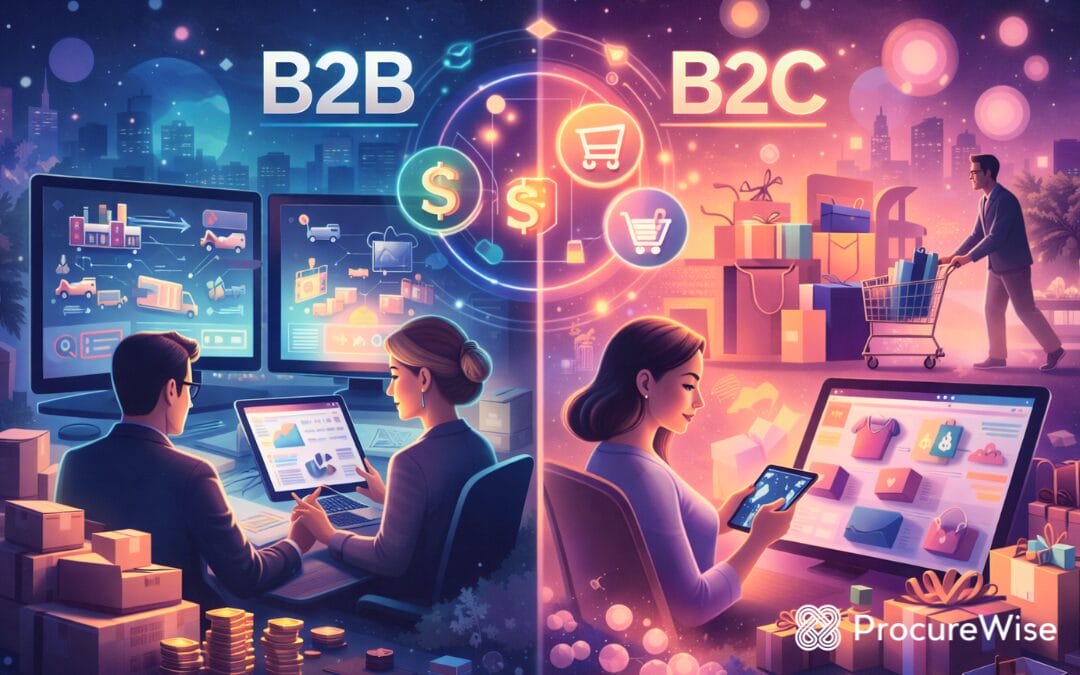
Procurement today is much more than a purchasing function. In both B2B and B2C environments, it directly influences operational efficiency, customer experience, and long-term business growth. While business and consumer buying may appear fundamentally different, in reality they increasingly overlap and influence each other. Understanding these dynamics allows companies to design better strategies, processes, and communication.
⚙️ Key Differences Between B2B and B2C Procurement ⚙️
Buyer Profile and Decision-Making 👥
In B2B, purchasing decisions are typically multi-stakeholder and structured. They are driven by logic, return on investment, risk reduction, and alignment with broader business goals. Decisions take time, involve multiple departments, and are rarely impulsive.
In B2C, the buyer is an individual consumer. Decisions are usually faster, more intuitive, and emotionally driven, influenced by convenience, brand perception, and immediate needs. The decision-making process is short and often non-linear.
Purchase Motivations 💡
The motivation behind a B2B purchase is rooted in performance and efficiency. Companies buy to improve productivity, reduce costs, ensure continuity, or gain a competitive edge.
In B2C, purchases are more personal. Consumers buy to satisfy needs or desires, seek comfort or enjoyment, and enhance their lifestyle. Emotional value and instant gratification often play a decisive role.
Transaction Scale and Complexity 🧾
B2B procurement typically involves high-value, complex transactions with negotiations, customized solutions, and long sales cycles. Contracts, compliance, and long-term commitments are standard.
B2C transactions are generally standardized and low to mid-value, designed for speed and simplicity. The buying process is optimized to minimize friction and enable instant decisions.
🔗 Relationships and Post-Purchase Support 🔗
Relationship Models in B2B and B2C 🤝
In B2B, relationships are long-term and trust-based, supported by account managers, service-level agreements, and ongoing collaboration. In B2C, relationships are more transactional and scalable, often supported by automation and self-service tools.
Despite these differences, customer loyalty and experience are becoming increasingly important in both models.
🔄 The Procurement Process in B2B and B2C – How It Works in Practice 🔄
Although B2B and B2C procurement follow the same basic logic – need → choice → purchase → evaluation – the way this journey unfolds differs significantly. The main differences lie in decision speed, level of formalization, and the role marketing plays throughout the process.
The B2B Buying Journey – Structure and Control 🏗️
The B2B procurement process is structured, methodical, and risk-aware. Each purchase can have a direct impact on operational continuity and financial performance, which is why decisions are rarely rushed.
The journey typically begins with identifying an internal need, followed by defining detailed requirements and specifications. Potential suppliers are then sourced and evaluated, negotiations take place, and contracts are finalized. After implementation, performance is reviewed to ensure expectations are met. This process is often supported by ERP systems, procurement policies, and approval workflows that ensure consistency, compliance, and control. Speed is secondary to accuracy and reliability.
The B2C Buying Journey – Speed and Experience ⚡
In contrast, the B2C buying journey is short, intuitive, and experience-driven. It often starts with a trigger such as advertising, social media content, or a situational need.
Consumers quickly compare options based on price, reviews, and convenience before making a purchase. The entire process can take just minutes. As a result, user experience, seamless checkout, and fast delivery are critical. Procurement in B2C operates behind the scenes, while the customer perceives a smooth and effortless journey.
📣 The Role of Marketing in Procurement 📣
Marketing in B2B – Education and Trust-Building 🎓
In B2B, marketing plays a supporting and educational role in the procurement process. Its purpose is to help decision-makers understand the value, reduce uncertainty, and justify investment.
Thought leadership content, case studies, and webinars build credibility and support long decision cycles. Marketing and procurement must work closely together, as trust and knowledge are essential for moving deals forward.
Marketing in B2C – Triggering Action and Reducing Friction 🎯
In B2C, marketing often initiates the purchase itself. It captures attention, creates desire, and guides the consumer toward a fast decision.
Advertising, influencers, and social platforms become part of the buying journey rather than just communication channels. The shorter and simpler the path to purchase, the higher the conversion rate.
🔗 Relationships, Loyalty, and Long-Term Value in B2B and B2C 🔗
At this stage, it becomes clear that procurement is no longer about a single transaction. In both B2B and B2C, success increasingly depends on relationships, retention, and value created over time.
B2B Relationships – Strategic Partnerships 🤝
In B2B, relationships are built with a long-term perspective. Buyers and suppliers often work together for years, which makes trust, reliability, and collaboration essential.
These relationships typically involve long-term contracts, dedicated account managers, and ongoing cooperation beyond the initial purchase. Because switching suppliers can be costly and risky, procurement teams focus on stability and partnership rather than short-term savings. As a result, relationship quality directly affects business continuity and performance.
B2C Relationships – Loyalty Over Commitment 🔁
In B2C, relationships are more flexible and less formal, but they are still strategically important. Consumers have many alternatives and can switch brands easily.
This is why B2C companies focus on creating positive experiences that encourage repeat purchases. Loyalty programs, personalized communication, and consistent brand experiences help keep customers engaged. The goal is not contractual commitment, but emotional connection and habitual return.
⭐ Post-Purchase Experience as a Strategic Factor ⭐
After-Sales in B2B – Continuity and Accountability 🛠️
In B2B, post-purchase activities are a core part of the procurement strategy. Service levels, technical support, and ongoing performance reviews are often defined contractually.
Procurement teams monitor delivery quality, compliance with SLAs, and overall supplier performance throughout the contract lifecycle. In this model, procurement continues long after the contract is signed.
After-Sales in B2C – Experience and Perception 😊
In B2C, post-purchase experience strongly influences brand perception and future buying decisions. Easy returns, responsive customer support, and clear communication all shape how the customer remembers the purchase.
Even small interactions after the sale can determine whether a customer comes back or chooses a competitor next time.
📈 Customer Lifetime Value (CLV) 📈
Both B2B and B2C organizations increasingly measure success through Customer Lifetime Value, not individual transactions.
In B2B, CLV is driven by long contracts and expanding cooperation. In B2C, it is built through frequency of purchase and loyalty over time. In both cases, effective procurement requires close alignment with sales and marketing to maximize long-term value.
🚀 The Convergence of B2B and B2C – The Future of Procurement 🚀
The final perspective shows that while B2B and B2C procurement still differ in structure and pace, their strategies are increasingly moving toward each other. This convergence is driven by technology, changing buyer expectations, and the growing importance of user experience.
Technology as a Shared Foundation 🖥️
Digitalization has become the common ground for both models. Procurement platforms—whether designed for business buyers or consumers—are now expected to be simple, intuitive, and fast. Automation, system integrations, and data analytics support smarter purchasing decisions, better cost control, and reduced risk.
B2B buyers, shaped by their personal e-commerce experiences, now expect the same level of convenience and usability at work. As a result, user experience is no longer a B2C-only concern.
Customer Experience Over Price 🌟
Price remains important, but it is rarely the sole deciding factor. In both B2B and B2C, buyers increasingly value ease of cooperation, responsiveness, transparency, and trust. Procurement therefore plays a direct role in shaping how a brand is perceived—not just as a supplier, but as a reliable partner.
Companies that combine operational efficiency with a strong customer experience build a competitive advantage that is difficult to replicate.
🧠 Strategic Takeaways for Organizations 🧠
For B2B companies, this means simplifying procurement journeys and designing processes from the end-user’s perspective, not just around internal procedures. For B2C businesses, it involves adopting more structured, data-driven approaches inspired by B2B—especially in managing relationships and long-term value.
In both models, procurement is evolving from a support function into a strategic growth driver, closely connected with sales and marketing.
🌍 Conclusion: One Direction, Different Paths 🌍
B2B and B2C procurement will not become identical, but they are clearly heading in the same direction. B2B continues to adopt the simplicity, UX, and personalization of B2C, while B2C increasingly embraces process discipline and relationship thinking typical of B2B.
Organizations that understand and act on this convergence will gain greater flexibility, stronger customer loyalty, and sustainable competitive advantage. Procurement is no longer just about buying—it is a strategic tool for long-term business growth.