
The era of reactive inventory management, spreadsheets, and intuition-based decisions is rapidly ending. In 2026, growing supply chain complexity, volatile demand fluctuations, and rising service level expectations force organizations to move beyond automation toward AI-powered inventory optimization.
This shift is not about marginal gains. It is about redefining inventory management as a strategic capability that directly improves supply chain efficiency, reduces excess inventory, stabilizes inventory levels, and strengthens resilience across global supply chains. Artificial Intelligence is no longer an add-on—it is the core engine of modern inventory optimization.
🔮 From Reactive to Predictive Supply Chains 🔮
Traditional supply chain management relies on reacting to problems after they occur: stockouts, overstocking, missed forecasts. In an environment shaped by market volatility, geopolitical risk, and rapidly shifting customer behavior, this model collapses under pressure.
AI enables a fundamental transition—from reactive control to predictive analytics and proactive decision-making. By continuously analyzing real-time data, historical patterns, and external signals, modern systems anticipate disruptions before they materialize. Inventory becomes adaptive, responsive, and strategically aligned with demand rather than lagging behind it.
🧠 Why 2026 Is a Breakthrough Year for AI Inventory Optimization? 🧠
Several forces converge in 2026. Machine learning, neural networks, and scalable cloud platforms have matured enough to handle multi-location, high-volume inventory ecosystems. At the same time, customer expectations for availability and speed are at all-time highs, while logistics costs and inventory carrying costs continue to rise.
Basic automation—such as static reorder points or rule-based replenishment—can no longer cope with this complexity. True AI inventory management leverages advanced models to dynamically balance inventory replenishment, safety stocks, and service targets in near real time. This marks a decisive shift from task automation to intelligent orchestration.
⚙️ Inventory as a Strategic Asset, Not a Cost Center ⚙️
Historically, inventory optimization focused on minimizing inventory costs. AI expands this goal. Intelligent systems simultaneously reduce excess inventory, prevent stockouts, and protect service levels, turning inventory into a lever for growth.
By aligning demand forecasting with customer expectations and sales velocity, organizations improve availability where it matters most. The result is stronger loyalty, higher conversion rates, and measurable gains in supply chain efficiency—not just leaner warehouses.
Resilience and Agility in Volatile Demand Environments 🔄
AI excels at handling demand fluctuations that overwhelm traditional planning. Through continuous learning, models adapt to new demand trends, unexpected spikes, and regional variations.
When disruptions occur, AI-driven systems rebalance inventory across the network, adjust replenishment plans, and protect critical SKUs. This agility transforms inventory management into a stabilizing force, enabling organizations to operate confidently even under uncertainty.
🧩 Breakthrough AI Inventory Optimization Strategies for 2026 🧩
In 2026, AI inventory optimization is no longer limited to improving forecasts or automating replenishment. Leading organizations deploy interconnected strategies that combine machine learning, real-time data, and advanced predictive analytics to manage inventory holistically across the entire supply chain. These approaches directly address excess inventory, stockouts, and unstable inventory levels—while protecting service levels.
Hyper-Accurate, Real-Time Demand Sensing 📡
Traditional demand forecasting relies heavily on historical sales data, which quickly becomes unreliable during market volatility. AI-driven demand prediction models go further by ingesting real-time data from sales velocity, promotions, weather, economic indicators, and even social media trends.
By continuously recalibrating forecasts, AI dramatically reduces forecast error and aligns inventory levels with true demand signals. This capability is critical for managing demand spikes, seasonal demand fluctuations, and fast-changing customer behavior without inflating safety stocks.
Multi-Echelon & Multi-Location Inventory Optimization 🏗️
Modern supply chains span warehouses, distribution centers, retail locations, and supplier networks. AI-powered inventory optimization evaluates all these nodes simultaneously instead of in isolation.
Using advanced algorithms, systems dynamically reposition inventory across locations to minimize lead times, reduce logistics costs, and maintain consistent service levels. This supply chain optimization approach prevents localized overstocking while reducing global excess inventory.
Proactive Risk Orchestration & Supply Chain Resilience 🛡️
AI-driven supply chain management continuously monitors supplier performance, transportation data, geopolitical signals, and internal KPIs. Rather than reacting to failures, AI identifies risk patterns early and initiates mitigation actions automatically.
This includes adjusting reorder points, diversifying suppliers, or reallocating inventory buffers. As a result, organizations protect inventory availability even during disruptions, strengthening resilience without overstocking.
Hyper-Personalized Inventory & Customer-Centric Optimization 🧠
AI now enables inventory management at the level of micro-segments or even individual customers. By analyzing usage patterns, purchase history, and channel preferences, systems predict which products should be stocked, where, and for whom.
This hyper-personalized approach improves service levels while reducing slow-moving stock. Inventory becomes demand-led, not warehouse-led—directly linking customer experience with operational efficiency.
Autonomous Replenishment & AI-Driven Decision Loops 🤖
Unlike static automated replenishment, AI systems learn continuously. Reinforcement learning models optimize replenishment planning by testing decisions, measuring outcomes, and refining strategies over time.
These self-learning loops balance inventory replenishment, inventory carrying costs, and service targets dynamically—laying the groundwork for autonomous supply chains that require minimal manual intervention.
🧠 Technological Foundations of AI Inventory Optimization in 2026 🧠
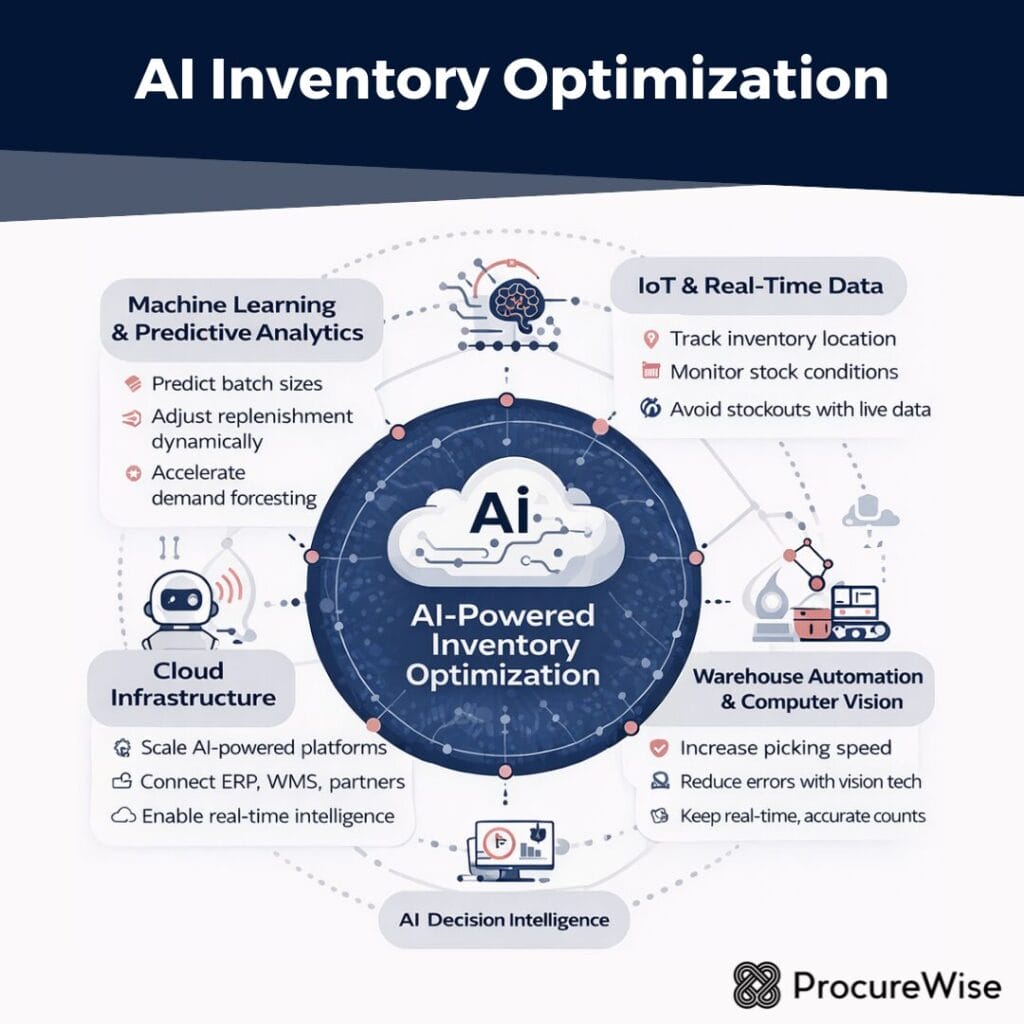
Breakthrough AI inventory optimization strategies would not be possible without a strong technological backbone. In 2026, competitive advantage comes from combining advanced machine learning, real-time data, and intelligent automation into one coherent inventory management ecosystem. These technologies transform raw data into precise, actionable decisions across the supply chain.
Advanced Machine Learning & Neural Networks 🤖
Modern machine learning models—especially neural networks and deep learning architectures—excel at identifying non-linear demand patterns that traditional forecasting cannot detect. These models continuously adapt to demand trends, promotional effects, and external market signals.
Reinforcement learning further enhances inventory optimization by allowing systems to evaluate replenishment decisions over time. The result is optimized reorder points, balanced inventory levels, and reduced excess inventory without sacrificing service levels.
Real-Time Data & Internet of Things (IoT) Integration 🌐
High-performing AI inventory management depends on real-time data. Internet of Things (IoT) devices—such as RFID tags, smart shelves, GPS trackers, and IoT sensors—deliver continuous updates on inventory location, quantity, and condition.
This real-time inventory tracking eliminates blind spots in warehouses and in transit. AI systems instantly respond to deviations, preventing stockouts and minimizing inventory carrying costs while improving overall supply chain efficiency.
Computer Vision & Warehouse Automation 👁️
Computer vision enables AI to visually identify, count, and verify inventory using cameras and image recognition. This technology automates cycle counting, damage detection, and SKU identification with high accuracy.
When combined with warehouse automation, such as robotics and autonomous guided vehicles, computer vision accelerates fulfillment while maintaining precise inventory levels. The outcome is faster operations, reduced manual errors, and more reliable inventory data feeding AI models.
AI-Powered Analytics & Decision Intelligence 📊
Advanced predictive analytics engines generate massive volumes of insights, but value is unlocked only when humans can act on them. AI-powered dashboards translate complex outputs into intuitive visuals—forecast accuracy, service-level risks, excess inventory alerts, and replenishment recommendations.
Decision frameworks embedded within these platforms guide planners toward optimal actions, bridging the gap between advanced AI and everyday inventory management decisions.
Cloud Infrastructure & Scalable Inventory Platforms 🔗
Cloud-based inventory management platforms provide the scalability and processing power required for real-time AI execution. They enable seamless integration across ERP, WMS, suppliers, and logistics partners.
This flexibility allows organizations to expand AI capabilities across regions and business units without rebuilding systems—creating a unified, future-ready foundation for supply chain optimization.
🧩Human–AI Synergy and the Future of Inventory Optimization 🧩
As AI inventory optimization accelerates in 2025, success is no longer defined by technology alone. True transformation emerges from a balanced collaboration between intelligent systems and human expertise. Organizations that master this synergy will lead the next era of supply chain efficiency, resilience, and customer-centricity.
From Inventory Managers to Strategic Orchestrators 🤝
AI does not replace humans—it elevates them. Routine tasks such as manual forecasting, static reorder point management, and exception handling are increasingly automated. In response, inventory professionals evolve into strategic orchestrators who interpret AI insights, manage edge cases, and align inventory decisions with broader business goals.
This shift strengthens supply chain management by combining machine precision with human judgment, creativity, and contextual awareness—especially in high-impact decisions involving service levels and customer experience.
Building a Structured AI Adoption Framework 🧭
Successful AI inventory management starts with data readiness—clean, integrated, and real-time. Organizations then deploy targeted pilot projects focused on measurable wins such as reducing excess inventory or improving demand forecasting accuracy.
A phased rollout ensures minimal disruption while building trust in AI-driven decisions. Training, change management, and cross-functional alignment are critical to unlocking long-term gains in inventory optimization and supply chain efficiency.
⚖Responsible AI & Ethical Inventory Management ⚖️
As AI influences replenishment planning, supplier selection, and customer availability, ethical considerations become essential. Transparent algorithms, bias monitoring, and responsible data usage protect both brand trust and operational integrity.
Organizations that invest in ethical AI also invest in workforce reskilling—ensuring employees grow alongside intelligent systems rather than being displaced by them.
Preparing for Autonomous Supply Chains 🚀
The future points toward autonomous supply chains, where AI systems dynamically manage inventory levels, replenishment, and network flows with minimal human intervention. Powered by real-time data, machine learning, and continuous feedback loops, these systems adapt instantly to demand fluctuations and disruptions.
In this model, humans define strategy and governance, while AI executes and optimizes at scale—unlocking unprecedented speed, accuracy, and resilience.
🌍 Conclusion: Beyond Automation Starts Now 🌍
The shift beyond automation marks a defining moment for inventory management in 2026. Advanced AI-powered inventory optimization enables organizations to reduce stockouts, minimize excess inventory, and protect service levels—while transforming inventory into a strategic growth engine.
By combining intelligent technologies, cloud-based platforms, and human expertise, businesses can build agile, resilient, and future-ready supply chains. Those who act now will not only optimize inventory—they will redefine how value is created in an increasingly unpredictable world.