

Are you struggling to optimize your content for search engines and attract more organic traffic to your website? SEO content writing is essential for improving your website’s visibility and ranking on search engine results pages.
To master SEO content writing, you need to understand the best practices and strategies that will help you create high-quality, keyword-rich content that appeals to both search engines and your target audience. From conducting keyword research to optimizing meta tags and creating engaging, informative content, there are many aspects to consider.
In this guide, we’ll provide you with tips and strategies to help you master SEO content writing and effectively optimize your content for search engines. Whether you’re a beginner looking to improve your skills or an experienced writer seeking to enhance your SEO knowledge, this guide will help you take your content to the next level. Read more Most effective types of content marketing
❓What is SEO writing❓
SEO (Search Engine Optimization) writing is a crucial aspect of digital marketing that involves creating content optimized for search engines. Its primary objective is to drive organic traffic to a website and help achieve business goals. By strategically incorporating keywords and phrases into the content, SEO writing aims to improve a website’s visibility in search engine results pages (SERPs).
📌 The process of SEO writing begins with keyword research, where writers identify relevant keywords and phrases that are commonly used by their target audience. This research helps in understanding user intent and crafting content that meets their needs effectively. Once the keywords are determined, the writer creates high-quality content that incorporates these keywords naturally and provides value to the readers.
📌 Additionally, optimizing headers plays a significant role in SEO writing. Headers help search engines understand the structure and relevance of the content. By including keywords in headers, writers can improve search engine rankings and make it easier for users to find the information they are looking for.
Overall, SEO writing is essential in attracting organic traffic to a website, increasing its visibility, and ultimately achieving the desired business objectives. By focusing on keyword research, creating high-quality content, and optimizing headers, businesses can improve their online presence and drive more targeted traffic to their websites.
Take advantage of our content marketing services now!
⚠️ Why is SEO content writing important? ⚠️
SEO content writing plays a crucial role in improving website traffic, visibility, and organic rankings. By incorporating relevant keywords and quality content, websites can attract more visitors and rank higher on search engine results pages (SERPs).
➡️ Keywords are an essential component of SEO content writing. They help search engines identify the relevance of a webpage to user queries. By strategically including keywords in website content, businesses can increase their visibility and attract more organic traffic. Additionally, keyword research allows businesses to discover valuable insights into customer behavior, preferences, and trends.
➡️ However, simply stuffing content with keywords is not enough. Quality content is equally important. Websites that offer informative, engaging, and valuable content are more likely to be shared and linked to by others, ultimately boosting their visibility and credibility. Moreover, high-quality content enhances user experience, leading to increased user engagement, longer page dwell times, and lower bounce rates. These factors positively impact organic rankings.
In conclusion, SEO content writing is crucial for improving website traffic, visibility, and organic rankings. By utilizing keywords effectively and providing high-quality content, businesses can attract more visitors, increase their search engine rankings, and achieve long-term success in the digital landscape.
📜 The basics of SEO content writing 📜
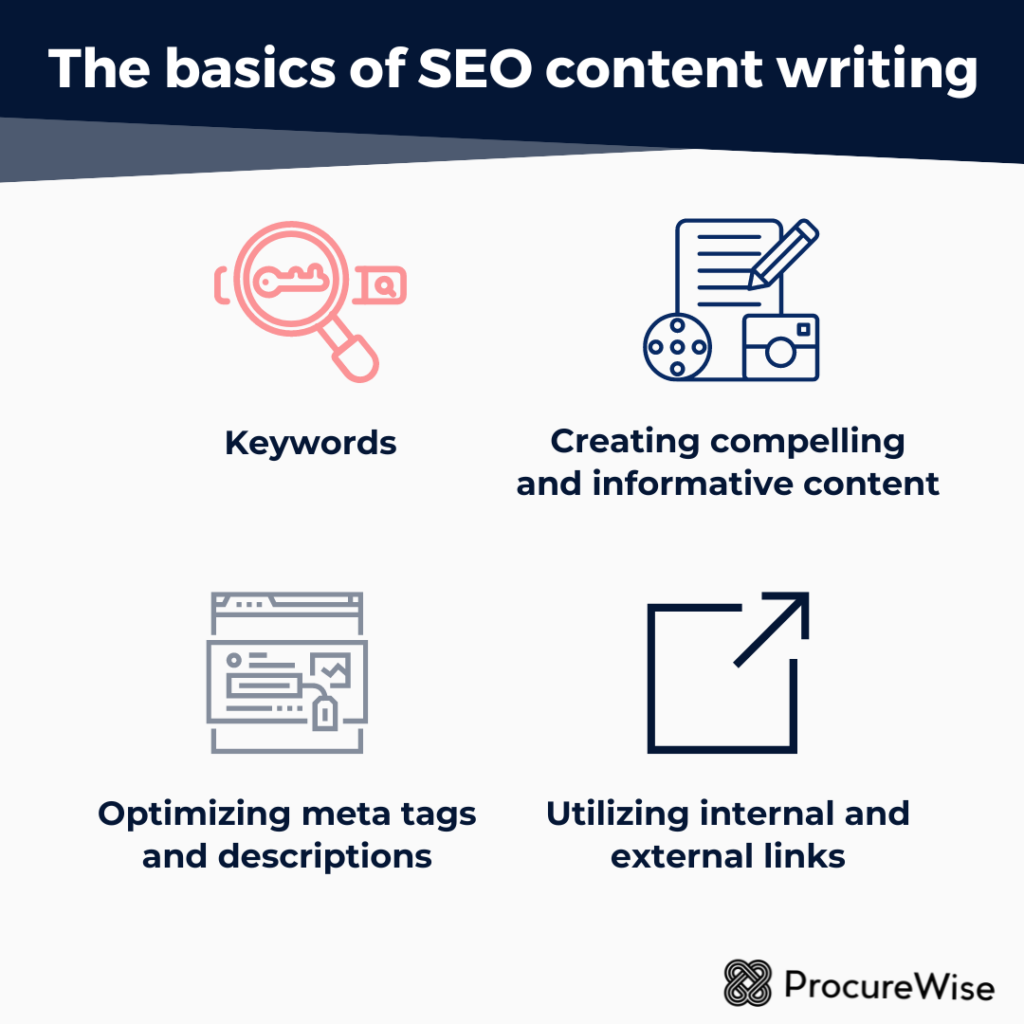
SEO content writing is the practice of producing high-quality, informative, and engaging content that is optimized to rank well in search engine results. It involves strategically using keywords in a natural and relevant way, creating high-quality and valuable content, optimizing meta tags and descriptions, and utilizing internal and external links.
👉 Keywords: By identifying and incorporating relevant keywords into the content, it becomes easier for search engines to understand what the content is about and to rank it accordingly. This helps in driving organic traffic to the website.
👉 Creating compelling and informative content: By providing valuable information and addressing the needs of the target audience, it increases engagement and encourages visitors to spend more time on the website. This also increases the chances of them coming back for more.
👉 Optimizing meta tags and descriptions: These elements provide a summary of the content to search engines and potential visitors. By writing compelling and keyword-rich meta tags and descriptions, it increases the click-through rate and improves the website’s visibility in search engine results.
👉 Utilizing internal and external links: Internal links help search engines understand the structure and hierarchy of the website, while external links add credibility and authority to the content. Both types of links contribute to better search engine rankings and improved online visibility.
In summary, SEO content writing is vital for enhancing online visibility and effectively engaging with the target audience. By strategically incorporating keywords, creating valuable content, optimizing meta tags and descriptions, and utilizing internal and external links, it helps in driving organic traffic and improving search engine rankings.
👤 What is an SEO copywriter? 👤
An SEO copywriter is a professional who specializes in creating written content that is optimized for search engines. Their primary role is to write high-quality, informative, and engaging content that not only appeals to readers but also meets SEO best practices.
✏️ The responsibilities of an SEO copywriter extend beyond just writing content. They also need to have a solid understanding of SEO techniques and be able to implement these strategies effectively. This involves conducting keyword research, optimizing meta tags and headers, and incorporating internal and external links.
✏️ In addition to their expertise in implementing SEO best practices, SEO copywriters also have a deep understanding of various types of copy. They are skilled in writing web copy, blog posts, articles, product descriptions, and social media posts. They know how to tailor their writing to the specific format and style requirements of each platform.
✏️ The main focus of an SEO copywriter is to drive website traffic and convert leads. By creating optimized content, they aim to improve a website’s visibility in search engine results pages (SERPs), attract more organic traffic, and ultimately increase conversions.
The key difference between an SEO copywriter and a traditional content writer is the focus on SEO best practices. While both types of writers may have similar skills in writing well-crafted content, an SEO copywriter specifically crafts content with the intention of driving organic traffic to a website. They work closely with a content team to ensure that the overall content strategy aligns with SEO goals and objectives.
📢 10 Must-Follow SEO Writing Rules 📢
SEO writing is an essential practice to optimize content for search engines while keeping the human audience engaged. To achieve this, there are 10 must-follow SEO writing rules:
1️⃣ Write for humans first: Prioritize writing high-quality, engaging content that resonates with readers. Remember, search engines aim to deliver valuable content to users.
2️⃣ Understand SEO writing goals: Comprehend the purpose of SEO writing, which is to improve visibility and ranking in search engine results pages (SERPs).
3️⃣ Use targeted key phrases strategically: Identify relevant key phrases that align with the content’s topic and incorporate them naturally in critical areas such as titles, headings, meta descriptions, and throughout the text.
4️⃣ Avoid excessive keyword usage: Overstuffing keywords can lead to a poor user experience and penalties from search engines. Maintain a balance between optimizing content and keeping it reader-friendly.
5️⃣ Create valuable and shareable content: Craft informative, well-researched, and comprehensive articles that readers find useful and are likely to share with others, enhancing your website’s visibility.
6️⃣ Optimize meta tags: Optimize title tags and meta descriptions to accurately represent the content, grab users’ attention, and improve click-through rates (CTR).
7️⃣ Implement proper formatting: Organize your content using headings, subheadings, bullet points, and paragraphs to enhance readability and make it more attractive to search engines.
8️⃣ Optimize page load speed: Improve website performance by optimizing images, enabling browser caching, and reducing unnecessary plugins, as faster load times positively impact SEO and user experience.
9️⃣ Optimize for mobile devices: Ensure your content is mobile-friendly, responsive, and easily accessible on different devices, as mobile-friendliness is a crucial ranking factor.
🔟 Regularly update and improve content: Stay relevant by regularly updating articles, fixing broken links, and enhancing information to provide users with the most current and reliable content possible.
By adhering to these SEO writing rules, you can achieve a balance between optimizing content for search engines and creating valuable and engaging material for human readers.

💎 Tips on How To Incorporate SEO in Your Writing 💎
When it comes to incorporating SEO in your writing, there are several tips that can help improve your visibility in search engine results pages (SERPs).
✔️ Firstly, keyword research is essential. By identifying the right keywords, you can target the specific terms that your audience is searching for. Use these keywords strategically throughout your content, including in headings and subheadings.
✔️ Optimizing your content for featured snippets is another effective way to boost your SEO. Featured snippets are concise summaries of information that appear at the top of SERPs. Create content that directly answers common questions, and structure it in a way that makes it easy for search engines to extract the relevant information for featured snippets.
✔️ While it’s important to incorporate keywords, it’s equally essential to write for humans, not just search engines. Focus on providing valuable and engaging content that appeals to readers. This will not only improve user experience but also increase your chances of earning backlinks and social shares.
✔️ Lastly, optimize your title and include relevant keywords in your meta description. These elements play a crucial role in convincing users to click on your content in search results. By following these tips, you can effectively incorporate SEO into your writing to improve your online visibility and reach a wider audience.sw