

In today’s fast-paced retail environment, staying competitive requires more than instinct and traditional practices; it demands data-driven strategies. Market data scraping has emerged as a pivotal tool for modern category and price management, giving businesses the insights they need to make informed decisions.
At its core, market data scraping involves the automated extraction of data from online sources, allowing companies to gather information about competitor pricing, product assortments, customer reviews, and more. This data can be invaluable for category managers, as it enables them to adjust their strategies quickly in response to market trends and shifts in consumer behavior.
One of the primary advantages of market data scraping is its ability to provide real-time or near-real-time data. This immediacy allows businesses to react swiftly to price changes by competitors or to detect emerging market trends before they become mainstream. As a result, companies can optimize pricing strategies, adjust category offerings, and enhance their overall competitive positioning.
However, to fully leverage the benefits of market data scraping, it’s essential to integrate the insights gathered into a comprehensive category and price management strategy. This integration ensures that the data isn’t just collected but actively informs decision-making processes across different levels of the organization.
Join us as we explore the transformative role of market data scraping and how it can elevate your category and price management to new heights.
🚀 Unlock Smarter Category & Price Management: The Power of Market Data Scraping 🚀
The global eCommerce market is evolving at lightning speed. With online sales projected to hit $7.5 trillion by 2025, retailers are operating in an environment defined by constant change, fierce competition, and increasingly informed customers. In this landscape, category management and pricing strategy can no longer rely on intuition or static reports. What separates market leaders from the rest is their ability to leverage market data scraping to make faster, smarter, and more profitable decisions.
Market data scraping has become the backbone of pricing intelligence, competitive intelligence, and modern category management, enabling companies to act on real-time insights instead of lagging indicators.
🔍 The Ever-Shifting eCommerce Landscape 🔍
Today’s digital marketplace is anything but stable. Prices change multiple times a day, competitors launch new products overnight, and customer sentiment can shift instantly based on reviews or promotions. Static pricing models and manual monitoring simply cannot keep up.
Key forces shaping this volatility include:
- Dynamic pricing across competitor websites
- Rapid changes in market trends and customer behavior
- Easy access to customer reviews and price comparisons
- Constant product launches and seasonal promotions
To survive and scale, retailers must continuously monitor web pages, competitor prices, inventory levels, and customer sentiment — all in near real time.
🧠 The Imperative for Smarter Category & Price Management 🧠
“Smarter” management means moving from reactive decisions to data-driven, predictive strategies. Instead of asking what just happened?, leading organizations ask what will happen next?
This shift requires:
- Continuous access to market data
- Automated data extraction instead of manual work
- The ability to react instantly to competitor price changes
- A structured approach to turning raw data into insights
Traditional market research cannot deliver this speed or depth. That’s why real-time data scraping has become a strategic necessity rather than a technical nice-to-have.
⚙️ How Market Data Scraping Transforms Strategy ⚙️
Market data scraping automates the collection of publicly available information from competitor websites, marketplaces, and online platforms. It fuels both pricing engines and category management systems with accurate, up-to-date data.
With scraping, businesses can:
- Track competitor prices and promotions at scale
- Monitor dynamic content such as availability and discounts
- Analyze customer reviews and sentiment signals
- Identify emerging market trends and product categories
Over 80% of top online retailers already scrape competitor data daily — not for curiosity, but because it directly impacts margins, conversions, and positioning.
📊 What Is Market Data Scraping — and Why It Matters 📊
At its core, market data scraping is the automated process of collecting information from web pages by analyzing their HTML structure or rendered dynamic content. Unlike manual checks, scraping works at scale and speed.
Scraped data often includes:
- Prices and discounts
- Product descriptions and categories
- Inventory levels
- Reviews and ratings
- Promotional mechanics
This raw data is then transformed into structured data (for example JSON) that can be fed into analytics tools, pricing engines, or machine learning models via API integration.
The result? A continuous stream of reliable market intelligence that powers smarter decisions across the organization.
💡 From Data to Decisions: Pricing Intelligence Powered by Scraping 💡
Modern pricing is no longer about simple price matching. In an environment driven by dynamic pricing, constant promotions, and instant customer comparison, pricing must be context-aware, real-time, and predictive. This is where market data scraping becomes the engine behind truly intelligent pricing decisions.
By continuously collecting competitor prices, promotions, and availability from thousands of web pages, companies gain a live view of the market — not a snapshot from last week.
⚖️ Competitive Pricing Analysis: Seeing the Whole Market ⚖️
Scraping enables a 360-degree view of competitor pricing across channels, regions, and product categories. Instead of tracking a handful of rivals manually, retailers can monitor entire markets automatically.
Key benefits include:
- Continuous tracking of competitor prices and discounts
- Visibility into competitor promotions and bundles
- Identification of pricing gaps and positioning opportunities
- Support for pricing intelligence dashboards
This level of insight allows pricing teams to move beyond reactive decisions and design strategies aligned with real market conditions.
⚡ Dynamic Pricing in Real Time ⚡
Dynamic pricing relies on speed. When a competitor changes a price, launches a promotion, or runs low on inventory, delays can directly impact conversion and margin.
With real-time data scraping, pricing engines can react instantly by:
- Adjusting prices based on competitor moves
- Responding to changes in inventory levels
- Aligning prices with demand signals
- Supporting automated pricing engines
Retailers using dynamic pricing report conversion increases of 5–15%, driven by better price relevance and timing.
🔮 Predictive Pricing: Anticipating Market Shifts 🔮
Scraped historical data unlocks predictive power. By analyzing past pricing behavior, promotions, and seasonality, companies can forecast what’s likely to happen next.
Predictive pricing enables:
- Anticipation of competitor discounts
- Smarter planning of seasonal promotions
- Better margin control during demand spikes
- Proactive instead of reactive pricing decisions
When combined with machine learning and AI models, predictive pricing transforms pricing from a tactical function into a strategic advantage.
🧩 From Raw Web Data to Structured Pricing Signals 🧩
Pricing intelligence depends on clean, reliable inputs. Scraped data — often messy and unstructured — must be standardized before it fuels decisions.
This process includes:
- Parsing HTML structure and dynamic content
- Normalizing currencies, units, and product names
- Validating accuracy through data validation
- Delivering structured data to pricing systems
Through API integration, this data flows directly into pricing tools, dashboards, and automated pricing engines without manual intervention.
🎯 Why Smarter Pricing Starts with Scraping 🎯
Smarter pricing is not about lowering prices — it’s about pricing with intent. Market data scraping provides the foundation for:
- Confident pricing decisions
- Faster reactions to market changes
- Stronger competitive positioning
- Sustainable margin optimization
Without real-time market data, even the most advanced pricing algorithms operate in the dark.
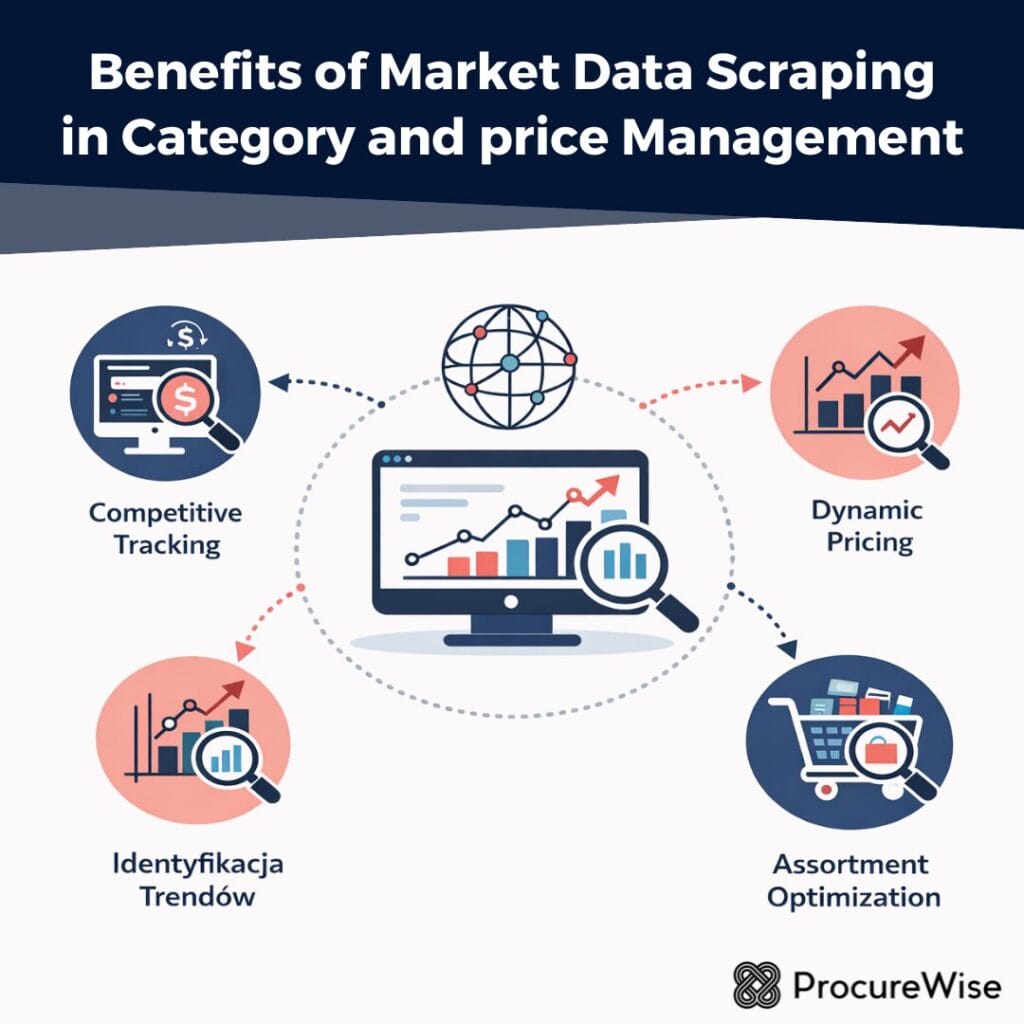
🧩 Smarter Category Management Through Market Data Scraping 🧩
While pricing often gets the spotlight, category management is where long-term competitive advantage is built. Deciding what to sell, how to present products, and when to expand or reduce assortments requires a deep, continuous understanding of the market. Market data scraping turns category management from a reactive discipline into a proactive, insight-driven process.
By monitoring competitor websites and marketplaces, retailers gain visibility into product categories, assortment strategies, and evolving customer expectations — all in real time.
🛒 The Digital Shelf: Assortment & Listing Optimization 🛒
The digital shelf is your virtual storefront. Scraping competitor product descriptions, categories, and listings reveals how products are positioned and which attributes matter most.
Category teams can use this data to:
- Identify assortment gaps and oversaturated categories
- Benchmark product descriptions and feature sets
- Optimize naming, attributes, and keywords for SEO
- Improve visibility across search and category pages
This intelligence ensures your assortment remains relevant, competitive, and aligned with current market trends.
🧠 Understanding Customer Behavior & Sentiment 🧠
One of the richest data sources online is customer reviews. Scraping reviews across platforms allows businesses to systematically analyze what customers actually think — at scale.
Insights unlocked include:
- Customer sentiment toward products and brands
- Recurring pain points and unmet needs
- Feature preferences driving purchase decisions
- Signals of declining or rising demand
When paired with natural language processing, review data becomes a powerful input for both category planning and product improvement.
🚀 Product Launches & Lifecycle Intelligence 🚀
Timing is critical in retail. Scraping data on product launches, pricing changes, and competitor activity provides a clearer view of when categories are heating up — or cooling down.
This enables:
- Better launch timing based on competitor activity
- Early detection of fast-growing categories
- Smarter end-of-life decisions for declining products
- Alignment of pricing and promotions with lifecycle stage
Instead of guessing, category managers act on live market intelligence.
📦 Inventory Signals & Market Availability 📦
Scraping inventory levels and stock availability across competitor websites offers valuable context for category decisions.
Use cases include:
- Identifying market-wide stockouts
- Supporting price increases during low supply
- Avoiding overstock in declining categories
- Improving replenishment planning
These insights connect category management directly with pricing and supply chain strategy.
🎯 From Static Categories to Living Strategies 🎯
Traditional category management relies on periodic reviews and historical sales data. Market data scraping introduces a living view of the category — constantly updated, market-driven, and customer-informed.
With continuous access to:
- Market data
- Competitor assortments
- Customer sentiment
- Inventory dynamics
Category managers gain the confidence to adapt faster and plan smarter.
🤖 The “Smarter” Layer: Turning Market Data into Action 🤖
Collecting data is only the beginning. The real competitive advantage emerges when market data scraping is combined with automation, analytics, and advanced intelligence. This “smarter” layer transforms raw market signals into decisions that scale across pricing, category management, marketing, and sales.
At this stage, data stops being descriptive and becomes decisive.
🧠 AI & Machine Learning as Force Multipliers 🧠
When large volumes of scraped market data are processed by machine learning models, patterns emerge that humans would never detect manually.
AI-powered use cases include:
- Demand forecasting across product categories
- Identifying price elasticity by segment
- Detecting early signals of changing market trends
- Optimizing predictive pricing strategies
Modern AI models enable retailers to shift from reacting to the market to anticipating it — often days or weeks ahead.
🔄 Automation & API Integration at Scale 🔄
To be truly effective, scraped data must flow seamlessly into existing systems. This is where API integration plays a critical role.
Through APIs, businesses can:
- Feed data directly into pricing engines
- Sync category insights with BI and analytics tools
- Trigger automatic price updates from scraping outputs
- Eliminate manual data handling and errors
This integration ensures real-time insights are available exactly where decisions are made.
⚙️ Operational Intelligence for Pricing & Categories ⚙️
With automation in place, both pricing and category teams benefit from a unified intelligence layer.
This enables:
- Continuous competitive intelligence monitoring
- Faster reaction to dynamic pricing signals
- Smarter assortment adjustments
- Better alignment between pricing, marketing, and inventory
What once required days of analysis can now happen in minutes — or automatically.
🛡️ Data Quality, Validation & Responsible Scraping 🛡️
Advanced strategies still depend on trust in the data. Ensuring quality and compliance is non-negotiable.
Best practices include:
- Data validation to catch anomalies
- Normalization of structured data across sources
- Respect for website terms and ethical scraping rules
- Monitoring changes in HTML structure and dynamic content
High-quality data is the foundation of every intelligent system built on top of scraping.
🏆 Building a Sustainable Competitive Advantage 🏆
When combined, market data scraping, AI, and automation form a powerful intelligence ecosystem. This ecosystem supports:
- Smarter pricing decisions
- Stronger category strategies
- More effective marketing
- Higher profitability and resilience
In a world where markets change by the hour, the winners are those who see clearly, decide faster, and act smarter.
🚀 Final Takeaway 🚀
Unlocking smarter category & price management is no longer about having more data — it’s about having the right data at the right time. Market data scraping provides that foundation, enabling businesses to evolve from reactive operators into predictive, market-driven leaders.
Those who invest in this intelligence today won’t just keep up with the market — they’ll define it.