

Procurement fraud is a significant concern for many businesses, with the potential to result in financial losses and damage to reputation. Fortunately, AI solutions are now available to help detect and prevent procurement fraud. These solutions leverage advanced algorithms and machine learning capabilities to analyze vast amounts of data and identify patterns indicative of fraudulent activity.
By implementing AI-powered procurement fraud solutions, organizations can proactively monitor their procurement processes, flag suspicious transactions, and take appropriate action to mitigate risks. In this guide, we will explore how AI solutions work to combat procurement fraud, the benefits they offer, and some key considerations for selecting the right solution for your business. Let’s dive in and learn more about the power of AI in fighting procurement fraud. Read more Digital transformation in procurement
❓How AI can help the fight against procurement fraud❓
AI can play a crucial role in detecting and preventing procurement fraud by providing advanced tools and techniques for data analysis, pattern detection, and staying ahead of fraudsters. This article will explore the various ways in which AI can be utilized in the fight against procurement fraud, while ensuring transparency, efficiency, and integrity in the process.
➡️ One of the key advantages of AI-powered tools is their ability to analyze large volumes of data in real-time. By using machine learning algorithms, these tools can automatically process and extract valuable insights from financial transactions, vendor data, and other procurement-related information. This enables organizations to identify patterns and anomalies that may indicate fraudulent activities, such as duplicate invoices, overbilling, or suspicious vendor relationships.
➡️ AI can also help in staying ahead of fraudsters by continuously monitoring and analyzing procurement data. By using predictive analytics, organizations can identify potential fraud risks and take proactive measures to prevent them. For example, AI-powered tools can flag unusual purchasing behavior, identify high-risk vendors, and detect changes in invoice patterns. This enables organizations to intervene promptly and mitigate the risk of fraud before it occurs.
➡️ Furthermore, AI-powered tools can enhance transparency and integrity in the procurement process by automating auditing and verification procedures. Machine learning algorithms can evaluate procurement data against predefined rules and policies, ensuring that all transactions comply with the established guidelines. This reduces the risk of human error and increases the efficiency of fraud detection.
➡️ To implement AI-powered tools effectively, organizations need to invest in robust data analytics platforms and integrate them with their existing procurement systems. These platforms should have the capability to process large volumes of data, apply complex algorithms for pattern detection, and provide real-time insights for fraud prevention. Additionally, organizations should also focus on training and upskilling their procurement teams to leverage the full potential of AI tools.
AI provides powerful tools and techniques for detecting and preventing procurement fraud. By leveraging AI-powered tools, organizations can analyze data, identify patterns and anomalies, and stay ahead of fraudsters. This not only enhances transparency and integrity in the procurement process but also enables organizations to proactively mitigate the risk of fraud.
Take advantage of our services AI in procurement now!
📚 What are the types of fraud AI detect? 📚
Fraud detection is a critical aspect of modern businesses, as it helps safeguard against financial losses and reputational damage. With advancements in technology, artificial intelligence (AI) has emerged as a powerful tool in detecting and preventing various types of fraud. AI systems are capable of analyzing vast amounts of data, identifying patterns, and detecting anomalies that may indicate fraudulent activity. Let us explore the types of fraud that AI can effectively detect in fraud detection.
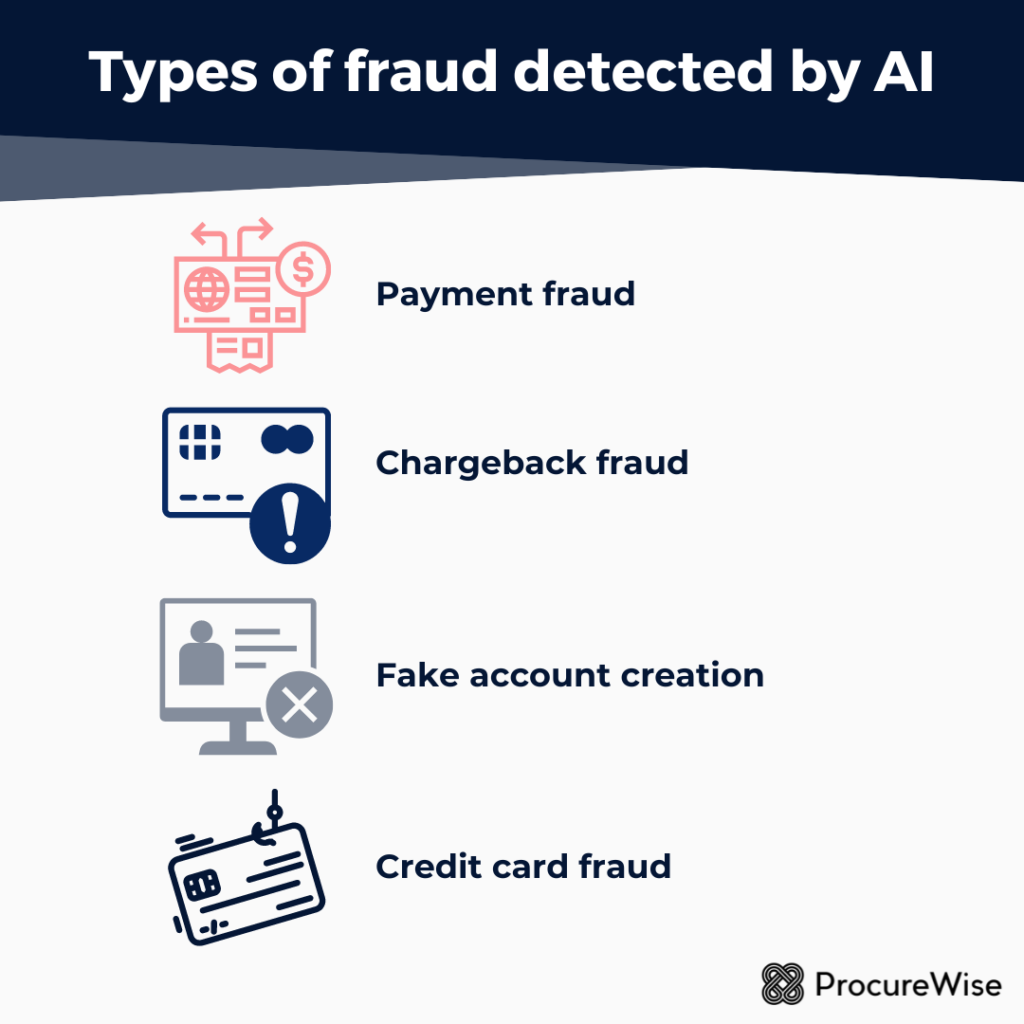
📌 Payment fraud: AI can detect fraudulent transactions in real-time by analyzing various factors such as transaction amount, location, timing, and user behavior. For example, if a customer suddenly makes a large purchase in a different country from their usual spending patterns, AI can raise an alert and flag it as potential payment fraud.
📌 Chargeback fraud: Chargebacks occur when customers dispute a credit card transaction, claiming that it was unauthorized or that they did not receive the product or service. AI can analyze customer behavior, purchase history, and transaction details to identify suspicious patterns associated with chargeback fraud. This can include frequent chargebacks, high-value items being frequently disputed, or multiple chargebacks from the same individual.
📌 Fake account creation: AI models can detect fraudulent account creation by analyzing user data, behavior patterns, and network information. For example, if an unusually high number of accounts are created from the same IP address or device, AI can flag it as potential fake account creation. Additionally, AI can analyze user interactions and identify suspicious activities such as automated account creation or unusual activity patterns.
📌 Credit card fraud: By leveraging AI’s machine learning algorithms, payment service providers can detect credit card fraud in real-time. AI models can analyze various factors such as spending patterns, transaction frequency, and geographic location to identify potential fraudulent activities. For instance, if a credit card is used for multiple high-value transactions within a short period or transactions made in locations far apart, AI can flag it as suspicious activity.
AI has revolutionized fraud detection by enabling businesses to identify and prevent various types of fraud effectively. From payment fraud and chargeback fraud to fake account creation and credit card fraud, AI’s ability to analyze large amounts of data and detect patterns makes it a valuable tool in combating fraudulent activities. Implementing AI-based fraud detection systems can better protect businesses and their customers from financial losses while ensuring a secure and trustworthy environment for transactions.
🥊 What are the challenges of using AI in fraud detection? 🥊
AI in fraud detection is increasingly popular due to its ability to analyze large data sets and identify suspicious patterns. However, there are significant challenges affecting its effectiveness:
💥 Black Box Issue: AI algorithms often operate as black boxes, making their decision-making process opaque. This lack of transparency raises concerns about accountability and trust, complicating efforts to ensure AI systems are accurate and fair. Organizations and regulators may struggle to understand and justify AI-driven fraud detection outcomes, hindering adoption.
💥 Non-Digital Threats: AI is adept at detecting online fraud, such as credit card fraud or identity theft, but less effective against non-digital fraud like insider trading, bribery, or money laundering involving human interactions or physical documents. This limitation can leave certain fraudulent activities undetected.
These challenges impact the effectiveness of AI in fraud detection. The black box issue can discourage trust and adoption, while the ineffectiveness against non-digital threats creates vulnerabilities. To address these limitations, organizations should combine AI with traditional fraud detection methods to ensure comprehensive protection.
While AI shows promise in fraud detection, challenges like transparency and non-digital threat detection need to be addressed. Overcoming these issues is crucial for fully leveraging AI’s potential and safeguarding against fraud.
✅ What are the benefits of AI in fraud detection? ✅
Artificial intelligence (AI) has revolutionized various industries, and fraud detection is no exception. The benefits of using AI in fraud detection are numerous and can greatly enhance the efficiency and accuracy of fraud detection systems.
🦾 Ability to provide fast and efficient solutions: Traditional methods of fraud detection involve manual review processes that are time-consuming and often prone to errors. On the other hand, AI algorithms can analyze vast amounts of data in real-time, quickly identifying patterns and anomalies that may indicate fraudulent activities. This allows for immediate action to be taken to prevent further damage.
🦾 Reducing manual review time: With the use of AI algorithms, large volumes of data can be analyzed and processed within seconds, eliminating the need for human intervention in routine fraud detection tasks. This frees up valuable time for fraud analysts to focus on more complex cases that require their expertise, thereby improving the overall efficiency of the detection process.
🦾 Enabling better predictions: By analyzing historical data and identifying patterns, AI algorithms can better predict and detect fraudulent activities. As fraudsters constantly evolve their techniques, AI algorithms can adapt and learn from new patterns, ensuring that fraud detection systems stay ahead of potential threats.
🦾 Processing of larger datasets: In traditional methods, the amount of data that could be analyzed was limited due to human limitations in terms of time and capacity. AI algorithms, however, can handle vast amounts of data, allowing for more comprehensive analysis and a deeper understanding of fraud patterns. This leads to more accurate and reliable detection of fraudulent activities.
🦾Cost-effectiveness: While initial investment and development costs may be involved, the long-term benefits outweigh the expenses. By automating manual processes and improving overall efficiency, AI reduces operational costs associated with fraud detection. Moreover, the ability to detect and prevent fraud in real-time can save organizations from significant financial losses.
The benefits of AI in fraud detection are far-reaching. AI provides fast and efficient solutions, reduces manual review time, enables better predictions, processes larger datasets, and is cost-effective. Incorporating AI into fraud detection systems can greatly enhance the accuracy and efficiency of detecting and preventing fraudulent activities, making it an invaluable tool in today’s increasingly digital world.

🔒 Fraud and risk protection by AI in procurement 🔒
AI has revolutionized fraud and risk protection in procurement by enabling organizations to detect and prevent fraudulent activities more effectively. Here are the key benefits:
👉 Real-Time Data Analysis: AI rapidly processes vast amounts of data, identifying suspicious trends and anomalies that manual methods might miss. This proactive approach allows organizations to address potential fraud risks before they escalate.
👉 Cost Savings: AI detects and prevents fraudulent activities like inflated prices and kickbacks, helping organizations avoid significant financial losses.
👉 Deterrent Effect: The presence of AI monitoring can deter potential fraudsters, fostering a culture of compliance and discouraging fraudulent behavior.
👉 Adaptability: AI systems continuously learn from past fraud cases, adapting to new and emerging fraud schemes, ensuring organizations stay ahead of evolving tactics.
👉 Minimized False Positives/Negatives: AI fine-tunes fraud detection, reducing unnecessary investigations (false positives) and undetected fraud (false negatives), enhancing overall accuracy.
👉 Enhanced Transparency and Efficiency: AI automation ensures consistent, unbiased fraud detection, with detailed audit trails that increase transparency and accountability. This strengthens risk management and improves procurement efficiency.
Leveraging AI in procurement fraud detection provides significant advantages, including real-time data analysis, cost savings, deterrence, adaptability, accuracy, transparency, and efficiency. As fraud risks evolve, implementing AI is crucial for organizations to mitigate these risks and protect their resources effectively.