

Scraping data, also known as web scraping, is the process of automatically extracting information from the internet. In times when access to large datasets is becoming crucial for understanding market trends and making business decisions, data scraping offers many opportunities for companies and analysts.
It enables the collection of up-to-date data without the need to manually browse through websites. This way, one can quickly gain access to information about competitors, pricing trends, consumer opinions, and also monitor changes in the market. Data scraping, when used ethically and in compliance with legal regulations, can significantly increase a company’s competitive advantage.
When applied correctly and within the law, scraping becomes an invaluable support tool in market analysis, increasing the effectiveness of marketing and strategic activities. In this article, we present detailed information about data scraping techniques and show how they can be used to build valuable market insights. Let’s dive into the fascinating world of data scraping and discover the benefits it can bring to your business.
🔎 Differences between Web Scraping and Web Crawling 🔎
Web scraping and web crawling are two terms often used in the context of processing online data, but while they are related, they represent different operations.
➡️ Web crawling, also known as indexing, is the process of automatically browsing the internet by programs called crawlers or bots. Their main purpose is to identify and download data from various websites in order to build an updated index of content available on the web. Crawlers move through websites by following links, collecting information about page structure and content—usually to feed search engines like Google or Bing.
➡️ Web scraping, on the other hand, refers to the technique of extracting specific data from one or more websites. Unlike crawling, which focuses on exploring the entire web, scraping aims to retrieve precise information, such as contact details, product prices, or reviews, from clearly identified sources. Scraping often requires more detailed data structure analysis, using tools like BeautifulSoup or Scrapy.
In summary, the main difference between web scraping and web crawling lies in their purpose and scope. Crawling is about broad data collection across the internet, while scraping focuses on extracting specific information from selected websites. Both processes can complement each other and together contribute to efficient data acquisition and analysis.
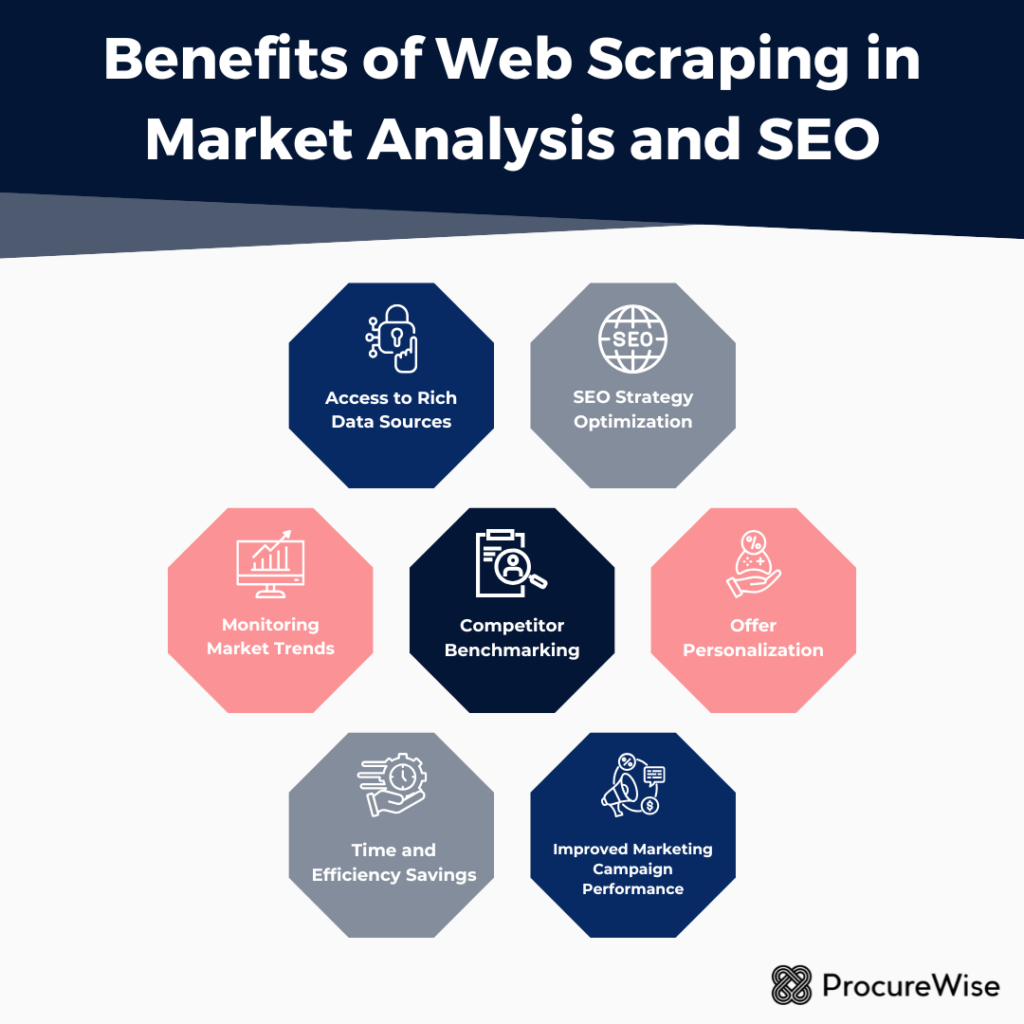
✅ Benefits of Web Scraping in Market Analysis and SEO ✅
✔️ Access to Rich Data Sources: Web scraping enables companies to collect vast amounts of data from diverse online sources. This provides market analysts with insights into market dynamics, consumer preference shifts, and competitor activities. The collected data can serve as the foundation for more informed business decisions.
✔️ SEO Strategy Optimization: In the SEO field, web scraping allows monitoring of keyword positions, backlink analysis, and competitor SEO activities. Thorough SEO data collection also supports identifying effective strategies and trends to improve website visibility in search results.
✔️ Monitoring Market Trends: Automated data collection from multiple sources enables continuous tracking of market changes. Companies can quickly adjust their strategies, identify new opportunities, and prevent potential threats.
✔️ Competitor Benchmarking: Web scraping makes it possible to track prices, promotions, and customer reviews of competitors’ products. This kind of data helps identify best practices in the market and adjust a company’s offering to be more competitive.
✔️ Offer Personalization: Data collected via web scraping can be used to better understand consumer behavior. By analyzing customer preferences, companies can personalize their offers, increasing customer loyalty and boosting sales.
✔️ Time and Efficiency Savings: Automating data collection through web scraping significantly reduces the time and effort required for manual research. Employees can focus on strategic tasks like data analysis and planning.
✔️ Improved Marketing Campaign Performance: With detailed market and competitor data, marketers can plan and optimize campaigns more effectively. Acquiring data on user preferences and purchasing behavior enables precise ad targeting, enhancing effectiveness and ROI.
Web scraping is becoming an increasingly important tool in market analysis and SEO, enabling companies to gain a competitive advantage and effectively respond to dynamic market changes
🌐 Choosing Data Sources for Scraping 🌐
Choosing the right data sources is crucial for effective scraping. First, define the goal of scraping and the type of information needed. Next, select sources that are up-to-date, reliable, and legally available for scraping. Popular sources include websites, databases, social media platforms, and government portals.
It is also essential to understand data usage policies to avoid copyright infringement or privacy regulation violations. The final choice should be based on data quality and accessibility.
🛠️ Preparing Tools for Scraping 🛠️ Every scraping project begins with proper preparation. The key is choosing technologies and tools that not only enable efficient data collection but also guarantee high quality and security.
At Procurewise, we focus on solutions that ensure: 🔧 high accuracy of collected data, 🔧 the ability to scrape dynamic websites, 🔧 automatic data validation, 🔧 compliance with legal requirements.
Thanks to this, we eliminate potential risks at the preparation stage—risks that often cause errors or incomplete data in standard solutions.
📋 Starting the Scraping Process 📋
Scraping requires a planned approach. First, we define the data sources—this could be product prices, product availability, or offers from new suppliers. Next, we prepare an initial prototype and test it in practice.
At Procurewise, we support clients from the very first step, helping them choose the most relevant market sources and align update schedules with real business needs. As a result, our partners receive data exactly when they need it, without delays.
Writing Scraping Scripts ✏️
This is where the heart of the process is built—the scripts that collect and process data. Technically, it is code responsible for retrieving, parsing, and saving information in the required format.
The difference between a “do-it-yourself script” and a professional solution lies in scalability and customization. At Procurewise, we tailor scripts to client requirements—from simple CSV reports, through analytical dashboards, to integration with existing procurement systems.
Testing and Debugging Scripts 💡
Markets are dynamic, and websites often change structure. That’s why testing and debugging scraping solutions is so important. In practice, this means verifying whether collected data is complete, current, and in the expected format.
At Procurewise, we use automatic data validation mechanisms and monitoring systems that immediately detect potential issues. This ensures that our clients always receive business-ready data without the need for additional verification.
Maintaining and Updating Existing Scripts 🔄
Scraping is not a one-time process. To keep data reliable, scripts must be maintained and updated.
At Procurewise, we provide full post-implementation support—from updating selectors, to adjusting collection schedules, to expanding functionalities in response to changing client needs. In practice, this means our partners don’t need to worry about technical aspects—they can fully focus on analyzing and using the data to make accurate procurement decisions.
📌 Why Procurewise? Because we don’t just deliver data—we build comprehensive analytical solutions that support negotiations, trend identification, and forecasting market changes. Our team combines modern web scraping technologies with expert procurement and negotiation experience—providing clients not only with data, but with real competitive advantage.
⚖️ Legal Aspects of Scraping ⚖️
Data scraping—automatic data collection from websites—raises many legal concerns. Regulations vary across countries, affecting the legality of this process. The most important considerations include intellectual property rights and personal data protection laws.
▶️ The first key aspect is respecting copyright. Content published on websites may be protected, and unauthorized copying may lead to violations. Therefore, before scraping, it is vital to ensure that the activity complies with the website’s terms and whether the content is subject to protection.
▶️ Another critical issue is GDPR (General Data Protection Regulation), which imposes obligations regarding the processing of personal data. If scraping involves data considered personal, specific conditions must be met—such as obtaining consent or ensuring appropriate safeguards.
▶️ The website’s own terms of service also play a role. Many sites explicitly prohibit automated data collection. Ignoring such clauses may result in legal consequences, including actions taken by the site owner.
In summary, data scraping involves many legal aspects that should be carefully analyzed before taking action. In case of doubt, it is worth consulting a lawyer specializing in technology law to avoid violations and related penalties.
💼 Practical Examples of Scraping Applications in Procurement💼
👉 Market Price Analysis: Scraping enables the collection of product prices from multiple suppliers in real time. This allows companies to quickly react to market changes and negotiate better procurement terms.
👉 Monitoring Product Availability: Automated stock information collection helps businesses avoid production delays by finding alternative procurement sources when shortages occur.
👉 Supplier Evaluation: Scraping reviews and ratings of various suppliers supports more informed collaboration decisions, reducing the risk of partnering with unreliable providers. 👉 Demand Forecasting: Analyzing sales trends and market data helps procurement teams more accurately forecast future demand, improving supply planning.
👉 Supply Chain Optimization: Scraping supports gathering information that optimizes the entire supply chain—from identifying the best transport routes to selecting optimal storage facilities.
👉 Managing Client and Supplier Relationships: Data analysis provides deeper understanding of stakeholder needs and preferences, leading to more efficient service and stronger business relationships.
Data scraping in the area of procurement not only delivers cost savings but also provides strategic advantages that can significantly improve operational efficiency for enterprises.