

AI inventory management is a game-changer for businesses looking to streamline their operations and improve efficiency. By utilizing artificial intelligence, businesses can optimize their inventory levels, predict demand accurately, reduce stockouts, and ultimately maximize profitability.
With AI-powered inventory management tools, businesses can automate various tasks, such as forecasting, reordering, and tracking inventory levels, saving time and resources. In this guide, we’ll explore the benefits of AI inventory management and recommend some of the best tools available in the market. Let’s dive in! Read more How to use AI in supplier selection?
💡 Understanding Artificial Intelligence in Inventory Management 💡
AI has revolutionized inventory management by transforming data analysis, pattern recognition, and prediction capabilities. Traditional methods rely on manual data entry – repetitive tasks and analysis, which are time-consuming and error-prone. AI, however, uses advanced algorithms to quickly process vast amounts of data, including sales figures, customer behavior, and market trends.
➡️ AI excels at identifying patterns and trends in large datasets, enabling businesses to make informed decisions about stock levels, slow-moving products, and potential risks. Its ability to make accurate predictions is particularly valuable, as AI can forecast demand by analyzing historical data and applying machine learning algorithms. This helps businesses optimize inventory levels, ensuring they meet customer demand without overstocking.
➡️ Real-time demand forecasting is another major advantage of AI over traditional methods, which often miss rapid market changes. AI can analyze data in real-time, adjust inventory levels accordingly, and automate replenishment processes, reducing the need for manual intervention. This ensures smooth inventory management, minimizing stockouts and overstocking.
In conclusion, AI enhances inventory management through superior data analysis, trend identification, accurate predictions, and automation. These capabilities lead to improved efficiency and effectiveness in managing inventory, surpassing traditional methods.
Take advantage of our services AI in procurement now!
💼 How to use AI for intelligence inventory management? 💼
Implementing AI for inventory management involves several key steps: identifying pain points, collecting and integrating data, choosing AI techniques, developing AI models, training and validation, integrating with inventory systems, monitoring and fine-tuning, user training and adoption, and continuous improvement.
👉 First, businesses must identify pain points in their current inventory management, such as inaccurate forecasting, stockouts, overstocking, or manual errors. Next, relevant data like historical sales, purchase orders, customer demand, and supplier lead times must be collected and integrated from various sources, possibly augmented with external market trends.
👉 Choosing the appropriate AI techniques, such as machine learning, deep learning, and neural networks, is crucial for tasks like demand forecasting and inventory optimization. Developing AI models involves training these models with the collected data to make accurate predictions, followed by validation using a hold-out data set to ensure effectiveness.
👉 Integrating these validated models with existing inventory management systems is necessary for seamless daily operations, typically via APIs or custom integrations. Continuous monitoring and fine-tuning are required to maintain optimal model performance, involving regular performance tracking and adjustments.
👉 User training is essential, ensuring employees can interpret and act on AI-generated insights through dedicated training programs. Continuous improvement, driven by user and stakeholder feedback, helps fine-tune AI models, update algorithms, and collect additional data for enhanced accuracy and adaptability.
By following this process, businesses can leverage AI to optimize inventory management and improve overall efficiency.

✅ Benefits of AI in inventory management ✅
AI in inventory management offers significant benefits, enhancing efficiency, precision, automation, analytics, real-time decision-making, and driving business growth and innovation.
✔️ AI enhances efficiency by analyzing large data volumes in real-time, optimizing inventory levels, and reducing carrying costs. By automating tasks like inventory replenishment, AI systems save time and boost operational efficiency. They also identify demand and supply patterns, helping businesses predict and meet customer needs effectively.
✔️ Precision: AI algorithms accurately forecast demand, identify potential stockouts or excess stock, and optimize order quantities. Leveraging historical data and multiple variables, AI systems provide accurate forecasts and reduce errors, improving inventory management and cutting costs.
✔️ Automation of complex processes such as demand forecasting, inventory replenishment, and order management is crucial. AI-powered systems save time, minimize human errors, streamline operations, reduce holding costs, and enhance productivity.
✔️ AI also offers insightful analytics by analyzing extensive data to provide insights into customer behavior, inventory trends, and supplier performance. These insights help optimize inventory levels and make data-driven decisions, giving businesses a competitive edge and driving supply chain innovation.
✔️ Real-time decision-making is enabled through AI’s predictive analytics, allowing businesses to make faster, informed decisions on inventory replenishment, order fulfillment, and product returns. This agility helps respond to changes in demand and market conditions, reducing stockouts and improving customer satisfaction.
Overall, AI in inventory management improves efficiency, precision, automation, analytics, and decision-making, leading to reduced costs, increased productivity, and business growth. Embracing AI is crucial for staying competitive in today’s dynamic marketplace.
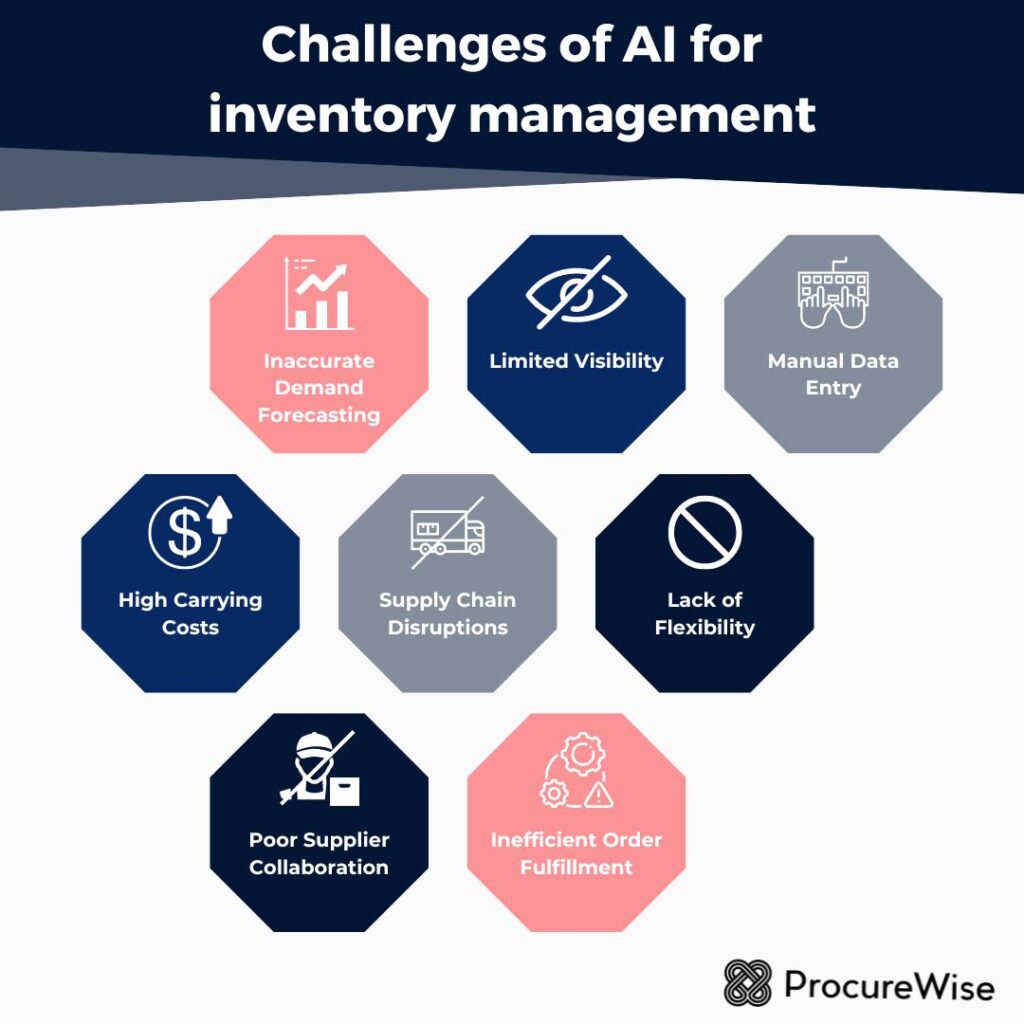
🥊 Challenges of Artificial Intelligence for inventory management 🥊
AI has revolutionized inventory management but also faces several challenges. This article highlights these challenges and solutions to overcome them.
💥 Inaccurate Demand Forecasting: Traditional methods often fail to capture market demand’s dynamic nature. AI can improve this by using machine learning algorithms to analyze historical data and market trends, generating more accurate forecasts. Continuous learning helps optimize inventory levels and reduce stock-outs or overstock situations.
💥 Limited Visibility: Businesses often struggle with real-time visibility across multiple locations. AI can integrate data from various sources (point-of-sale systems, warehouses, suppliers) to provide a consolidated view, allowing informed decisions, improved accuracy, and proactive issue identification.
💥 Manual Data Entry: This hampers efficiency and increases errors. AI technologies like optical character recognition (OCR) and natural language processing (NLP) can automate data extraction from documents (invoices, purchase orders), reducing manual errors and ensuring up-to-date inventory records.
💥 High Carrying Costs: AI can optimize inventory levels based on demand variability, lead time, and storage costs. Advanced algorithms determine optimal order quantities and reorder points, minimizing carrying costs while maximizing customer satisfaction.
💥 Supply Chain Disruptions: Unforeseen events can disrupt inventory levels. AI analyzes real-time data and external factors to identify risks, providing early warnings and suggesting alternative suppliers or routes to mitigate disruptions.
💥 Lack of Flexibility: Traditional systems often can’t adapt to changing needs. AI provides intelligent recommendations based on real-time data and market dynamics, supporting agile and informed decision-making.
💥 Poor Supplier Collaboration: AI enhances collaboration by automating communication, streamlining order processing, and facilitating real-time data exchange. Seamless integration improves order fulfillment efficiency and accuracy, reducing lead times.
💥 Inefficient Order Fulfillment: AI optimizes order fulfillment by predicting stock availability, suggesting alternatives, and streamlining operations. Advanced algorithms minimize errors, improve accuracy, and enhance customer satisfaction.
AI holds great potential for improving inventory management. By addressing challenges in demand forecasting, visibility, data entry, carrying costs, supply chain disruptions, flexibility, supplier collaboration, and order fulfillment, AI can optimize inventory levels, enhance efficiency, and drive better business outcomes. Continuous advancements and increased adoption will unlock AI’s full benefits in inventory management.
🗝️ Key AI techniques for inventory management 🗝️
Inventory management is a critical aspect of any business, as it directly impacts customer satisfaction, operational costs, and overall profitability. Artificial intelligence (AI) techniques have emerged as powerful tools for optimizing inventory management processes. In this article, we will explore some key AI techniques that are revolutionizing inventory management.
📌 Demand forecasting is a crucial aspect of inventory management, as it helps businesses determine the optimal stock levels to meet customer demand while minimizing excess inventory. Machine learning algorithms have proven to be highly effective in demand forecasting. These algorithms analyze historical sales data, market trends, and other relevant factors to forecast future demand accurately. By leveraging machine learning techniques, businesses can optimize inventory levels, reduce stockouts, and improve customer satisfaction.
📌 Sentiment analysis is another AI technique that plays a vital role in inventory management. Natural language processing (NLP) algorithms are used to analyze customer feedback and reviews, social media posts, and other text data to gauge customer sentiment towards products. By analyzing sentiment data, businesses can identify popular products, track customer preferences, and adjust inventory levels accordingly. This helps businesses meet customer demands effectively and avoid overstocking or understocking.
📌 Computer vision is an AI technique that enables computers to understand and interpret visual information, and it has significant implications for inventory management. In the context of inventory management, computer vision can be used for product recognition. By training computer vision models on product images, businesses can automate the process of identifying and classifying products. This saves time and improves accuracy in inventory management, especially in large warehouses with thousands of SKUs.
📌 Robotic Process Automation (RPA) has emerged as a game-changing technology for warehouse automation, a critical component of inventory management. RPA utilizes software robots to automate repetitive, rule-based tasks such as order processing, inventory tracking, and reporting. By implementing RPA in warehouses, businesses can improve operational efficiency, reduce errors, and enhance inventory accuracy. This allows for better inventory control and streamlined fulfillment processes.
📌 Predictive analytics is an AI technique that involves the use of statistical models and machine learning algorithms to analyze historical data and make predictions about future events. In the context of inventory management, predictive analytics can be used for maintenance optimization. By analyzing data from sensors and systems, predictive analytics models can identify potential equipment failures, allowing for proactive maintenance. This minimizes costly downtime and ensures smooth operations.
AI techniques such as machine learning, NLP, computer vision, RPA, and predictive analytics offer immense potential for optimizing inventory management processes. By leveraging these techniques, businesses can improve demand forecasting accuracy, understand customer sentiment, automate product recognition, streamline warehouse operations, and optimize maintenance activities. Implementing these AI techniques can lead to cost savings, improved customer satisfaction, and enhanced overall performance in inventory management.
🚀 The Future of Artificial Intelligence in Inventory Management 🚀
The future trends of AI in inventory management holds immense potential, offering advancements in automation, predictive analytics, and real-time optimization to revolutionize processes, minimize errors, reduce costs, and improve efficiency.
✨ Automation: AI enables the automation of tasks such as demand forecasting, order processing, and stock replenishment. By analyzing historical data and market trends, AI algorithms predict demand patterns, ensuring the right products are available and preventing overstocking or stockouts. This proactive management reduces costs and maximizes operational efficiency.
✨ Predictive Analytics: AI leverages advanced algorithms to analyze vast amounts of data, identifying patterns and trends for data-driven decisions on inventory levels, lead times, and reordering points. This optimization improves resource allocation and cash flow while identifying obsolete stock, helping avoid wastage and making informed decisions on discounts or promotions.
✨ Real-Time Optimization: AI provides accurate, agile solutions by con0tinuously monitoring inventory levels, customer orders, and supplier performance. AI algorithms dynamically adjust inventory planning and distribution to meet demand fluctuations, minimizing stockouts, reducing lead times, and improving customer satisfaction.
✨ Error Minimization and Improved Accuracy: AI algorithms integrate seamlessly with existing ERP systems, accurately collecting and analyzing data to eliminate manual errors and human oversight. This ensures consistently updated inventory levels, better demand forecasting, and optimized stock replenishment.
By leveraging AI, businesses can reduce costly errors, minimize stockouts, streamline processes, and free up resources for strategic activities. This leads to better resource allocation, improved customer satisfaction, and a competitive edge in the market.
In conclusion, AI’s future in inventory management promises automation, predictive analytics, and real-time optimization, driving efficiency, cost reduction, and enhanced accuracy, ultimately providing businesses with significant competitive advantages.