

In a competitive and data-driven market, key performance indicators (KPIs) are no longer optional. They define how companies evaluate product effectiveness, pricing decisions, and overall business performance. Especially in areas such as assortment management and pricing strategy, the wrong KPIs can lead to misleading conclusions, poor resource allocation, and missed growth opportunities.
While many organizations track general metrics like revenue or net profit, these alone do not explain why performance changes. To truly understand conversion rate, customer satisfaction, retention rate, and customer experience, companies need a focused KPI framework aligned with business objectives and strategic goals.
This article explains what matters most when selecting KPIs for measuring assortment and pricing effectiveness, starting with the strategic foundation.
🎯 Why KPIs Matter for Assortment & Pricing Decisions 🎯
Choosing KPIs is not a reporting exercise — it is a strategic management decision. Well-defined KPIs translate strategy into measurable actions and help teams understand what really drives results across the product portfolio and pricing model.
Poorly chosen metrics often result in:
- Optimizing volume instead of profitability
- Improving conversion rate at the expense of retention
- Growing product range complexity without value creation
The right KPIs prevent these traps.
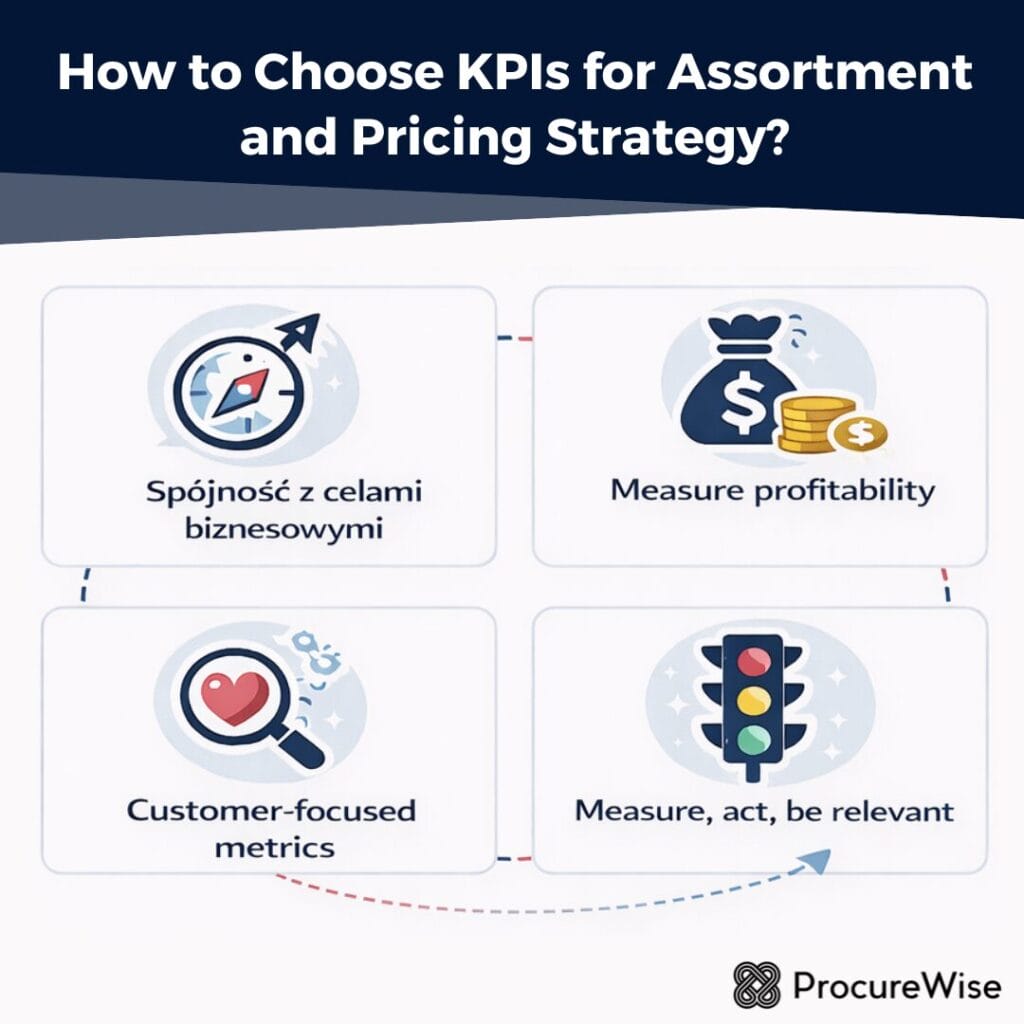
Aligning KPIs with Business Objectives 🧭
Every KPI must clearly support business objectives and strategic goals. Without this alignment, teams risk improving numbers that do not move the business forward.
Effective alignment means:
- Product KPIs show how the assortment supports growth, differentiation, and customer needs
- Pricing KPIs demonstrate how prices influence profitability, conversion rate, and perceived value
- Metrics reflect decisions, not just outcomes
Examples of aligned KPIs:
- Conversion Rate → supports acquisition and sales efficiency
- Retention Rate / User Retention → supports sustainable growth
- Net Profit & Net Profit Margin → support long-term financial health
Revenue and Profitability as Core Signals 💰
Revenue alone is not enough. Two assortments can generate the same revenue but deliver completely different outcomes when profitability is considered.
Key profitability-focused KPIs include:
- Net Profit and Net Profit Margin
- Return on Investment (ROI) per product or category
- Margin contribution by product or price tier
From a pricing perspective, these KPIs help answer:
- Which prices maximize profit, not just sales?
- Which products destroy margin despite high volume?
- Where does discounting harm long-term value?
Customer-Centric Metrics as Leading Indicators ❤️
Modern assortment and pricing strategies must reflect customer behavior and customer experience. Metrics such as customer satisfaction and Net Promoter Score (NPS) act as early warning systems.
Customer-focused KPIs help to:
- Detect pricing resistance before churn rate increases
- Understand perceived value, not just willingness to pay
- Link product range decisions to loyalty and advocacy
Key examples:
- Customer Satisfaction Score (CSAT)
- Net Promoter Score (NPS)
- Customer Experience metrics across the journey
These indicators often predict future performance better than financial metrics alone.
Why Data-Driven KPI Selection Reduces Risk 📉
Assortment and pricing decisions are high-risk by nature. Adding or removing products, changing prices, or restructuring offers can directly impact:
- Conversion rate
- Customer retention
- Revenue stability
A data-driven KPI framework allows companies to:
- Prioritize actions based on measurable impact
- Compare performance across products and price levels
- Reduce emotional or intuition-based decisions
In practice, this means fewer assumptions and more evidence-based optimization.
🧠 Core Principles for Selecting the Right KPIs 🧠
Selecting KPIs for assortment and pricing is not about quantity, but relevance and clarity. Too many metrics dilute focus, while poorly defined ones create false confidence. Effective KPI systems are intentional, selective, and decision-oriented.
A strong KPI framework answers three fundamental questions:
- What decision will this metric influence?
- Which business objective does it support?
- Can teams realistically act on it?
From Strategic Goals to Actionable Metrics 🎯
Every KPI should be traceable back to a strategic goal. High-level ambitions such as growth, profitability, or customer loyalty must be translated into operational metrics.
Example alignment:
- Strategic goal: Improve customer lifetime value → KPI: Retention Rate, Net Promoter Score, Repeat Purchase Rate
- Strategic goal: Increase pricing efficiency → KPI: Conversion Rate by price tier, Net Profit Margin
This cascade ensures KPIs are not abstract numbers but practical decision tools for product and pricing teams.
Balancing Leading and Lagging Indicators ⚖️
One of the most common KPI mistakes is relying only on lagging indicators (what already happened). While important, they react too late.
A healthy KPI system balances:
- Leading indicators → predict future performance
- Lagging indicators → confirm past results
Examples in assortment and pricing:
- Leading: Product adoption rate, Conversion Rate, Session Duration
- Lagging: Net Profit, Churn Rate, Retention Rate
This balance allows companies to adjust prices or product mix early, before negative results appear in revenue or profit.
Measurability, Actionability, and Relevance 🚦
Not every measurable metric is a good KPI. Effective KPIs must meet strict criteria:
- Measurable – reliable data source (e.g. analytics tools, CRM)
- Actionable – teams know what to change if the number moves
- Relevant – directly linked to assortment or pricing decisions
Weak example:
- “Number of products in the portfolio” Strong alternative:
- Revenue per product, Profit per SKU
The second option clearly supports performance management and portfolio optimization.
Avoiding Vanity Metrics in Pricing & Assortment ❌
Vanity metrics look impressive but rarely drive value. In pricing and assortment, common traps include:
- Traffic without conversion insight
- Sales volume without margin context
- Product usage without retention analysis
Instead, prioritize metrics that connect customer behavior with financial outcomes, such as:
- Conversion Rate × Average Order Value
- Retention Rate × Customer Lifetime Value
- Customer Satisfaction × Churn Rate
These combinations reveal whether growth is healthy and sustainable.
Data-Driven Prioritization Across Teams 📊
KPIs also function as a shared language across departments:
- Product management focuses on product metrics and usage
- Marketing optimizes conversion rate and qualified leads
- Finance monitors ROI, net profit, and margins
When KPI priorities are clear, teams:
- Align faster
- Avoid conflicting optimization goals
- Focus on what truly impacts business objectives
This is especially critical when managing complex assortments and multiple price levels.
🧩 Key Performance Indicators for Product Range Effectiveness 🧩
A product range is not a static list of offerings — it is a dynamic system that should evolve with customer needs, market trends, and strategic goals. Measuring its effectiveness requires more than tracking sales. The right KPIs reveal which products create value, which dilute focus, and which should be optimized or removed.
Product range KPIs help answer:
- Which products support business objectives?
- How does the assortment influence customer experience?
- Where is value created — and where is it lost?
Product Portfolio Structure & Performance 🗂️
At the foundation lies visibility into how the assortment is structured and how each product contributes to results.
Core portfolio KPIs include:
- Revenue per Product / SKU
- Net Profit per Product
- Net Profit Margin by Product Line
- Product Metrics comparing categories or variants
These metrics prevent over-investment in low-margin products and support data-driven assortment decisions.
Product Adoption & Customer Behavior 📈
Strong products are adopted quickly and used consistently. Monitoring customer behavior reveals whether the assortment truly fits market demand.
Key adoption and behavior KPIs:
- Product Adoption Rate
- Product Usage Frequency
- Session Duration for digital products
- Monthly Active Users (MAU) and Daily Active Users (DAU)
Low adoption or declining usage often signals mispricing, unclear value proposition, or product complexity.
Retention, Churn, and Lifecycle Signals 🔁
Retention is one of the clearest indicators of long-term product success. Products that fail to retain users increase churn rate and erode profitability.
Essential lifecycle KPIs:
- Retention Rate / User Retention
- Churn Rate by Product or Category
- Repeat Purchase Rate
- Customer Lifetime Value by Product Group
These KPIs connect product decisions directly to sustainable growth, not just short-term sales.
Customer Experience & Satisfaction per Product ⭐
A broad assortment can harm customer experience if poorly managed. Measuring satisfaction at product level highlights hidden risks.
Customer-centric product KPIs:
- Customer Satisfaction (CSAT) per Product
- Net Promoter Score (NPS) by Product Line
- Customer Experience feedback linked to usage
Products with good revenue but poor satisfaction often drive future churn and brand damage.
Innovation Efficiency & Time to Market 🚀
An effective assortment evolves efficiently. Innovation KPIs show whether new products strengthen the portfolio or simply add complexity.
Key innovation KPIs:
- Time to Market
- Revenue from New Products
- ROI of Product Development
- Product success rate after launch
Fast launches without adoption are as dangerous as slow launches in competitive markets.
When Product Range KPIs Fail ❗
Warning signs that KPIs are misaligned:
- Too many products, declining net profit margin
- Growing assortment but falling retention rate
- High usage but low customer satisfaction
These patterns indicate the need for assortment simplification or repositioning, not expansion.
💸 Key Performance Indicators for Pricing Strategy Success 💸
Pricing is one of the most powerful — and risky — levers in business. Even small price changes can significantly impact conversion rate, customer satisfaction, retention rate, and net profit. Effective pricing KPIs help organizations understand not only what customers pay, but why they pay and how prices influence behavior.
Strong pricing measurement connects customer behavior, financial outcomes, and strategic positioning.
Revenue and Profitability-Focused Pricing KPIs 💰
Pricing decisions must ultimately support profitability, not just volume. Revenue growth without margin control is unsustainable.
Core pricing KPIs include:
- Revenue Growth by Price Tier
- Average Order Value (AOV)
- Net Profit Margin
- Return on Investment (ROI) for pricing initiatives
These metrics clarify which prices create value and which simply increase operational load.
Conversion Rate & Behavioral Pricing Signals 🔄
Pricing directly influences how customers move through the sales funnel. Behavioral KPIs reveal price sensitivity and friction.
Key behavioral pricing KPIs:
- Conversion Rate by Price Level
- Price Elasticity
- Discount Usage and Impact
- Drop-off rate after price exposure
A falling conversion rate combined with stable traffic often indicates pricing misalignment, not marketing failure.
Pricing Impact on Customer Retention & Loyalty 🔐
Pricing decisions shape long-term relationships. Customers may convert once, but only fair and transparent pricing builds loyalty.
Retention-related pricing KPIs:
- Retention Rate after Price Change
- Churn Rate by Pricing Plan
- Customer Lifetime Value (CLV) by price tier
- Net Promoter Score (NPS) linked to pricing perception
High churn after price adjustments is a clear signal that perceived value has been damaged.
Competitive Positioning & Market Metrics 🧭
Pricing never exists in isolation. Customers compare options instantly, making relative price positioning critical.
Competitive pricing KPIs:
- Price Index vs Competitors
- Market Share by Price Segment
- Performance of premium vs value tiers
These metrics help define whether a brand competes on value, price, or experience — and whether that position is credible.
🔗 The Synergy Between Product Range and Pricing KPIs 🔗
The real strategic advantage appears when product and pricing KPIs are analyzed together. Optimizing them separately often leads to internal conflicts and suboptimal outcomes.
How Product Decisions Shape Pricing Results 🧩
Product complexity, differentiation, and perceived value directly affect pricing power.
Examples:
- Overlapping products → internal price competition
- Strong differentiation → higher acceptable prices
- Poor product clarity → lower conversion despite discounts
Monitoring conversion rate, net profit, and retention across products reveals where pricing supports — or undermines — the assortment.
How Pricing Strategy Drives Product Performance 🚦
Pricing can actively steer product adoption:
- Tiered pricing encourages upgrades
- Bundling increases average order value
- Entry pricing accelerates product adoption
Without KPI monitoring, these tactics risk damaging customer experience or long-term profitability.
✅ Conclusion: What Really Matters When Choosing KPIs for Assortment & Pricing ✅
Choosing KPIs is a strategic act, not a reporting task. The most effective KPI systems:
- Align directly with business objectives and strategic goals
- Balance leading and lagging indicators
- Connect customer behavior with financial outcomes
- Avoid vanity metrics in favor of actionable insights
Key KPIs that consistently matter:
- Conversion Rate
- Retention Rate & Churn Rate
- Customer Satisfaction & Net Promoter Score
- Net Profit, Net Profit Margin, ROI
When assortment and pricing KPIs work in synergy, companies gain clarity, focus, and control — enabling sustainable growth, stronger customer relationships, and better strategic decisions.