

In today’s volatile markets, accurate demand forecasting is no longer optional — it’s a core capability. Rising customer expectations, complex supply chains, and real-time market shifts mean that traditional methods simply can’t keep up. This is where artificial intelligence, machine learning, and predictive analytics step in.
This article answers one key question: What do you really need to implement AI-powered demand forecasting successfully?
Why AI Is No Longer Optional in Demand Forecasting ?⚡
AI demand forecasting transforms static, backward-looking plans into adaptive, real-time demand planning systems. It connects market trends, customer demand, and inventory levels into one intelligent flow.
The Limits of Traditional Forecasting Models 📉
Traditional forecasting models rely heavily on historical sales and simple techniques like exponential smoothing. While useful in stable conditions, they struggle with:
- Sudden shifts in customer demand
- Seasonal and promotional volatility
- Supply chain disruptions
- Real-time signals from POS data, market data, or social media trends
The result? ❌ Overstocked inventory ❌ Stockouts ❌ Poor forecast accuracy ❌ Lower customer satisfaction
These models react too late — modern businesses need to anticipate, not just respond.
What AI-Driven Demand Forecasting Does Better 🧠
AI replaces rigid logic with learning systems. Using machine learning models, AI demand forecasting can:
- Combine big data from multiple sources
- Detect complex, non-linear patterns
- Adjust forecasts continuously using real-time data
- Improve forecast accuracy across short- and mid-term horizons
By processing demand signals from inventory systems, market trends, and customer behavior, AI creates forecasts that are both faster and smarter.
From Forecasting to Demand Sensing 🔍
A key leap enabled by AI is demand sensing.
Unlike classic demand forecasting, demand sensing:
- Uses near-real-time inputs (POS systems, online activity, inventory levels)
- Detects shifts as they happen
- Supports rapid adjustments in inventory management and supply chain workflows
This makes AI forecasting especially powerful in industries where timing and availability directly impact revenue.
🎯 The Business Impact: Accuracy, ROI, Advantage 🎯
Better forecasts drive better decisions. Companies using AI demand forecasting report:
- Higher forecast accuracy
- Lower inventory holding costs
- Fewer stockouts
- Faster reaction to market trends
- Stronger alignment between demand planning and supply chain execution
In short: AI turns forecasting into a competitive advantage.
🧩 Toolkit Component #1 – The Robust Data Foundation (The Fuel) 🧩
AI-powered demand forecasting is only as good as the data behind it. Before machine learning models, forecasting tools, or predictive analytics can deliver value, you need a solid data foundation. Think of data as fuel: low quality in = unreliable forecasts out.
This section answers a critical question: What data must you have to make AI demand forecasting actually work?
Why Big Data Is the Backbone of AI Forecasting 🗄️
AI thrives on big data — not just volume, but also variety and velocity. Unlike traditional forecasting models, AI can process massive datasets and learn from subtle patterns across time, channels, and markets.
A strong data foundation enables:
- Higher forecast accuracy
- Better detection of seasonal trends
- Faster reaction to market trends
- Smarter inventory management
Without big data, even the most advanced ML models are blind.
From Historical Data to Living Demand Signals 📊➡️📡
Classic demand forecasting relies mainly on past sales. AI goes further by combining historical data with real-time data and external inputs.
This shift enables AI demand forecasting to move from static planning to continuous demand planning and demand sensing.
Key Internal Data Sources You Must Integrate 📥
Internal data is your starting point — it reflects how customers actually buy.
Core Operational Data 🧾
At minimum, AI forecasting systems should ingest:
- POS data and point-of-sale systems
- Historical sales and order history
- Current inventory levels
- Warehouse capacity and warehouse space
- Pricing, promotions, and discounts
- Existing supply chain workflows
These data sources help AI understand baseline demand and operational constraints.
Inventory & Supply Chain Signals 📦
For accurate supply chain forecasting, AI needs visibility into:
- Replenishment cycles
- Lead times
- Stockouts and overstock events
- Historical inventory management decisions
This directly improves alignment between forecasts and real-world execution.
External Data: Where AI Gains Its Edge 🌍
What truly differentiates AI-powered forecasting from traditional methods is its ability to absorb external demand signals.
Market & Customer Intelligence 🧠
High-impact external data includes:
- Market data and macroeconomic indicators
- Market trends and competitive pricing
- Customer demand signals from online behavior
- Social media trends and sentiment analysis
- News events and promotions
AI models can correlate these signals with sales patterns — something manual forecasting can’t do at scale.
Contextual & Environmental Data 🌦️
Advanced AI demand forecasting may also leverage:
- Weather data
- Local events
- Regional demand differences
- Industry-specific indicators
These inputs significantly improve short-term forecast accuracy.
Data Integration: Turning Chaos into One Source of Truth 🔗
Collecting data is not enough. It must be integrated, standardized, and accessible.
Effective Data Integration Strategies 🧩
Successful AI implementations typically rely on:
- Centralized data platforms (data lakes / warehouses)
- Automated ETL pipelines
- APIs connecting POS systems, ERP, and forecasting tools
- Continuous ingestion of real-time data
Good data integration ensures consistency across forecasting, inventory levels, and supply chain planning.
Why This Component Matters Most ?🎯
No data foundation = no AI advantage.
A strong data layer enables:
- Reliable forecasting models
- Scalable predictive analytics
- Smarter inventory management
- Faster response to supply chain disruptions
It is the single most common failure point in AI demand forecasting projects — and the most critical success factor.
🧠 Toolkit Component #2 – The AI Engine (The Brain) 🧠
If data is the fuel, then the AI engine is the brain that turns raw inputs into accurate, actionable demand forecasts. This is where machine learning, forecasting models, and predictive analytics actually do the heavy lifting.
In this part, we answer: What AI capabilities must you have to forecast demand effectively?
Core Machine Learning Models for Demand Forecasting ⚙️
Modern AI demand forecasting rarely relies on a single model. Instead, it combines multiple ML models, each optimized for different demand patterns.
Most Common Forecasting Models 📈
Effective AI engines typically include:
- Time-series models (enhanced versions of classical forecasting)
- Regression-based models for demand drivers
- Tree-based models like Random Forest and XGBoost
- Deep learning models such as LSTM neural networks
These models learn from big data, detect non-linear relationships, and adapt as demand evolves.
Forecasting vs. Demand Sensing: Why You Need Both 🔄
AI excels because it handles two time horizons at once.
Demand Forecasting (Mid & Long Term) 📆
Used for:
- Production planning
- Capacity decisions
- Strategic supply chain forecasting
- Budgeting and demand planning
Demand Sensing (Short Term, Real-Time) ⚡
Powered by:
- Real-time data
- POS data
- Online customer behavior
- Short-term demand signals
Demand sensing allows businesses to react instantly to spikes or drops in customer demand, protecting inventory levels and service quality.
Together, they create a responsive and resilient forecasting system.
Why Predictive Analytics Changes Everything? 🧩
Predictive analytics transforms forecasting from guesswork into probability-driven decision-making.
With predictive analytics, AI can:
- Estimate demand ranges instead of single numbers
- Identify risks of stockouts or overstocking
- Simulate “what-if” scenarios
- Anticipate supply chain disruptions
This enables proactive — not reactive — inventory management and demand planning.
The Role of Advanced AI (NLP & Generative AI) 🧠
Beyond classic ML, advanced AI techniques bring new capabilities.
Natural Language Processing (NLP) 📝➡️📊
NLP allows AI systems to:
- Analyze social media trends
- Extract signals from news and reports
- Detect sentiment shifts affecting demand
Generative AI in Forecasting ✨
Generative AI can:
- Create synthetic data when history is limited
- Simulate future market conditions
- Explain forecast changes in plain language
- Support decision-makers with AI-generated insights
This makes forecasting more transparent and usable across teams.
What a Strong AI Engine Delivers 🎯
A mature AI engine provides:
- Higher forecast accuracy
- Continuous learning from new data
- Faster reaction to market trends
- Better alignment between demand planning and execution
Without the right AI engine, even perfect data can’t produce reliable forecasts.
🔗 Toolkit Component #3 – Integration & Automation (The Connectors) 🔗
Even the best AI forecasting models fail if they operate in isolation. To unlock real value, AI-powered demand forecasting must be deeply embedded into everyday operations through integration and automation — and guided by people who know the business.
Integrating AI into the Supply Chain Ecosystem 🔌
AI demand forecasting must connect seamlessly with existing systems to support end-to-end demand planning and supply chain forecasting.
Critical Systems to Integrate 🧩➡️
AI should exchange data with:
- Point-of-sale systems and POS data
- ERP platforms (planning, procurement, finance)
- Inventory and warehouse space management systems
- Supply chain workflows and logistics tools
- Forecasting and replenishment platforms
This integration ensures that improved forecast accuracy directly impacts inventory levels, availability, and customer experience.
Automation: Making Forecasts Operational at Scale ⚡
Automation turns insights into action — continuously and reliably.
What Should Be Automated 🤖
High-performing AI forecasting setups automate:
- Data ingestion from internal and external sources
- Continuous model retraining
- Forecast updates based on real-time data
- Alerts for demand spikes, drops, or disruptions
- Distribution of forecasts to planners and systems
Automation reduces manual effort while increasing responsiveness to market trends and customer demand.
🧑🤝🧑 Toolkit Component #4 – Human Execution & Governance 🧑🤝🧑
AI doesn’t replace planners — it amplifies them.
Human + AI = Better Decisions 🧠✨
People remain essential for:
- Validating AI-driven forecasts
- Interpreting unusual demand signals
- Managing exceptions and edge cases
- Aligning forecasts with business strategy
The strongest organizations treat AI as a decision-support system, not an autopilot.
Measuring Success: KPIs That Actually Matter 📊
To ensure long-term value, performance must be measurable.
Key Metrics to Track 🎯
Successful teams monitor:
- Forecast accuracy
- Inventory turnover
- Stockout and overstock rates
- Customer satisfaction
- ROI from AI and machine learning investments
These KPIs link AI forecasting directly to business outcomes.
Future-Proofing Your AI Demand Forecasting Stack 🛡️
To stay competitive, your toolkit must evolve.
What to Plan For 🔮
- Scalability across products, regions, and channels
- Flexibility to adopt new forecasting tools
- Responsible AI, data privacy, and transparency
- Rapid response to supply chain disruptions
AI demand forecasting is not a one-off project — it’s a living capability.
🚀 Conclusion: What You Must Have to Succeed with AI Demand Forecasting 🚀
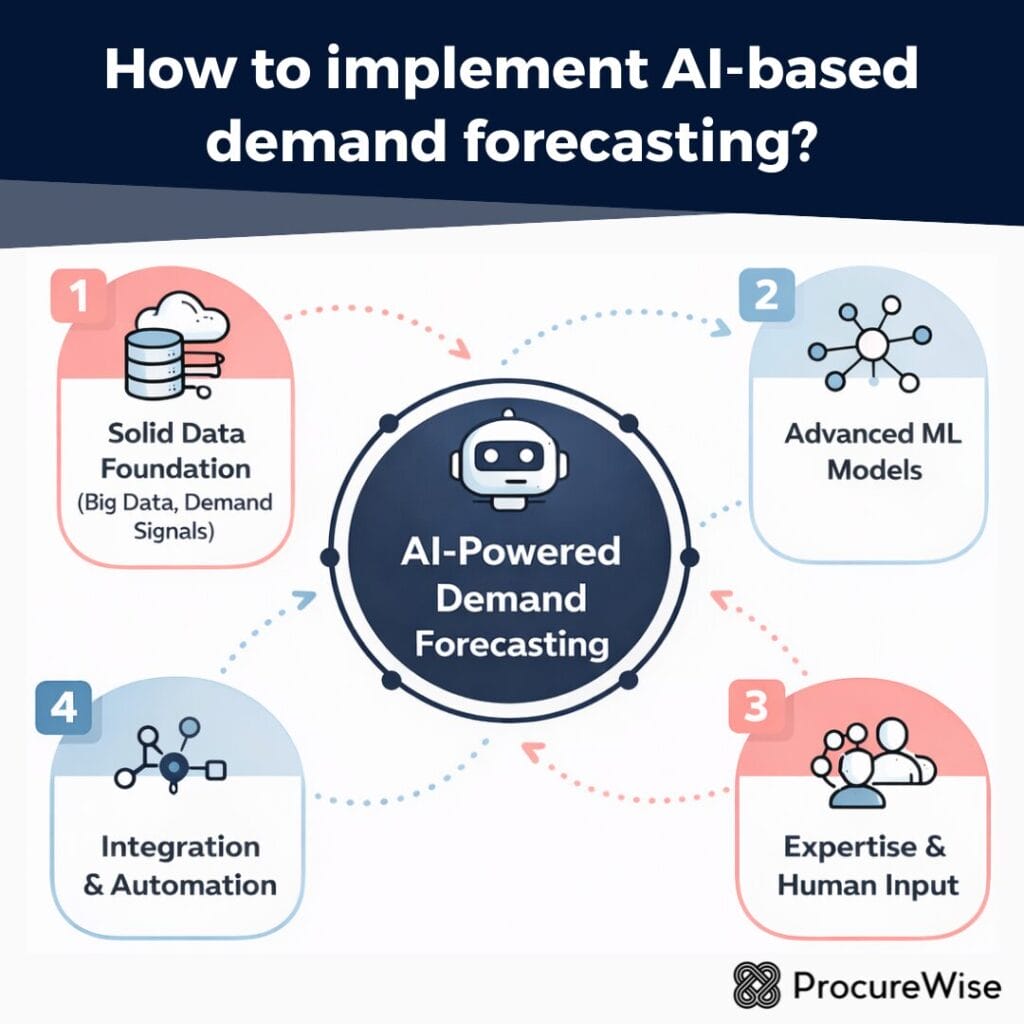
To implement AI-powered demand forecasting effectively, you need:
✔️ Big data and high-quality demand signals ✔️ Advanced ML models and predictive analytics ✔️ Seamless data integration and automation ✔️ Human expertise guiding AI insights
Together, these elements transform forecasting into a strategic advantage — improving inventory management, customer satisfaction, and supply chain resilience.