

In today’s volatile global economy, procurement process management is no longer an operational afterthought — it is a strategic lever that directly impacts margins, resilience, and long-term growth. Companies that still rely on historical data, manual research, and intuition struggle to respond to rapid price changes, supply chain risk, and declining supplier performance.
By integrating market data scraping into your annual purchasing plan, procurement teams can transform planning from a static exercise into a living, data-driven strategy. Real-time market intelligence supports smarter budgeting, stronger negotiations, and more accurate financial reporting, while strengthening supply chain management across the organization.
🚀 Why Procurement Needs Market Intelligence Today 🔍
Traditional procurement models were built for stable markets. Long-term supplier contracts, predictable lead times, and limited data access allowed buyers to plan once a year and adjust occasionally. That world no longer exists.
Today, procurement teams face:
- Rapid fluctuations in steel products, raw materials, and energy prices
- Growing supply chain risk caused by geopolitics and logistics disruptions
- Increasing pressure on supplier performance and compliance
- Higher expectations for transparency in financial reporting
Relying on outdated spreadsheets or manual market checks leaves organizations exposed. Operations management now requires continuous access to market signals — not quarterly updates.
📉 The Limits of Traditional Purchasing Methods ⚠️
Manual market research is slow, fragmented, and incomplete. By the time pricing benchmarks or supplier insights are collected, the market has already moved.
Key weaknesses include:
- Static data that fails to reflect current market conditions
- Limited visibility into supplier performance and alternative supply sources
- Inability to anticipate cost spikes in raw materials and logistics
- Weak linkage between procurement decisions and financial reporting
In complex industries such as manufacturing, steel production, or automotive equipment, these gaps can quickly translate into cost overruns, stockouts, and planning errors.
📊 What Market Data Scraping Changes 🤖
Market data scraping automates the collection of real-time information from online sources such as supplier websites, commodity exchanges, industry portals, and news outlets. For procurement teams, this means instant access to:
- Competitive pricing benchmarks
- Commodity and material cost trends
- Early warnings of supply chain risk
- Signals impacting supplier performance and availability
When integrated into supply chain management and purchasing workflows, scraped data enables faster decisions, stronger negotiations, and proactive risk mitigation — all aligned with annual planning and budgeting cycles.
🧭 Your Roadmap to Data-Driven Purchasing 🧩
In this first part, we focus on why integrating market data scraping into annual procurement planning is no longer optional. The next sections of the article will explore:
- How to identify the right market data for your purchasing plan
- How scraping supports supplier performance, budgeting, and forecasting
- How procurement insights improve financial reporting accuracy
- How to operationalize data within supply chain management systems
Together, these steps form a scalable framework for smarter spending and stronger procurement governance.
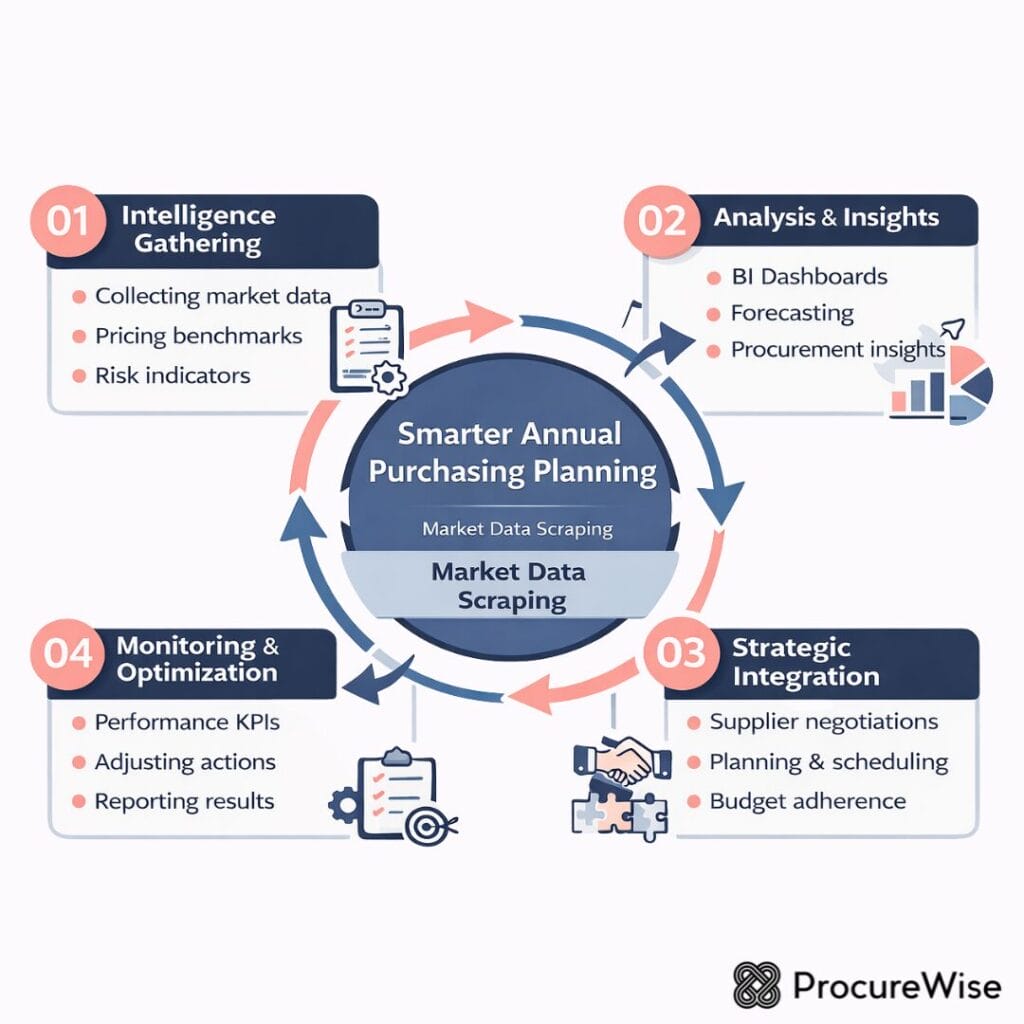
🧠 Phase 1: Intelligence Gathering 🧠
The first step in integrating market data scraping into your annual purchasing plan is defining what intelligence truly matters. Without a clear focus, procurement teams risk collecting excessive data without strategic value. Effective intelligence gathering aligns external market signals with internal priorities such as cost control, availability, risk mitigation, and long-term supplier strategy.
At this stage, market data scraping becomes a decision-support engine for the entire procurement process, feeding reliable inputs into planning, budgeting, and supplier management.
Competitive Pricing & Market Benchmarking 📉
Scraping market prices across supplier websites, online marketplaces, and industry portals allows procurement teams to establish real-time benchmarks for goods and materials. This is particularly critical for volatile categories such as steel products, flat-rolled steel, steel beams, or merchant bar.
With continuous pricing intelligence, teams can:
- Detect price anomalies and inflated quotes
- Compare regional and global pricing trends
- Strengthen negotiation positions
- Avoid reactive purchasing under pressure
Instead of negotiating blind, procurement operates with market-backed confidence.
Supplier Performance & Supply Sources Intelligence 📊
Annual planning should not rely solely on historical supplier scorecards. Market data scraping expands visibility into supplier performance beyond internal KPIs by analyzing:
- Public financial signals and expansion activity
- News related to disruptions, strikes, or compliance issues
- Capacity indicators in steel production and manufacturing
- Changes in supply sources and ownership structures
This external intelligence supports smarter supplier selection, diversification, and long-term relationship planning — all core pillars of modern supply chain management.
Material Costs & Production Signals ⚙️
For procurement teams sourcing raw materials, components, or industrial equipment, monitoring upstream signals is essential. Market data scraping enables automated tracking of:
- Commodity price movements
- Production slowdowns or overcapacity
- Energy and logistics cost indicators
- Regional disruptions affecting steel production
These insights help teams time purchases strategically, adjust volumes, and reduce exposure to sudden price shocks — directly supporting budget stability and margin protection.
Supply Chain Risk Indicators 🌍
One of the strongest advantages of scraping market data is proactive supply chain risk detection. By monitoring global news, regulatory updates, weather alerts, and logistics data, procurement teams gain early visibility into potential disruptions.
This enables:
- Faster contingency planning
- Supplier and route diversification
- Reduced dependence on single-source suppliers
- Stronger continuity across operations
In volatile markets, risk visibility is cost control.
Sustainability & Compliance Signals ♻️
With growing regulatory and stakeholder pressure, sustainability has become a strategic procurement concern. Market data scraping supports ethical sourcing by collecting publicly available data on:
- Environmental certifications
- Regulatory compliance
- ESG-related disclosures
- Industry reputation signals
This intelligence helps procurement align supplier selection with corporate sustainability goals while reducing reputational and compliance risks.
Why Phase 1 Matters for Annual Planning 🎯
Phase 1 lays the groundwork for everything that follows. Without accurate, relevant market intelligence, procurement planning remains reactive and fragmented. When done correctly, intelligence gathering ensures that:
- Supplier strategies are evidence-based
- Cost assumptions reflect market reality
- Supply chain management is resilient, not fragile
- The procurement process supports long-term business goals
Super — jedziemy dalej 🚀 Poniżej 3/4 artykułu, zgodnie z zasadami: H2/H3, pogrubienia, SEO, emoji, lekkie skróty i mocne dopasowanie do tytułu oraz słów kluczowych (financial reporting, operations management, supply chain management, CMM system, ERP, production scheduling, preventive maintenance).
📊 Phase 2: Analysis & Insights 📊
Collecting market data is only half the battle. The real value emerges when raw information is transformed into actionable insights that directly support operations management, financial reporting, and strategic purchasing decisions.
In this phase, procurement shifts from data accumulation to decision orchestration — connecting external market signals with internal systems, forecasts, and plans.
Tools That Power Data-Driven Procurement 🧠
To process scraped market data effectively, organizations rely on a layered technology stack. Each layer plays a role in turning chaos into clarity.
Key tools include:
- Business Intelligence (BI) platforms for dashboards and trend visualization
- ERP systems for cost control, budgeting, and purchasing execution
- Supply chain management platforms for demand and inventory alignment
- CMM systems and asset data for operational reliability and sourcing decisions
When these systems are connected, procurement insights flow seamlessly into planning, execution, and reporting — not trapped in spreadsheets.
Identifying Trends That Shape Annual Planning 🔍
Analyzing scraped data over time reveals patterns that manual reviews often miss. Procurement teams can detect:
- Seasonal pricing cycles
- Early cost pressure signals
- Supplier capacity constraints
- Shifts in production output or logistics availability
For example, combining commodity pricing trends with supplier news allows teams to anticipate cost increases before they appear in invoices — a major advantage for budgeting and forecasting.
Linking Procurement Insights to Financial Reporting 💰
One of the most immediate benefits of market data analysis is improved financial reporting quality. When procurement plans are grounded in real market data, finance teams gain:
- More reliable cost forecasts
- Reduced variance between planned and actual spend
- Better accrual accuracy
- Stronger justification for budget adjustments
This alignment strengthens trust between procurement, finance, and leadership — and positions procurement as a strategic contributor, not a cost center.
Operational Signals: Beyond Price Alone ⚙️
Market data analysis also feeds into broader operations management priorities. By correlating supplier data with operational needs, procurement teams can support:
- Production scheduling decisions
- Preventive sourcing aligned with preventive maintenance cycles
- Spare parts availability planning
- Risk mitigation for critical equipment and logistics
This ensures purchasing decisions support uptime, throughput, and operational stability — not just unit price optimization.
Integrating Insights into Core Systems 🔗
For insights to drive value, they must be embedded into daily workflows. Integration with ERP, supply chain platforms, and reporting tools ensures that:
- Buyers see market benchmarks during negotiations
- Planners adjust volumes based on demand signals
- Finance reflects real-time cost assumptions
- Management gains visibility into procurement risk and opportunity
This integration transforms procurement into a control tower for spending and risk.
Why Phase 2 Is the Turning Point 🧩
Phase 2 is where procurement stops observing the market and starts using it. With structured analysis:
- Market volatility becomes manageable
- Forecasts become defensible
- Decisions become repeatable and scalable
- Annual plans gain real-world credibility
Without this phase, even the best data scraping efforts remain underutilized.
🧭 Phase 3: Strategic Integration 🧭
At this stage, market data stops being “insight” and becomes action. Strategic integration means embedding analyzed market intelligence directly into the annual purchasing plan, ensuring that sourcing decisions, budgets, and timelines reflect real market conditions — not assumptions.
This is where procurement becomes a strategic governance function.
Smarter Negotiations & Vendor Performance Control 💬
With real-time benchmarks and supplier intelligence, negotiations shift dramatically. Procurement teams can:
- Challenge pricing with verified market data
- Adjust contract terms based on capacity and risk signals
- Monitor vendor performance beyond delivery and price
- Reduce dependency on underperforming suppliers
This data-backed approach strengthens relationships while protecting margins — a core goal of modern supply chain management.
Supplier Selection, Diversification & Risk Balancing ⚖️
Market intelligence supports proactive supplier portfolio design. By analyzing market coverage, geographic exposure, and operational stability, procurement teams can:
- Diversify supply without inflating costs
- Reduce concentration risk
- Align suppliers with production and maintenance needs
- Strengthen long-term sourcing strategies
This ensures continuity across volatile markets and reinforces resilience at scale.
Demand Forecasting, Production Scheduling & Inventory Control 📆
Integrating market insights with production scheduling allows procurement to align purchasing volumes with real demand signals. This reduces:
- Excess inventory
- Emergency buying
- Production stoppages
When combined with preventive maintenance planning and spare parts forecasting, procurement becomes a stabilizing force across operations — not a reactive one.
Budgeting, Cost Avoidance & Financial Alignment 💸
Protecting Financial Reporting Integrity 💸
Accurate market intelligence enables smarter budget allocation and proactive cost avoidance. Procurement can:
- Anticipate price increases
- Lock in favorable pricing windows
- Avoid unplanned spend
- Support more accurate financial reporting
This tight alignment between procurement and finance improves forecast reliability and executive confidence.
🔄 Phase 4: Performance Monitoring & Continuous Optimization 🔄
Keeping the Purchasing Plan Alive 🔄
Market integration is not a one-time exercise. Continuous monitoring ensures that the purchasing plan evolves with the market.
KPIs for Data-Driven Procurement 🎯
Effective organizations track KPIs such as:
- Cost savings from market-informed negotiations
- Supplier performance improvement
- Reduction in supply disruptions
- Forecast accuracy versus actual spend
These metrics validate procurement’s strategic impact and guide continuous improvement.
Real-Time Adjustments & Agile Response 🧠
With ongoing data scraping and analysis, procurement teams can adjust sourcing strategies mid-cycle — not after damage is done. This agility protects margins, operations, and customer commitments.
Long-Term Strategic Value for the Business 🏢
Over time, accumulated market intelligence informs multi-year sourcing strategies, investment decisions, and risk governance. Procurement evolves into a trusted advisor at board level — contributing directly to resilience, growth, and competitive advantage.
🏁 Conclusion: Unlocking Smarter Spending 🔓
Integrating market data scraping into annual purchasing planning transforms procurement from reactive buying into strategic control. Organizations gain:
- Smarter negotiations
- Stronger supplier ecosystems
- Better supply chain management
- More reliable financial reporting
- Lower risk and higher resilience
In today’s volatile markets, this approach is no longer optional. Smarter spending starts with smarter data.