

In a crowded market, pricing isn’t a “nice-to-have” lever — it’s one of the fastest ways to improve profit without changing your product, headcount, or supply chain. This review focuses on ROI-driven pricing modeling tools: the ones that help you predict outcomes, justify decisions to stakeholders, and turn pricing from “gut feel” into a repeatable profit engine.
Instead of treating pricing as a last-step calculation, ROI-first tools connect pricing to what executives and investors care about most: margin, cash flow, and sustainable growth.
🧠 Why Pricing Strategy Still Leaves Money on the Table? 🧠
💬 Pricing is a Value Signal, Not Just a Number 📣
Pricing communicates positioning and value. When companies rely on intuition or “match the competitor,” they often undercharge for high-value segments and overcharge for price-sensitive ones. ROI-focused modeling helps you align price with willingness-to-pay, market dynamics, and strategic goals.
📈 A Small Price Change Can Move Profit Disproportionately ⚖️
A modest, well-placed price increase can expand profits more than comparable improvements in volume or cost cutting — because price acts directly on margin. Underpricing, meanwhile, quietly destroys growth by shrinking contribution margins and weakening reinvestment capacity.
🧾 Pricing Hits Every Key Financial Line Item 💰
Strong pricing decisions ripple through:
- Income Statement: revenue, gross margin, operating profit
- Balance Sheet: receivables, inventory, retained earnings
- Cash Flow: timing and magnitude of cash generation
That’s why pricing tools that model ROI are valuable: they don’t just “set a price” — they forecast business consequences.
🧭 Why ROI-Driven Pricing Models Are Non-Negotiable 🧭
🧩 From “Cover Costs” to “Maximize Returns” 🏁
Traditional pricing often stops at cost-plus or competitor parity. ROI-driven pricing reframes the question to: “What price maximizes return on the investments behind this offer?” (product, marketing, sales, onboarding, service, acquisition).
🔮 Forward-Looking Decisions Beat Rearview Reporting 🧠
What separates real pricing tools from spreadsheets is the ability to:
- forecast outcomes under different price levels,
- measure risk and upside,
- and continuously improve pricing based on performance.
In other words: pricing becomes an optimization loop, not a one-time decision.
🧱 Where Traditional Pricing Methods Break Down? 🧱
🧮 Cost-Plus and Benchmarking Miss the Real Driver: Demand 🧨
Cost-plus ignores elasticity and value perception; competitor benchmarking ignores the fact that competitors may have different costs, positioning, or objectives. This leads to price wars, margin erosion, and confused positioning.
🏹 The Competitive Edge Comes From Data-Backed Pricing 🎯
In volatile markets, teams that use modeling tools can respond faster and smarter — not by reacting, but by testing scenarios:
- “What if demand softens?”
- “What if a competitor cuts price?”
- “What if we shift packaging or tiers?”
This is where ROI tools shine: they turn uncertainty into structured choices.
🧩 Foundations of ROI-Driven Pricing Models 🧩
ROI-driven pricing isn’t about finding a “good” price — it’s about finding the price that maximizes financial return on everything you invested to bring an offer to market: product development, marketing, sales, onboarding, and support.
Instead of asking “Will this price sell?”, the model asks: “At which price does this investment generate the strongest return over time?”
That shift alone turns pricing into a strategic finance decision, not a sales tactic.
Core Principles Behind High-ROI Pricing Models 🧠
Data-First, Not Opinion-First 🧮
Effective pricing models are grounded in:
- real customer behavior,
- cost structures (fixed & variable),
- demand sensitivity,
- competitive context.
Gut feeling can guide hypotheses — data decides.
Forward-Looking, Not Backward-Locked 🚀
Historical prices explain the past; ROI models simulate the future. Strong tools allow teams to:
- forecast revenue and cash flow,
- test price changes before rolling them out,
- estimate downside risk and upside potential.
Pricing becomes a controlled experiment, not a gamble.
Continuous Optimization Beats “Set & Forget” 🔄
Markets move. Costs change. Customer value evolves. ROI-driven pricing assumes prices must be revisited, monitored, and refined — continuously. Tools that support iteration outperform static spreadsheets every time.
🧱 Key Building Blocks of an ROI Pricing Model 🧱
🧾 Cost Reality (Not Just Unit Cost) 🧩
High-quality models separate:
- fixed vs variable costs,
- marginal vs fully loaded costs,
- customer-level acquisition and service costs.
Without this, ROI calculations are misleading — especially in SaaS, platforms, and services.
👥 Segmentation & Willingness-to-Pay 🎯
Different customers extract different value. ROI pricing models explicitly account for:
- segments,
- use cases,
- perceived value drivers,
- elasticity by segment.
One price rarely maximizes ROI across all customers.
📉 Elasticity & Demand Response 📐
Understanding how demand reacts to price changes is central. Even simple sensitivity ranges help answer:
- “How much volume do we lose if price rises 5%?”
- “At what point does margin gain outweigh volume loss?”
This is where pricing starts behaving like financial engineering.
💰 Financial Outcome Metrics That Matter 📈
Strong models don’t stop at revenue. They project impact on:
- gross margin,
- operating profit,
- cash flows,
- and often IRR or NPV for launches and major initiatives.
That’s why pricing decisions suddenly become board-level relevant.
🧮 Why IRR & Cash Flow Thinking Elevate Pricing 🧮
⏳ Timing Matters as Much as Price 🕰️
Two prices can generate the same revenue — but very different cash profiles. ROI-driven tools model:
- speed of payback,
- cash intensity,
- reinvestment capacity.
This is critical for growth companies and investor-facing decisions.
🧠 Pricing as Capital Allocation 🏦
When pricing is modeled via ROI, it competes directly with other investments:
- new features,
- marketing spend,
- expansion projects.
Pricing wins because it often delivers the highest return with the lowest risk.
🛠️ Building ROI-Driven Pricing Models in Practice 🛠️
Most pricing maturity journeys start simple — and that’s fine. What matters isn’t the tool at first, but the logic behind the model. ROI-driven pricing grows from basic financial structure into a scalable decision system that leadership can trust.
The key shift: pricing models stop answering “What price works?” and start answering “Which price creates the best financial outcome?”
🧱 Foundational Models: Where Most Teams Begin 🧱
📄 Excel & Spreadsheet-Based Pricing Models 📉
Spreadsheets remain the entry point for many teams because they’re flexible and familiar. A solid ROI-oriented spreadsheet typically models:
- unit economics (costs, margins),
- demand assumptions,
- basic ROI, payback, or contribution logic.
Their strength is customization. Their weakness? Manual work, version chaos, and limited scalability.
⚠️ Where Spreadsheets Start to Break 🧨
As soon as pricing decisions require:
- multiple scenarios,
- segmentation logic,
- sensitivity testing,
- or portfolio-level views,
spreadsheets become fragile. Errors compound, assumptions get buried, and confidence drops — especially in investor or board discussions.
🔬 Advanced Techniques That Separate Good From Great 🔬
📐 Sensitivity Analysis: Finding the Profit Levers 🔧
Sensitivity analysis tests how outcomes change when inputs move. Pricing teams use it to answer:
- Which variable matters most — price, cost, or volume?
- How sensitive is profit to small price moves?
This helps teams focus effort where ROI impact is highest, not where opinions are loudest.
🎭 Scenario Modeling: Pricing Under Uncertainty 🎲
Scenario models compare outcomes across different futures:
- optimistic demand,
- baseline expectations,
- downside risk cases.
This reframes pricing as risk management, not guesswork — especially valuable in volatile or competitive markets.
🎲 Probabilistic Thinking (Monte Carlo Logic) 🔮
More advanced tools simulate thousands of outcomes instead of one forecast. This shows:
- probability of hitting ROI targets,
- downside exposure,
- confidence intervals, not single numbers.
Executives trust pricing more when uncertainty is explicit — not hidden.
🧭 Strategic Pricing Models That Maximize ROI 🧭
💎 Value-Based Pricing: Monetizing What Customers Care About 🧠
Value-based pricing aligns price with perceived outcomes, not internal costs. ROI models help quantify:
- how value translates into willingness-to-pay,
- how price affects adoption vs margin.
When done well, this consistently outperforms cost-based pricing.
⚙️ Optimized Cost-Plus (Not Blind Markups) 📏
Cost-plus doesn’t have to be naive. ROI models refine it by:
- adjusting margins by segment,
- factoring in elasticity,
- linking markup to ROI targets instead of habits.
The result: cost discipline without margin laziness.
🔄 Dynamic & Hybrid Pricing: Flexibility Wins 🧩
Dynamic pricing adapts to demand, timing, and market signals. Hybrid models blend:
- value-based logic,
- segmentation,
- usage or outcome components.
ROI-driven tools make these models manageable instead of chaotic.
🧠 Why Tools Matter More as Complexity Grows? 🧠
⏱️ Speed, Accuracy, and Trust 🚦
Dedicated pricing tools outperform manual models because they:
- run scenarios instantly,
- enforce model consistency,
- surface assumptions clearly.
That builds organizational trust in pricing decisions — critical for execution.
🧩 Pricing Becomes Portfolio Optimization 🧺
Advanced tools don’t just price products — they optimize entire portfolios, showing:
- where profit is concentrated,
- which segments subsidize others,
- where pricing investment pays back fastest.
Pricing becomes a capital allocation decision.
🚀 ROI-Driven Pricing Tools, AI & The Road Ahead 🚀
Not all pricing tools are created equal. The ones that deliver real ROI share a common trait: they connect pricing decisions directly to financial outcomes, not just price points.
Broadly, tools fall into three useful categories — each suited to a different maturity level.
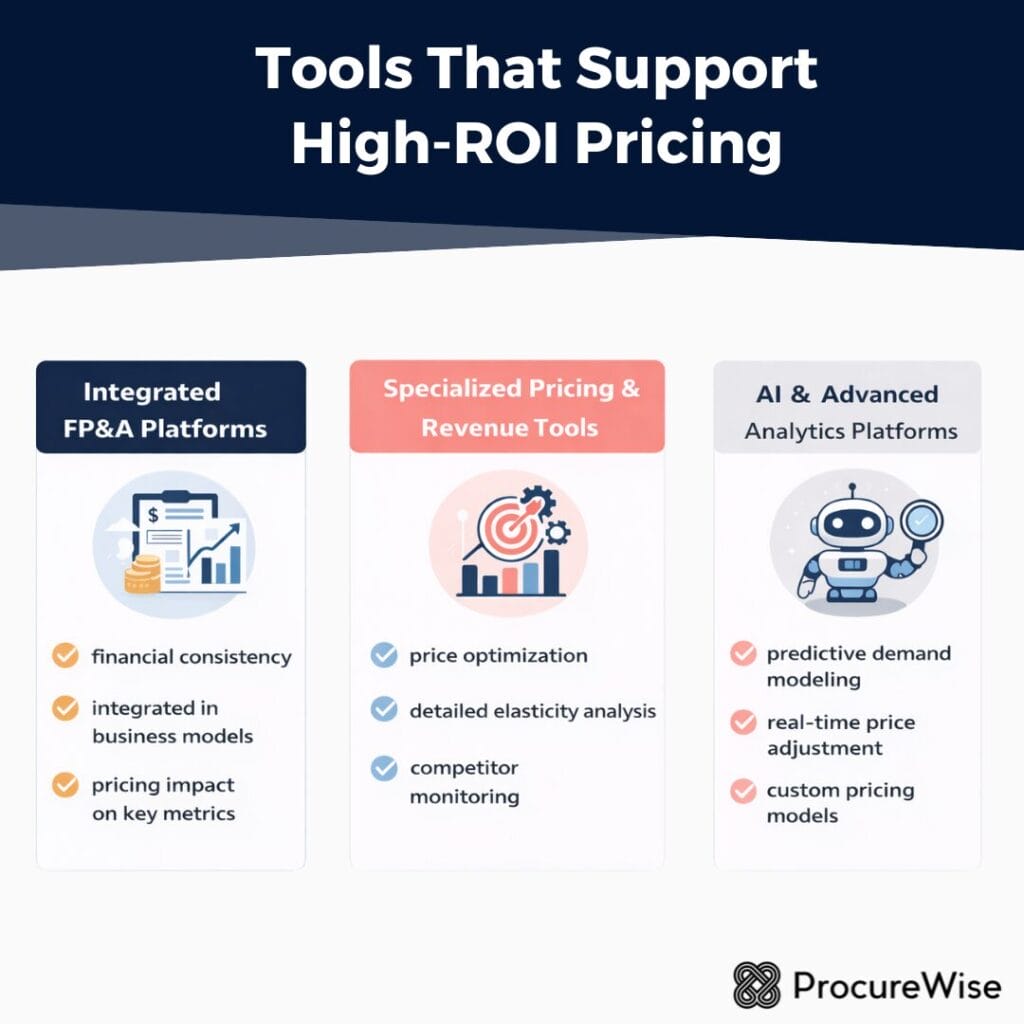
Tool Categories That Support High-ROI Pricing 🧩
Integrated FP&A Platforms (Finance-Led Control) 📊
Modern FP&A platforms embed pricing inside full financial models:
- income statement,
- balance sheet,
- cash flow projections.
Their strength lies in financial consistency. Leadership can instantly see how a price change affects margins, cash, and investor metrics. These tools shine in complex organizations where pricing must align with capital planning and reporting.
Specialized Pricing & Revenue Management Software 📈
Purpose-built pricing tools focus on:
- price optimization,
- elasticity modeling,
- dynamic and promotional pricing,
- competitor intelligence.
They’re ideal when pricing is a core competitive weapon rather than a periodic finance exercise. These tools often outperform general platforms in speed and granularity.
AI & Advanced Analytics Platforms (Custom Intelligence) 🤖
AI-driven tools unlock:
- predictive demand modeling,
- pattern recognition at scale,
- real-time price adjustment logic.
They’re powerful when businesses need bespoke models, complex segmentation, or continuous optimization across large portfolios.
🧠 Best Practices for Implementing ROI Pricing Tools 🧠
🏛️ Leadership Buy-In Is Non-Negotiable 🧑💼
Without executive sponsorship, pricing tools become dashboards no one trusts. ROI pricing works best when leadership treats pricing as capital allocation, not a sales lever.
🤝 Cross-Functional Ownership Beats Silos 🧩
High-performing pricing teams involve:
- finance (ROI discipline),
- sales (market reality),
- marketing (value communication),
- product (value creation).
This alignment prevents theoretical models that fail in execution.
📊 Data Discipline Before Fancy Algorithms 🧼
AI doesn’t fix bad inputs. The fastest ROI wins often come from:
- cleaning cost data,
- clarifying assumptions,
- documenting logic.
Sophisticated tools only pay off once fundamentals are solid.
🤖 The Future of Pricing: From Insight to Automation 🤖
🔮 Predictive → Prescriptive → Autonomous Pricing 🧭
Pricing is moving fast:
- Predictive: what will happen if we change price?
- Prescriptive: what price should we set?
- Autonomous: the system adjusts prices continuously.
Each step tightens the link between pricing and ROI.
🗣️ NLP & Customer Value Intelligence 💬
Natural Language Processing helps extract value signals from:
- reviews,
- sales conversations,
- market commentary.
This closes the gap between customer perception and financial modeling, strengthening value-based pricing.
⚡ Real-Time, ROI-Optimized Pricing Systems 🏎️
The endgame is pricing engines that:
- monitor markets continuously,
- react instantly to demand shifts,
- optimize cash flow and margin in real time.
When done right, pricing becomes one of the highest-return investments a company can make.
🏁 Final Takeaway: Pricing Is the Highest-ROI Lever 🏁
ROI-driven pricing tools transform pricing from intuition into infrastructure. Companies that adopt them:
- grow margins faster,
- generate stronger cash flows,
- and earn investor confidence.
The path isn’t about buying the fanciest tool first — it’s about thinking in ROI, modeling outcomes, and iterating relentlessly.