

In today’s hyper-competitive retail landscape, inventory management is no longer just an operational task — it is a strategic advantage. Retailers constantly face one key question: how many active SKUs should a store really have?
Too many SKUs lead to SKU proliferation, rising holding costs, and operational chaos. Too few may result in stockouts, lost sales, and reduced customer satisfaction. The answer is not a fixed number. The ideal SKU count depends on balancing:
- Product variety
- Inventory efficiency
- Operational capacity
- Demand forecasting accuracy
- Gross margins and inventory turnover rate
The goal is simple: maximize profitability while maintaining optimal inventory levels.
⚖️ Variety vs. Efficiency: The Core Retail Dilemma ⚖️
At the heart of SKU management lies a strategic tension.
On one side, retailers expand product variants (sizes, colors, materials) to:
- Increase market share
- Improve customer satisfaction
- Capture diverse customer demand
On the other side, every new SKU number adds complexity to:
- Warehouse management
- Stock levels control
- Order fulfillment
- Inventory tracking
- Reorder points planning
More SKUs mean:
- Higher holding costs
- Increased risk of dead stock
- Slower fulfillment process
- Lower inventory visibility
Fewer SKUs mean:
- Missed revenue opportunities
- Higher stockout risk
- Lower competitive positioning
The ideal strategy lies in controlled SKU rationalization, not unlimited expansion.
🏷️ What Is an SKU and Why It Matters in Inventory Management 🏷️
A Stock Keeping Unit (SKU) is a unique internal identifier assigned to a specific product variant. Unlike a Universal Product Code (UPC), which is standardized across retailers, the SKU is designed for internal inventory tracking.
Each SKU may represent:
- Brand
- Size
- Color
- Packaging type
- Product variation
Without clear SKU system structure, businesses struggle with:
- Accurate stock levels
- Inventory turnover rate calculation
- Demand forecasting
- Automated reordering
- Product catalog organization
A properly structured SKU management system enables:
- Real-time inventory visibility
- Better supply chain coordination
- Improved warehouse management system (WMS) performance
- Faster POS system integration
In short: strong SKU tracking is the backbone of inventory efficiency.
📊 Why the “Ideal” SKU Count Is a Strategic Advantage 📊
An optimized SKU portfolio directly impacts:
💰 Profitability
- Focus on high-margin SKUs
- Improve gross margins
- Reduce dead stock
🚀 Operational Efficiency
- Streamline fulfillment centers
- Reduce picking and packing errors
- Optimize reorder points
🔄 Inventory Turnover Rate
- Increase stock rotation
- Free working capital
- Improve automated reordering accuracy
😊 Customer Satisfaction
- Reduce stockouts
- Improve product availability
- Simplify purchasing decisions
When SKU levels are aligned with demand forecasting and warehouse capacity, inventory becomes a growth driver, not a cost center.
⚠️ The Risks of SKU Imbalance ⚠️
SKU Proliferation (Too Many SKUs) 📉
Excessive SKU expansion leads to:
- Tied-up capital in slow movers
- Increased dead stock
- Higher storage costs
- Reduced inventory turnover rate
- Complicated warehouse management
It also creates decision fatigue for customers. Too many product variants may reduce conversion rates instead of increasing them.
Too Few SKUs (Limited Assortment) 📈
Insufficient product variety results in:
- Frequent stockouts
- Lost sales
- Lower market share
- Reduced customer loyalty
Poor SKU strategy often shows up in:
- Weak demand forecasting
- Inaccurate reorder points
- Poor supply chain coordination
📊 Jak obliczyć optymalną liczbę SKU? Data-driven framework dla retail 📊
Analyze SKU Performance and Profitability 📈
To determine how many active SKUs your store should have, start with twarde dane, nie intuicję. Effective SKU management begins with deep performance analysis.
Focus on these key metrics:
- Sales velocity – how fast a SKU sells
- Gross margins – profit per SKU
- Contribution margin – real profitability after variable costs
- Inventory turnover rate – how often stock rotates
- Stock levels vs. demand
Very often:
- 20% of SKUs generate 80% of revenue
- 30–40% of SKUs contribute marginally to profit
This is where SKU rationalization becomes critical.
Use ABC classification:
- A-SKUs → high revenue, high turnover
- B-SKUs → moderate contribution
- C-SKUs → low rotation, often dead stock
Your goal is not maximum variety — but maximum productivity per SKU number.
📦 Monitor Inventory Turnover and Stock Levels 📦
One of the strongest indicators of healthy SKU count is inventory turnover rate.
Formula:
Inventory Turnover = Cost of Goods Sold ÷ Average Inventory Value
High turnover:
- Strong demand forecasting
- Healthy supply chain
- Optimized reorder points
Low turnover:
- Overstock
- Dead stock
- SKU proliferation
Healthy businesses continuously monitor:
- Stock levels per SKU
- Dead stock percentage
- Lead time impact
- Reorder points accuracy
When turnover drops, it usually signals:
- Too many product variants
- Poor demand forecasting
- Weak automated reordering rules
📉 Identify SKU Proliferation Early 📉
SKU proliferation often happens silently.
Symptoms include:
- Growing product catalog without margin growth
- Increasing warehouse management complexity
- More fulfillment errors
- Declining gross margins
- Reduced inventory visibility
Ask critical questions:
- Does each SKU serve a clear customer segment?
- Does it improve customer satisfaction?
- Does it increase overall inventory turnover rate?
- Is it justified by demand forecasting data?
If not — it may be time for SKU rationalization.
🔍 Improve Demand Forecasting Accuracy 🔍
Accurate demand forecasting is fundamental to deciding how many SKUs you can safely maintain.
Modern Inventory Management Software (IMS) and warehouse management systems (WMS) help analyze:
- Historical sales data
- Seasonality
- Market trends
- POS system data
- Lead time variability
Better forecasting improves:
- Reorder points precision
- Automated reordering efficiency
- Safety stock planning
- Inventory visibility
When forecasting is weak, retailers compensate by adding more SKUs “just in case” — which increases complexity and stock levels unnecessarily.
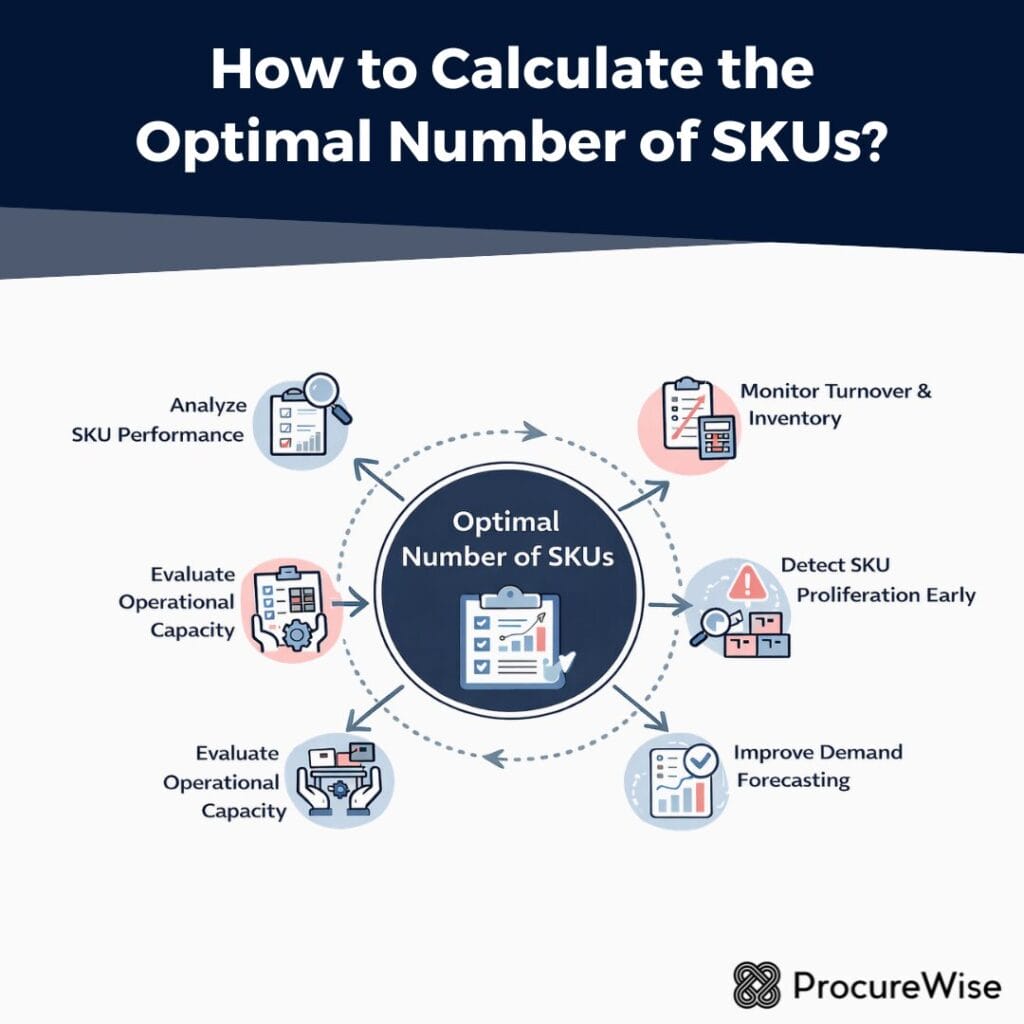
🏭 Assess Operational Capacity Before Expanding SKU Count 🏭
Before adding product variants, evaluate operational readiness:
- Can your warehouse management system handle more SKUs?
- Is your fulfillment process optimized?
- Does your supply chain support higher complexity?
- Do you have strong SKU tracking?
Each additional SKU increases:
- Picking time
- Packing complexity
- Risk of errors
- Lead time variability
An optimal SKU system must match operational capacity — otherwise efficiency drops sharply.
🧠 Competitive Strategy and SKU Structure 🧠
Your ideal SKU count also depends on positioning:
Niche strategy
- Curated product catalog
- Higher margins
- Lower stock levels
Mass assortment strategy
- Broader product variants
- Higher inventory complexity
- Strong reliance on inventory management software
There is no universal number. The right SKU count depends on:
- Market saturation
- Customer expectations
- Supply chain maturity
- Technology capabilities
🧹 Strategic SKU Rationalization: How to Reduce Without Losing Revenue 🧹
Effective SKU rationalization is not random product removal — it is a structured profitability strategy within inventory management.
Start by identifying:
- SKUs with low inventory turnover rate
- Products below minimum gross margins
- Variants generating minimal contribution to total revenue
- Items increasing warehouse management complexity
Focus especially on:
- Slow-moving product variants
- Seasonal SKUs with declining demand
- Duplicated or overlapping product variations
Ask:
- Does this SKU improve customer satisfaction?
- Does it justify its stock levels and storage cost?
- Does it strengthen competitive positioning?
If not, consider:
- Phased discontinuation
- Clearance campaigns
- Bundling with high-performing SKUs
- Removing it from automated reordering rules
Reducing even 10–20% of underperforming SKUs often improves:
- Inventory visibility
- Fulfillment speed
- Gross margins
- Inventory turnover rate
📦 Optimize Product Variants Instead of Expanding Blindly 📦
SKU growth should be strategic — not reactive.
Instead of launching entirely new products, optimize existing ones:
- Add high-demand sizes or colors
- Introduce limited editions
- Test variants with controlled stock levels
- Use POS system data before scaling
This reduces risk while maintaining product variety.
A smarter SKU system focuses on:
- High-performing core products
- Controlled product variants
- Demand-driven expansion
- Clear reorder points
This approach protects both:
- Customer satisfaction
- Operational efficiency
🤖 Automate Reordering and SKU Tracking 🤖
Technology is critical in controlling SKU complexity.
Strong inventory management software enables:
- Real-time inventory visibility
- SKU tracking across fulfillment centers
- Automated reordering
- Accurate reorder points
- Dead stock alerts
Automation improves:
- Inventory levels accuracy
- Demand forecasting precision
- Supply chain coordination
- Lead time management
When automated reordering is aligned with sales velocity and safety stock, businesses avoid:
- Overstock
- Stockouts
- Manual planning errors
🏭 Strengthen Warehouse and Fulfillment Efficiency 🏭
High SKU count increases operational strain.
To maintain efficiency:
- Optimize warehouse management system (WMS)
- Group high-rotation SKUs strategically
- Improve SKU number structure
- Simplify picking paths
Better SKU organization improves:
- Order fulfillment speed
- Accuracy in SKU tracking
- Inventory visibility
- Customer satisfaction
If fulfillment complexity grows faster than revenue, SKU count is likely too high.
📊 Protect Gross Margins Through SKU Discipline 📊
Every SKU must justify its existence financially.
Monitor:
- Margin per SKU
- Carrying cost per SKU
- Contribution to revenue
- Inventory turnover rate
Avoid:
- Low-margin product catalog expansion
- Emotional product launches
- Supply chain inefficiencies
SKU discipline directly protects:
- Cash flow
- Working capital
- Profitability
🔁 Build a Continuous SKU Review Process 🔁
The best retailers treat SKU optimization as an ongoing process.
Implement:
- Quarterly SKU performance audits
- Monthly stock levels review
- Regular demand forecasting updates
- Continuous supply chain monitoring
Strong SKU management integrates:
- Inventory management software
- Warehouse management system
- POS system data
- Demand forecasting tools
Without regular review, SKU proliferation returns quickly.
📊 KPI Dashboard for Optimal SKU Count and Inventory Health 📊
Measure SKU Contribution and Profitability Precisely 📈
To maintain the ideal SKU count, retailers must continuously monitor SKU-level performance. Without measurable KPIs, SKU management becomes guesswork.
Track these critical indicators:
- Revenue per SKU
- Gross margins per SKU
- Contribution margin
- Inventory turnover rate
- Stock levels vs. sales velocity
- Dead stock percentage
- Stockout rate per SKU
In most retail businesses:
- 10–20% of SKUs generate the majority of profit
- 30% of SKUs often reduce operational efficiency
Your dashboard should clearly show:
- Which SKUs drive cash flow
- Which SKUs slow down warehouse management
- Which product variants justify their storage space
This improves:
- Inventory visibility
- Automated reordering accuracy
- Reorder points precision
- Supply chain planning
📦 Control Inventory Levels Without Limiting Growth 📦
Healthy inventory levels are not about minimizing stock — they are about balance.
Strong SKU governance ensures:
- Safety stock is optimized
- Lead time variability is accounted for
- Demand forecasting is continuously updated
- Inventory turnover rate remains healthy
A balanced SKU system reduces:
- Overstock
- Dead stock
- Emergency replenishment costs
- Fulfillment delays
Well-managed stock levels directly increase:
- Customer satisfaction
- Order fulfillment speed
- Gross margins
- Inventory efficiency
🏭 Build a Long-Term SKU Governance Model 🏭
Sustainable SKU optimization requires structure.
Implement:
- Quarterly SKU rationalization reviews
- Product catalog performance audits
- Supply chain efficiency assessments
- Warehouse management system evaluations
- POS system data integration
Governance should answer regularly:
- Should we expand this product variant?
- Should we discontinue this SKU number?
- Are reorder points aligned with real demand?
- Is automated reordering functioning properly?
Without governance, SKU proliferation returns quickly and weakens inventory management performance.
🤖 Technology as the Backbone of SKU Strategy 🤖
Modern Inventory Management Software and Warehouse Management Systems are no longer optional.
They enable:
- Real-time SKU tracking
- Advanced demand forecasting
- Inventory visibility across fulfillment centers
- Automated reordering
- Dead stock identification
- Inventory turnover rate monitoring
Technology reduces:
- Manual errors
- Operational complexity
- Lead time uncertainty
- Gross margin erosion
The more complex your product variants, the more critical your technology stack becomes.
🔄 Continuous Optimization: SKU Strategy Is Never Finished 🔄
The ideal SKU count is dynamic.
It evolves with:
- Market trends
- Customer behavior
- Supply chain conditions
- Competitive landscape
- Operational capacity
Retailers that win long-term:
- Monitor KPIs monthly
- Adjust stock levels proactively
- Align SKU tracking with demand forecasting
- Protect margins through disciplined SKU management
The question is not:
“How many SKUs should I have?”
The better question is:
“Is every active SKU improving my inventory efficiency and profitability?”
🚀 Final Strategic Takeaways 🚀
An optimized SKU portfolio allows you to:
- Increase inventory turnover rate
- Improve gross margins
- Reduce dead stock
- Enhance customer satisfaction
- Strengthen warehouse management efficiency
- Improve order fulfillment performance
The ideal SKU count is not about more products — it is about productive products.
Start by auditing:
- Your product catalog
- Inventory levels
- Reorder points
- Demand forecasting accuracy
- Supply chain efficiency
Then implement disciplined SKU rationalization, strong inventory tracking, and intelligent automated reordering.
That is how modern retailers turn SKU management into a competitive advantage.