
Price is not just a number — it is a psychological signal. In modern pricing strategy, price acts as emotional communication that directly shapes customer perception, consumer behavior, and overall perceived value.
In competitive markets, brands no longer compete only on features or cost efficiency. They compete on how customers feel about the price. Every price point, every framing choice, and every pricing tactic influences subconscious evaluation.
From psychological pricing to price anchoring and the decoy effect, businesses use behavioral mechanisms rooted in behavioral economics to influence emotional response and decision-making.
Understanding this emotional layer of pricing allows brands to:
- Increase perceived value
- Improve sales volume
- Strengthen brand reputation
- Influence customer behavior
- Enhance customer loyalty
Price, therefore, becomes a strategic emotional lever — not a financial afterthought.
💡 The Invisible Hand: How Price Shapes Customer Perception & Emotional Response 💡
Customers rarely evaluate price rationally. Instead, they interpret it through cognitive shortcuts and cognitive biases.
A higher price may signal:
- Premium quality
- Exclusivity
- Prestige positioning
A lower price may trigger:
- Urgency
- Deal perception
- Increased price sensitivity
This automatic reaction is part of consumer perception psychology. Before analyzing product features, the brain asks:
“What does this price say about the product?”
This is why prestige pricing, charm pricing, and dynamic pricing affect not only conversion rates but also long-term brand positioning.
Price shapes emotional response first — rational justification comes second.
🛍️ The Emotional Core of Perceived Value: Why Consumers Buy 🛍️
At the heart of purchasing decisions lies perceived value — a multidimensional construct influenced by emotion more than logic.
Customers buy because of:
- Aspiration
- Security
- Social status
- Fear of missing out (FOMO)
- Emotional triggers
Price plays a crucial role in activating these drivers.
For example:
- Prestige Pricing increases perceived quality and status.
- Discounts trigger emotional satisfaction and loss aversion relief.
- Scarcity messaging enhances desirability and urgency.
Perceived value is not cost minus benefit. It is:
Emotional impact + price framing + brand reputation + expectations
Brands that understand this outperform competitors even at higher price points.
🧩 Beyond the Rational: Subconscious Processing of Price Signals 🧩
Human decision-making operates through two systems:
- Fast, emotional, intuitive thinking
- Slow, rational, analytical thinking
Pricing primarily activates the first.
Techniques such as:
- Charm prices (.99, .95)
- Left-digit effect
- Price thresholds
- Odd-even pricing
trigger subconscious processing.
A price of $9.99 feels significantly lower than $10.00 due to the left-digit effect, even when the difference is minimal. This small adjustment changes emotional perception and reduces purchase friction.
This is why price framing and presentation matter as much as the price itself.
📊 Deconstructing Perceived Value: A Multi-Dimensional Experience 📊
Perceived value consists of several interacting dimensions:
- Perceived quality
- Brand reputation
- Emotional response
- Reference price comparison
- Price anchoring effect
- Customer expectations
Higher prices often increase perceived quality — especially when aligned with strong branding. Meanwhile, lower prices increase accessibility but may reduce prestige perception.
Smart brands balance:
- Pricing tiers
- Tiered pricing structures
- Reference prices
- Bundling strategies
- Average order value optimization
By structuring price architecture strategically, companies influence customer perception without changing the product itself.
🧠 The Brain’s Pricing Playbook: Behavioral Economics in Action 🧠
Behavioral economics explains why consumers do not behave rationally when evaluating price.
Key mechanisms include:
- Anchoring effect
- Decoy effect
- Loss aversion
- Mental accounting
- Endowment effect
- Price sensitivity bias
These cognitive biases shape how customers interpret pricing tactics.
For example:
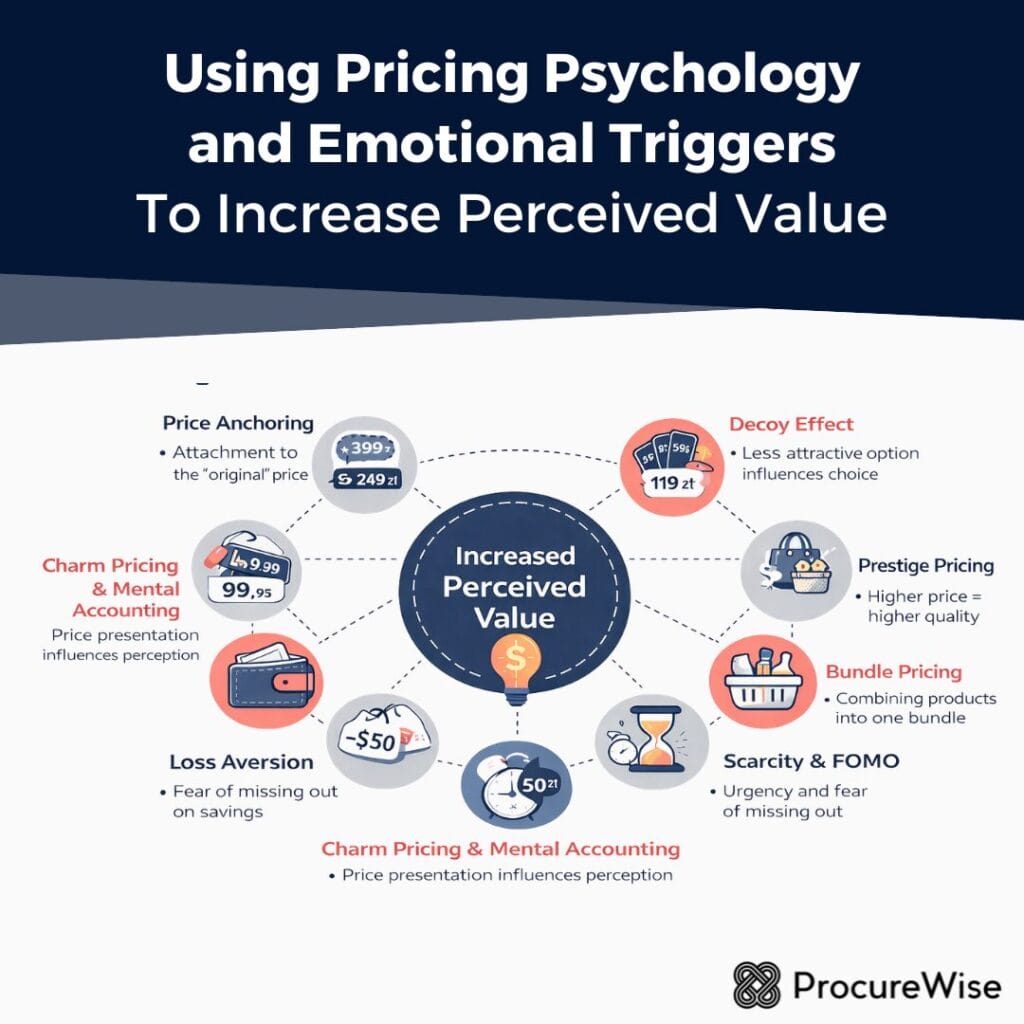
- A higher “original” price increases the attractiveness of a discount (Price Anchoring).
- Introducing a less attractive third option increases selection of a premium offer (Decoy Pricing).
- Framing a discount as “Don’t lose $50” activates stronger motivation than “Save $50” (Loss Aversion).
Understanding these psychological principles transforms pricing from arithmetic into strategic persuasion.
🧠 Fundamental Psychological Pricing Tactics That Increase Perceived Value 💰
Charm Pricing & Left-Digit Effect: The Illusion of a Better Deal 🪄
Charm pricing (e.g., 9.99, 4.95, 19.90) is one of the most powerful tools in psychological pricing. It leverages the left-digit effect, where consumers disproportionately focus on the first digit of a price.
A shift from $10.00 to $9.99:
- Lowers perceived price thresholds
- Reduces price sensitivity
- Triggers “good deal” perception
- Improves sales volume
Although the difference is minimal, the emotional response is significant. This tactic strongly influences consumer behavior, especially in high-volume retail and e-commerce environments.
When used strategically within defined price points, charm pricing enhances value perception without altering the product itself.
Price Anchoring & Reference Price: Framing Value Through Comparison ⚖️
Price anchoring (or reference price strategy) uses an initial number to shape evaluation of subsequent options.
Example structure:
- Was $199
- Now $129
The original price acts as a psychological anchor, making the final price feel like a gain. This works because of the anchoring effect, one of the strongest cognitive biases in behavioral economics.
Benefits of anchoring:
- Enhances perceived savings
- Increases average order value
- Strengthens perceived value
- Reduces purchase hesitation
Anchoring is especially effective in:
- Pricing tiers
- Tiered pricing
- Subscription models
- Bundled offers
When customers compare options, the highest visible anchor often elevates the attractiveness of mid-tier offers.
Decoy Pricing & The Decoy Effect: Steering Customer Behavior Strategically 🎯
The decoy effect introduces a third, less attractive option to influence decision-making.
Example:
- Basic: $10
- Premium: $25
- Standard (Decoy): $23
The decoy makes Premium appear more valuable relative to its price. This reduces decision paralysis and increases premium selection rates.
This tactic:
- Influences customer perception
- Guides consumer behavior
- Boosts sales volume
- Enhances perceived value of target offer
Decoy pricing is especially powerful in SaaS, subscription pricing, and menu-based pricing structures.
Pricing Tiers & Tiered Pricing: Structuring Value Architecture 📊
Well-designed pricing tiers increase perceived control and reduce uncertainty.
Tiered pricing:
- Anchors high value with premium plans
- Makes middle plans appear optimal
- Creates transparent differentiation
- Supports customer segmentation
Three-tier structures are most effective:
- Entry-level (low commitment)
- Core / Recommended (best value framing)
- Premium (aspirational anchor)
This structure leverages:
- Anchoring effect
- Mental accounting
- Consumer perception comparison
It also increases average order value and aligns pricing strategy with different emotional drivers across segments.
🔥 Advanced Emotional Triggers That Amplify Perceived Value 🚀
Scarcity, Urgency & FOMO: Emotional Acceleration Mechanisms ⏳
Scarcity activates one of the strongest emotional triggers in pricing psychology.
When customers see:
- “Limited stock”
- “Offer ends today”
- “Only 3 left”
They experience urgency and loss aversion — the fear of missing out on value.
This:
- Increases emotional response
- Reduces rational hesitation
- Boosts short-term sales volume
- Enhances perceived exclusivity
Scarcity must remain authentic to preserve brand reputation and long-term trust.
Prestige Pricing: Signaling Status & Exclusivity 👑
Prestige pricing intentionally sets higher price points to signal superior quality and exclusivity.
Higher prices:
- Increase perceived quality
- Enhance brand reputation
- Attract status-oriented segments
- Reduce price sensitivity among premium buyers
This strategy works particularly well when aligned with strong branding and emotional storytelling.
Luxury positioning depends not only on product quality, but also on the psychological interpretation of the price itself.
Bundling & Product Bundling: Increasing Holistic Value 🎁
Bundle pricing combines products to enhance perceived convenience and total savings.
Benefits:
- Increases average order value
- Enhances perceived deal size
- Reduces individual price scrutiny
- Encourages cross-selling
Consumers evaluate bundles through mental accounting. The total package often feels like higher value than separately evaluated components.
Bundling works best when:
- Products are complementary
- Savings are clearly framed
- Value comparison is visible
Price Framing & Emotional Language: Controlling Perception Through Presentation 🗣️
How you present price often matters more than the number itself.
Effective price framing includes:
- “Only $2 per day” instead of $60 per month
- “Under $100” instead of $99.99
- Emphasizing savings vs. cost
Framing directly impacts:
- Emotional response
- Price sensitivity
- Consumer perception
- Purchase justification
Small linguistic adjustments can dramatically influence perceived fairness and accessibility.
🧩 Deep Behavioral Biases in Pricing Strategy & Consumer Behavior 🧠
Loss Aversion: The Emotional Power of Avoiding Loss 😨
One of the strongest principles in behavioral economics is loss aversion — the idea that people feel losses more intensely than gains.
In pricing psychology, this means:
- “Don’t miss saving $50” works better than “Save $50”
- “Offer expires today” increases urgency
- “Last chance price” reduces hesitation
Customers react more strongly to potential loss than to potential gain. This directly influences:
- Emotional response
- Consumer perception
- Sales volume
- Conversion rates
Strategically framed messaging reduces price sensitivity and strengthens perceived value by positioning purchase as loss prevention, not spending.
Anchoring Effect vs. Price Anchoring: Subtle Differences That Matter ⚖️
While often used interchangeably, there is a distinction:
- Anchoring effect → cognitive bias
- Price anchoring → pricing tactic leveraging that bias
The anchoring effect explains why the first visible number becomes a mental reference point. Businesses then apply this bias using:
- Crossed-out original prices
- High-tier premium anchors
- Reference price comparisons
- Tiered pricing models
When a premium plan costs $499, a $249 option suddenly feels reasonable — even if it originally seemed expensive.
Anchoring reshapes customer perception without changing the actual value delivered.
The Endowment Effect: Creating Psychological Ownership 💼
The endowment effect describes how consumers value something more once they feel ownership.
This can be activated through:
- Free trials
- Product customization
- Personalization
- “Build your own” pricing tiers
When customers mentally “own” a product, their perceived value increases, and their price sensitivity decreases.
This strengthens:
- Customer loyalty
- Emotional triggers
- Brand attachment
- Conversion probability
Ownership precedes justification — and justification supports purchase.
Mental Accounting & Price Sensitivity: How Customers Categorize Spending 💳
Consumers do not treat all money equally.
According to mental accounting, people assign spending into emotional categories:
- Essentials
- Luxuries
- Investments
- Deals
A $300 online course framed as an “investment” feels different than $300 framed as a “cost.”
Effective price framing shifts perception between categories, reducing resistance and increasing perceived value.
Understanding mental accounting allows brands to:
- Reduce price sensitivity
- Adjust price thresholds
- Improve conversion rates
- Optimize average order value
🎨 Emotional Pricing Architecture: Structuring Price for Maximum Perceived Value 💎
Customer Segmentation: Matching Emotional Triggers to Audience 🎯
Different customer segments respond to different pricing tactics.
For example:
- Price-sensitive buyers → respond to charm prices and bundles
- Status-driven segments → respond to prestige pricing
- Younger demographics → respond to scarcity & urgency
- Loyal customers → respond to exclusive reference price offers
Effective customer behavior analysis allows:
- Personalized pricing tiers
- Dynamic pricing adaptation
- Tailored emotional triggers
- Improved sales volume
Value is not universal — it is emotional and contextual.
Dynamic Pricing & AI Pricing Platforms: Emotional Optimization at Scale 🤖
Modern dynamic pricing uses AI-driven systems to analyze:
- Market trends
- Consumer behavior
- Price sensitivity
- Purchase history
- Demand fluctuations
AI pricing platforms adjust price points in real time to maximize:
- Perceived value
- Conversion rates
- Revenue
- Competitive positioning
However, emotional perception remains critical. Even automated systems must consider:
- Reference price expectations
- Brand reputation
- Consumer perception consistency
Technology enhances pricing — but psychology defines its effectiveness.
Pricing Tactics & Brand Reputation: The Strategic Balance 🏷️
Short-term pricing tactics can increase sales, but misalignment damages brand reputation.
For example:
- Excessive discounts reduce prestige perception
- Artificial scarcity reduces trust
- Inconsistent pricing tiers confuse customers
A strong pricing strategy aligns:
- Emotional triggers
- Brand positioning
- Customer expectations
- Long-term value
Consistency builds trust. Trust builds loyalty. Loyalty increases lifetime value.
📈 From Pricing Tactics to Customer Loyalty & Sales Growth 🚀
Increasing Average Order Value Through Psychological Design 📊
Strategic use of:
- Bundling
- Tiered pricing
- Anchoring
- Decoy pricing
- Add-on pricing
can significantly increase average order value (AOV).
Customers spend more when:
- Higher tiers feel justified
- Savings appear substantial
- Value comparison is visible
- Emotional satisfaction is strong
Increasing AOV without increasing traffic is one of the most effective growth levers in pricing strategy.
Emotional Response & Customer Loyalty: Beyond One Transaction ❤️
Sustainable growth depends on emotional experience.
When pricing feels:
- Fair
- Transparent
- Justified
- Consistent
Customers develop:
- Trust
- Reduced price sensitivity
- Repeat purchase behavior
- Brand advocacy
Perceived value, when emotionally reinforced, leads to customer loyalty, not just one-time conversions.
⚖️ Ethical Psychological Pricing & Long-Term Perceived Value 🤝
The Fine Line Between Persuasion and Manipulation 🧭
Psychological pricing is powerful — but it must remain ethical.
There is a difference between:
- Strategic price framing
- Deceptive artificial scarcity
- Transparent reference price
- Fake “was” pricing
- Smart decoy pricing
- Misleading price thresholds
When customers detect manipulation, brand reputation suffers. Trust declines. Customer loyalty weakens.
Sustainable pricing strategy should:
- Enhance clarity
- Highlight real value
- Reduce decision friction
- Respect consumer intelligence
Emotional triggers should amplify genuine value — not fabricate it.
Consumer Perception & Trust: The Foundation of Customer Loyalty 🔐
Long-term customer loyalty depends on consistent emotional experience.
If pricing feels:
- Fair
- Predictable
- Justified
- Aligned with brand promise
Customers develop:
- Lower price sensitivity
- Stronger brand attachment
- Higher lifetime value
- Positive word-of-mouth
Perceived value is cumulative. Each interaction reinforces — or erodes — trust.
Pricing tactics must support long-term relationship building, not short-term sales spikes.
🚀 Future Outlook: AI, Dynamic Pricing & Emotional Data 📊
AI Pricing Platforms & Emotional Intelligence 🤖
The future of dynamic pricing lies in AI-powered systems that analyze:
- Consumer behavior patterns
- Emotional response signals
- Price sensitivity trends
- Market trends
- Sales volume fluctuations
AI pricing platforms can adjust:
- Price points
- Pricing tiers
- Promotional framing
- Bundle pricing strategies
in real time.
However, even the most advanced technology cannot replace understanding of:
- Cognitive biases
- Behavioral economics
- Emotional triggers
- Customer perception dynamics
Technology optimizes numbers. Psychology optimizes perceived value.
Dynamic Pricing vs. Brand Consistency ⚖️
While dynamic pricing increases efficiency, brands must ensure:
- Price stability within expected thresholds
- Transparent communication
- Consistent reference pricing
- Protection of prestige positioning
If price fluctuates unpredictably, perceived value may decline — even if revenue increases short term.
The balance between automation and emotional consistency will define future pricing leadership.
💡 Strategic Framework: Building an Emotional Pricing Strategy 🎯
Step 1: Define Core Perceived Value Drivers 🧠
Identify:
- Emotional triggers
- Key customer segments
- Brand positioning
- Price sensitivity levels
- Competitive reference prices
Map how pricing tactics reinforce these elements.
Step 2: Design Structured Pricing Architecture 🏗️
Implement:
- Clear pricing tiers
- Logical tiered pricing
- Strategic decoy pricing
- Intentional charm prices
- Well-framed bundle pricing
Ensure alignment with:
- Consumer perception
- Brand reputation
- Sales objectives
Pricing is architecture — not improvisation.
Step 3: Optimize Emotional Framing & Presentation 🎨
Refine:
- Price display formatting
- Emotional language
- Savings emphasis
- Visual hierarchy
- Reference price positioning
Small adjustments in price framing significantly influence:
- Emotional response
- Conversion rates
- Average order value
Presentation shapes perception.
Step 4: Monitor Behavioral Signals & Adapt 📈
Track:
- Sales volume changes
- AOV fluctuations
- Tier selection distribution
- Customer behavior shifts
- Price sensitivity metrics
Integrate behavioral economics insights with real-time data.
Refine without compromising trust.
🎯 Conclusion: Mastering the Emotional Language of Price 💎
Price is not arithmetic — it is psychology.
Through:
- Psychological pricing
- Price anchoring
- Decoy effect
- Prestige pricing
- Bundling
- Scarcity triggers
- Behavioral economics principles
brands can significantly increase perceived value without changing the core product.
The most successful companies understand:
Consumers buy emotions first — logic second.
By aligning pricing strategy with:
- Emotional triggers
- Brand reputation
- Customer perception
- Ethical transparency
you build not just transactions — but sustainable growth, stronger customer loyalty, and long-term competitive advantage.
Master the emotional language of price, and you master perceived value.