

In today’s dynamic business environment, purchasing negotiations are no longer just transactional discussions about price. They are a strategic element of procurement functions, directly influencing cost savings, risk management, supplier stability, and long-term competitive advantage.
Modern organizations operate within increasingly complex supply chains, face volatile market trends, and must comply with strict regulatory compliance and compliance standards. At the same time, internal procurement teams are expected to deliver advanced spend analysis, manage supplier relationships, oversee contract management, and ensure continuous cost reduction.
This growing complexity explains the rising interest in Procurement Outsourcing and more specialized Outsourcing Procurement models—particularly in the area of contract negotiations and strategic sourcing.
The global growth of the procurement outsourcing market reflects a clear shift: companies are turning to external outsourcing providers and third-party service providers to gain access to specialized expertise and measurable ROI.
The Evolving Landscape of Procurement 🌍
Over the past decade, procurement has evolved from an operational back-office function into a strategic business driver.
Today’s organizations increasingly rely on:
- Advanced spend management systems
- Digitalized purchase orders workflows
- Structured supplier selection processes
- Data-driven supplier performance monitoring
However, despite digital tools, negotiation itself remains a highly specialized skill requiring:
- Deep category knowledge
- Strong supplier negotiations capabilities
- Legal awareness in contract management
- Market intelligence across industries
Even mature procurement teams may struggle to maintain high-level negotiation expertise across all spend categories. This gap often leads to considering outsourcing provider support for high-value or complex negotiations.
What This Article Covers: Beyond Cost Savings 💡
When discussing outsourcing negotiations, many companies focus solely on cost savings. While important, the real value goes much further.
The true ROI of outsourcing negotiations includes:
- Direct cost reduction
- Improved supplier relationship management
- Stronger risk management frameworks
- Better data protection and compliance alignment
- Greater operational focus on core business
In this four-part article, we will explore:
- What purchasing negotiation outsourcing really means
- How it differs from broader procurement outsourcing
- The key benefits and potential risks
- How to calculate the real ROI beyond price reductions
📘 Understanding Outsourced Purchasing Negotiations 📘
Defining Purchasing Negotiation Outsourcing 🤝
Purchasing negotiation outsourcing is the strategic delegation of negotiation activities to a specialized outsourcing provider.
It focuses specifically on:
- Structuring and leading contract negotiations
- Optimizing commercial terms
- Securing favorable pricing models
- Managing negotiation strategy within defined categories
Unlike general vendor coordination or vendor management, this model concentrates on high-impact negotiation outcomes that influence total cost of ownership (TCO).
It often involves:
- Pre-negotiation spend analysis
- Market benchmarking
- Risk assessment
- Final agreement structuring
- Post-negotiation contract management alignment
Differentiating from General Procurement Outsourcing 📂
While often grouped under Procurement Outsourcing, negotiation outsourcing is more specialized.
General outsourcing procurement may include:
- Strategic sourcing
- End-to-end purchase orders processing
- Supplier management
- Ongoing vendor relationships oversight
- Compliance documentation
Negotiation outsourcing, however, focuses specifically on the high-stakes interaction phase—where financial, legal, and operational terms are defined.
It requires advanced:
- Persuasion techniques
- Knowledge of supplier cost structures
- Understanding of supplier relationship management
- Control over negotiation leverage
This makes it a targeted, high-impact service rather than a broad administrative solution.
Common Models of Outsourced Negotiation Services 🧩
Organizations typically choose among several outsourcing models:
1️⃣ Project-Based Negotiations Support for a specific initiative, such as:
- Enterprise software contracts
- Logistics agreements
- Major infrastructure deals
2️⃣ Category-Specific Negotiations Delegating negotiations within selected spend categories (e.g., IT, logistics, marketing services).
3️⃣ Continuous Negotiation Support The outsourcing provider acts as an extension of the internal procurement team.
4️⃣ Tactical Negotiation Support On-demand advisory for difficult clauses, supplier negotiations, or complex risk management scenarios.
The scope often includes:
- Market research and market trends analysis
- Strategy preparation
- Active negotiation leadership
- Final contract structuring
- Support for ongoing contract management
🚀 The Strategic Case for Outsourcing Negotiations 🚀
Access to Specialized Expertise and Market Intelligence 🧠
One of the strongest arguments for Procurement Outsourcing in negotiation is immediate access to specialized expertise.
Professional negotiators bring:
- Deep category knowledge
- Advanced strategic sourcing methods
- Strong supplier negotiations capabilities
- Real-time insights into market trends
- Understanding of supplier cost structures and margins
Internal teams often manage multiple procurement functions simultaneously—supplier selection, purchase orders, supplier management, and contract management. Maintaining elite-level negotiation skills across all categories is difficult.
An experienced outsourcing provider operates across industries and clients, gaining leverage and benchmarking data that internal teams rarely possess. This strengthens negotiation positioning and increases outcome predictability.
Superior Cost Savings and Spend Optimization 💰
For many organizations, the primary driver is measurable cost savings.
Outsourced negotiation experts focus on:
- Direct cost reduction
- Total Cost of Ownership (TCO) optimization
- Improved payment terms
- Volume leverage
- Contractual flexibility
Through advanced spend analysis and structured strategic sourcing, companies often uncover hidden savings opportunities.
But the value extends beyond price cuts:
- Improved pricing models
- Better rebate structures
- Risk-adjusted contracts
- Performance-based clauses tied to supplier performance
Effective outsourcing procurement strategies also reduce maverick spend and strengthen spend management discipline.
Enhanced Focus on Core Business Activities 🎯
Negotiations consume time, energy, and senior-level attention.
By outsourcing complex contract negotiations, internal teams can redirect efforts toward:
- Long-term supplier relationship management
- Innovation partnerships
- Supply chain resilience
- Business growth initiatives
Many procurement departments face increasing pressure due to:
- Expanding supply chain complexity
- Regulatory and compliance requirements
- Growing data reporting obligations
Outsourcing high-intensity negotiation phases frees internal experts to focus on strategic value creation instead of tactical bargaining.
Improved Efficiency and Speed to Market ⚡
Negotiation cycles can delay projects and product launches.
Experienced third-party service providers bring:
- Standardized negotiation playbooks
- Structured approval workflows
- Advanced contract management methodologies
- Data-backed negotiation strategies
The result:
- Faster agreement closure
- Shorter sourcing cycles
- Reduced bottlenecks
- Streamlined procurement processes
In competitive markets, speed is often a decisive advantage.
Stronger Risk Management and Compliance Control 🛡️
Effective negotiations are critical to robust risk management.
Outsourcing providers help ensure:
- Clear Service Level Agreements (SLAs)
- Defined liability frameworks
- Exit clauses
- Data security protections
- Alignment with compliance standards
This is particularly important in areas such as:
- Data protection
- Cross-border agreements
- Regulated industries
- Complex supply contracts
By strengthening contractual safeguards, organizations reduce exposure to:
- Legal disputes
- Financial penalties
- Supply chain disruptions
- Regulatory breaches
Outsourcing negotiations therefore enhances not only cost performance, but also operational resilience.
Improved Vendor Relationships Through Structured Negotiation 🤝
Contrary to common concerns, professional negotiation does not damage relationships when executed properly.
Structured, data-driven discussions can actually improve:
- Transparency
- Long-term vendor relationships
- Mutual performance expectations
- Measurable supplier performance
Well-managed vendor management frameworks ensure negotiations remain strategic rather than adversarial.
When done correctly, outsourcing negotiation can elevate supplier collaboration rather than weaken it.
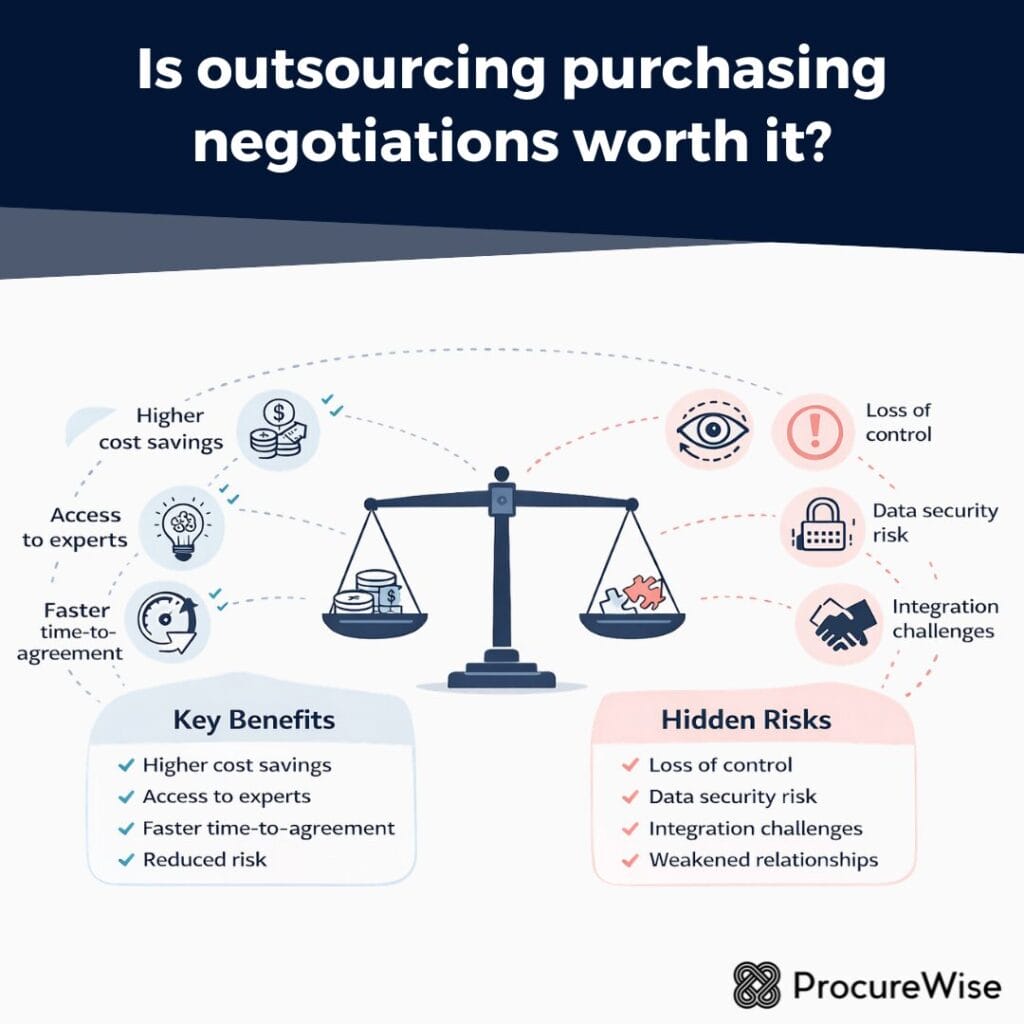
⚠️ The Hidden Hurdles of Outsourcing Negotiations ⚠️
Perceived Loss of Control and Oversight 👀
One of the most common concerns in Outsourcing Procurement is the fear of losing control over strategic contract negotiations.
When an external outsourcing provider handles discussions with key suppliers, organizations may worry about:
- Reduced visibility into negotiation tactics
- Misalignment with business priorities
- Limited internal influence over final terms
- Weakened internal vendor management authority
Negotiations often define long-term supplier relationships, pricing models, and operational flexibility. Without strong governance, companies may feel disconnected from decisions that directly impact their supply chain stability.
Clear KPIs, structured reporting, and shared decision checkpoints are critical to mitigate this risk.
Data Security and Confidentiality Risks 🔐
Negotiations require sharing sensitive information such as:
- Cost structures
- Financial forecasts
- Strategic sourcing plans
- Internal spend analysis data
Entrusting such data to a third-party service provider increases exposure to:
- Cybersecurity threats
- Confidentiality breaches
- Regulatory non-compliance
Strong data protection frameworks and alignment with compliance standards are non-negotiable. Companies must verify:
- IT security certifications
- Secure document exchange protocols
- Contractual confidentiality clauses
- Regulatory compliance requirements adherence
Inadequate protection can create long-term financial and reputational damage.
Potential Impact on Supplier Relationships 🤝
Poorly managed outsourcing can disrupt established supplier relationship management strategies.
If external negotiators:
- Apply overly aggressive tactics
- Lack knowledge of historical cooperation
- Ignore cultural or partnership nuances
It may harm trust and damage long-term vendor relationships.
This is particularly sensitive in strategic categories where collaboration, innovation, and continuity matter more than short-term cost reduction.
Successful outsourcing requires alignment between:
- Internal procurement leaders
- The outsourcing provider
- Key stakeholders managing supplier ecosystems
Integration Challenges and Hidden Costs 💸
While cost savings are often the main motivation, hidden costs may emerge.
Potential challenges include:
- Integration with existing procurement functions
- Misalignment with internal contract management systems
- Additional workload during transition
- Time investment in onboarding
In some cases, poor data quality within spend management systems can delay or weaken negotiation preparation.
Hidden costs may arise from:
- Extended transition phases
- Additional advisory fees
- Process redesign
- Duplicate internal oversight
Without careful planning, expected ROI may be diluted.
Cultural Misalignment and Communication Gaps 🌍
Effective negotiations depend on communication style, negotiation philosophy, and strategic intent.
Differences in:
- Organizational culture
- Risk appetite
- Negotiation approach
- Decision-making speed
Can lead to friction between internal teams and the outsourcing provider.
Misaligned communication may also affect:
- Supplier performance expectations
- Escalation processes
- Strategic sourcing direction
Establishing shared governance, clear escalation frameworks, and regular alignment meetings significantly reduces this risk.
Over-Reliance on External Expertise ⚖️
Another overlooked risk is internal capability erosion.
If organizations outsource too broadly:
- Internal negotiation skills may weaken
- Knowledge transfer may be limited
- Strategic leverage may shift externally
A balanced model—combining internal expertise with external specialized support—often delivers the most sustainable results.
📊 Unpacking the Real ROI of Outsourcing Negotiations 📊
Quantifying Direct Financial Benefits 💰
The most visible return from Procurement Outsourcing in negotiations is measurable cost savings.
Direct financial impact typically includes:
- Negotiated cost reduction in unit prices
- Improved payment terms and cash-flow benefits
- Lower Total Cost of Ownership (TCO)
- Reduced commercial risk exposure
Advanced spend analysis combined with expert supplier negotiations often reveals untapped savings in both direct and indirect categories.
In addition, structured strategic sourcing improves pricing transparency and supports long-term spend management discipline.
However, focusing only on price misses the broader value.
Strategic and Competitive Value Creation 🚀
Outsourcing negotiations can significantly strengthen strategic positioning.
Key long-term benefits include:
- Stronger supplier relationship management
- More structured vendor relationships
- Improved supplier performance frameworks
- Increased innovation potential
Professional negotiators help build balanced agreements that align incentives on both sides.
Well-designed contracts enhance:
- Collaboration
- Supply chain resilience
- Operational continuity
- Competitive differentiation
In volatile markets shaped by changing market trends, structured negotiation expertise becomes a strategic asset rather than a tactical tool.
Operational Efficiency and Resource Optimization ⚙️
One of the hidden ROI drivers is internal efficiency.
By outsourcing complex contract negotiations, organizations can:
- Free internal procurement leaders
- Reduce negotiation cycle times
- Streamline procurement functions
- Accelerate sourcing decisions
Internal teams can then focus on:
- Long-term category strategy
- Innovation programs
- Risk mitigation planning
- Strengthening supplier management frameworks
This reallocation of talent creates opportunity value that is often greater than direct cost savings alone.
Risk Mitigation and Compliance Value 🛡️
The financial impact of avoided risk is rarely visible—but highly significant.
Strong negotiation support improves:
- Contractual clarity
- Liability protection
- SLA definitions
- Exit strategies
It enhances risk management across the entire supply chain and ensures alignment with:
- Industry compliance standards
- Regulatory compliance requirements
- Internal governance policies
- Data protection obligations
Avoided disputes, penalties, and disruptions often represent substantial long-term savings.
How to Build a Successful Outsourcing Model 🤝
Maximizing ROI requires structure and governance.
Best practices include:
- Clearly defining negotiation scope
- Setting measurable KPIs for cost savings and performance
- Maintaining strong vendor management oversight
- Ensuring transparency in decision-making
- Integrating outsourced negotiation with internal contract management
A hybrid approach—combining internal strategy ownership with external negotiation expertise—often delivers the most sustainable results.
🎯 Final Conclusion: Is Outsourcing Negotiations Worth It? 🎯
Outsourcing purchasing negotiations is not simply about cutting costs.
It is a strategic lever that can:
- Improve cost savings and cost reduction
- Strengthen supplier relationships
- Enhance risk management
- Optimize procurement functions
- Increase operational efficiency
- Support long-term competitive advantage
However, success depends on:
- Careful provider selection
- Clear governance structures
- Strong data protection standards
- Balanced internal-external collaboration
When implemented thoughtfully, Outsourcing Procurement—especially in the negotiation phase—can deliver real, measurable ROI that goes far beyond price optimization.
In today’s complex global environment, the question is no longer whether outsourcing negotiations can create value—but how strategically organizations choose to implement it.