

In modern retail, a Category Manager increasingly operates at the intersection of Artificial Intelligence, Data Scraping, and Big Data Analytics. The amount of market data, competitor information, and signals from social media has become so large that making fast and accurate decisions without automation is nearly impossible.
That is why more and more category managers rely on Machine Learning, Data Extraction, Web Scraping, and Predictive Analytics to analyze markets, prices, and customer behavior on a daily basis.
In this article, we present a practical interview with a Category Manager showing how AI integration and automated data analysis help improve efficiency, refine pricing strategies, and better understand customer needs.
📊 Why Artificial Intelligence and Data Scraping Are Transforming Category Management? 📊
The role of a Category Manager has always relied on data analysis, but the development of technologies such as:
- Artificial Intelligence
- Machine Learning
- Natural Language Processing
- Data Scraping
- Predictive Analytics
- Big Data Analytics
has made it possible to analyze markets almost in real time.
As a result, category managers can:
- react faster to competitors’ price changes
- analyze customer opinions and trends from social media
- identify product popularity
- optimize product assortment and pricing strategies
- make decisions based on data analytics rather than intuition.
According to industry reports, more than 70% of companies use Artificial Intelligence in at least one business function, and the use of AI in data analytics and automation continues to grow every year.
For Category Managers, this means one thing: data has become the most important strategic resource.
👩💼 Meet Our Expert – A Category Manager Working with AI 👩💼
To illustrate the real-world application of these technologies, we spoke with Sarah, a Senior Category Manager with over a decade of experience in the fashion retail industry.
Sarah is responsible for:
- managing product clusters
- analyzing market trends
- optimizing product assortments
- developing pricing strategies
- monitoring competitors.
Several years ago, she began implementing AI tools and web scraping to handle the growing volume of data in her daily work.
As she explains:
“At first we treated AI as an experiment. Today, I can’t imagine working as a Category Manager without automated data collection from the internet and Machine Learning analysis.”
Thanks to AI integration and automated Data Extraction, her team can analyze thousands of data points daily — from competitor prices to customer feedback in social media.
🌐 Data in Category Management: Challenges and Opportunities 🌐
The daily work of a Category Manager involves analyzing vast amounts of information. Data comes from sources such as:
- e-commerce stores
- social media
- customer reviews
- sales reports
- industry portals
- video marketing campaigns
- competitor websites.
The problem is that manual data collection is slow and inefficient.
That is why companies increasingly rely on technologies such as:
- Web Scraping
- Data Scraping
- Automation
- Machine Learning
- Natural Language Processing
- Big Data Analytics
- Cloud Computing
to automatically collect and analyze data from the internet.
As Sarah explains:
“The internet is the largest database of market insights. If you can analyze it faster than your competitors, you win.”
With AI-powered tools, data from multiple sources can be processed automatically, allowing Category Managers to make faster and more confident business decisions.
🕵️ Hack #1: Competitor Monitoring with AI and Web Scraping 🕵️
One of the most important uses of Data Scraping and Artificial Intelligence is competitor analysis.
Through automated web scraping, companies can continuously monitor:
- competitor product prices
- new product launches
- promotional campaigns
- product availability
- trends on social media.
Systems powered by Machine Learning can analyze this data and detect significant market changes.
For example, AI systems can automatically detect:
- sudden competitor price drops
- the launch of new products
- increased product interest in social media
- shifts in competitor marketing strategies.
Sarah describes it this way:
“Before we implemented automated Data Scraping, we were always reacting too late. Now our systems monitor the market 24/7 and notify us about important changes almost instantly.”
This allows Category Managers to quickly adjust pricing, promotions, and sales strategies, creating a real competitive advantage.
Interestingly, research shows that more than 73% of companies use web scraping to analyze markets and monitor competitors, and this number continues to grow as Artificial Intelligence and Big Data Analytics technologies evolve.
🧩 Hack #2: Using Machine Learning and Customer Reviews to Optimize Assortment 🧩
One of the most valuable sources of insights for a Category Manager today is customer feedback available online. Reviews on e-commerce platforms, comments on social media, and discussions on forums contain enormous amounts of information about how customers perceive products.
The challenge is that manually analyzing thousands of reviews is practically impossible. That is why companies increasingly rely on technologies such as:
- Machine Learning
- Natural Language Processing (NLP)
- Data Scraping
- Artificial Intelligence
- Big Data Analytics
These technologies allow businesses to automatically collect and analyze customer feedback from multiple sources simultaneously.
AI systems can process large volumes of text and identify:
- recurring product issues
- the most frequently praised product features
- the emotional sentiment of customers
- emerging market needs and expectations.
This enables Category Managers to align their product assortment with real customer demand.
💬 How AI Analyzes Customer Emotions in Social Media and Reviews?
Technologies such as Natural Language Processing and Machine Learning make it possible to analyze not only words but also the emotions behind customer feedback.
With AI-powered sentiment analysis, companies can detect:
- customer frustration
- enthusiasm toward specific products
- quality concerns
- requests for new product features.
AI analyzes data from sources such as:
- product reviews
- comments on social media
- industry articles
- video content
- online forums.
Sarah Chen explains how this works in practice:
“We collect thousands of customer reviews using Data Scraping. Our Machine Learning models then analyze the content and identify the most common themes. This helps us clearly understand what customers are looking for.”
This approach allows companies to detect changes in consumer preferences earlier than competitors.
📦 How Data Analysis Influences Assortment Decisions?
One of the key responsibilities of a Category Manager is assortment optimization — selecting products that:
- meet customer expectations
- generate strong sales
- stand out from competitors.
By combining Artificial Intelligence, Predictive Analytics, and Data Scraping, companies can analyze large volumes of product-related data.
AI systems can evaluate:
- sales performance data
- customer reviews
- product popularity on social media
- market trends
- competitor offerings.
Based on these insights, AI can indicate:
- which products should be added to the assortment
- which products should be removed
- which product features are most desired by customers.
Sarah shares a real example from her experience:
“By analyzing customer feedback, we discovered that many people were searching for a specific type of material within our category. We introduced a new product that matched that demand, and sales exceeded our expectations.”
This demonstrates how internet data can directly influence product development and sales strategy.
📈 Predictive Analytics: Forecasting Sales and Market Trends
Another major advantage of using Artificial Intelligence and Machine Learning is the ability to predict future trends.
With Predictive Analytics, systems can analyze:
- historical sales data
- seasonal demand patterns
- trends from social media
- product popularity across online platforms.
Based on these inputs, AI can forecast:
- which products are likely to grow in popularity
- when demand will increase
- which pricing strategies may perform best.
This capability is particularly important in industries such as fashion, electronics, and FMCG, where trends evolve rapidly.
As Sarah explains:
“Predictive Analytics helps us plan purchases and manage inventory levels. It allows us to avoid both stock shortages and overstocking.”
This enables companies to:
- increase sales performance
- reduce financial risk
- improve marketing and pricing strategies.
🌍 The Internet as the Largest Source of Market Data
For modern Category Managers, the internet has become the largest database of consumer behavior and market insights.
Data can be collected from sources such as:
- e-commerce platforms
- social media
- industry blogs
- video platforms
- market reports
- competitor websites.
Thanks to technologies like:
- Web Scraping
- Data Extraction
- Cloud Computing
- Artificial Intelligence
- Big Data Analytics
this information can be automatically gathered and analyzed.
As Sarah summarizes:
“The biggest competitive advantage today is access to data. If you can analyze it quickly using AI, you can make better decisions than your competitors.”
This is why more companies are investing in automated data analytics systems to support the daily work of Category Managers.
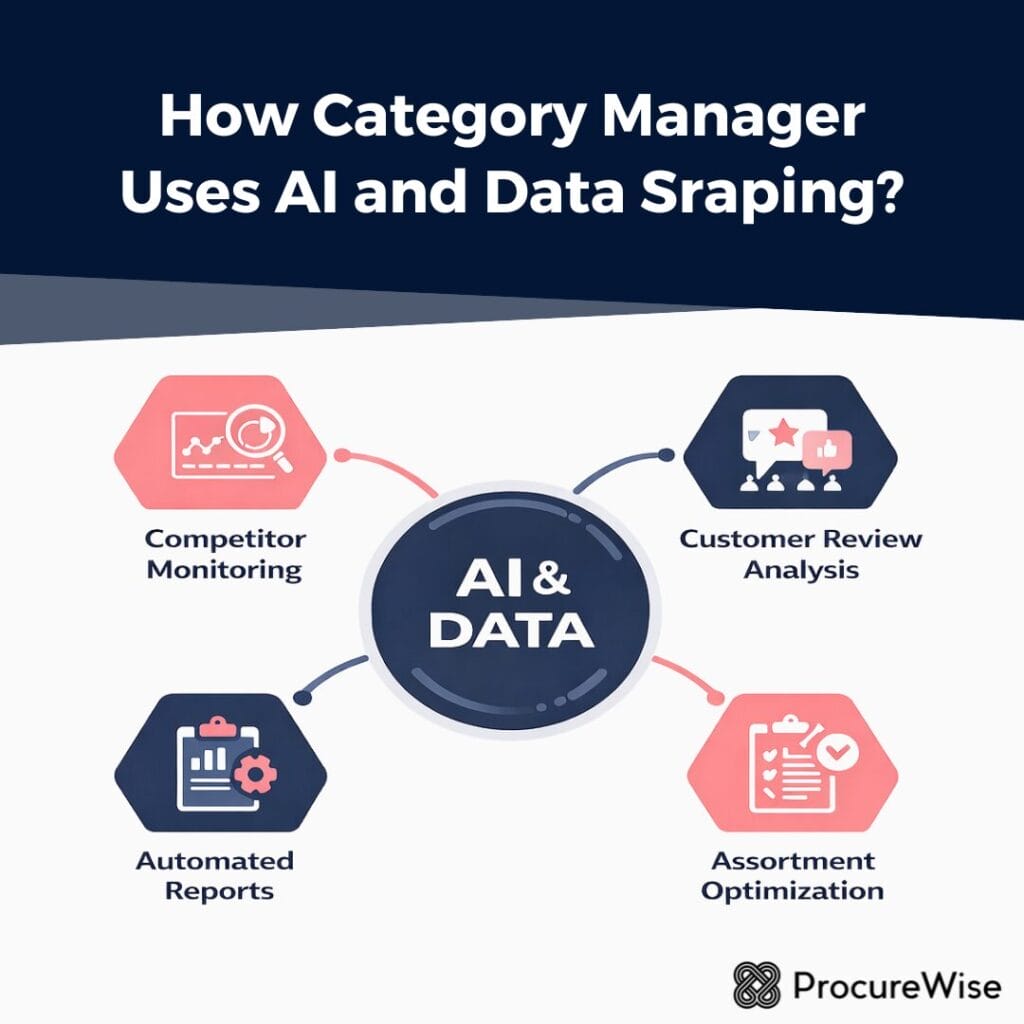
⚙️ Automating the Category Manager’s Workflow with AI and Data Analytics
One of the biggest challenges in the work of a Category Manager is the sheer volume of daily tasks related to data analysis. Sales reports, market monitoring, competitor tracking, and product availability analysis all require constant data processing.
That is why more companies are implementing technologies such as:
- Artificial Intelligence
- Automation
- Big Data Analytics
- Cloud Computing
- AI Integration
- Data Extraction
These technologies automate many analytical processes and allow managers to focus on strategic decision-making rather than manual data work.
📊 Hack #3: Automated Reporting and Sales Data Analysis 📊
In many organizations, Category Managers previously spent hours preparing sales reports. Data often came from multiple sources such as:
- internal sales systems
- e-commerce platforms
- marketing performance reports
- inventory management systems
- competitor monitoring tools.
With Artificial Intelligence and Automation, much of this process can now be automated.
AI systems can automatically:
- collect data from different databases
- perform data cleaning and structuring
- analyze sales performance
- generate ready-to-use reports.
As Sarah Chen explains:
“Preparing a sales report for one category used to take several hours. Now our AI system generates it automatically, and I can immediately focus on analyzing the insights.”
This significantly improves work efficiency and the quality of business decisions.
☁️ Cloud Computing and Integrated Data Sources
Modern analytics systems often operate within Cloud Computing environments, which makes it possible to integrate data from many different sources.
Category Managers can analyze information from:
- internal sales systems
- e-commerce platforms
- marketing tools
- social media
- inventory databases
- Data Scraping tools.
Through AI integration, all of this data can be processed within a single analytical ecosystem.
The benefits include:
- faster access to insights
- better collaboration between teams
- more accurate analytics
- scalable data infrastructure.
In practice, this means a Category Manager can obtain a comprehensive view of market performance within minutes.
🤖 How Automation Reduces Manual Tasks?
One of the biggest inefficiencies in data-driven roles comes from repetitive manual tasks.
Examples include:
- copying product data from websites
- manually checking competitor prices
- preparing spreadsheets and reports
- updating product information.
With technologies such as Automation, AI, and Web Scraping, many of these tasks can now be handled automatically.
AI systems can:
- monitor competitor prices 24/7
- collect product data from the internet
- analyze changes in demand
- generate alerts about important market developments.
Sarah highlights the impact clearly:
“Automation changed our work the most. Instead of manually collecting data, we now focus on interpreting insights and building strategy.”
As a result, the role of the Category Manager becomes more strategic and less operational.
🧠 Better Decisions Through Big Data Analytics
By combining technologies such as:
- Big Data
- Artificial Intelligence
- Machine Learning
- Predictive Analytics
- Data Analytics
companies can analyze massive datasets and uncover patterns that would otherwise remain invisible.
AI systems can detect insights such as:
- the relationship between price and sales performance
- the impact of promotions on demand
- seasonal purchasing trends
- changes in customer preferences.
With these insights, Category Managers can:
- develop better pricing strategies
- optimize product assortments
- increase sales and margins
- respond faster to market changes.
As Sarah concludes:
“The greatest advantage of AI is its ability to analyze data at a scale that humans simply cannot manage.”
This is why Artificial Intelligence and Data Analytics are becoming essential tools in modern retail category management.
🛡️ Ethical Data Scraping and Data Quality
As the use of technologies such as Artificial Intelligence, Data Scraping, and Big Data Analytics continues to grow, the importance of ethical data practices and data quality becomes increasingly critical.
Companies using Web Scraping and Data Extraction must follow several key principles:
- collecting only publicly available data
- respecting website policies and terms of service
- protecting sensitive customer information
- ensuring high data accuracy and reliability.
In many industries, organizations must also comply with data protection regulations, which means implementing responsible data governance and transparent analytics practices.
Sarah Chen emphasizes this point:
“Our team only works with publicly available data. The goal is not to bypass systems but to better understand the market and customer needs.”
This responsible approach helps companies build trust with customers and partners while still benefiting from the enormous potential of internet-based data.
🔬 The Future of AI in Category Management
The rapid development of technologies such as:
- Artificial Intelligence
- Deep Learning
- Machine Learning
- Neural Networks
- Predictive Analytics
- Big Data Analytics
means that data-driven decision-making will become even more central to category management strategies.
In the coming years, new tools will increasingly be able to:
- automatically recommend pricing strategies
- analyze customer emotions from social media
- predict consumer demand trends
- optimize product assortments in real time.
AI systems will also integrate data from multiple ecosystems, including:
- Internet of Things (IoT)
- internal sales systems
- e-commerce platforms
- marketing tools
- logistics and supply chain data.
This integration will allow Category Managers to make decisions based on more comprehensive and accurate datasets than ever before.
📈 Measuring the Impact of AI and Data Analytics
Implementing technologies such as Artificial Intelligence, Automation, and Data Scraping should always be evaluated using clear business metrics.
Common indicators include:
- reduced time spent on preparing reports
- increased category sales performance
- improved pricing competitiveness
- better inventory turnover
- faster responses to market changes.
Companies that successfully integrate AI tools and Big Data Analytics often also experience improved confidence in strategic decision-making.
As Sarah notes:
“The real value of data isn’t just having it — it’s being able to analyze it quickly and use it in decision-making.”
🚀 Conclusion: How AI and Data Scraping Are Transforming Category Management 🚀
This interview with a Category Manager demonstrates how technologies such as Artificial Intelligence, Machine Learning, Data Scraping, and Predictive Analytics are becoming essential tools for modern retail management.
Key takeaways include:
- AI enables large-scale market data analysis
- Data Scraping allows continuous monitoring of competitors and trends
- Machine Learning helps analyze customer feedback
- Automation streamlines daily analytical work
- Big Data Analytics supports more accurate business decisions.
With these technologies, Category Managers can shift from reactive decision-making to proactive strategy planning.
Sarah Chen summarizes it clearly:
“AI and data scraping changed the way we work. Instead of simply reacting to the market, we can now anticipate changes and plan our strategy ahead of time.”
💡 Getting Started with AI and Data Scraping 💡
For many companies, implementing Artificial Intelligence and Data Scraping solutions may seem complex. However, the most effective approach is often to start with small, practical steps.
A good starting point could include automating processes such as:
- competitor price monitoring
- customer review collection
- analyzing trends on social media
- generating automated sales reports.
Over time, organizations can expand their capabilities by integrating technologies such as:
- Machine Learning
- Natural Language Processing
- Predictive Analytics
- Cloud Computing
- AI Integration.
One thing is clear: companies that learn how to effectively leverage data will gain a significant competitive advantage in the modern retail landscape.