
The AI-powered demand forecasting market is entering a phase of explosive growth — and this is not just a trend. It’s a structural transformation of how companies manage Demand Planning, inventory levels, and Supply Chain Management.
Modern commerce is defined by volatility:
- Rapidly shifting customer demand
- Disruptions in global Supply Chain
- The growing influence of Social Media trends
- Real-time demand signals
- Increasing impact of external variables (weather, geopolitics, market trends)
Traditional forecasting models based purely on historical data and exponential smoothing are no longer sufficient. They struggle with fragmented data, non-linear behavior, and fast-changing market conditions.
AI-assisted demand forecasting changes the rules.
Powered by machine learning algorithms, deep learning, neural networks, and predictive analytics, modern systems can process massive datasets and dramatically improve forecast accuracy — often by up to 30% compared to traditional approaches.
This shift directly impacts:
- Inventory Management
- Reduction of stockouts and overstocking
- Optimization of logistics costs
- Improved product availability
- Smarter allocation of working capital
In short: AI forecasting is no longer a competitive advantage. It is becoming a survival requirement.
📉 Why Traditional Demand Forecasting Is Failing 📉
The Limits of Manual and Statistical Models ⚠️
Manual spreadsheets and classic statistical forecasting tools:
- Are reactive, not adaptive
- Cannot process real-time data
- Fail to detect complex demand signals
- Ignore nonlinear patterns in customer behavior
For example, a sudden spike in Social Media activity can change product demand within hours. Traditional models cannot dynamically adjust inventory planning fast enough.
Basic statistical techniques like exponential smoothing assume stability and predictable seasonality — assumptions that no longer hold in volatile markets.
The Modern Demand Landscape: Hyperconnected and Unpredictable 🌍
Today’s product demand is shaped by a web of interconnected factors:
- Competitor pricing
- Promotions
- Social media trends
- Macroeconomic shifts
- Weather changes
- Customer behavior analytics
- Real-time data streams
- Generative AI-driven content influence
Traditional forecasting tools were never designed to model this complexity.
The result?
- Poor forecast accuracy
- Excess safety stock
- Inventory imbalances
- Increased logistics costs
- Lost revenue from stockouts
This is why businesses are accelerating adoption of AI in Demand Forecasting.
🤖 The Core Benefits of AI-Assisted Demand Forecasting 🤖
AI systems analyze structured and unstructured data simultaneously:
- Historical sales
- Demand signals
- Social Media chatter
- External variables
- Market trends
- Supply chain data
Using machine learning algorithms and neural networks, AI detects patterns invisible to human analysts.
The result:
- Up to 30% improvement in forecast accuracy
- Better inventory planning
- Reduced overstocking
- Lower inventory holding costs
- Improved product availability
AI transforms forecasting from static reporting into dynamic decision intelligence.
From Reactive Forecasting to Predictive Analytics 🔍
AI-powered systems do not just predict demand — they continuously learn.
Through:
- Deep learning
- Reinforcement learning
- Predictive analytics
- Real-time model retraining
Forecasting models evolve with market conditions.
This creates:
- Faster reaction to demand fluctuations
- Automated adjustment of inventory levels
- Smarter Supply Chain Management
- Stronger alignment between sales, operations, and logistics
In highly competitive sectors like retail and e-commerce, this agility directly translates into higher margins.
🧠 How AI Transforms Demand Planning at Its Core 🧠
AI forecasting platforms integrate:
- ERP data
- POS systems
- Customer demand analytics
- External economic indicators
- Weather forecasts
- Social media trends
- Real-time transaction data
This unified view enables AI to detect subtle relationships between demand signals and purchasing behavior.
For example: A weather forecast combined with historical customer behavior may significantly impact seasonal inventory planning decisions.
Machine Learning Algorithms as the Prediction Engine ⚙️
At the center of AI demand forecasting are:
- Machine learning algorithms
- Deep learning models
- Neural networks
- Time-series forecasting
- Predictive analytics frameworks
These systems:
- Identify nonlinear correlations
- Continuously improve through feedback loops
- Adapt to demand variability
- Generate SKU-level and geographic-level forecasts
This level of granularity was previously impossible with traditional forecasting models.
⚡ AI-Driven Demand Sensing & Decision Intelligence: The Competitive Edge ⚡
Traditional forecasting models update weekly or monthly. AI-driven demand sensing operates in real time.
By analyzing:
- POS transactions
- E-commerce clicks
- Social Media trends
- Customer demand signals
- External variables (weather, events)
- Market trends
AI systems detect micro-shifts in product demand instantly.
This enables:
- Dynamic inventory levels adjustment
- Faster response to demand spikes
- Reduction in stockouts
- Improved product availability
- Lower logistics costs
Demand sensing transforms static forecasting into a live operational system.
In volatile sectors like fashion, electronics, and FMCG, this capability directly impacts margin protection.
🧩 Generative AI in Demand Forecasting 🧩
Generative AI expands forecasting beyond historical extrapolation.
Instead of simply predicting what will likely happen, it simulates what could happen.
Examples:
- What if a competitor launches a price promotion?
- What if Social Media sentiment suddenly turns negative?
- What if supply chain disruption occurs?
- What if customer behavior shifts due to macroeconomic changes?
Generative AI models create multiple demand scenarios, allowing:
- Smarter Demand Planning
- Risk stress-testing
- Stronger Supply Chain resilience
- Proactive inventory planning
This moves forecasting from predictive analytics to strategic foresight.
🧠 Decision Intelligence: From Prediction to Action 🧠
Improved forecast accuracy alone is not enough.
Modern AI systems integrate forecasting with:
- Inventory Management systems
- Supply Chain Management platforms
- ERP environments
- Logistics optimization tools
This creates Decision Intelligence — where AI recommends specific actions:
- Adjust safety stock levels
- Modify reorder points
- Shift production schedules
- Launch targeted promotions
- Reallocate stock geographically
Instead of just saying “Demand will increase by 12%”, AI answers: 👉 “Increase inventory levels by 8%, prioritize region A, reduce logistics buffer in region B.”
This closes the gap between predictive analytics and operational execution.
🔁 Reinforcement Learning for Dynamic Inventory Optimization 🔁
Reinforcement learning (RL) allows AI systems to continuously optimize:
- Inventory levels
- Reorder thresholds
- Safety stock
- Logistics allocation
Unlike static models, RL learns through iterative feedback:
- AI recommends action
- System observes outcome
- Model adjusts strategy
Over time, this reduces:
- Overstocking
- Logistics costs
- Inventory holding costs
- Forecast bias
And improves:
- Product availability
- Supply chain efficiency
- Capital allocation
This is the next generation of Inventory Management powered by AI.
📦 Granular Forecasting: SKU-Level & Geographic Precision 📦
Modern machine learning algorithms and neural networks can now deliver:
- SKU-level forecasts
- Store-level demand prediction
- Region-specific projections
- Channel-specific customer demand insights
This granularity supports:
- Precise inventory planning
- Localized promotions
- Optimized warehouse allocation
- Reduced product obsolescence
Instead of forecasting demand for an entire product category, AI predicts demand for:
Specific SKU Specific store Specific week
This dramatically improves forecast accuracy and Supply Chain performance.
📊 Predictive Analytics + Real-Time Data = Competitive Moat 📊
Organizations that combine:
- Real-time data
- Machine learning algorithms
- Generative AI
- Demand sensing
- Predictive analytics
- Deep learning
Gain a sustainable advantage in:
- Demand Planning
- Inventory Management
- Supply Chain Management
- Customer satisfaction
- Margin optimization
AI forecasting is no longer about reporting the future. It is about engineering operational advantage.
🏭 AI in Action: Real-World Impact Across Industries 🏭
AI-assisted demand forecasting has become a core growth engine for modern retailers.
By combining:
- Customer demand analytics
- Social Media trends
- Real-time POS data
- Promotions and pricing signals
- External variables (weather, events)
- Predictive analytics
Retailers can dramatically improve forecast accuracy at SKU level.
Business impact:
- Fewer stockouts
- Reduced overstocking
- Smarter inventory planning
- Higher product availability
- Lower inventory holding costs
AI-driven inventory management allows retailers to align supply precisely with customer demand — even during peak seasons or viral product moments.
For e-commerce players, real-time demand signals from clicks, searches, and cart behavior provide an additional predictive layer, strengthening Supply Chain agility.
🚚 Manufacturing & Logistics: Building a Smarter Supply Chain 🚚
In manufacturing, inaccurate forecasting causes:
- Excess safety stock
- Production inefficiencies
- Increased logistics costs
- Poor capacity planning
AI-powered Supply Chain Management changes this.
By integrating:
- Demand forecasting models
- Machine learning algorithms
- Inventory levels monitoring
- Predictive analytics
- External demand signals
Manufacturers can optimize:
- Production schedules
- Raw material procurement
- Distribution planning
- Warehouse allocation
This reduces working capital lock-in and improves operational resilience.
In logistics, AI forecasts shipping volumes and regional product demand, enabling:
- Route optimization
- Smarter fleet allocation
- Reduced last-mile costs
- Better product availability
AI doesn’t just improve forecasting — it synchronizes the entire Supply Chain.
🏥 Beyond Retail: Expanding AI Forecasting Across Sectors 🏥
AI-assisted demand forecasting is transforming:
Healthcare
- Predicting pharmaceutical demand
- Preventing shortages
- Optimizing medical inventory levels
Consumer Packaged Goods (CPG)
- Managing high-frequency product demand
- Aligning promotions with demand signals
- Reducing waste
Energy & Utilities
- Forecasting electricity demand
- Balancing grid loads
- Improving predictive analytics for peak usage
Fashion & Seasonal Industries
- Predicting social media-driven market trends
- Reducing unsold inventory
- Improving SKU-level forecasting precision
AI is particularly powerful in industries with volatile or seasonal customer demand.
📈 Measurable ROI: Why Companies Are Scaling AI Fast 📈
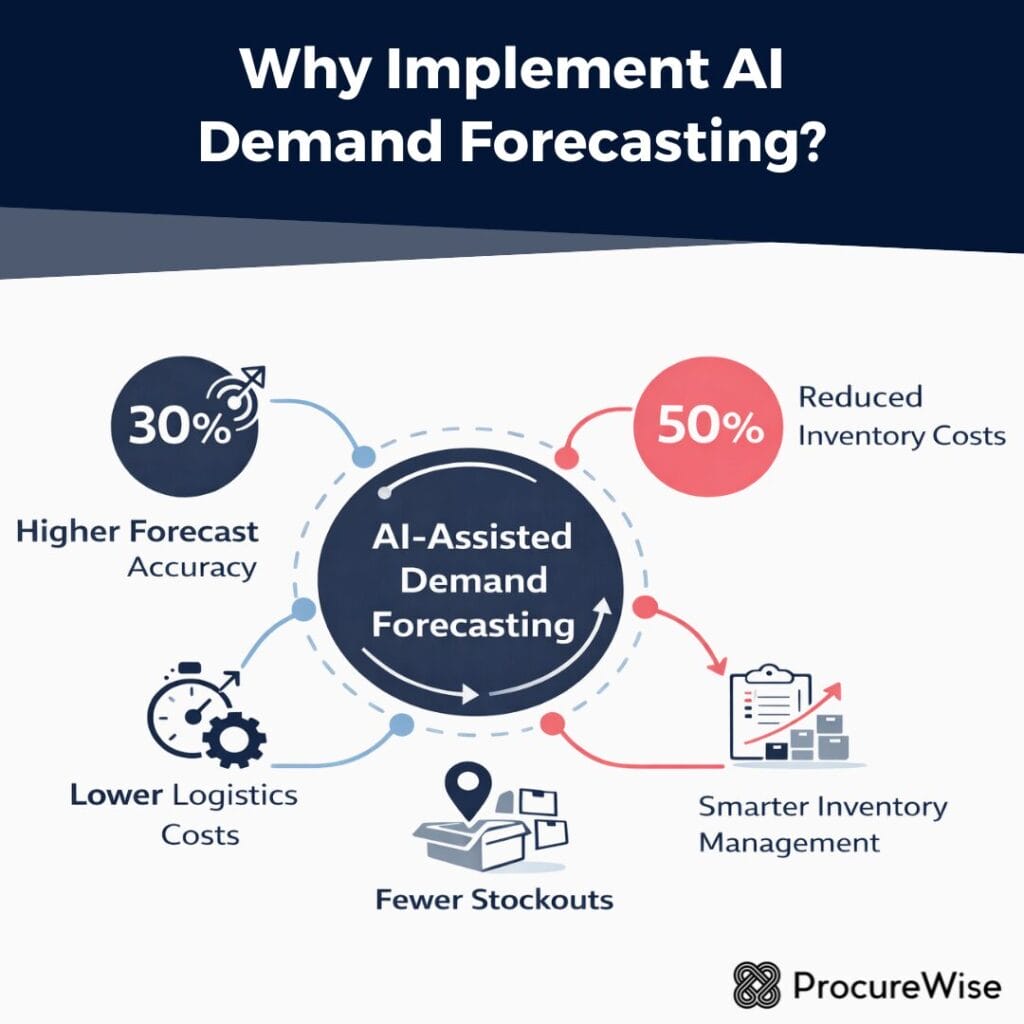
Organizations that mature their AI in Demand Forecasting capabilities report:
- Up to 30% higher forecast accuracy
- Up to 50% reduction in inventory costs
- Lower stockouts
- Reduced overstocking
- Faster reaction to market trends
- Better logistics cost control
Companies that integrate machine learning algorithms, neural networks, and deep learning into their forecasting models consistently outperform competitors still relying on traditional forecasting tools.
The ROI comes from three major levers:
- Working capital optimization
- Revenue protection (avoiding stockouts)
- Operational efficiency in Supply Chain Management
AI forecasting is no longer experimental — it is becoming standard in advanced enterprises.
🧠 From Pilot Projects to Enterprise AI Adoption 🧠
Successful companies treat AI demand forecasting not as a standalone tool, but as part of an integrated ecosystem:
- ERP systems
- Inventory Management platforms
- Predictive analytics engines
- Real-time data pipelines
- Decision Intelligence frameworks
Key success factors include:
- Strong data governance
- Cross-functional collaboration
- Investment in machine learning expertise
- Continuous model retraining
- Executive sponsorship
Organizations moving from isolated AI pilots to full-scale deployment gain exponential benefits.
The shift is clear:
From static forecasting model → To adaptive AI-driven demand planning → To autonomous inventory optimization.
🔮 The Competitive Gap Is Widening 🔮
Companies still relying on:
- Manual spreadsheets
- Basic exponential smoothing
- Lagging demand signals
- Siloed inventory planning
Are falling behind.
Meanwhile, AI-driven organizations leverage:
- Real-time data
- Deep learning
- Generative AI
- Reinforcement learning
- Neural networks
- Advanced predictive analytics
To build resilient, agile, data-driven Supply Chains.
The result? Higher margins, stronger customer satisfaction, and long-term strategic advantage.
🧭 Implementing AI-Assisted Demand Forecasting: Your Practical Roadmap 🧭
AI-powered demand forecasting is only as good as the data behind it.
To improve forecast accuracy, organizations must unify:
- Historical sales
- Inventory levels
- Customer demand data
- Promotions & pricing
- External variables (weather, economic signals)
- Social Media trends
- Real-time demand signals
Poor data quality leads to distorted forecasting models and weak predictive analytics.
Key priorities:
- Data governance
- Centralized data architecture
- Clean SKU-level datasets
- Integration between ERP and Supply Chain Management systems
Remember: Machine learning algorithms amplify data quality — good or bad.
⚙️ Choosing the Right Forecasting Tools & AI Stack ⚙️
When evaluating forecasting tools, consider:
- Support for machine learning algorithms & deep learning
- Real-time data processing
- Integration with Inventory Management systems
- SKU-level and geographic-level forecasting
- Built-in predictive analytics dashboards
- Generative AI scenario simulation
Cloud-based platforms often provide flexibility, scalability, and faster deployment.
Your AI stack should support:
- Demand Planning workflows
- Inventory optimization models
- Reinforcement learning capabilities
- Decision Intelligence integration
The goal is not just prediction — it is operational execution.
🛠️ Model Development & Deployment Strategy 🛠️
Successful AI in Demand Forecasting follows a phased approach:
1️⃣ Proof of Concept
- Start with one product category or region
- Test forecast accuracy improvement
- Validate ROI
2️⃣ Controlled Expansion
- Expand to more SKUs
- Integrate with inventory planning
- Automate demand sensing
3️⃣ Full Operational Integration
- Connect to Supply Chain Management
- Enable Decision Intelligence
- Activate automated inventory optimization
Deployment should ensure:
- Seamless data pipelines
- Cross-functional collaboration
- Real-time performance monitoring
AI forecasting must integrate into business processes — not remain an isolated analytics tool.
🔁 Continuous Learning & Model Optimization 🔁
Unlike traditional exponential smoothing models, AI systems require:
- Continuous retraining
- Monitoring of demand signals
- Bias detection
- Model recalibration
As market trends shift and customer behavior evolves, models must adapt.
Best practices include:
- A/B testing forecasting models
- Monitoring forecast accuracy by SKU
- Tracking inventory level performance
- Evaluating logistics costs impact
The companies that win treat AI forecasting as a living system.
⚠️ Common Adoption Barriers (And How to Overcome Them) ⚠️
Common obstacles include:
- Data silos
- Legacy IT systems
- Lack of AI expertise
- Resistance to change
- Poor alignment between Supply Chain and sales
Solutions:
- Executive sponsorship
- Clear KPI definition (forecast accuracy, stockouts, inventory costs)
- Upskilling teams in machine learning basics
- Gradual implementation roadmap
- Strong cross-department communication
AI transformation is as much cultural as technical.
🔮 The Future of AI-Assisted Demand Forecasting 🔮
Over the next few years, we can expect:
- Widespread use of Generative AI in scenario planning
- Fully autonomous inventory planning systems
- Real-time demand sensing becoming standard
- Deeper integration of predictive analytics with ERP
- Greater use of reinforcement learning for inventory management
- Hyper-granular forecasting (SKU, store, region, channel)
AI will increasingly move from:
Descriptive analytics → Predictive analytics → Prescriptive Decision Intelligence → Autonomous Supply Chain optimization.
Organizations that delay adoption risk widening the competitive gap.
🏁 Final Takeaway: AI Forecasting Is Now a Strategic Imperative 🏁
The rise of AI-assisted demand forecasting marks a fundamental shift in how companies approach:
- Demand Planning
- Inventory Management
- Supply Chain Management
- Forecast accuracy
- Customer demand prediction
- Product availability
Traditional forecasting tools can no longer keep pace with volatile, hyperconnected markets.
AI — powered by:
- Machine learning algorithms
- Neural networks
- Deep learning
- Generative AI
- Predictive analytics
- Real-time data
Enables smarter inventory planning, fewer stockouts, lower logistics costs, and stronger financial performance.
The question is no longer:
“Should we implement AI in demand forecasting?”
But rather:
“How fast can we scale it across the enterprise?”