
In highly competitive markets, discounts often feel like the fastest lever to pull. They spike short-term sales, clear inventory, and look great in dashboards. But over time, constant price reductions quietly destroy promotional margin, weaken brand perception, and condition customers to wait rather than buy.
This is the discount trap: promotions drive volume, but profits leak out the bottom.
The good news? You don’t need to touch your standard price to improve results. By shifting promotions from price cuts to value creation, companies can increase promotional ROI, protect margins, and build long-term customer loyalty.
⚠️ The Invisible Cost of Perpetual Price Cuts ⚠️
Discounts look harmless on the surface, but their real cost is rarely visible in a single campaign. The damage accumulates slowly—across margins, cash flow, and customer behavior.
🧨 Why Discounts Hurt More Than They Help? 🧨
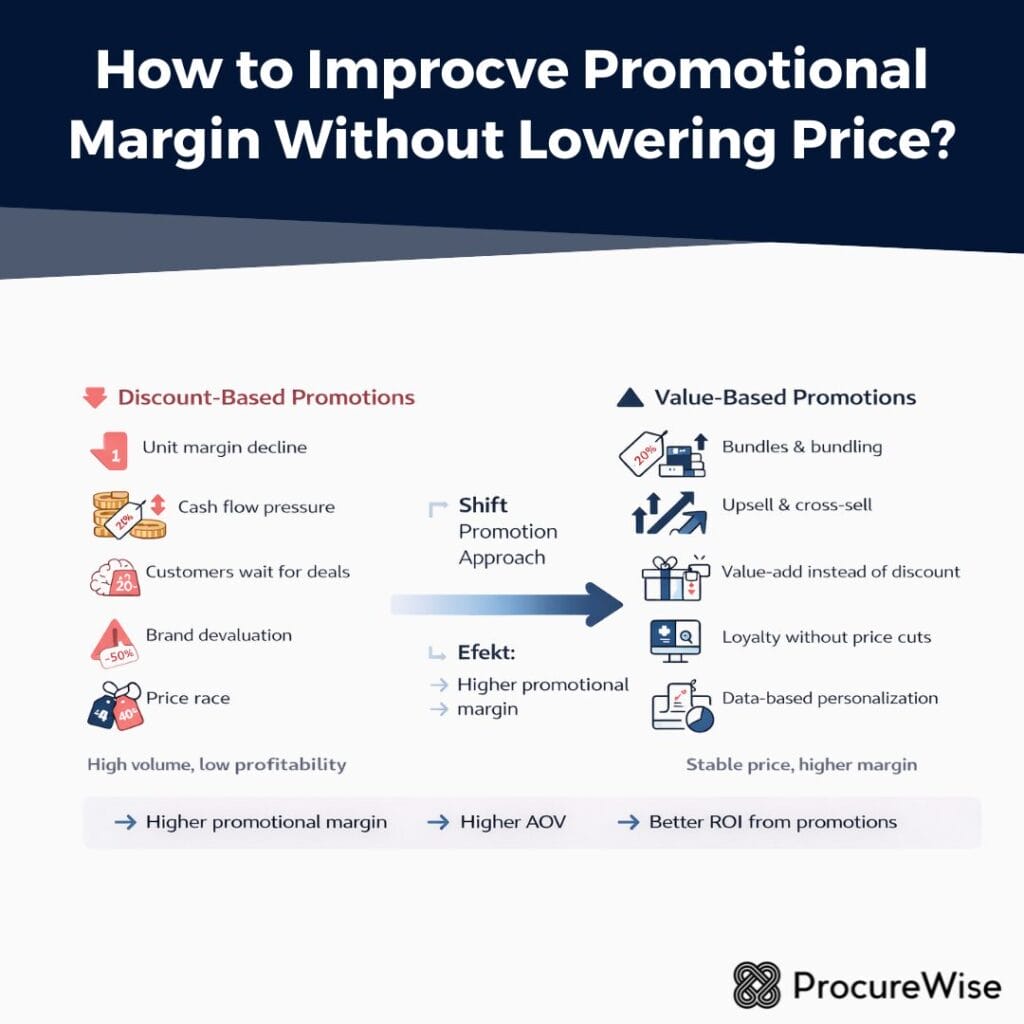
Promotions based purely on price reduction don’t just reduce revenue per unit—they reprogram how customers perceive value and how your business earns money.
Eroding Profit Margins and Cash Flow 🩸
A simple rule of thumb: A 20% discount can wipe out up to 50% of unit profit.
If your costs stay fixed, every price cut compresses profit margin. To compensate, you need disproportionate volume growth—often unrealistic. The result is a race to the bottom, where volume rises but profitability collapses.
Lower profit margins also mean weaker cash flow, less flexibility, and reduced ability to invest in growth, innovation, or customer experience.
Diluting Brand Value and Customer Perception 🧠
Frequent discounts send a clear signal: this product isn’t worth full price.
Over time, customers associate the brand with deals rather than quality or differentiation. Premium positioning erodes, and price becomes the only competitive lever. This attracts price-sensitive buyers who churn quickly and rarely convert at full profit margin.
Training Customers to Wait for Sales ⏳
Heavy discounting creates promotion dependency. Customers delay purchases, waiting for the next deal. Full-price demand shrinks, revenue becomes volatile, and forecasting gets harder.
Even worse, when discounts stop, customers perceive the regular price as “too high”—even if it hasn’t changed.
Why You Need a New Promotional Playbook? 🔄
If promotions reduce profit margin, weaken the brand, and attract low-quality demand, they’re not growth tools—they’re liabilities.
To grow profitably, businesses must separate promotion from price erosion and focus on strategies that:
- Increase perceived value
- Lift average order value
- Strengthen customer loyalty
- Improve contribution margin
The Promise: Growth Without Price Degradation 🚀
Margin-positive promotions don’t rely on cutting prices. They rely on smarter mechanics: bundling, loyalty, personalization, service, and value-adds.
Done right, these strategies:
- Deliver real ROI
- Protect standard pricing
- Increase customer lifetime value
- Build brands that customers are willing to pay for
📦 Strategy 1: High-Value Bundles That Lift Margin 📦
Bundling is one of the highest-ROI promotional mechanics when the goal is profit margin improvement without touching standard prices. Done right, bundles increase average order value (AOV), improve contribution margin, and shift attention away from unit price.
Identify Naturally Complementary Products 🧩
The best bundles feel obvious to the customer. Use transaction data and behavior patterns to spot products that are already bought together—or logically should be.
Examples:
- Core product + accessories
- Best-seller + new or slow-moving item
- Product + service or warranty
This approach creates value through convenience, not discounts.
Protect and Optimize Contribution Margin 📈
Bundles should rarely be “cheap.” Instead:
- Price slightly below the sum of individual items
- Anchor the value on the full standalone price
- Use high-margin items to subsidize lower-margin ones
The result: higher total profit margin per order, even if one item is lightly discounted.
Sell the Bundle as the Smart Choice 🧠
Position bundles as:
- “Complete solution”
- “Best experience”
- “Most popular setup”
Avoid framing them as discounts. Customers should feel they’re upgrading their decision, not hunting for a deal.
Use Bundles to Lift Average Order Value 💰
Bundles work because they reset the reference price. Instead of deciding whether to buy, customers decide which bundle to choose—naturally pushing AOV up without resistance.
Operational Readiness Matters ⚙️
Margin gains disappear if fulfillment breaks:
- Ensure consistent stock across bundle components
- Create dedicated bundle SKUs where possible
- Align ops and marketing calendars
Efficient execution protects both customer experience and profitability.
🔁 Strategy 2: Upsell & Cross-Sell Without Price Erosion 🔁
Upselling and cross-selling increase revenue after intent is already established—which makes them far more profit margin-friendly than acquisition discounts.
Match Offers to Real Customer Intent 🎯
Effective upsells are contextual, not aggressive.
- Premium version instead of basic
- Add-ons that improve usability or outcomes
- Services that reduce risk or effort
When relevance is high, resistance is low.
Integrate Seamlessly Into the Purchase Flow 🛒
High-performing touchpoints include:
- Product pages (“Frequently bought together”)
- Cart suggestions
- Post-purchase emails
The key rule: help, don’t interrupt.
Improve the Experience—Not Just the Ticket Size ✨
Great upsells make customers feel smarter about their purchase. When recommendations genuinely improve results or convenience, satisfaction rises alongside revenue.
That’s how profit margin growth and CX improvement align.
Train Teams to Sell Value, Not Price 🗣️
For sales-led businesses, training matters:
- Diagnose needs before recommending upgrades
- Explain outcomes, not features
- Position upsells as problem-solvers
Consultative selling drives higher margins and stronger retention.
🎁 Strategy 3: Loyalty Programs That Protect Margin 🎁
Most loyalty programs fail because they default to permanent discounts. Effective loyalty doesn’t make customers pay less—it makes them stay longer, buy more often, and buy smarter.
Reward Behavior, Not Just Spending 🧠
High-margin loyalty programs reward actions that improve unit economics:
- Repeat purchases
- Referrals
- Reviews and engagement
- Subscription adoption
These behaviors increase Customer Lifetime Value (CLV) without touching base prices.
Use Experiential Rewards Instead of Discounts ✨
Experiences scale better than price cuts:
- Early access to launches
- Priority support
- Exclusive content or events
- Personalized recommendations
They feel premium, cost less than discounts, and strengthen emotional loyalty.
Tiered Loyalty Drives Margin Expansion 🏆
Tiered programs gamify retention:
- Higher tiers unlock status, not cheaper prices
- Benefits grow with profit margin contribution
- Customers consolidate spend to “level up”
This structure naturally increases AOV and purchase frequency.
Measure Loyalty by CLV, Not Points 📊
Redemption rates are vanity metrics. What matters:
- Retention uplift
- AOV growth
- Purchase frequency
- Margin per customer
If CLV doesn’t rise, the program isn’t working.
💎 Strategy 4: Increase Perceived Value, Not Discounts 💎
When perceived value rises, price resistance falls. This is one of the most reliable long-term levers for profit margin protection.
Brand Positioning Justifies Full-Price Buying 🏷️
Strong brands compete on meaning, not price:
- Clear differentiation
- Consistent visual and verbal identity
- Outcome-focused messaging
A premium narrative allows promotions to add value without cutting price.
Service Quality Is a Hidden Margin Lever 🤝
Exceptional service:
- Reduces churn
- Increases repeat purchase
- Justifies higher willingness to pay
Customers forgive price—but not poor experience.
Social Proof Multiplies Perceived Value ⭐
Reviews, testimonials, and case studies:
- Reduce risk perception
- Support full-price conversion
- Improve promo efficiency
They are profit margin-positive assets.
Close the Loop With Customer Feedback 🔄
Actively using feedback:
- Signals brand maturity
- Improves product-market fit
- Reinforces trust
Customers pay more for brands that listen.
🎨 Strategy 5: Value-Add Promotions That Beat Discounts 🎨
When promotions feel generous without cutting price, profit margin stays intact. Value-add mechanics outperform percentage discounts because they shift attention from how much cheaper to how much more you get.
Use “Free” Strategically 🎯
“Free” beats “% off” psychologically—even when value is identical.
- Buy X, Get Y Free
- Free upgrade
- Free shipping
These offers feel like gains, not concessions, and often cost less than direct discounts.
Bundle Content, Services, or Access 🧩
Non-physical value scales well:
- Tutorials, onboarding, guides
- Setup or consultation
- Early or exclusive access
These add-ons increase perceived value while preserving gross margin.
Limited Editions and Promo Sets ⏱️
Scarcity increases conversion without price cuts:
- Seasonal collections
- Themed sets
- Time-boxed offers
Urgency replaces discounting as the conversion driver.
🛡️ Strategy 6: Pricing Discipline as a Margin Defense System 🛡️
Promotions fail when pricing loses control. Discipline protects both brand equity and profitability.
Use MAP to Prevent Price Wars ⚖️
Minimum Advertised Price policies:
- Stop public undercutting
- Protect partner margins
- Shift competition to service and value
MAP doesn’t block promotions—it structures them.
Design Controlled Promo Exceptions 🎛️
Instead of cutting price:
- Add bundles
- Add services
- Add exclusivity
This keeps pricing architecture clean and predictable.
Consistency Builds Trust and Willingness to Pay 🔐
Stable pricing:
- Signals confidence
- Reduces customer skepticism
- Supports premium perception
Chaos in pricing always leaks margin.
🧠 Strategy 7: Personalization That Optimizes Margin 🧠
The most profitable promotions are targeted, not universal.
Segment Customers by Value, Not Demographics 🎯
Effective segmentation includes:
- Purchase frequency
- Margin contribution
- Price sensitivity
- Lifecycle stage
High-value customers don’t need discounts—they need relevance.
A/B Test Mechanics, Not Just Discounts 🧪
Test:
- Value-add vs. discount
- Bundle depth
- Messaging angle
- Timing
Optimization isn’t about bigger discounts—it’s about better design.
Let Data Decide When Discounts Are Worth It 📈
Sometimes discounts make sense—but only when:
- Elasticity is proven
- Incremental margin stays positive
- It serves a strategic goal
Data turns promotions from intuition into investment decisions.
🏁 Conclusion: Promotions That Actually Pay Back 🏁
Discounts are easy. Profitable promotions are designed.
By shifting from price cuts to:
- Bundles
- Upsell & cross-sell
- Loyalty and perceived value
- Value-add mechanics
- Pricing discipline
- Data-driven personalization
…businesses can grow revenue without sacrificing margin or brand.
The key mindset shift: 👉 Promotions are not about selling cheaper. They’re about selling smarter.