

Procurement strategy is no longer just about negotiating the lowest price. In today’s volatile market conditions, shaped by digital transformation, supply chain disruptions, and rising ESG expectations, procurement teams must unlock long-term value through strategic partnerships with strategic suppliers.
Modern organizations recognize that traditional, transactional supplier relationships are not enough. Instead of focusing solely on cost savings, leading companies strengthen supplier collaboration, improve supplier performance, and optimize the total cost of ownership (TCO) across the entire supply chain.
Strategic supplier partnerships are not operational add-ons — they are the engine of resilient supply chain management, innovation, and sustainable growth.
🔄 The Evolving Procurement Landscape: Beyond Transactional Buying 🔄
From Cost Focus to Long-Term Value Creation 💡
The classic procurement model prioritized short-term contracts and competitive bidding. While effective for commodities, it limits innovation, weakens supplier relationships, and increases exposure to supply chain disruptions.
Today’s procurement leaders must move beyond transactional buying toward:
- Stronger supplier management
- Data-driven performance tracking
- Proactive risk management
- Strategic sourcing aligned with business objectives
With most decision-makers acknowledging room for procurement optimization, the shift toward collaborative supply chains is no longer optional — it’s strategic.
⚠️ Why Traditional Procurement Models Fall Short ⚠️
Transactional procurement focuses on:
- Immediate cost reduction
- Contract compliance
- Short-term savings
Strategic partnerships focus on:
- Long-term value
- Innovation and product quality
- Shared performance indicators
- Supply chain resilience
In an era where companies face frequent supply chain disruptions, weak supplier visibility creates risk exposure. Without strong supplier relationship management (SRM) and transparent collaboration, businesses struggle with:
- Delayed response to market shifts
- Poor performance monitoring
- Limited innovation input
- Suboptimal supplier performance
A fragmented supplier network weakens the entire procurement process.
🌍 Strategic Supplier Partnerships: The New Procurement Mandate 🌍
From Vendors to Strategic Suppliers 🔗
Strategic suppliers are not just vendors — they are extensions of the enterprise. This transformation requires:
- Mutual trust
- Shared long-term goals
- Transparent performance data
- Integrated supply chain collaboration
Organizations increasingly recognize suppliers as part of their extended ecosystem. Strong strategic partnerships enable joint problem-solving, improved procurement decisions, and higher supplier performance standards.
For procurement teams, this means shifting from contract administration to relationship orchestration.
🎯 What You’ll Gain from This Approach 🎯
By embedding supplier collaboration into your procurement strategy, you can:
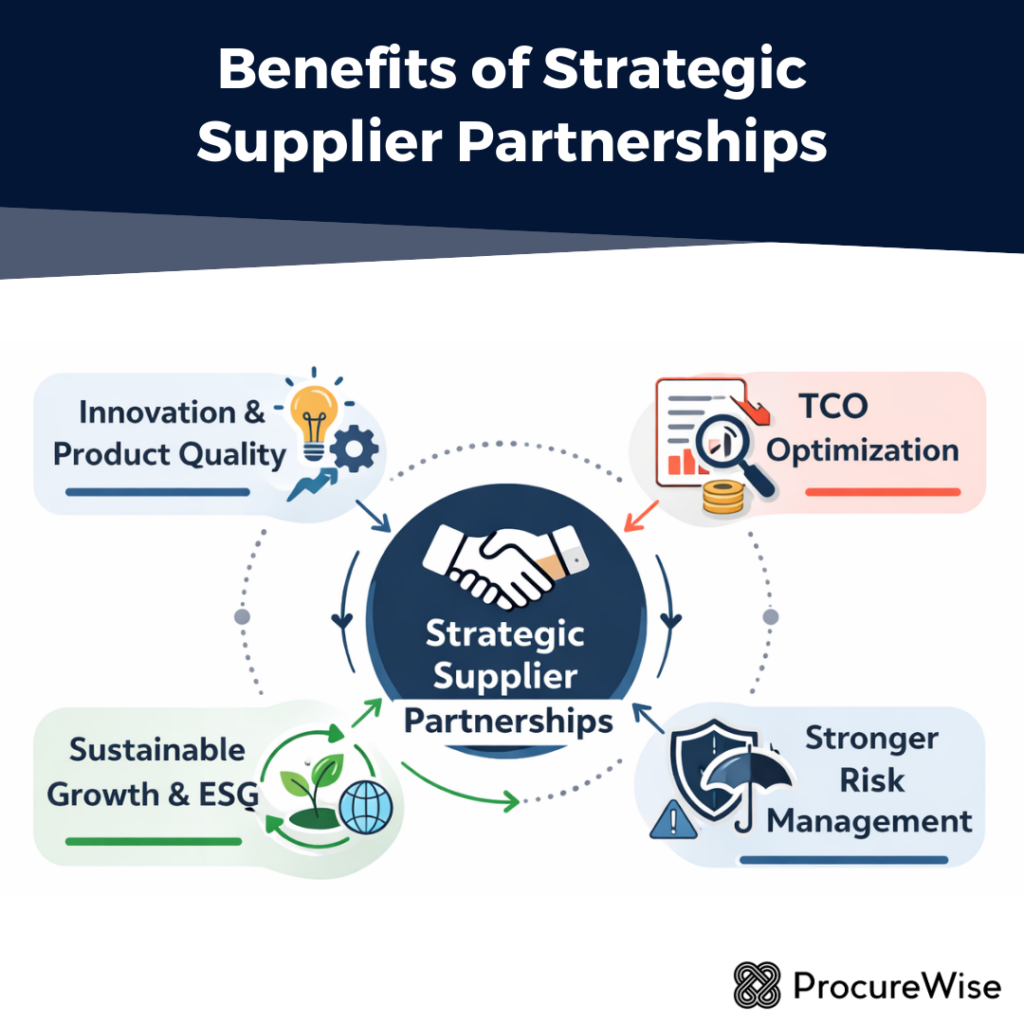
- Optimize total cost of ownership
- Improve performance monitoring and KPIs
- Strengthen risk management capabilities
- Increase resilience against supply chain disruptions
- Support ESG and sustainability goals
- Drive long-term business growth
The result? Procurement evolves from a cost center into a strategic value driver.
🏗️ Defining Strategic Supplier Partnerships 🏗️
A Foundation of Mutual Value and Performance Excellence 🤲
Strategic supplier partnerships are built on:
- Mutual trust and transparency
- Shared performance indicators
- Open communication channels
- Long-term collaboration models
- Joint innovation initiatives
- Continuous performance reviews
Unlike transactional supplier relationships, strategic alliances prioritize supplier collaboration, innovation, and building strong relationships that generate measurable long-term value.
They strengthen:
- Product quality
- Supplier performance
- Cost savings beyond price negotiation
- Strategic sourcing outcomes
- Overall supply chain stability
💡 Driving Innovation and Operational Excellence Through Strategic Suppliers 💡
Strategic supplier partnerships unlock innovation, improve product quality, and accelerate time-to-market. Unlike transactional supplier relationships, collaborative engagement enables suppliers to contribute expertise early in the procurement process — especially during product development and strategic sourcing initiatives.
Through structured supplier collaboration, companies can:
- Integrate suppliers into R&D and engineering processes
- Launch joint innovation workshops
- Improve performance indicators tied to quality standards
- Reduce redesign costs and production inefficiencies
Early supplier involvement strengthens the entire supply chain, ensuring better alignment between procurement teams and strategic suppliers. The result is measurable improvement in supplier performance and market responsiveness.
💰 Optimizing Total Cost of Ownership (TCO) and Cost Savings 💰
Traditional procurement focuses on unit price. Strategic procurement focuses on total cost of ownership (TCO).
By strengthening supplier relationships, organizations uncover hidden savings across:
- Logistics and transportation
- Inventory management
- Lead-time reduction
- Waste elimination
- Process automation
This broader perspective enables sustainable cost reduction, not just one-time cost savings. Strategic suppliers collaborate on operational improvements that enhance efficiency across the supplier network.
Key outcomes include:
- Lower lifecycle costs
- Improved performance tracking
- Increased visibility into procurement processes
- Better procurement decisions based on performance data
This approach aligns directly with long-term procurement strategy and strengthens financial resilience.
🛡️ Strengthening Risk Management and Supply Chain Resilience 🛡️
Proactive Mitigation of Supply Chain Disruptions 🌍
Modern supply chain management must address increasing global risks — from geopolitical instability to raw material shortages.
Strong strategic partnerships enhance:
- Real-time performance monitoring
- Transparency across the supplier network
- Early risk identification
- Faster response to disruptions
Instead of reacting to crises, procurement leaders can proactively manage risk management frameworks supported by shared performance indicators and collaborative planning.
Strategic suppliers provide:
- Greater visibility into sub-tier sourcing
- Joint contingency planning
- Flexible capacity management
- Shared accountability for business continuity
In uncertain market conditions, supplier collaboration becomes a competitive differentiator.
🌱 Advancing ESG, Ethical Sourcing and Long-Term Value 🌱
Sustainability is no longer optional. Strong supplier management directly impacts ESG performance, brand reputation, and regulatory compliance.
Strategic supplier partnerships support:
- Ethical sourcing standards
- Supplier diversity initiatives
- Reduction of carbon footprint
- Compliance with quality standards
- Transparent performance reviews
Through integrated supplier relationship management (SRM) programs, procurement teams can align sustainability targets with performance tracking systems.
This drives long-term value creation — not only financial, but environmental and social.
📈 Strategic Partnerships as a Growth Multiplier 📈
When procurement leaders cultivate strong supplier collaboration, they enable:
- Faster innovation cycles
- More informed procurement decisions
- Better alignment with strategic sourcing goals
- Stronger performance indicators tied to business KPIs
A well-managed ecosystem of strategic suppliers strengthens the entire procurement strategy and improves competitive positioning.
In today’s dynamic environment, companies that invest in building strong relationships with key suppliers transform procurement into a strategic growth engine.
🏗️ Building Strategic Supplier Partnerships: A Practical Framework for Procurement Leaders 🏗️
Not every supplier requires the same level of engagement. Effective strategic sourcing begins with supplier segmentation based on:
- Spend and impact on total cost of ownership (TCO)
- Criticality to operations and product quality
- Innovation potential
- Exposure to supply chain disruptions
- Alignment with long-term procurement strategy
By mapping the supplier network, procurement teams can distinguish transactional vendors from true strategic suppliers. This ensures resources are focused where collaboration drives the greatest long-term value.
Clear segmentation strengthens supplier management and improves overall supply chain performance.
Establishing Governance and Clear Procurement Processes 🧩
Strategic partnerships require structured governance. Without defined procurement processes, even strong supplier relationships can lose momentum.
Key governance elements include:
- Defined ownership within procurement teams
- Executive sponsorship from procurement leaders
- Structured performance reviews
- Clear escalation paths
- Agreed performance indicators (KPIs)
Formalizing these processes ensures accountability and supports consistent performance monitoring across strategic partnerships.
Implementing Supplier Relationship Management (SRM) 🖥️
A robust Supplier Relationship Management (SRM) framework is essential for scaling collaboration.
Effective SRM integrates:
- Supplier performance tracking
- Risk management dashboards
- Performance data analysis
- Communication workflows
- Supplier portals for transparency
Digital tools improve visibility across the supply chain and enhance procurement decisions based on real-time insights. Technology supports — but does not replace — strong human relationships built on mutual trust.
When properly implemented, SRM strengthens:
- Supplier performance
- Performance indicators alignment
- Long-term collaboration
- Continuous improvement initiatives
Embedding Performance Tracking and Data-Driven Decisions 📊
Strategic partnerships must be measurable. Traditional cost metrics are no longer sufficient.
Modern performance tracking should include:
- Innovation contribution metrics
- Quality standards compliance
- Risk mitigation effectiveness
- ESG performance indicators
- Responsiveness during disruptions
Leveraging performance data allows procurement leaders to refine sourcing strategies and improve supplier performance continuously.
Data-driven insights also support stronger procurement decisions and reinforce the strategic role of procurement teams.
Fostering Mutual Trust and Supplier Collaboration 🤝
Trust remains the foundation of strong supplier relationships. Without it, collaboration becomes superficial.
To build strong relationships:
- Maintain transparent communication
- Share forecasts and strategic plans
- Align on long-term value objectives
- Conduct regular performance reviews
- Engage cross-functional teams
Open dialogue enhances supplier collaboration and reduces friction across procurement processes.
When suppliers feel integrated into the extended enterprise, they invest more actively in innovation, risk management, and operational excellence.
Aligning Strategic Partnerships with Business Objectives 📈
Strategic supplier partnerships must directly support corporate goals, including:
- Cost reduction targets
- Market expansion
- Product innovation
- Sustainability commitments
- Operational resilience
By aligning supplier management with overall business strategy, procurement teams transition from operational support to strategic leadership.
Strong strategic partnerships transform supply chain management into a competitive advantage — reinforcing long-term value creation.
📊 Measuring ROI and Sustaining Strategic Supplier Partnerships for Long-Term Value 📊
Quantifying Performance Beyond Cost Savings 💰
To fully strengthen your procurement strategy, strategic supplier partnerships must be measurable. Focusing solely on short-term cost savings no longer reflects the real value generated through collaboration.
Modern performance tracking should measure:
- Improvement in supplier performance
- Innovation delivered by strategic suppliers
- Reduction in supply chain disruptions
- Optimization of total cost of ownership (TCO)
- ESG and sustainability impact
- Operational efficiency across procurement processes
Advanced performance indicators allow procurement teams to demonstrate tangible business impact and reinforce procurement’s strategic role.
Demonstrating Return on Investment (ROI) to Stakeholders 📈
Procurement leaders must translate partnership outcomes into clear business value.
ROI from strategic partnerships may include:
- Long-term cost reduction through process optimization
- Revenue growth from faster product innovation
- Reduced financial exposure through stronger risk management
- Improved product quality and customer satisfaction
- Increased resilience in volatile market conditions
Clear reporting supported by performance data strengthens credibility with executive leadership and positions procurement teams as value creators — not just cost controllers.
Overcoming Challenges in Supplier Relationship Management ⚙️
Even strong supplier relationships face obstacles.
Common challenges include:
- Misaligned procurement decisions and supplier expectations
- Weak communication channels
- Limited supplier visibility
- Resistance to shifting from transactional models
- Poor integration of supplier portals or performance monitoring tools
To overcome these barriers, organizations must:
- Formalize governance structures
- Align incentives across procurement teams and strategic suppliers
- Invest in digital SRM capabilities
- Promote a culture of mutual trust and transparency
- Conduct regular performance reviews
Consistency is key to building strong relationships that endure beyond short-term objectives.
Leveraging Technology for Deeper Supplier Collaboration 🤖
Emerging technologies are redefining supply chain management and strategic sourcing.
Tools such as:
- AI-driven analytics
- Predictive risk management systems
- Blockchain for transparency
- Advanced supplier portals
- Automated performance monitoring platforms
enhance visibility across the supplier network and strengthen data-driven procurement decisions.
Digital enablement improves supplier collaboration while increasing agility in responding to market conditions.
The Future of Procurement Strategy: Partnership-Centric and Data-Driven 🌍
The future of procurement lies in integrated ecosystems of strategic suppliers, not fragmented vendor networks.
Organizations that prioritize:
- Strong supplier management
- Robust performance tracking
- Sustainable sourcing practices
- Collaborative innovation
- Proactive risk management
will build more resilient, agile, and competitive supply chains.
Strategic partnerships are no longer optional — they are the foundation of modern procurement strategy.
🚀 Conclusion: Transforming Procurement Through Strategic Supplier Partnerships 🚀
Wzmacnianie strategii zakupowej przez strategiczne partnerstwa z dostawcami to nie trend — to konieczność w dynamicznym środowisku biznesowym.
By moving beyond transactional supplier relationships and embedding supplier collaboration, structured SRM, and performance-driven governance, organizations unlock:
- Sustainable cost reduction
- Higher supplier performance
- Stronger risk management
- Improved product quality
- Long-term value creation
Procurement teams that invest in strategic partnerships transform supply chain disruptions into opportunities, align supplier networks with business objectives, and elevate procurement to a core strategic function.
In a world defined by uncertainty and rapid change, strategic supplier partnerships are the true engine of competitive advantage.