

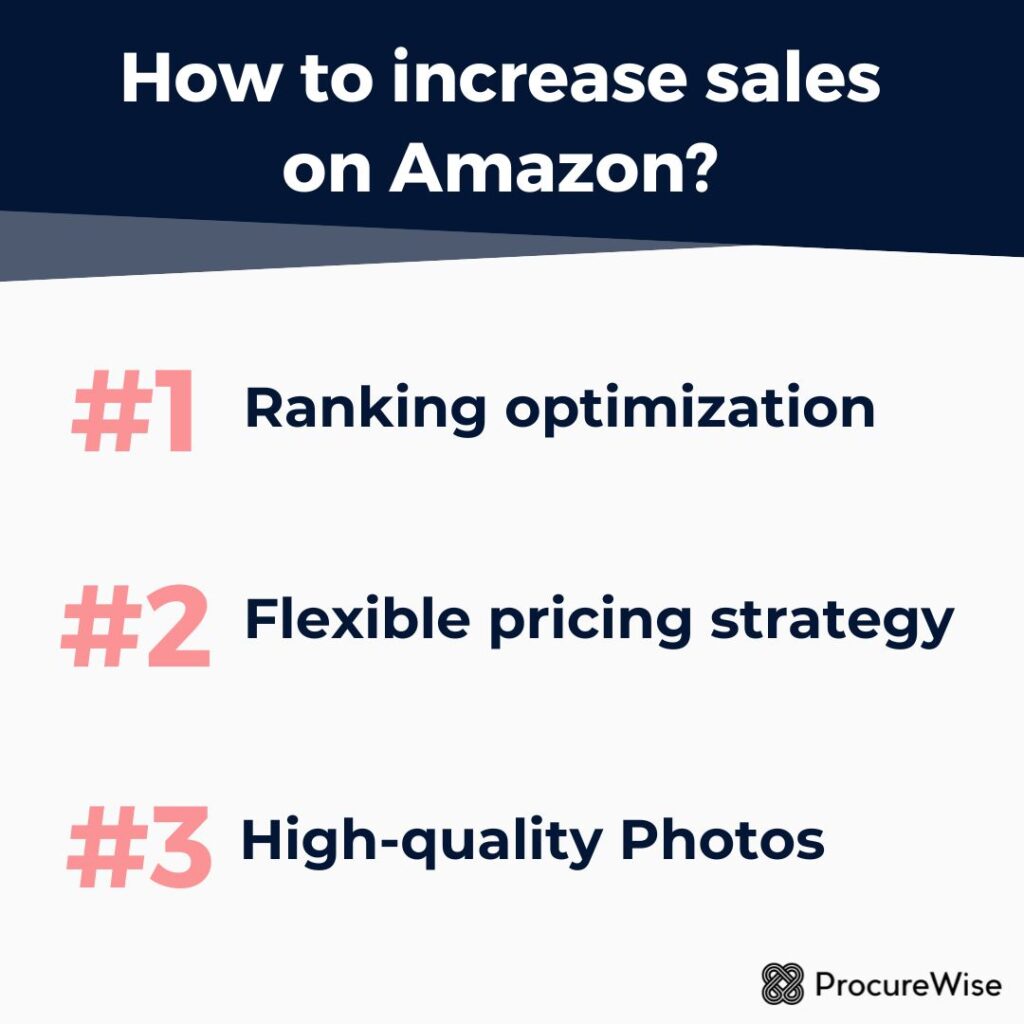
If you are a Seller on Amazon, you know how competitive this market can be. To stand out and increase sales, you need to have the right strategies. In this article, we will share three tips that will help you boost sales on Amazon and achieve success. Whether you are a new or experienced Seller, these tips can significantly impact your sales results. Let’s dive in and learn how to increase sales on Amazon! Read more How to sell on Amazon in 5 easy steps – a guide for beginners.
#1 Ranking optimization 📃
It’s essential to optimize your listings to rank high in Amazon search results. Why? Because this platform operates similarly to a search engine, and most Customers use the search function to find products of interest. The goal of optimization is to increase the visibility of your products in search results and convince Customers to click on your listing.
✒️ Matching keywords in the product title, descriptions, and even in areas labeled as “backend keywords”: This allows Amazon’s algorithms to match your product to search results and correct product categories. Therefore, it’s crucial for the mentioned keywords to be easily identified by the algorithms to understand what products you offer.
✒️ Conducting keyword research: Using keyword research tools is a good idea to find valuable and popular keywords related to your product. Focus on placing these keywords in essential places such as the product title, product description, and backend. However, avoid keyword stuffing – excessive use of keywords – as it may be negatively evaluated by algorithms.
✒️ Obtaining positive Customer product reviews, maintaining competitive prices, and responding to Customer inquiries and with good Customer service. All of these directly impact your Seller rating and, therefore, your positions in search results with positive reviews.
✒️ Remember that listing optimization is not a one-time process: regularly monitor results, analyze the competition, and adjust your listings based on changing market needs. Utilize tools available on the Amazon platform to provide you with real-time sales data and statistics, enabling you to make better decisions.
Understanding how search engine algorithms work on Amazon and applying appropriate optimization strategies will effectively improve the visibility of your products in search results, contributing to increased sales.
Take advantage of our pricing services now!
❓How to find the right keywords on Amazon❓
Using keyword research tools
If a keyword has a high search volume, it means it is popular, and many people are searching for items related to that keyword. Less competition means there is a smaller chance of competing with other Sellers and a greater chance of appearing in top search results.
⭕ Use the Amazon search bar: Start by entering relevant keywords into the Amazon search bar. As you type, Amazon suggests popular keywords frequently searched by Customers. Include these keywords in your product listings to increase their visibility.
⭕ Analyze competitor offerings: Examine your competitors’ listings to see which keywords they use. Use tools like Helium 10 or Jungle Scout to analyze their product lists and identify highly positioned keywords. Incorporate these keywords into your own listings to compete effectively.
⭕ Utilize keyword research tools: Use external keyword research tools like MerchantWords or Sonar to find suitable keywords for your product. These tools provide insights into search volume, competition, and relevance. Choose keywords with high search volume and low competition to maximize your chances of a higher position in search results. Note that these tools may require payment.
By finding the right keywords and incorporating them into your product listings, you can improve your visibility on Amazon and increase sales.
🔍 Amazon SEO 🔍
Amazon SEO, or search engine optimization, is the process of optimizing product listings to achieve a higher rank in Amazon search results. Amazon uses an algorithm called A9, which considers various factors to determine product ranking. Key factors include keyword optimization, matching keywords to potential user queries, and the likelihood of Customer purchases.
A crucial element in Amazon SEO is placing keywords correctly on the product page. The algorithm considers the presence of keywords in the product title, description, bullet points, and other areas on the product page. Therefore, it’s essential to use relevant and significant keywords in various parts of your listings. For example, if you sell running shoes, key words may include “running shoes,” “running,” “athletic shoes,” and so on.
Remember that Amazon is a commercial platform focused on sales. Therefore, keywords should be selected based on the likelihood of Customer purchases, reflecting product features that are most important to potential Customers. For example, if you sell thermal mugs, the key phrase “temperature-retaining” may be more attractive to Customers than the generic term “mug.”
Remember that Amazon is a shopping platform and focuses on sales. Therefore, keywords should be chosen in terms of the likelihood of customers buying. They should reflect the product features that are most important to potential Customers. For example, if you sell thermal mugs, the keyword ‘keeping warm’ may be more attractive to Customers than the generic word ‘mug’.
Do not forget that Amazon is constantly adjusting its SEO algorithms and rules. Therefore, it is important to monitor real-time data and remain flexible in applying SEO strategies. Incorporating competitor analysis and learning from their successes can help to better understand Customer preferences and current trends on the platform.
💵 Amazon Ads 💵
Amazon Ads is one of the most effective ways to promote products on the Amazon platform. Through this tool, Sellers can increase the visibility of their products, attract new Customers, and boost sales.
Amazon PPC (Pay-Per-Click) is an advertising system where Sellers pay for clicks on their ads. There are several types of advertising campaigns available under Amazon PPC, such as Sponsored Products, Sponsored Brands, and Sponsored Display. Each type of advertising campaign offers different benefits and allows achieving different goals.
➡️ Sponsored Products campaigns allow the promotion of individual products on Amazon. Sellers can increase the visibility of their products in search results and on product pages similar to their offerings. It’s an excellent way to grab the attention of potential Customers and increase sales.
➡️ Sponsored Brands enables Sellers to promote their brand on the Amazon platform. Using this advertising campaign, Sellers can place their logo, headline, and three selected products on a dedicated page with branded search results. It’s a great way to increase brand exposure and attract potential Customers.
➡️ Sponsored Display campaigns allow Sellers to promote their products outside the Amazon platform (Amazon Ads). With them, you can reach Customers on other websites and apps, increasing brand visibility and attracting new Customers.
Amazon Ads charges depend on you. You can set a maximum budget for the advertising campaign, establish the cost per click with automatic bidding (the rate will be automatically optimized to help achieve the goal). Amazon presents detailed costs as the average cost per click (PPC – pay per click) and as the cost per thousand impressions (CPM), the average cost incurred for 1000 ad views.
Thanks to this billing model, Sellers have full control over advertising expenses and can effectively manage their budget.
❔How to start with Amazon Ads❔
✔️ Set up an Amazon Advertising account: Create an account and link it to the Seller Central account.
✔️ Define your advertising goals: Decide what you want to achieve with Amazon PPC campaigns, whether it’s increasing sales, traffic, or brand visibility.
✔️ Choose the right campaign type: Amazon offers various campaign types, such as Sponsored Products, Sponsored Brands, and Sponsored Display. Choose the one that aligns with your goals.
✔️ Conduct keyword research: Use tools like Amazon Keyword Tool or external keyword research tools to find valuable keywords for your campaigns.
✔️ Optimize product listings: Ensure that titles, descriptions, and bullet points contain relevant keywords to improve ad visibility.
✔️ Set campaign budgets and rates: Determine how much you want to spend on campaigns and set rates for keywords.
✔️ Monitor and optimize campaigns: Regularly check campaign performance and make adjustments to improve results. This includes adjusting rates, adding excluding keywords, and testing different ad creatives.
✔️ Analyze and track metrics: Use Amazon’s advertising reports and analytics to measure the success of your campaigns and make data-driven decisions.
✔️ Test and monitor: Continuously test different strategies, keywords, and ad formats to find what works best for your products and audience.
✔️ Stay updated with Amazon advertising policies: Amazon’s advertising guidelines and policies may change, so it’s essential to stay informed to ensure compliance and maximize campaign performance.
#2 Flexible pricing strategy 🪗
During selling on Amazon, having a flexible pricing strategy that can adapt to market fluctuations and competition is crucial. Here are some tips and quick solutions:
📢 Monitor competition: Keep a close eye on competitor prices and adjust yours accordingly. You can use automated tools for regular price tracking and comparison.
📢 Utilize Amazon algorithms: Use dynamic pricing tools that can automatically adjust prices based on factors like demand, availability, and competitor prices. This can help win the Buy Box and increase sales.
📢 Leverage promotional pricing: Run time-limited promotions and discounts to attract Customers and encourage them to make purchases. This can help generate more sales and increase visibility on Amazon.
📢 Consider price optimization software: Invest in pricing software that can analyze market conditions, competitor prices, and desired profit margins. This can assist in making informed pricing decisions and optimizing sales.
📢 Test different price points: Experiment with different price points to find the optimal balance between maximizing profits and attracting Customers. A/B testing can help determine which prices generate the highest conversion rates.
Remember that pricing strategies should be regularly reviewed and adjusted based on market dynamics and Customer behavior. Be flexible to ensure the best results for your business on Amazon.

#3 High-quality photos 📸
In the consistent and dynamic world of online sales on the Amazon platform, high-quality product photos play a crucial role in attracting Customers and emphasizing the brand. An image can convey more than a thousand words, and when it comes to online shopping, product photos play a critical role in Customer purchasing decisions. Therefore, to succeed on Amazon, it is essential to use high-quality product photos that capture attention and build Customer trust.
💡 The quality of product photos can impact Customers’ perception and product reception. High-quality images of the product that are clean, sharp, well-lit, and well-exposed can have a positive impact on consumers and build brand trust.
💡 Clarity, accuracy, and exposure: Photos should be clear, sharp, and free from blurring. Customers want to see products as realistically as possible, and no details, specifics, or materials should be blurred. Therefore, it’s important to use a sharp lens and appropriate exposure to ensure the product looks as impressive in the photo as it does in reality.
💡 Proper lighting in the photo shooting location: Well-lit photos can completely change how a product is perceived by Customers. Avoiding shadows and spots in photos is crucial to creating a clean and professional product look. It’s worth investing in good lighting to achieve the best result.
💡 The background of the product photo: It’s important to use a white background that provides contrast and clarity to the product. A white background allows for easier visualization of the product and creates a professional impression. Avoiding cluttered backgrounds and various patterns or texts helps focus the Customer’s attention on the product itself.
💡 Dimensions, size, and file format: Amazon also has specific requirements for photo dimensions, size, and file format. Sellers should check if their photos meet these requirements to avoid issues and delays in product listing publication.
For even better results, some Sellers choose to use the services of professional eCommerce photographers or product photographers. These specialists have the right equipment and know how to capture every detail of the product in an attractive and customer-friendly way. Advanced tools, such as 360-degree shots, can also enhance the product impression and increase attractiveness for Customers.
Summary
We hope that these 3 tips for Sellers will help you increase sales on Amazon. These tips include optimizing offer rankings, conducting keyword research, understanding SEO, and taking appropriate photos on Amazon. By implementing these strategies, Sellers can improve the visibility of their products, reach the right Customers, and achieve higher positions in search results.