

In today’s fast-changing business environment, negotiation is no longer an occasional skill — it’s a core capability that directly affects financial management, vendor selection, contract negotiation, and long-term organizational success. Whether you’re managing operating budgets, negotiating health insurance, or working with local government and vendors, the absence of a structured plan often leads to lost value and unnecessary risk.
This article introduces a free Annual Negotiation Plan Template, supported by a step-by-step guide, designed to help organizations move from reactive bargaining to proactive, strategic negotiation. 🚀
💼 Why Negotiations Fail Without a Plan 💼
Unplanned negotiations are one of the most common — and costly — blind spots in organizations. When negotiation is handled ad hoc, several issues consistently emerge:
Suboptimal Financial Outcomes
Poor preparation often results in unfavorable contract terms, inflated costs, weak cost-benefit analysis, and missed revenue opportunities. This directly undermines financial management, operating budgets, and long-term sustainability. 📉
Strained Stakeholder Relationships
Rushed or unclear negotiations damage trust with vendors, internal teams, and external stakeholders. Over time, this leads to friction, failed partnerships, and reputational risk. 🤷♂️
Wasted Time and Resources
Without a structured approach, teams duplicate effort, lack consistent materials, and fail to capture lessons learned — reducing efficiency and weakening future negotiations. ⏳
Missed Strategic Opportunities
Negotiations are powerful strategic moments — yet without alignment to a strategic plan, organizations fail to use them to advance broader goals such as professional development, service quality, or long-term vendor stability. 🎯
🧭 From Reactive to Strategic Negotiation 🧭
Many organizations focus narrowly on individual negotiation types — such as procurement or salary discussions — without a unified framework. This fragmented approach ignores the reality that negotiations span:
- Vendor selection and contract negotiation
- Operating and capital budgets
- Professional development and training plans
- Emergency response and business continuity
- Grant management and fund reporting
- Stakeholder engagement and communication planning
A holistic annual negotiation plan connects all of these into one coordinated system — transforming negotiations into a repeatable, value-driven process.
📘 Introducing the Annual Negotiation Plan Template 📘
This resource is more than a document — it’s a strategic blueprint.
The Annual Negotiation Plan Template helps organizations:
- Identify and prioritize negotiations across the entire year
- Align negotiations with financial, operational, and strategic objectives
- Prepare consistent materials and performance measures
- Strengthen vendor and stakeholder relationships
- Support training sessions and professional development initiatives
Instead of reacting to negotiations as they arise, teams gain clarity, predictability, and control.
🎯 What You’ll Gain From Using This Template 🎯
Implementing an annual negotiation plan delivers measurable benefits:
Improved Financial Management
Better control over costs, clearer budget planning, and stronger justification for expenditures — especially in areas like vendor contracts and service agreements. 💰
Stronger Vendor & Stakeholder Outcomes
Negotiations become collaborative rather than confrontational, improving long-term value and service quality. 🤝
Operational Efficiency
Clear preparation reduces duplicated effort and supports smoother execution — especially during high-stakes negotiations or time-sensitive situations. ⚙️
Professional Development & Training
The plan creates a foundation for training sessions, tabletop exercises, and continuous skill improvement across teams. 📚
🌱 Why an Annual Negotiation Plan Is Essential 🌱
An annual negotiation plan is not administrative overhead — it’s a strategic asset. It connects negotiation activity with:
- Strategic planning
- Budget governance
- Risk management
- Business continuity and emergency response
- Long-term organizational resilience
By planning negotiations in advance, organizations shift from short-term fixes to intentional value creation.
📘 Understanding the Annual Negotiation Plan Template 📘
The Annual Negotiation Plan Template is the structural core of a proactive negotiation strategy. Instead of treating negotiations as isolated events (e.g. a single contract negotiation or one-off vendor selection), this template connects negotiations to financial management, strategic planning, and organizational priorities across the entire year.
In this section, we’ll break down what the template is, how it’s structured, and why each section matters — so it truly supports outcomes like budget control, stakeholder alignment, and professional development.
🧩 What Is the Annual Negotiation Plan Template? 🧩
At its core, the template is a centralized planning and tracking document that captures all significant negotiations expected within a given year — operational, financial, and strategic.
It applies to negotiations related to:
- Operating and capital budgets
- Vendor contracts and service agreements
- Grant management and fund reporting
- Health insurance and benefits
- Local government and public-sector coordination
- Professional development and training plans
- Emergency response and business continuity
Rather than reacting to deadlines or crises, the template ensures negotiations are planned, prioritized, and aligned with broader organizational goals.
🗂️ Core Sections of the Template (Overview) 🗂️
Each section of the Annual Negotiation Plan Template serves a specific strategic function. Together, they create a repeatable negotiation system rather than ad-hoc decision-making.1. Negotiation Inventory & Prioritization 📋
This section captures all anticipated negotiations for the year and ranks them by:
- Financial impact (costs, savings, income)
- Risk level
- Strategic importance
This is especially valuable for organizations managing:
- Multiple vendors
- Complex operating budgets
- Time-sensitive projects (e.g. streetscape projects, snow removal, emergency response)
2. Objectives & Performance Measures 🎯
Here, each negotiation is tied to clear, measurable goals, such as:
- Target cost reductions
- Service-level improvements
- Revenue protection
- Compliance or risk mitigation
This section links negotiations directly to performance measures, ensuring accountability and post-negotiation evaluation.
3. Stakeholder & Participant Analysis 👥
Negotiations succeed or fail based on people, not just numbers. This section documents:
- Internal participants and decision-makers
- External stakeholders (vendors, local government, partners)
- Influence, constraints, and expectations
This is critical for stakeholder engagement, communication planning, and avoiding misalignment during execution.
4. Financial & Cost-Benefit Analysis 💰
This section supports disciplined financial management by documenting:
- Budget constraints
- Cost-benefit analysis
- Funding sources (e.g. grants, operating funds)
- Long-term financial implications
It is especially relevant for negotiations tied to grant management, fund reporting, and capital budgeting.
5. Strategy & Method Selection ♟️
Not every negotiation should be handled the same way. This section defines:
- Negotiation style (collaborative, competitive, facilitated)
- Escalation paths
- Risk tolerance
It’s particularly useful for complex or sensitive areas like incident response plans, homeland security coordination, or business continuity discussions.
6. Resources, Tools & Training 🛠️
This section connects negotiations with:
- Online tools
- Training sessions
- Professional development
- Facilitation resources
It ensures teams are properly prepared — not just authorized — to negotiate effectively.
7. Execution & Documentation Plan 📝
This operational section defines:
- Timelines
- Roles and responsibilities
- Documentation standards
- Approval workflows
Clear execution planning is essential for audits, compliance, and future reference — especially in public-sector or regulated environments.
8. Post-Negotiation Review & Learning 🔄
The most overlooked — and most valuable — section.
It captures:
- Outcomes vs. objectives
- Lessons learned
- Process improvements
- Training needs
This directly supports continuous improvement, future training plans, and stronger results year over year.
🧠 Why This Structure Works 🧠
The power of the Annual Negotiation Plan Template lies in integration:
- Negotiations connect to strategic plans
- Financial decisions align with budgets
- Stakeholder input feeds communication plans
- Outcomes inform professional development
Instead of scattered spreadsheets or last-minute emails, organizations gain clarity, consistency, and institutional memory.
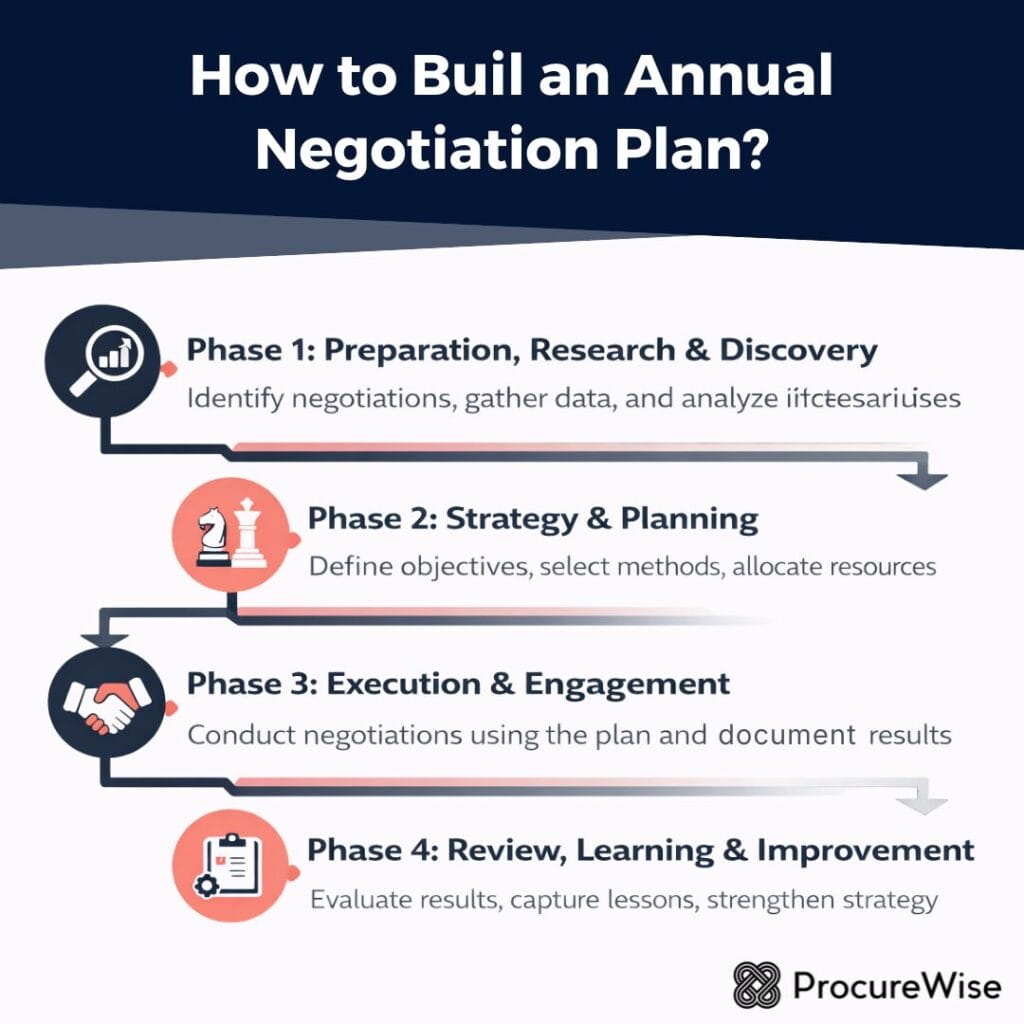
🛠️ How to Build Your Annual Negotiation Plan – Step by Step 🛠️
With a clear understanding of the Annual Negotiation Plan Template structure, it’s time to put it into action. This section walks you through a practical, phased process for building your plan — ensuring negotiations are aligned with your strategic plan, operating budget, and stakeholder requirements.
This step-by-step approach works across sectors, including business, education, and local government.
🔍 Phase 1: Preparation, Research & Discovery 🔍
Strong negotiations start long before anyone enters the room.
Identify & Prioritize Negotiations 🗺️
Create a complete list of negotiations expected this year, including:
- Vendor selection and contract negotiation
- Operating and capital budget discussions
- Health insurance and benefit renewals
- Grant management and fund reporting
- Emergency response, snow removal, and service contracts
- Training programs and professional development initiatives
Rank each negotiation by financial impact, urgency, and risk exposure.
Gather Data & Materials 📊
Effective negotiation relies on facts, not assumptions. Collect:
- Cost-benefit analysis data
- Historical contract performance
- Budget constraints and funding sources
- Market benchmarks and comparable pricing
This is especially important for negotiations tied to financial management, vendor contracts, and local government procurement.
Analyze Stakeholders & Participants 👥
Document:
- Decision-makers vs. influencers
- Internal participants and approvers
- External stakeholders and vendors
- Political, operational, or budgetary constraints
This step strengthens stakeholder engagement and reduces friction later.
♟️ Phase 2: Strategy & Planning ♟️
With research complete, shift from data to direction.
Define Clear Objectives & Limits 🎯
For each negotiation, define:
- Ideal outcome
- Minimum acceptable terms
- Non-negotiables (legal, budgetary, policy-driven)
Tie objectives to performance measures so success can be evaluated later.
Select Negotiation Methods & Roles 🧠
Choose the right approach:
- Collaborative (long-term vendor partnerships)
- Competitive (cost-sensitive procurements)
- Facilitated (multi-party or high-risk negotiations)
Assign roles clearly, including when to involve a facilitator or legal review.
Allocate Resources & Tools 🛠️
Plan ahead for:
- Staff time and preparation effort
- Online tools and documentation systems
- Training sessions and tabletop exercises
This prevents last-minute scrambling and supports consistent execution.
🤝 Phase 3: Execution & Engagement 🤝
This is where preparation delivers results.
Conduct the Negotiation 🗣️
Use your plan as a guide:
- Stay aligned with objectives
- Listen actively to stakeholder needs
- Adapt tactics without losing strategic direction
Well-prepared teams negotiate with confidence and credibility.
Manage Communication & Documentation 📝
Ensure:
- Clear communication plans
- Consistent messaging to stakeholders
- Accurate documentation of terms, timelines, and obligations
This is critical for audits, compliance, and future reference.
🔄 Phase 4: Review, Learning & Improvement 🔄
Negotiation success doesn’t end at agreement.
Evaluate Outcomes vs. Plan 📈
Assess:
- Financial results (cost savings, revenue protection)
- Relationship impact
- Alignment with strategic and budget goals
This step reinforces disciplined financial management.
Capture Lessons Learned 🧠
Document:
- What worked
- What didn’t
- Skills gaps or training needs
These insights directly inform future training plans, professional development, and negotiation strategies.
🌱 Why This Process Delivers Better Results 🌱
This phased approach:
- Reduces risk and surprises
- Improves cost control and value creation
- Strengthens stakeholder relationships
- Builds repeatable negotiation capability
Instead of relying on individual experience, organizations create a system that scales.
🚀 Applying the Annual Negotiation Plan & Maximizing Long-Term Value 🚀
You now have the structure, process, and tools to build an Annual Negotiation Plan. The final step is application — turning planning into measurable results across budgets, vendors, stakeholders, and teams.
This section focuses on real-world use cases, long-term optimization, and how to ensure your negotiation plan continues delivering value year after year.
🏗️ Real-World Applications of the Annual Negotiation Plan 🏗️
A well-designed negotiation plan adapts to many organizational contexts. Below are the most common — and highest-impact — scenarios.
Vendor Contracts & Vendor Selection 🤝
Annual planning allows organizations to:
- Track contract renewals and renegotiation windows
- Compare vendors using consistent performance measures
- Strengthen service-level agreements while controlling costs
This approach is especially effective for recurring services like IT, facilities, snow removal, and outsourced operations.
Operating & Capital Budget Negotiations 💰
Negotiations are central to budgeting. The plan supports:
- Clear justification of funding requests
- Better cost-benefit analysis
- Alignment between departments and finance teams
This reduces last-minute budget conflicts and improves financial transparency.
Health Insurance & Employee Benefits 🏥
Health insurance negotiations are high-cost and high-risk. An annual plan helps:
- Benchmark plans and premiums
- Align benefits with workforce needs
- Control long-term benefit costs
Better preparation here delivers both financial stability and employee trust.
Local Government & Public-Sector Negotiations 🏛️
For public-sector organizations, negotiation planning improves:
- Compliance and documentation
- Stakeholder engagement and communication plans
- Coordination across departments and agencies
This is critical for grants, service agreements, and community-facing projects.
Emergency Response, Business Continuity & Incident Planning 🚨
Negotiations aren’t always planned — but preparation can be. Annual planning supports:
- Mutual aid agreements
- Vendor readiness for emergencies
- Clear roles during incident response
This reduces risk during natural disasters, security incidents, or service disruptions.
📈 Strengthening Results Beyond Individual Negotiations 📈
The true power of an Annual Negotiation Plan lies in continuous improvement.
Building Negotiation Capability Over Time 🧠
Each completed negotiation feeds data back into the system:
- Better stakeholder profiles
- Improved negotiation strategies
- Stronger performance benchmarks
Over time, negotiation becomes an organizational competency, not an individual talent.
Professional Development & Training Integration 🎓
Use real negotiations to inform:
- Training sessions
- Tabletop exercises
- Facilitation and leadership development
This ensures learning is practical, relevant, and immediately applicable.
Using Tools, Templates & Documentation 🛠️
Leverage:
- Online tools for tracking and collaboration
- Centralized documentation for audits and reviews
- Clear templates to ensure consistency
This supports scalability and continuity, even when staff change.
🔄 From Planning to Strategic Advantage 🔄
Organizations that adopt annual negotiation planning gain:
- Predictable financial outcomes
- Stronger vendor and stakeholder relationships
- Reduced risk and conflict
- Better alignment with strategic plans
Instead of negotiating under pressure, teams operate with confidence and clarity.
📥 Download the Free Annual Negotiation Plan Template 📥
You’re now ready to move from theory to action.
The Annual Negotiation Plan Template provides:
- A structured, repeatable framework
- Alignment with budgets, strategy, and stakeholders
- Built-in learning and improvement loops
👉 Download the free template and start planning your negotiations strategically — not reactively.
🌟 Final Takeaway 🌟
Negotiation is not a moment — it’s a system.
With an Annual Negotiation Plan, you transform negotiations from isolated events into a strategic engine for value creation, supporting financial management, operational resilience, and long-term success.