

In modern sales negotiations and B2B commerce, winning isn’t about who argues harder — it’s about who reshapes the negotiation environment more intelligently. Traditional negotiation strategy focuses on preparation, positions, and counter-offers. Useful? Yes. Sufficient? Not anymore.
With global trade accelerating and supply chains becoming more complex, negotiators face power imbalances, algorithmic decision-making, and highly informed counterparties. In this reality, predictable tactics lose impact fast. What actually improves trading terms today are unconventional negotiation techniques — subtle, strategic, and often invisible.
This article explores how advanced negotiators go beyond textbook methods to unlock value creation, shift leverage, and secure better commercial outcomes without escalating conflict.
⚠️ The Limits of Standard Negotiation Advice ⚠️
Classic frameworks — BATNA, win-lose logic, distributive negotiations — are a solid foundation, but they assume a reactive mindset. You respond to offers instead of shaping them.
In high-stakes environments like partner company negotiations, employment contracts, or multi-layered supply chain agreements, this creates three problems:
- Predictability — standard tactics are easy to counter
- Missed leverage — hidden constraints and motivations stay unused
- Value leakage — price dominates while non-monetary gains are ignored
When a large share of negotiations is influenced by automation and standardized terms and conditions, relying only on “best practices” often weakens your position instead of protecting it.
🚀 Why Unconventional Tactics Win Better Deals 🚀
Unconventional negotiation isn’t about manipulation. It’s about strategic diagnosis — understanding what really drives the other side and designing the deal around that insight.
These tactics matter because they:
- Exploit information asymmetry in niche markets
- Leverage anchoring bias and commitment tactics without confrontation
- Enable integrative negotiations instead of zero-sum bargaining
- Unlock hidden value beyond price (risk, timing, reputation, access)
Professionals trained in advanced negotiation tactics consistently outperform average negotiators — not by pushing harder, but by playing a different game.
🔎 Reframing Preparation: Finding Hidden Leverage 🔎
Preparation isn’t a checklist. It’s a diagnostic process.
Advanced negotiators prepare by identifying:
- Structural constraints
- Psychological drivers
- Internal pressures on the other side
This is where unconventional advantage is born — before the first offer is ever made.
Strategic Diagnosis Through Maslow’s Hierarchy of Needs 🧠
Instead of focusing on stated positions, analyze the underlying needs driving them.
Ask:
- Are they optimizing for security (stable supply, predictable revenue)?
- Esteem (appearing strong internally or to the market)?
- Belonging (maintaining social network ties or partner status)?
Mapping these needs allows you to frame proposals that feel irresistible because they solve deeper problems — not just surface demands.
The “Phantom Alternative” and Perceived Scarcity 👻
By subtly signaling that you have credible alternatives, you reshape leverage without making threats. This tactic relies on perception, not deception — and is especially powerful in B2B commerce where options are rarely symmetrical.
Anticipating Concessions Before They Exist ♟️
Elite negotiators pre-map:
- What the other side can concede cheaply
- What they must protect
- What they will trade under pressure
This allows you to give low-cost concessions early (building momentum) and reserve high-value trades for critical moments — a core principle of value creation.
📊 Mastering Information Dynamics 📊
In advanced negotiation strategy, information is not power by default — controlled information flow is. Most negotiators collect data. Elite negotiators decide what to reveal, when, and why.
In complex B2B commerce, supply chain negotiations, and partner-company deals, information asymmetry often matters more than price.
Selective Revelation: Controlling Transparency Without Lying 🔍
Unconventional negotiators practice strategic disclosure. They reveal just enough to guide perception while keeping leverage intact.
Examples include:
- Sharing partial forecasts without exposing margins
- Signaling constraints without confirming urgency
- Using ambiguity to invite assumptions that work in your favor
This balance of openness and opacity builds credibility while quietly anchoring expectations.
Exploiting Information Asymmetry in Niche Markets ⚖️
In B2B negotiations, one side almost always knows more — about logistics, regulations, internal pressure, or timing.
Advanced negotiators actively search for:
- Operational bottlenecks in the other party’s supply chain
- Regulatory blind spots
- Decision-making dependencies inside the partner company
When your insight exceeds theirs, you don’t argue harder — you structure smarter deals.
Proactive Elicitation: Getting Data Without Asking Directly 🎣
Instead of blunt questions, use:
- Scenario discussions (“What happens if demand shifts?”)
- Strategic silence after key statements
- Asking why something matters, not whether it matters
This approach reveals priorities, reservation prices, and hidden constraints — without triggering defensiveness.
🎯 Psychological Levers That Quietly Shift Power 🎯
Negotiation outcomes are shaped less by logic than by perception. Understanding cognitive biases allows you to influence deals without escalating tension.
Reverse Anchoring: Letting Them Go First (Anchoring Bias) ⚓
While classic advice says “always anchor first,” advanced negotiators sometimes wait deliberately.
Why?
- First offers often reveal ambition, fear, or internal pressure
- You gain insight before committing your own anchor
- Counter-anchors become more precise and harder to reject
Used correctly, reverse anchoring turns the other side’s opening move into free intelligence.
Invisible Concessions: Relationship Equity as Leverage 🤝
Small, low-cost gestures — extra insight, flexibility, responsiveness — create psychological credit.
These “invisible concessions”:
- Strengthen client engagement
- Increase future flexibility
- Reduce resistance during tough moments
They don’t show up in the contract, but they pay off when it matters most.
Strategic Red Herrings: Distract to Advance Core Goals 🪤
A red herring tactic introduces a secondary issue that absorbs attention while your main objective moves forward.
Used well, it:
- Creates the illusion of compromise
- Protects high-value priorities
- Helps close deals without hard-bargaining tactics
The key is discipline: the distraction must never become the deal.
Orchestrating Reciprocity Without Demanding It 🔄
People feel compelled to return favors — even in professional negotiations.
By offering:
- Early flexibility
- Small, thoughtful accommodations
- Symbolic commitments
You trigger commitment tactics that later translate into real concessions — often without asking directly.
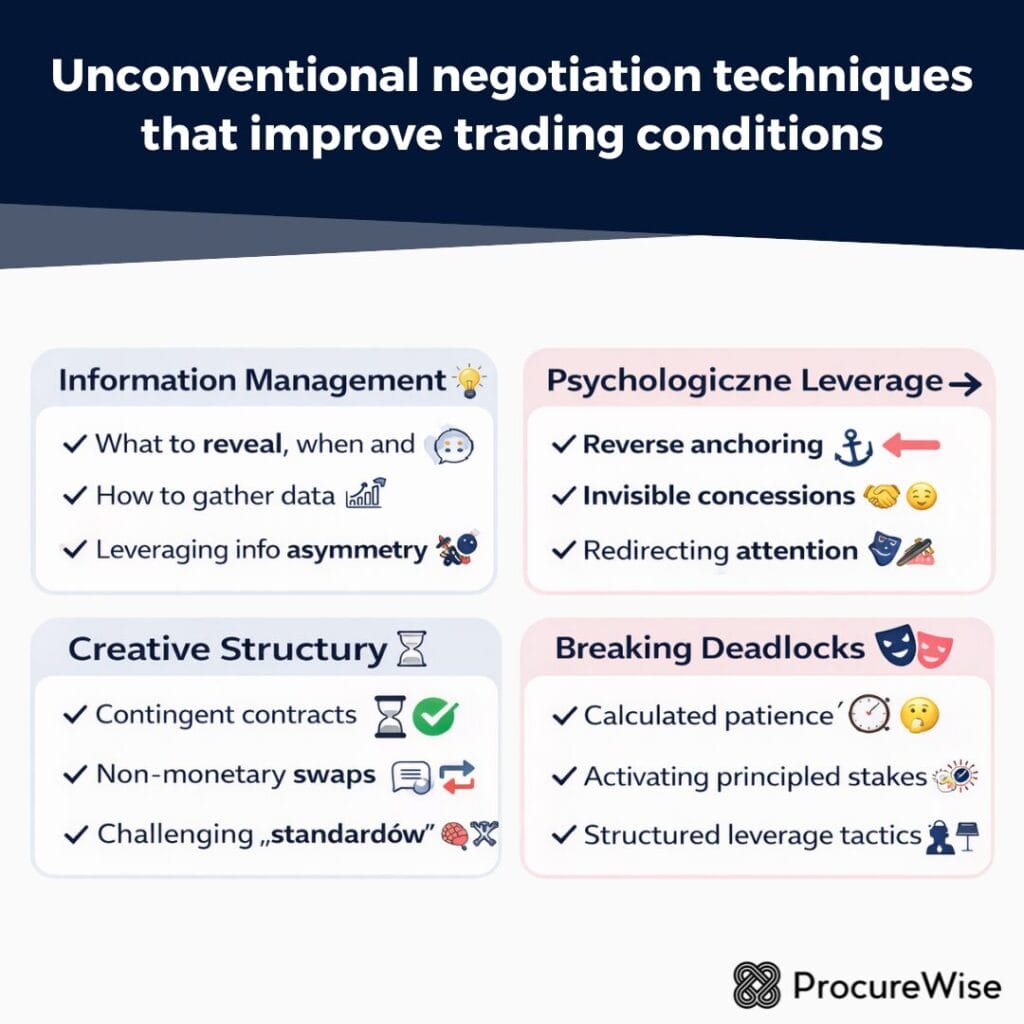
Superior trading terms rarely come from pushing price alone. They emerge from how the deal is structured. Unconventional negotiators redesign agreements to create flexibility, reduce risk, and unlock hidden value — especially in complex B2B commerce and supply chain environments.
Contingent Contracts: “If–Then” Deals That De-Risk Uncertainty 🔄
Contingent contracts tie outcomes to future performance instead of fixed assumptions.
They work especially well when:
- Results are uncertain
- Innovation or scale is involved
- Risk needs to be shared, not shifted
Examples include linking pricing to delivery performance, market adoption, or sustainability metrics. In industrial-scale projects, this approach aligns incentives and keeps negotiations moving when forecasts are fragile.
Non-Monetary Value Swaps: Trading Intangibles for Hard Gains 🔁
Advanced value creation happens when negotiators look beyond money.
Common non-monetary levers:
- Access to social network ties
- Preferred partner status
- Co-branding or joint market entry
- Priority access to future capacity
What costs little for one partner company can be extremely valuable to the other — making this one of the most underused negotiation tools.
Challenging “Standard Terms and Conditions” Without Escalation 🧱
Many negotiators treat standard clauses as untouchable. They’re not.
In areas like:
- Employment contracts
- Long-term supply agreements
- Tariffs and compliance-heavy deals
Power imbalances can often be softened by reframing risk, timing, or accountability. The key is not confrontation, but precision — showing how small adjustments reduce friction for both sides.
Designing ZOPA-Expanding Options Instead of Single Demands 📐
The Zone of Possible Agreement (ZOPA) expands when negotiations stop being one-dimensional.
Instead of “price vs. price,” introduce:
- Phased implementation
- Variable volumes
- Optional extensions
- Performance-based escalators
More variables = more paths to agreement. This is how integrative negotiations outperform distributive ones.
🔓Breaking Deadlocks Without Burning Bridges 🔓
Deadlocks happen when both sides protect positions instead of interests. Unconventional negotiators break impasses by changing the game, not forcing moves.
The Calculated Outlast Strategy: Let Time Work for You ⏳
When you have a strong alternative, patience becomes leverage.
By signaling comfort with delay:
- Pressure quietly shifts
- Internal urgency rises on the other side
- Concessions appear without demands
Time favors the party with lower dependency.
Activating Principled Pressure Points 🎯
Instead of threats, identify what the stalemate endangers:
- Reputation
- Internal KPIs
- Strategic timelines
By calmly highlighting these risks, you apply pressure that feels reasonable, not aggressive — preserving relationships while unlocking movement.
Orchestrated Leverage: Using Structure, Not Force 🎭
Tactics like:
- Good cop / bad cop
- Commitment tactics
- External expert opinions
Work best when they appear organic, not staged. The goal is to limit perceived options — without ever saying “take it or leave it.”
Beyond the “Best and Final Offer” ♻️
A best and final offer doesn’t have to be final.
Stalled negotiations can be revived by:
- Repackaging the deal
- Introducing a new variable
- Sequencing agreement into stages
Changing structure often succeeds where persuasion fails.
🤖 The Future Edge: AI as a Negotiation Multiplier 🤖
Unconventional negotiation is entering a new phase. Artificial intelligence is no longer just an analytics tool — it’s becoming a strategic partner in shaping negotiation outcomes.
In environments dominated by sales negotiations, algorithmic pricing, and complex supply chains, AI helps negotiators see patterns, anticipate moves, and test strategies long before real stakes are on the table.
AI-Powered Predictive Analytics: Reading Moves Before They Happen 🔮
AI excels at modeling interdependent decisions — exactly what negotiation is.
Used correctly, it can:
- Simulate opponent responses
- Identify likely concession points
- Detect escalation risk early
- Stress-test anchoring strategies
This turns preparation into probabilistic advantage, not guesswork — especially valuable in high-volume B2B commerce.
The “ChatGPT Negotiator”: Thinking Partner, Not Autopilot 🧩
Used as a negotiation assistant, AI can:
- Reframe offers in multiple strategic styles
- Surface hidden trade-offs
- Challenge your assumptions
- Generate alternative deal structures
The key rule: AI supports judgment — it doesn’t replace it. The human negotiator still controls tone, ethics, and timing.
Scenario Planning and Pre-Mortems: Testing Unconventional Tactics Safely 🧪
Before using bold tactics in real negotiations, advanced players run AI-driven simulations.
This allows you to:
- Test red herring strategies
- Evaluate commitment tactics
- Anticipate counter-moves
- Identify failure points early
Think of it as rehearsing high-risk plays — without paying real-world costs.
⚖️ Ethics, Power, and Long-Term Advantage ⚖️
Unconventional does not mean unethical.
Sustainable negotiation power comes from:
- Trust
- Reputation
- Repeat interactions
Tactics that rely on deception or personal insults may win once — and lose forever. The most effective negotiators use subtlety, structure, and insight, not intimidation.
🔥 Conclusion: Winning Better Deals by Playing Smarter 🔥
Better trading terms don’t come from harder bargaining — they come from better design.
Across this series, we’ve shown how unconventional negotiators:
- Diagnose hidden needs
- Control information flow
- Leverage psychology without aggression
- Structure deals for flexibility and value creation
- Break deadlocks creatively
- Use AI as a strategic amplifier
In a world of tightening margins, rising complexity, and constant power shifts, the edge belongs to those who shape the negotiation — not just survive it.
Your next step isn’t to memorize tactics. It’s to experiment, adapt, and redesign how you negotiate.