

Margin pressure is no longer a temporary headache — it’s the new normal. Rising input costs, fragile supply chains, and tougher customer expectations are squeezing profitability from every side. In this environment, supplier negotiation becomes a strategic weapon, not just a procurement routine.
Instead of reactive cost reduction, leading companies focus on cash flow, payment terms, and supplier relationships to protect margins sustainably. This article breaks down the essential rules and common pitfalls of negotiating with suppliers when margin pressure is high — and how to turn negotiations into a long-term advantage.
⚙️ Why Margin Pressure Is Hitting So Hard ⚙️
Inflation, logistics volatility, and supplier cost increases are colliding at once. Suppliers are under pressure to remain profitable, while buyers are expected to deliver cost savings and stable pricing internally.
Key challenges include:
- Rising raw material and transport costs
- Limited supplier flexibility due to thin margins
- Increased risk to cash flow and working capital
- Short-term negotiations damaging long-term partnerships
The result? Aggressive negotiations that often backfire — damaging supplier performance, delivery reliability, and future leverage.
🛡️ From Cost-Cutting to Strategic Negotiation 🛡️
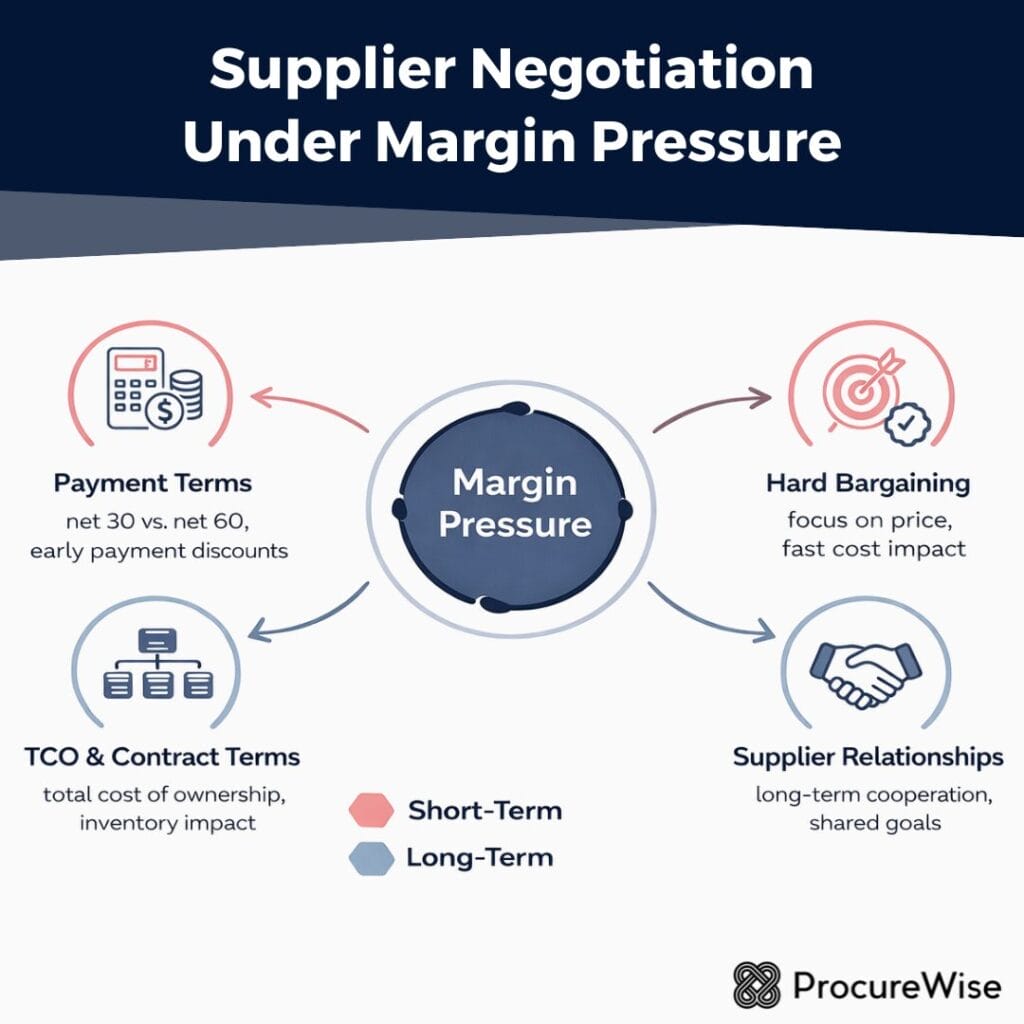
Many organizations still default to hard-bargaining tactics focused purely on price. Under margin pressure, this is risky.
Strategic negotiation shifts the focus to:
- Payment terms (Net 30, payment plans, early payment discounts)
- Total cost of ownership, not just unit price
- Supplier relationship management
- Long-term contract terms that reduce risk
Well-executed negotiations improve cash flow, stabilize supply, and unlock hidden value — without burning bridges.
🧱 Foundation of Margin Protection: Pre-Negotiation Rules 🧱
Strong negotiations begin before the first meeting. Preparation is your biggest leverage when margins are tight.
Rule 1: Master Your Own Numbers 📊
Before negotiating, you must fully understand your internal reality:
- True cost structure (logistics, inventory, quality, delays)
- Margin targets and acceptable trade-offs
- Impact of payment terms on cash flow
Without clarity, negotiators often concede too much — especially under time pressure or internal deadlines.
Rule 2: Understand the Supplier’s Financial Situation 💼
Effective vendor negotiation requires knowing what your supplier is dealing with:
- Cost drivers and margin constraints
- Dependence on your volume
- Sensitivity to payment history and payment timing
This insight enables collaborative negotiation instead of destructive price fights — protecting both sides.
Rule 3: Use Data as Your Negotiation Armor 🧠
Preparation means facts, not assumptions:
- Benchmark prices and contract terms
- Compare payment terms, lead times, and service levels
- Use procurement analytics to spot leverage points
Data-driven negotiations are harder to challenge and easier to defend internally.
Rule 4: Choose Collaborative Negotiation — With Clear Limits 🤝
Collaborative negotiation is not “soft negotiation.” It’s strategic.
Instead of aggressive hard-bargaining tactics, strong negotiators:
- Align on shared objectives (volume stability, cost predictability)
- Protect supplier performance while securing concessions
- Use transparency selectively — never desperation
Suppliers under financial pressure are more willing to collaborate when they see long-term value. Strong supplier relationships reduce risk, improve reliability, and unlock better terms over time — especially when margins are tight.
Rule 5: Optimize Payment Terms to Improve Cash Flow 💸
Payment terms are one of the fastest ways to protect margins without cutting price.
Smart negotiators actively manage:
- Net 30 vs extended payment terms
- Early payment discounts
- Flexible payment plans for strategic suppliers
Improving Days Payable Outstanding (DPO) strengthens cash flow, often with less resistance than price cuts. The biggest mistake? Treating payment terms as an afterthought instead of a negotiation lever.
Rule 6: Negotiate Value, Not Just Price 📦
Price-focused negotiations often destroy value elsewhere.
Effective contract negotiation looks at:
- Total cost of ownership (quality, delays, rework)
- Inventory management impact
- Contract flexibility and termination clauses
- Dispute resolution mechanisms
By shifting from cost reduction to value creation, negotiators avoid hidden costs that quietly erode margins long after the deal is signed.
Rule 7: Use Procurement Analytics to Strengthen Your Position 🧠
Data is leverage.
High-performing teams use procurement analytics to:
- Analyze spend and supplier performance
- Compare negotiation practices across vendors
- Identify cost savings beyond unit price
Analytics-backed negotiations reduce emotional decisions and strengthen credibility — especially when negotiating under time pressure or internal deadlines.
Rule 8: Treat Supplier Relationships as Margin Assets 🔗
Strong supplier relationship management directly supports margin stability.
Long-term partnerships enable:
- Better communication channels
- Faster dispute resolution
- Early visibility into supplier cost changes
When pressure hits, trusted suppliers negotiate — transactional ones dictate.
⚠️ Critical Negotiation Pitfalls Under Margin Pressure ⚠️
Where Companies Lose Margins Without Realizing It
Even strong negotiators make costly mistakes when margin pressure rises. Urgency, internal deadlines, and aggressive cost targets push teams into shortcuts that quietly destroy cash flow, weaken supplier relationships, and lock in bad contract terms. This section exposes the most dangerous pitfalls — the ones that look harmless in negotiations but hurt margins long after the deal is signed.
Pitfall 1: The Price-Only Obsession 🎯
Focusing only on unit price is the fastest way to lose money.
What gets ignored:
- Payment terms and cash flow impact
- Quality failures and rework costs
- Inventory buffers and delivery risk
- Contract rigidity during market changes
Many “cost savings” vanish once hidden costs appear. Smart negotiators evaluate total cost of ownership, not headline price.
Pitfall 2: Negotiating From Urgency or Weakness 🚨
Suppliers sense pressure immediately.
Common signals you should never reveal:
- Internal deadlines
- Budget gaps
- Supply shortages
- Poor payment history
Once urgency is visible, leverage disappears. Effective vendor negotiation controls information flow and maintains calm — even when internally things are burning.
Pitfall 3: Lack of Internal Alignment 🧩
Misaligned teams kill good deals.
Typical failures:
- Procurement pushes price, finance pushes cash flow
- Sales promises volumes not contractually secured
- Operations ignores supplier capacity constraints
Without alignment, negotiations collapse into concessions. Strong outcomes require one shared position across procurement, finance, sales teams, and operations.
Pitfall 4: Weak Contract Terms 📜
Great negotiations fail when contracts are sloppy.
Overlooked risks:
- Missing price escalation rules
- No performance KPIs or penalties
- Unclear dispute resolution mechanisms
- No exit or renegotiation clauses
Under margin pressure, poorly written contract negotiation outcomes silently erode profitability month after month.
Pitfall 5: No Follow-Up on Supplier Performance 📉
Negotiation doesn’t end at signature.
Without performance tracking:
- Service levels drift
- Costs creep back in
- Payment terms quietly change
Tracking supplier performance with clear KPIs is essential to realizing negotiated value — not just promising it.
Why These Pitfalls Repeat? 🧠
They usually stem from:
- Reactive cost reduction targets
- Short-term thinking
- Lack of procurement analytics
- Overreliance on hard-bargaining tactics
Margin pressure doesn’t excuse bad negotiation — it exposes it.
🚀 Advanced Strategies for Sustained Margin Resilience 🚀
Turning Supplier Negotiation Into a Long-Term Advantage
When margin pressure becomes permanent, one-off negotiations are no longer enough. The strongest organizations build systems, capabilities, and relationships that protect margins continuously — even during market shocks. This final section focuses on advanced, scalable strategies that turn supplier negotiation into a competitive edge.
Leverage Procurement Analytics for Predictive Advantage 📊
Modern negotiations are powered by data.
Leading teams use procurement analytics to:
- Track supplier performance and payment history
- Identify cost savings beyond price reductions
- Predict negotiation outcomes and risk scenarios
Analytics transform negotiations from reactive to proactive — supporting better decisions under margin pressure.
Use AI to Strengthen Negotiation Tactics 🤖
AI-driven tools increasingly support:
- Spend analysis and contract comparison
- Detection of unfavorable contract terms
- Scenario modeling for payment terms and cash flow
Organizations using advanced analytics negotiate faster, with stronger leverage and fewer concessions — especially when margins are thin.
Strategic Sourcing to Reduce Dependency Risk 🌍
Margin erosion often starts with over-dependence.
Strategic sourcing focuses on:
- Reducing single-supplier risk
- Balancing cost, resilience, and flexibility
- Supporting long-term partnerships without lock-in
Diversified sourcing strengthens your negotiation position and stabilizes costs during volatility.
Supplier Development for Long-Term Cost Reduction 🔄
Not all savings come from negotiation.
High-performing organizations invest in:
- Joint process improvements
- Inventory management optimization
- Collaborative cost reduction initiatives
Improving supplier performance lowers total cost over time — without constant renegotiation battles.
🏁 Conclusion: Make Margin-Conscious Negotiation a Core Capability 🏁
Margin pressure is not a crisis — it’s a test of negotiation maturity.
Organizations that win:
- Prepare with data and analytics
- Negotiate value, not just price
- Optimize payment terms for cash flow
- Build resilient supplier relationships
By embedding these principles into daily negotiation practices, companies transform pressure into profit protection and long-term stability.