
In today’s hyper-competitive digital economy, relying on gut feeling is no longer enough. Market monitoring, competitive intelligence, and data-driven decisions are now essential for staying ahead. The web is overflowing with valuable publicly available data—from pricing and job postings to customer reviews and AI-related signals—yet many companies still hesitate to use data scraping because of persistent myths.
This article kicks off a 4-part series that debunks the 5 most common myths about web scraping, web crawling, and market monitoring. The goal? To show how data scraping can be a legal, scalable, and reliable foundation for modern business intelligence and AI-powered analysis.
🔍 Why Market Monitoring Matters More Than Ever 🔍
Market monitoring is the continuous process of collecting and analyzing data from company websites, job listings, price monitoring systems, and other public data sources to understand what’s happening in your industry—right now.
Why it’s critical:
- Markets change fast: prices, demand, and competitors shift daily
- Competitors use automation: scraper bots and AI tools are already in play
- Real-time data beats reports: static research ages quickly
The rapid growth of the data scraping and web crawling ecosystem shows how central it has become to market research and competitive intelligence. Businesses increasingly rely on automated data collection to track pricing, AI models, job postings, and structural market changes.
🧱 The Myths Blocking Effective Competitive Intelligence 🧱
Despite its adoption, many organizations still avoid scraping because of fear and confusion. Common concerns include:
- “Isn’t web scraping illegal?”
- “Don’t you need advanced coding skills?”
- “Isn’t scraped data messy and unreliable?”
These misconceptions slow down data-driven teams, forcing them to rely on incomplete insights or manual research. In reality, when done correctly, data scraping is one of the most efficient ways to collect high-quality data points at scale.
Understanding the facts behind these myths is the first step toward smarter market monitoring.
🧭 What This Series Will Cover 🧭
Across this series, we’ll break down how web scraping really works—and why it’s far less risky than many believe. We’ll explore:
- Legal frameworks & Terms of Service
- Publicly available data vs. restricted data
- Scraping tools, crawler bots, and AI tools
- Data quality, cleaning, and validation
- How scraped data fuels AI models & analytics
The aim is simple: help you see data scraping not as a grey-area tactic, but as a core capability for effective market monitoring.
⚖️ Myth 1: “Data Scraping Is Always Illegal and Unethical” ⚖️
This is the biggest and most damaging myth—and it’s wrong.
The Reality of Publicly Available Data 📂
Scraping publicly available data—content accessible without logins, paywalls, or bypassing security—is fundamentally different from hacking or data theft. Search engines do it every day using web crawlers.
Key distinction:
- ❌ Scraping private, gated, or personal data without consent
- ✅ Collecting open data from company websites, job postings, or price listings
Legality depends on how data is collected, what data is collected, and whether rules are respected.
Terms of Service & robots.txt Still Matter 📜
Even with public data, responsible scraping means:
- Respecting website Terms of Service
- Following robots.txt instructions
- Avoiding aggressive scraper bots that overload servers
This is where ethical data collection meets technical best practices.
Why This Myth Persists ⚠️
Many professionals conflate:
- Computer Fraud and Abuse Act (CFAA) violations
- Copyright issues (DMCA)
- Legitimate data extraction for research
In reality, modern court rulings increasingly clarify that scraping public data—when done responsibly—is not the same as unauthorized access.
🧑💻 Myth 2: You Need to Be a Coding Expert to Scrape Data 🧑💻
One of the most stubborn data scraping myths is the belief that only senior developers or data scientists can extract data from the web. This misconception still blocks many teams from using web scraping for market monitoring, price monitoring, and competitive intelligence—even though the reality has changed dramatically.
Let’s break it down.
From Hardcore Coding to User-Friendly Scraping Tools 🛠️
In the past, web scraping usually meant writing custom scripts in Python, managing IP addresses, and building scraper bots from scratch. That’s no longer the default.
Today’s ecosystem includes:
- No-code scraping tools
- Low-code data extraction platforms
- Cloud-based scraping tools with built-in automation
These solutions handle web crawling, data collection, and even data cleaning, making them accessible to non-technical users focused on market research rather than code.
No-Code & Low-Code Tools for Market Monitoring 🧩
Modern AI tools and scraping platforms allow users to collect publicly available data with simple visual workflows.
Typical features include:
- Click-to-select data points on company websites
- Built-in handling of job listings, price monitoring, and customer reviews
- Automatic scheduling for continuous market monitoring
- Export-ready datasets for BI dashboards and AI models
This means product managers, analysts, and growth teams can run competitive intelligence without touching Python—or waiting for engineering resources.
When Coding Still Makes Sense (and Why That’s Okay) ⚙️
While no-code tools cover many use cases, custom coding still matters for advanced scenarios.
Popular Coding-Based Scraping Approaches 🔧
- Python + Scrapy for large-scale web crawlers
- Selenium for JavaScript-heavy, dynamic websites
- Custom pipelines for complex data extraction and transformation
These approaches shine when you need:
- Highly customized logic
- Deep integration with internal systems
- Large-scale crawling across thousands of pages
The key takeaway: coding is optional, not mandatory.
Dynamic Websites Aren’t a Dealbreaker Anymore 🧠
A common fear is that modern websites—built with JavaScript—are “unscrapable.” Not true.
Today’s tools can:
- Render dynamic HTML like a real browser
- Handle lazy-loaded content and pagination
- Simulate user behavior without violating website terms of service
This makes data scraping viable even for complex company websites, ecommerce platforms, and AI-driven interfaces.
What This Means for Competitive Intelligence 📌
The barrier to entry has collapsed.
You no longer need:
- A data science team
- Months of development
- Custom infrastructure
You do need:
- Clear goals for market monitoring
- Respect for legal frameworks and website terms of service
- The right mix of tools (no-code or custom)
Scraping is now a business capability, not a niche technical skill.
🧹 Myth 3: Scraped Data Is Always Messy and Unreliable 🧹
This myth scares off many teams before they even start. Yes—raw scraped data can look chaotic at first glance. But that’s not a flaw of data scraping itself. It’s simply the nature of data collection from websites built for humans, not machines.
The truth? With the right processes, scraped data becomes a reliable, high-value asset for market monitoring, competitive intelligence, and AI models.
Why Raw Data Looks “Messy” in the First Place 🧪
Websites aren’t databases. They’re dynamic interfaces.
Common issues in raw scraped data:
- Inconsistent formats (prices, dates, currencies)
- Duplicate entries from pagination or filters
- Extra HTML, symbols, or text noise
- Structural changes on company websites
This happens with any data source—including APIs and internal systems. Scraping just makes the problem visible earlier.
Data Cleaning Is a Feature, Not a Bug 🛠️
Modern scraping tools and AI tools treat data cleaning as a core capability—not an afterthought.
Typical cleaning steps include:
- Normalization of prices, dates, and units
- Deduplication across crawling sessions
- Validation of data points (e.g. numeric price fields)
- Schema alignment for analytics and dashboards
This process transforms raw web data into structured datasets ready for market research and price monitoring.
How to Ensure Accuracy & Reliability 📏
High-quality scraped data depends more on process than source.
Best practices:
- Scrape from consistent, reputable sources
- Use multiple sources to reduce bias
- Schedule regular crawls for freshness
- Monitor structural changes in web pages
- Log errors and anomalies automatically
That’s why data scientists and analysts increasingly trust scraped datasets for competitive intelligence and forecasting.
Bias, Gaps, and How to Handle Them 🧠
No dataset is perfect—scraped or not.
Potential risks:
- Over-reliance on a single website
- Skewed insights from limited customer reviews
- Regional or language bias in job postings
The fix? Breadth and balance. Combine multiple websites, platforms, and data types—pricing, job listings, reviews—to create a more accurate market view.
Why AI Models Actually Love Scraped Data 🤖
Clean scraped data is ideal fuel for:
- Predictive analytics
- Trend detection
- Anomaly spotting
- AI-led market insights
Once structured, scraped data integrates seamlessly into AI models, enabling smarter decisions and faster reactions to market changes.
This is why scraping underpins modern AI tools, especially in ecommerce, recruitment analytics, and pricing intelligence.
The Real Takeaway 📌
Scraped data isn’t unreliable—it’s unfinished.
When paired with:
- Strong cleaning pipelines
- Validation rules
- Ethical data collection
…it becomes one of the most scalable and flexible data sources available for market monitoring today.
🤖 Myth 4: Data Scraping Is Only About Automation, Not Strategy 🤖
Many people still see web scraping as a purely technical task—something scraper bots do in the background. In reality, data scraping is a strategic engine for market monitoring, competitive intelligence, and AI-driven decision-making.
Scraping doesn’t replace thinking—it amplifies it.
From Raw Data to Strategic Market Monitoring 📊
When aligned with business goals, scraped data supports:
- Price monitoring across competitors and regions
- Tracking structural changes on company websites
- Monitoring job postings to spot hiring trends
- Detecting shifts in product positioning and messaging
This turns web data into actionable intelligence, not just spreadsheets.
🧠 Myth 5: Scraping Has Nothing to Do with AI or Advanced Analytics 🧠
This myth couldn’t be further from the truth.
Modern AI models depend on large, fresh, external datasets—and scraping is one of the most scalable ways to collect them.
How Scraped Data Powers AI ⚡
- Training machine learning models
- Feeding generative AI with real-world signals
- Enabling trend detection and anomaly alerts
- Supporting predictive market analysis
Without automated data collection, AI insights quickly become stale.
Continuous Intelligence Beats One-Off Research 🔄
Traditional market research is static. Scraping enables always-on intelligence.
Benefits:
- Real-time reaction to market changes
- Early detection of competitor moves
- Faster experimentation and iteration
- Better alignment between data teams and business teams
This is why scraped data sits at the core of modern competitive intelligence platforms.
Responsible Scraping: The Non-Negotiables ⚖️
Strategic value only holds if scraping is done responsibly.
Key principles:
- Respect website terms of service
- Follow legal frameworks and court rulings
- Use rate limiting and ethical crawler behavior
- Avoid personal or sensitive data unless compliant
Responsible scraping isn’t a constraint—it’s what makes scaling possible.
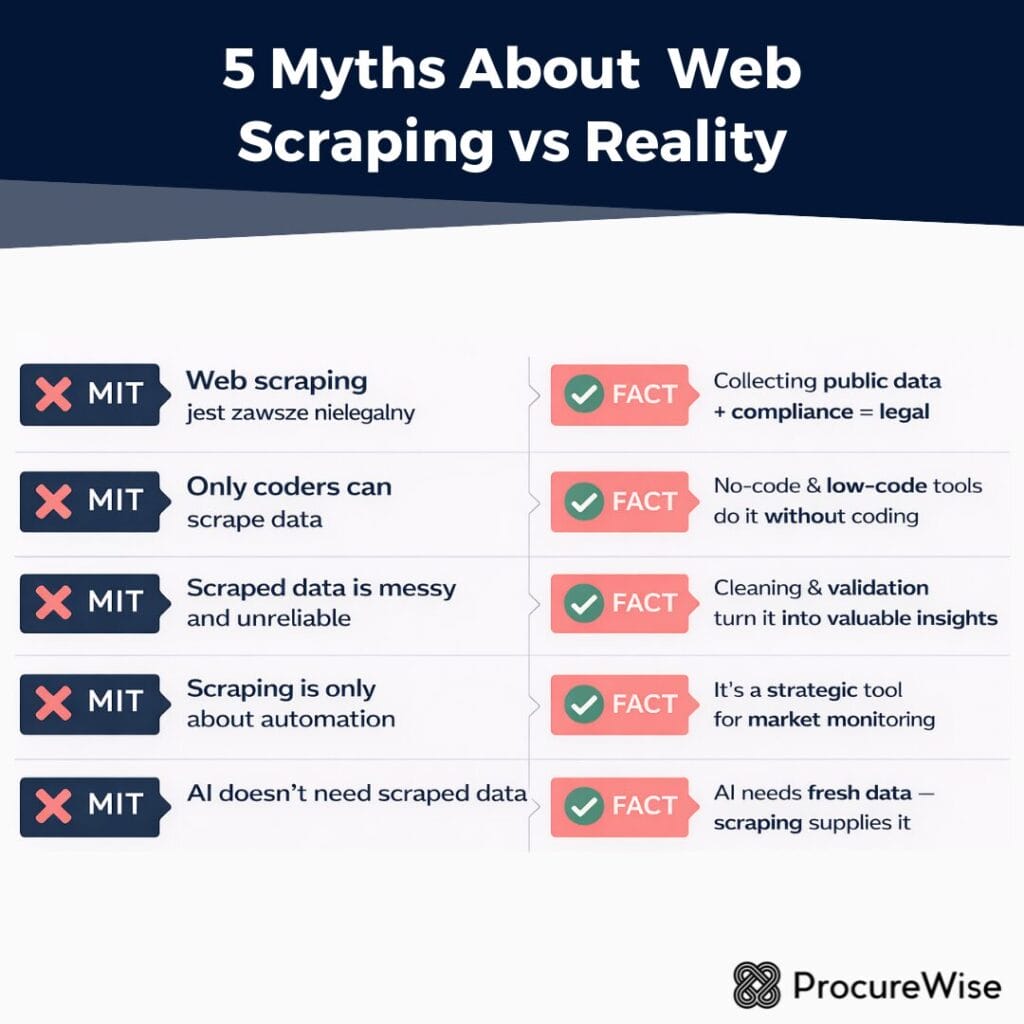
The Big Picture: What the 5 Myths Get Wrong 🧭
Let’s recap what we’ve dismantled:
- ❌ Scraping is illegal → ✅ Public data + compliance = lawful
- ❌ Only coders can scrape → ✅ No-code & AI tools exist
- ❌ Scraped data is unreliable → ✅ Cleaning makes it powerful
- ❌ Scraping isn’t strategic → ✅ It drives market monitoring
- ❌ AI doesn’t need scraped data → ✅ AI thrives on it
🚀 Final Takeaway: Scraping as a Competitive Advantage 🚀
In a world driven by AI, automation, and real-time markets, data scraping is no longer optional.
Used ethically and strategically, it becomes:
- A foundation for market research
- A driver of price monitoring
- A fuel source for AI models
- A lens into job markets, competitors, and customers
Effective market monitoring starts with understanding the web—not fearing it.