

The retail world is a perpetual motion machine — fast, competitive, and unforgiving. With hundreds of thousands of new business applications filed every month, retail expansion strategies are no longer optional; they are essential for survival. Expanding assortments, entering new markets, and optimizing pricing all require more than intuition — they require data intelligence, competitive advantage, and price monitoring at scale.
This article breaks down 8 proven retail expansion strategies, showing how data scraping, competitor prices, and online marketplaces enable sustainable growth — while debunking the most common myths that still hold retailers back.
📊 Why Retail Expansion Is No Longer Optional? 📊
Retailers that stand still lose relevance. Expansion unlocks market position, diversified revenue, and stronger customer loyalty — but only when executed with precision. Modern consumers expect convenience, personalization, and competitive pricing across channels.
Ignoring real-time inventory levels, price advice, and market position data often leads to overstocking, margin erosion, or missed demand. Expansion today must be data-driven, not reactive.
🧠 How Data Intelligence Powers Scalable Growth? 🧠
Data intelligence transforms raw market signals into actionable insights. By tracking competitor prices, cost-plus pricing benchmarks, and online marketplace dynamics, retailers can predict demand, optimize assortments, and protect margins.
Smart retailers use automated data collection to:
- Identify competitive advantage gaps
- Monitor price monitoring signals in real time
- Adapt faster than competitors relying on manual research
Without data intelligence, expansion becomes a gamble instead of a strategy.
🎯 What You’ll Learn in This Guide? 🎯
This guide delivers:
- 8 retail expansion strategies backed by data
- Practical use cases for price monitoring and inventory levels
- How data scraping supports pricing, assortment, and positioning
- Clear explanations that debunk common data scraping myths
The goal: help you expand faster, smarter, and more profitably — without guesswork.
🧩 The Strategic Foundation of Retail Expansion 🧩
Every successful expansion strategy rests on understanding market dynamics. That means knowing where demand exists, how competitors price, and which online marketplaces drive the highest ROI.
Data intelligence gives retailers clarity on:
- Competitor prices and promotional behavior
- Gaps in product assortment
- Regional differences in price sensitivity
This foundation ensures expansion efforts are scalable, profitable, and aligned with real market conditions.
Tactic 1: Market Entry Intelligence & Validation 🔍
Before entering a new market, retailers must validate demand, competition, and pricing realities. This is where data scraping becomes indispensable.
By analyzing competitor prices, customer reviews, and local assortment gaps, retailers can:
- Avoid oversaturated markets
- Identify unmet customer needs
- Validate pricing feasibility before launch
This tactic directly strengthens market position and reduces costly expansion failures.
Tactic 2: Channel Diversification Strategy 🛒
Why Online Marketplaces Matter for Expansion 🧩
Expanding through online marketplaces (Amazon, Allegro, Zalando) alongside D2C and new retail partners dramatically accelerates reach. Each channel attracts different customer segments, price sensitivities, and buying behaviors.
A smart retail expansion strategy compares:
- Competitor prices per channel
- Channel-specific fees vs margins
- Impact on customer loyalty
Retailers that actively monitor channels gain a competitive advantage by allocating inventory and marketing budgets where ROI is highest.
Data Intelligence Behind Channel Decisions 📊
Using automated price monitoring, retailers can see where competitors win visibility and where margins erode. This prevents blind expansion and supports price advice tailored to each channel — not guesswork.
Tactic 3: Geographic Pricing Optimization 🌍
One Price Never Fits All Markets 💸➡️
Geographic expansion fails most often due to poor pricing decisions. Regional income levels, demand elasticity, and local competition all differ. Relying solely on cost-plus pricing ignores market reality.
Data-driven retailers analyze:
- Local competitor prices
- Regional demand signals
- Currency and logistics impact on margins
This allows dynamic, localized pricing instead of static global price lists.
From Cost-Plus to Market-Driven Pricing ⚖️➡️
Cost-plus pricing is simple — but dangerous at scale. Competitive markets require adaptive models supported by price monitoring and historical trend analysis. The result: higher conversion rates without margin collapse.
Tactic 4: Strategic Assortment Expansion 📦
Expanding Inventory Without Increasing Risk 🧠
Adding products blindly increases inventory levels — and financial exposure. Strategic assortment expansion uses data to identify:
- High-demand product gaps
- Overcrowded categories to avoid
- Complementary products that boost basket size
This reduces dead stock and improves capital efficiency.
Using Data to Build Competitive Advantage 🏆
By analyzing online marketplaces, reviews, and competitor assortments, retailers uncover unmet needs. This insight fuels smarter product launches and strengthens long-term competitive advantage — not just short-term sales spikes.
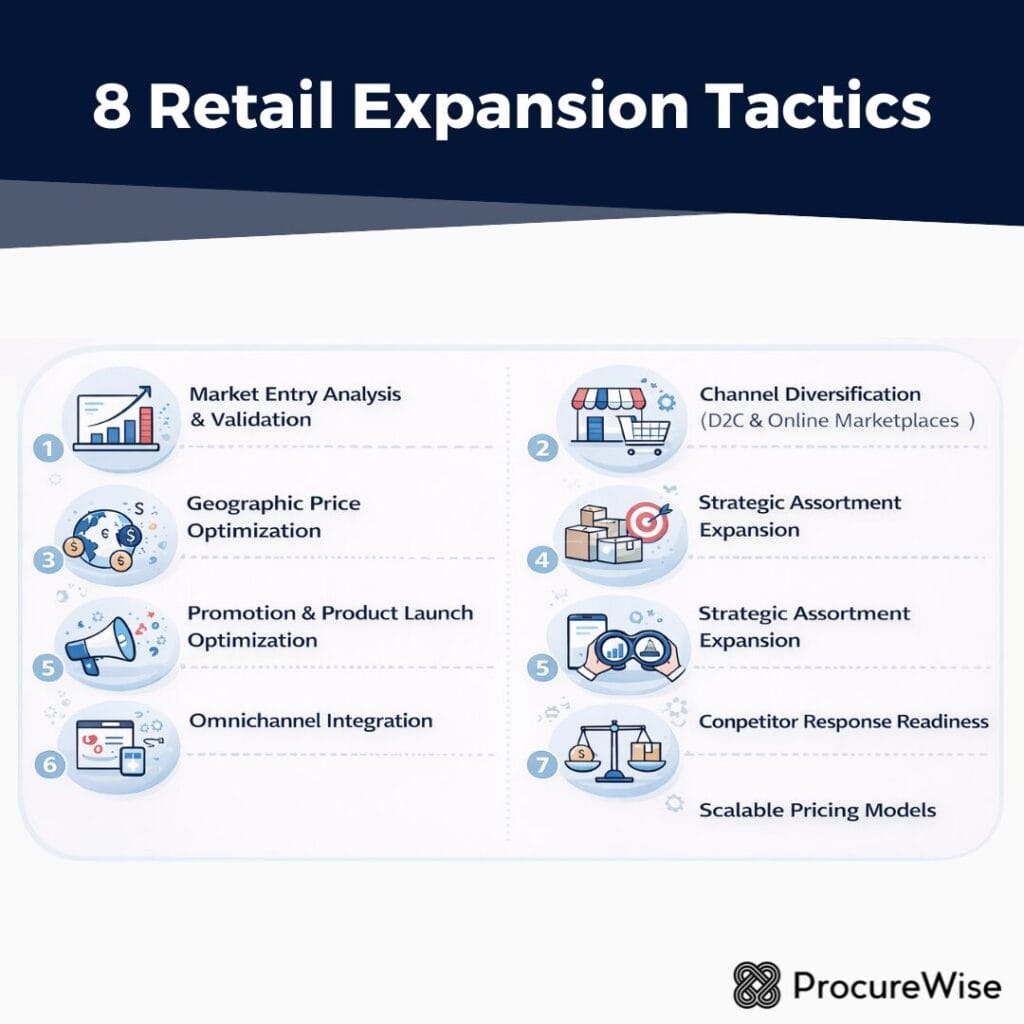
Tactic 5: Strategic Promotions & Product Launches 🎯
Why Most Promotions Fail 💥
Promotions often underperform because they’re launched without understanding competitor prices, timing, or real demand. Blanket discounts erode margins and weaken customer loyalty.
Data-driven promotion planning focuses on:
- Historical promo performance
- Real-time price monitoring of competitors
- Channel-specific elasticity
This turns promotions into growth levers — not margin killers.
Data-Backed Launch Campaigns 🚀
Before launching new products, top retailers analyze online marketplaces, reviews, and competitor launches. This reveals optimal price points, messaging, and bundle opportunities — creating immediate traction instead of slow adoption.
Tactic 6: Omnichannel Integration for Seamless Growth 🔗
Customers Don’t Think in Channels 🧠
Modern shoppers expect consistency across online, mobile, and physical stores. Omnichannel strategies connect pricing, availability, and experience into one ecosystem.
Successful retailers align:
- Inventory levels across channels
- Pricing logic to avoid internal competition
- Promotions that work online and offline
This improves conversion and strengthens market position.
From Online to Offline (and Back Again) 🔄
Features like click-and-collect or ship-from-store only work when powered by accurate data. Poor visibility into inventory or pricing creates friction — and lost sales.
Tactic 7: Competitor Response Preparedness ⚔️
Expansion Is a Competitive Game 🕵️
When you expand, competitors react — often aggressively. Retailers without real-time price monitoring are always one step behind.
Competitive readiness means tracking:
- Sudden price drops
- New product launches
- Promotional intensity
This enables fast counter-moves without panic discounting.
Dynamic Adjustments Beat Static Plans ⚡
Data scraping allows retailers to respond dynamically instead of rewriting strategies every quarter. Agility is the real competitive advantage in fast-moving retail markets.
Tactic 8: Scalable Pricing Models for Long-Term Growth 📈
Why Pricing Must Scale with Expansion 🧩
Expansion breaks fragile pricing models. What works in one market or channel may fail in another. Relying purely on cost-plus pricing limits flexibility and growth.
Scalable pricing models consider:
- Demand elasticity
- Channel-specific fees
- Competitor price behavior
When “Fun Pricing Methods” Actually Work 🎲
Psychological or “fun pricing methods” (charm pricing, bundles, thresholds) only succeed when backed by data. Without insight, they confuse customers and weaken trust instead of boosting sales.
⚙️ Data Scraping: The Engine Behind Retail Expansion ⚙️
What Retail Data Scraping Really Is 🧲
Retail data scraping is the automated collection of publicly available data from online marketplaces, retailer websites, and digital shelves. Instead of manual research, systems gather data at scale and in near real time.
Typical use cases include monitoring:
- Competitor prices
- Product availability and inventory levels
- Promotions and assortment changes
This data fuels smarter price advice, assortment decisions, and expansion planning.
Key Data Points That Drive Expansion 📊
High-performing retailers collect structured data such as:
- Product SKUs, variants, and availability
- Price monitoring history and promo depth
- Customer reviews (for demand signals)
- Channel-specific assortment strategies
Together, these insights shape sustainable retail expansion strategies.
🚫 Data Scraping Myths That Hold Retailers Back 🚫
Myth 1: “Data Scraping Is Illegal” ❌
Scraping publicly available data is legal when done responsibly. Ethical scraping respects website rules, avoids personal data, and focuses on market intelligence — not misuse.
Myth 2: “You Need Developers or Data Scientists” ❌
Modern tools make data scraping accessible to non-technical teams. Business users can track competitor prices or online marketplaces without writing code.
Myth 3: “Scraped Data Is Only for Price Wars” ❌
Pricing is only one use case. Scraped data supports:
- Market position analysis
- Assortment planning
- Promotion timing
- Competitive advantage mapping
Myth 4: “It’s Too Expensive for SMEs” ❌
Today’s tools scale with business size. Even small retailers can access price monitoring and inventory insights without enterprise budgets.
Myth 5: “Manual Research Is Enough” ❌
Manual tracking cannot keep up with fast-moving competitors. Automation ensures speed, accuracy, and continuous visibility — essential for expansion.
🛠️ Implementing a Data-Driven Expansion Strategy 🛠️
Choosing the Right Tools & Partners 🧩
Look for solutions that support:
- Scalable price monitoring
- Multi-market coverage
- Clean, actionable reporting
Some retailers build internal capabilities, others partner with platforms like Omnia Retail to accelerate results without complexity.
Building a Data-First Retail Culture 🌱
Technology alone isn’t enough. Successful expansion requires teams to trust data when making decisions about pricing, assortment, and channels — not intuition.
🏁 Final Takeaway: Intelligent Expansion Wins 🏁
Retail expansion is no longer about moving faster — it’s about moving smarter. The brands that win combine:
- Clear retail expansion strategies
- Real-time competitor price monitoring
- Scalable pricing and assortment logic
- Ethical, automated data intelligence
The future of retail belongs to companies that treat data as a strategic asset — not an afterthought.