

Navigating the journey of a product — from the first spark of innovation to its final market exit — requires more than intuition. It demands a structured, strategic, and connected approach. In today’s fast-moving market reality, treating product introduction, listing, and delisting as separate silos often leads to inefficiencies, lost insights, and underperforming portfolios.
This comprehensive checklist reframes the product lifecycle as one cohesive system. By aligning new product introduction (NPI), optimized listings, and strategic delisting, organizations can build agility, unlock market intelligence, and drive sustainable profitability. Think of it as a roadmap that ensures every product decision supports the next one — deliberately and intelligently.
🔄 Understanding the Product Lifecycle 🔄
The product lifecycle describes the stages a product moves through — from concept to withdrawal. Traditionally, this includes introduction, growth, maturity, and decline. However, in practice, high-performing organizations expand this view to include active listing and intentional delisting as equally critical phases.
A lifecycle-driven mindset enables businesses to:
- Anticipate market shifts
- Allocate resources efficiently
- Adapt strategies proactively
Managing these phases together — not in isolation — is what maximizes both profitability and product longevity.
🔗 The Interconnectedness of Listing, Delisting & Introduction 🔗
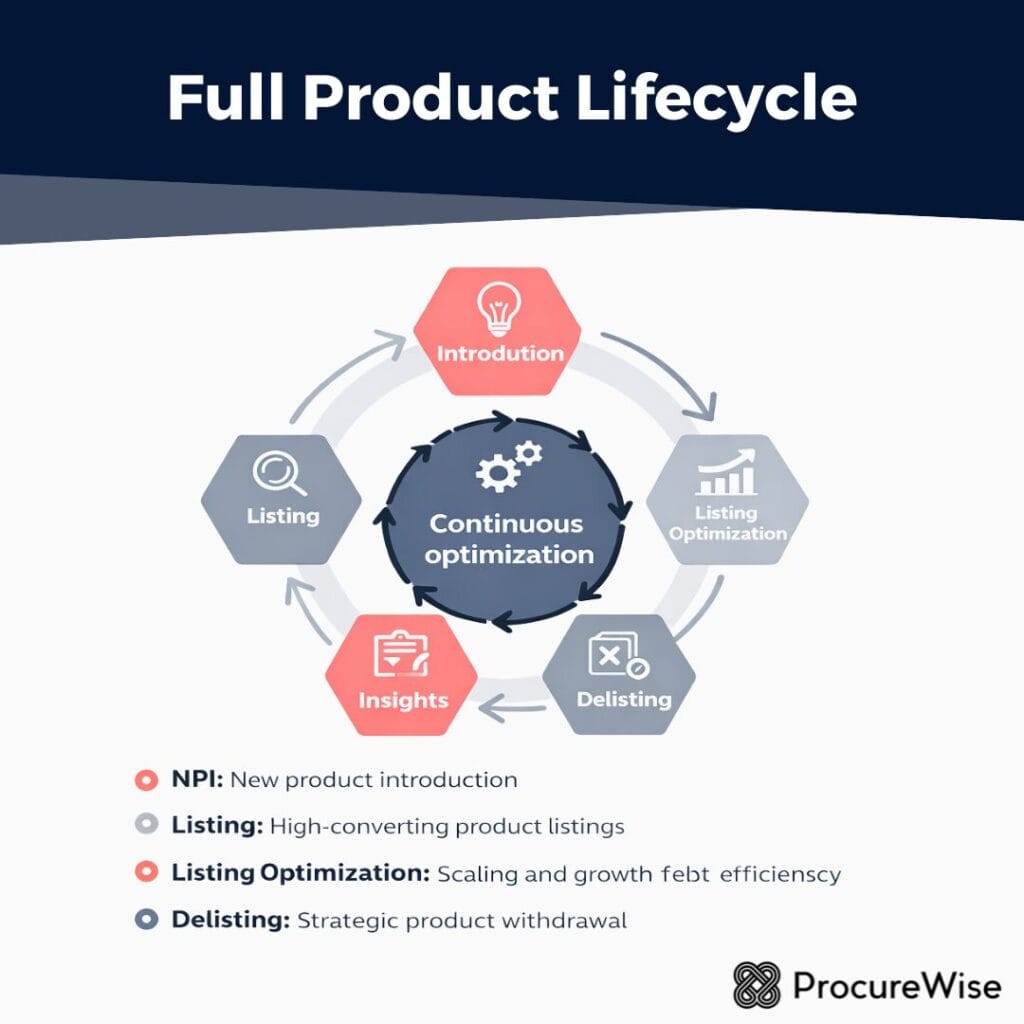
Product lifecycle management is a continuous loop, not a linear path. Each phase feeds directly into the next:
- Insights from active listings and sales data inform future product concepts
- Delisting decisions free up budget, focus, and capacity for innovation
- Lessons from past launches and retirements sharpen future go-to-market strategies
When these connections are ignored, organizations miss synergies and repeat avoidable mistakes. When embraced, they create a self-improving product ecosystem that evolves with the market.
🧭 Why a Comprehensive Checklist Is Essential? 🧭
In a system this interconnected, a checklist isn’t bureaucracy — it’s protection and leverage. A well-designed checklist ensures:
- No critical steps are missed
- Stakeholders stay aligned across teams
- Timing, data, and quality standards are consistently met
It also safeguards performance at key moments — from product content quality (a major purchase driver) to listing optimization in low-conversion environments. By guiding teams through development, launch, optimization, and exit, a checklist turns complexity into clarity and execution into repeatable success.
🌱 Phase 1: Introducing New Products – The NPI Journey 🌱
The New Product Introduction (NPI) phase starts long before a product appears on the shelf or online. It is a disciplined process that transforms ideas into market-ready solutions, balancing creativity with feasibility.
This phase focuses on:
- Validating real customer needs
- Building scalable, manufacturable products
- Reducing launch risk through structured preparation
A strong NPI foundation dramatically increases the odds of market adoption and long-term performance.
From Ideation to Product Concept ✨
Every product begins with an idea — but not every idea deserves to become a product. This stage is about filtering inspiration through market reality.
Key activities include:
- Market and user research
- Problem definition and opportunity sizing
- Target audience analysis
The output is a clear product concept: what problem it solves, for whom, and why it should exist. This clarity becomes the anchor for development, messaging, and positioning.
Product Development and Prototyping 🛠️
With a validated concept, teams move into design, engineering, and prototyping. Here, ideas become tangible.
This stage focuses on:
- Translating concepts into technical specifications
- Iterative prototyping and refinement
- Early manufacturing and supply chain planning
Decisions made here directly affect costs, scalability, and future listings, making precision and cross-team collaboration essential.
Testing, Quality Assurance, and Refinement 🧪
Before launch, products must prove they can perform — consistently and safely. Testing ensures the product meets both technical standards and user expectations.
This phase includes:
- Functional and durability testing
- User and beta testing
- Quality assurance validation
Feedback loops drive refinement, reducing post-launch issues and increasing the likelihood of a successful market entry.
🎯 Strategic Launch Planning 🎯
As product development nears completion, launch planning becomes the strategic bridge between readiness and real market impact. This phase aligns pricing, distribution, marketing, and internal ownership into one coordinated plan.
Key focus areas include:
- Defining go-to-market strategy and success criteria
- Selecting channels that match target audience behavior
- Aligning marketing, sales, and operations on timelines and roles
A strong launch plan doesn’t just announce a product — it positions it for adoption and sets clear expectations across the organization.
Pricing, Channels, and Positioning 💰
Pricing and positioning decisions shape how the product is perceived from day one. This step ensures the value proposition is both competitive and credible.
Considerations include:
- Value-based vs. competitive pricing
- Channel fit (e-commerce, marketplaces, retail, B2B)
- Clear differentiation vs. alternatives
When pricing, messaging, and channels reinforce each other, the product enters the market with confidence instead of confusion.
Marketing Readiness and Campaign Design 📣
Marketing readiness means more than having assets — it means having a story that resonates. Campaigns should clearly communicate why this product matters and who it’s for.
This includes:
- Core messaging and value proposition
- Campaign themes and creative concepts
- Channel-specific execution (social, email, ads, content)
Well-prepared campaigns create momentum before launch and accelerate early adoption.
🚀 Launch Execution & Market Entry 🚀
Launch execution is where preparation meets reality. This phase is about flawless coordination, not improvisation.
Success depends on:
- Campaigns going live on time
- Sales channels being fully enabled
- Inventory, logistics, and support teams being ready
A smooth launch builds trust — internally and externally — and sets the tone for the product’s lifecycle.
Cross-Team Coordination and Readiness 🤝
No launch succeeds in isolation. Product, marketing, sales, operations, and support must move in sync.
Critical checks include:
- Sales enablement materials finalized
- Customer support trained and briefed
- Internal FAQs and escalation paths defined
This alignment reduces friction and ensures a consistent customer experience from first contact.
Post-Launch Analysis and Early Signals 📊
The launch doesn’t end on day one. Early performance data reveals whether assumptions hold up in the real market.
Track early indicators such as:
- Initial sales and demand signals
- Customer feedback and objections
- Campaign performance vs. expectations
Fast analysis enables quick adjustments, turning early insights into competitive advantage.
🛒 Phase 2: Mastering Product Listing 🛒
Once a product is live, visibility and clarity determine its fate. Product listings are not static descriptions — they are conversion engines that influence discovery, trust, and purchase decisions.
This phase focuses on making sure the product is:
- Easy to find
- Easy to understand
- Easy to choose
Strong listings amplify the impact of a great product; weak ones quietly sabotage it.
Preparing Product Data for Listing 🧩
Effective listings start with complete, accurate, and structured data. This is where many products lose momentum.
Preparation includes:
- Core specifications and attributes
- Benefits translated into customer language
- High-quality images and supporting media
Clean, consistent product data ensures listings scale across platforms without dilution or errors.
🧲 Crafting High-Converting Product Listings 🧲
At this stage, the product is live — but success depends on how convincingly it’s presented. A high-converting listing translates features into value, reduces hesitation, and guides the customer toward a confident decision.
Effective listings balance clarity, persuasion, and accuracy. They don’t overwhelm — they prioritize what matters most to the buyer at the moment of choice.
Product Titles, Descriptions, and Benefits ✍️
The core of every listing is its content. Titles and descriptions must work hard in very little space.
Best practices include:
- Clear, keyword-aligned titles
- Benefit-driven descriptions (not feature dumps)
- Scannable bullet points focused on outcomes
When customers immediately understand what the product does and why it’s relevant to them, conversion friction drops fast.
Visual Content and Media Optimization 📸
Images and videos often do more selling than words. Visuals shape first impressions and build trust instantly.
High-impact listings include:
- Clean, high-resolution product images
- Contextual “in-use” visuals
- Short videos or animations explaining value
Strong visuals reduce uncertainty, answer silent questions, and shorten the path to purchase.
🧠 Platform-Specific Optimization 🧠
Each marketplace and channel has its own rules, algorithms, and customer behaviors. Winning listings are tailored, not copied.
Optimization ensures the product is discoverable and favored by platform logic — from search ranking to recommendations.
Search, Keywords, and Discoverability 🔍
Search visibility is foundational. If customers can’t find the product, they can’t buy it.
Key actions include:
- Keyword research aligned to real search intent
- Strategic placement in titles, bullets, and attributes
- Continuous refinement based on performance data
Discoverability is not a one-time task — it’s an ongoing optimization loop.
Mobile and UX Readiness 📱
With mobile commerce dominating, listings must be designed for small screens and short attention spans.
This means:
- Short paragraphs and scannable layouts
- Clear hierarchy of information
- Fast-loading images and media
A mobile-friendly listing respects the customer’s time — and is rewarded with higher engagement.
📣 Promoting and Scaling Your Listings 📣
Even the best listing needs traffic. Promotion fuels momentum, especially during early lifecycle stages.
Promotion strategies should be data-driven and targeted, not generic.
Traffic, Campaigns, and External Reach 🚦
To accelerate visibility, listings are supported by external demand generation.
Typical levers include:
- Paid search and social campaigns
- Email and CRM activation
- Influencer or affiliate partnerships
The goal is simple: bring the right audience to the right listing at the right moment.
Reviews, Trust Signals, and Social Proof ⭐
Trust closes the sale. Reviews and ratings often determine whether a customer converts or bounces.
Strong review strategies focus on:
- Ethical review generation
- Rapid response to feedback
- Highlighting authentic customer experiences
Social proof reassures buyers that choosing your product is a safe decision.
📈 Monitoring & Continuous Listing Optimization 📈
Listings are never “finished.” Performance data reveals what works — and what quietly blocks conversion.
Performance Metrics and Testing 🧪
Ongoing optimization relies on measurement and experimentation.
Track and refine:
- Conversion and click-through rates
- Bounce and exit behavior
- A/B tests on titles, images, and copy
Small improvements compound into significant revenue impact over time.
🧯 Phase 3: Strategically Delisting Products 🧯
Delisting is not a failure — it’s a deliberate portfolio decision. Products naturally reach a point where they no longer support strategic, financial, or brand objectives. Managing this phase intentionally protects margins, customer trust, and internal focus.
A structured delisting approach ensures exits are controlled, compliant, and informative, rather than reactive.
Recognizing the Right Time to Delist ⏱️
The decision to delist should be driven by data, not instinct. Clear signals help remove emotion from the process.
Common indicators include:
- Consistent sales and margin decline
- Rising operational or support costs
- Market obsolescence or regulatory pressure
- Strategic misalignment with future direction
Early recognition enables proactive planning instead of rushed damage control.
Delisting Impact Assessment & Planning 🧠
Before execution, it’s critical to understand the ripple effects of removal.
Key planning elements:
- Inventory run-down or liquidation strategy
- Financial and contractual implications
- Dependencies with bundles, accessories, or services
Thoughtful planning minimizes disruption and preserves value even at end-of-life.
📢 Executing the Delisting Process 📢
Execution is where trust is either maintained or lost. Clear communication and internal alignment are non-negotiable.
Customer, Partner, and Internal Communication 📬
Transparent communication prevents confusion and reputational damage.
Best practices include:
- Advance notice to customers and partners
- Clear timelines and final purchase options
- Suggested alternatives or upgrade paths
Internally, teams must be fully briefed to ensure consistent messaging across touchpoints.
Operational Shutdown and Channel Cleanup 🧹
Once communication is in motion, operational execution follows.
This includes:
- Halting production and procurement
- Updating all sales channels and listings
- Final inventory clearance
Clean execution avoids lingering costs and brand inconsistencies.
🔁 Post-Delisting Review & Knowledge Capture 🔁
Delisting is also a learning opportunity. What the product taught the organization may be more valuable than what it earned.
Lifecycle Retrospective and Insights 📘
Post-delisting analysis should capture:
- Root causes of decline
- Missed or misread market signals
- Effectiveness of launch, listing, and exit strategies
These insights directly strengthen future product decisions.
🧩 Integrating the Full Product Lifecycle (PLM) 🧩
True Product Lifecycle Management treats introduction, listing, optimization, and delisting as one continuous system — not isolated events.
The Continuous Feedback Loop 🔄
Information flows both ways across the lifecycle:
- Listing and sales data inform new product development
- Delisting insights prevent repeat mistakes
- Customer feedback shapes future positioning
This loop is the engine of long-term portfolio improvement.
KPIs Across the Lifecycle 📊
Measuring success requires stage-specific metrics.
Typical KPIs include:
- Introduction: time-to-market, launch adoption
- Listing: conversion rates, visibility, reviews
- Delisting: cost recovery, customer retention
Shared visibility into these metrics enables smarter, faster decisions.
🏁 Conclusion: A Practical Roadmap to Product Lifecycle Excellence 🏁
A successful product strategy doesn’t end at launch — and it doesn’t fear endings. By managing every phase with intention, organizations turn complexity into control.
This listing–delisting–introduction checklist provides a practical, repeatable framework to:
- Launch with confidence
- Scale with clarity
- Exit with insight
When the full lifecycle is treated as one connected journey, products stop being isolated bets — and become part of a resilient, learning-driven portfolio.