

In today’s hyper-connected economy, static pricing decisions are no longer enough. Markets shift instantly—market trends, competitor pricing, customer behavior, and market conditions evolve in real time. Companies relying on periodic updates risk missed revenue and shrinking margins.
To stay competitive, businesses must adopt advanced dynamic pricing strategies fueled by real-time market data. By integrating data collection, market insights, and pricing engines, organizations can transition from reactive price adjustments to proactive, AI-driven price optimization.
The goal is clear: maximize profit, protect margins, and respond instantly to demand fluctuations.
📡 Real-Time Market Data as the Foundation of Dynamic Pricing 📡
What Constitutes Real-Time Market Data? ⚙️
Real-time market data combines multiple high-velocity streams that directly influence pricing rules and optimization models:
- Market demand fluctuations (search spikes, trend shifts, seasonal demand)
- Competitor pricing changes (minute-by-minute updates)
- Inventory levels and sell-through rates
- Customer data and behavioral signals
- Market environment indicators (economic signals, sentiment, weather)
This data powers real-time price adjustments, enabling precise alignment between price and perceived value.
Without continuous monitoring, even the most advanced pricing optimization software becomes ineffective.
Data Collection & Market Intelligence Infrastructure 🔍
Effective data collection is the backbone of real-time pricing systems. Companies leverage:
- APIs for automated market data ingestion
- Web scraping tools for competitor tracking
- CRM & ERP systems for internal customer behavior analytics
- Third-party intelligence platforms for broader market insights
These inputs feed centralized pricing engines, which execute dynamic pricing optimization at scale.
Robust infrastructure ensures that pricing tools operate on accurate, high-frequency data rather than outdated snapshots.
🤖 The Core Engine: AI & Machine Learning in Pricing Optimization 🤖
From Raw Data to Smart Pricing Decisions 🧠
Advanced machine learning algorithms transform raw signals into actionable pricing strategies.
Key techniques include:
- Regression models for forecasting market demand
- Customer segmentation clustering models
- Elasticity modeling for demand trends analysis
- Reinforcement learning for automated price adjustments
AI enables businesses to process massive market data volumes and execute real-time price optimization far beyond manual capabilities.
In fact, AI adoption in pricing and revenue management continues to accelerate globally, making artificial intelligence-driven pricing a strategic necessity rather than a competitive advantage.
Pricing Engines & Optimization Software ⚡
Modern pricing optimization software acts as the command center for dynamic strategies.
These systems:
- Apply predefined pricing rules
- Monitor competitor pricing in real time
- Trigger automated real-time price adjustments
- Balance variable pricing models with margin protection
- Optimize across multiple SKUs simultaneously
Advanced pricing engines allow companies to implement:
- Personalized pricing
- Surge pricing
- Demand-based pricing
- Inventory-driven pricing
All while safeguarding profitability through automated margin controls.
📈 Predictive & Demand-Based Pricing Strategies 📈
Anticipating Demand Fluctuations 🔮
Predictive demand-based pricing uses:
- Historical demand trends
- Current market conditions
- Seasonal factors
- External demand signals
By anticipating demand spikes, companies can raise prices strategically. During downturns, prices adjust dynamically to stimulate conversions.
This proactive model transforms pricing from reactive correction to forward-looking profit optimization.
Hyper-Personalized & Segmented Pricing 🎯
Using customer segmentation and real-time customer data, businesses can deploy:
- Micro-segmented pricing strategies
- Loyalty-based offers
- Behavioral dynamic pricing
- Personalized pricing engines
However, transparency is critical. Poorly implemented price discrimination tactics may negatively impact customer satisfaction and customer loyalty.
Ethical, value-based personalization strengthens trust while maximizing revenue per customer.
Real-Time Competitive Response 🏁
Markets are fluid. Automated competitor monitoring allows businesses to:
- Match competitor pricing
- Undercut strategically
- Protect margins in premium positioning
- Capitalize on competitor stock shortages
Real-time market responsiveness ensures no opportunity is missed and no threat goes unanswered.
Dynamic Margin Protection & Profit Optimization 💰
Revenue growth alone isn’t enough—profit optimization is the objective.
Dynamic systems enforce:
- Minimum margin thresholds
- Cost-based price floors
- Automated margin recalibration
- Elasticity-driven adjustments
When prices align with real-time elasticity insights, companies can expand margins significantly while maintaining competitive positioning.
🏗️ Building the Technology Infrastructure for Advanced Pricing 🏗️
Essential Pricing Tools & Platforms 🖥️
Successful implementation requires:
- Scalable pricing tools
- Integrated pricing engines
- AI-powered analytics dashboards
- Real-time monitoring systems
- Seamless data pipelines
These components ensure smooth execution of dynamic pricing rules across global operations.
Continuous Optimization & Strategic Adaptation 🔄
Dynamic pricing is not “set and forget.” Continuous refinement includes:
- A/B testing pricing models
- Updating machine learning algorithms
- Monitoring market changes
- Evaluating demand trends
- Refining pricing decisions
Organizations that embrace continuous optimization report measurable revenue growth and improved strategic agility.
📊 Measuring Success: KPIs Beyond Revenue 📊
To fully assess performance, businesses must track:
- Profit margin per SKU
- Market share
- Conversion rate
- Average order value
- Customer satisfaction
- Customer loyalty metrics
Advanced real-time analytics provide actionable feedback, enabling strategic fine-tuning of pricing rules and segmentation logic.
⚡ Real-Time Competitive Strategy & Market Responsiveness ⚡
Real-Time Competitive Response Systems 🏎️
In highly volatile markets, competitor pricing can change within minutes. Businesses that rely on delayed pricing decisions risk losing market share or sacrificing margins.
Advanced pricing engines continuously monitor:
- Competitor price changes
- Product availability
- Promotional campaigns
- Market changes
Using automated real-time price adjustments, companies can:
- Match competitor pricing to protect conversions
- Undercut strategically to gain share
- Increase prices when competitors signal scarcity
- Maintain premium positioning when demand elasticity allows
This level of market responsiveness ensures pricing stays aligned with evolving market conditions.
📊 Dynamic Market Conditions & Demand Trends 📊
Monitoring Market Demand & Demand Fluctuations 📈
Market demand is not static—it shifts due to:
- Seasonal demand trends
- Economic changes
- Viral social media signals
- External market environment shifts
Advanced machine learning algorithms analyze:
- Historical demand trends
- Current browsing behavior
- Real-time transaction data
- Customer perception signals
This enables predictive demand modeling that supports proactive variable pricing strategies.
Instead of reacting after sales decline, businesses anticipate demand fluctuations and optimize pricing before revenue is impacted.
Adapting to Market Changes in Real Time 🔄
Modern dynamic pricing optimization systems incorporate:
- Market environment monitoring
- Competitive intelligence feeds
- Inventory levels
- Consumer sentiment analysis
This creates a closed feedback loop between market data, pricing rules, and execution via pricing tools.
The result: adaptive pricing that evolves with the market rather than lagging behind it.
🧠 Customer-Centric Dynamic Pricing Strategies 🧠
Leveraging Customer Behavior & Customer Data 👥
Understanding customer behavior is critical for intelligent pricing.
Real-time systems analyze:
- Browsing patterns
- Purchase frequency
- Basket size
- Abandonment signals
- Loyalty indicators
Through advanced customer segmentation, businesses can design nuanced pricing models aligned with customer perception and price sensitivity.
This reduces friction and increases conversion probability.
Customer Satisfaction & Loyalty in a Dynamic Pricing Model ❤️
Dynamic pricing must balance profit optimization with trust.
Poorly implemented strategies—especially aggressive price discrimination or opaque surge pricing—can damage:
- Customer satisfaction
- Customer loyalty
- Brand perception
Successful strategies focus on:
- Transparent communication
- Value-based personalization
- Loyalty rewards within personalized pricing
- Ethical data usage
When customers perceive fairness, dynamic pricing becomes a growth accelerator rather than a reputational risk.
🔍 Variable & Personalized Pricing Models 🔍
Variable Pricing in Practice 📌
Variable pricing adjusts based on context, such as:
- Time-based pricing (peak vs off-peak)
- Location-based pricing
- Demand-based dynamic pricing
- Inventory-driven pricing
Each model must be supported by real-time analytics and governed by strict pricing rules.
The goal is alignment between price, demand elasticity, and business objectives.
Personalized Pricing & AI-Driven Micro-Segmentation 🎯
With artificial intelligence and advanced machine learning algorithms, businesses can deploy:
- Micro-segmented offers
- Loyalty-based discounts
- Behavior-triggered price adjustments
- Real-time pricing optimization per customer segment
Personalized pricing increases conversion rates and average order value while supporting margin control through automated thresholds.
🛠️ Pricing Optimization Software & Tools 🛠️
The Role of Pricing Optimization Software 💻
Modern pricing optimization software centralizes:
- Data collection pipelines
- Pricing engines
- Machine learning models
- Pricing rules management
- Market insights dashboards
These platforms enable scalable, automated dynamic pricing optimization across thousands of SKUs simultaneously.
Real-Time Price Adjustments at Scale ⚙️
Executing real-time price adjustments requires:
- Low-latency data processing
- Automated decision engines
- Continuous elasticity modeling
- Integration with e-commerce and ERP systems
High-performing organizations treat pricing as a strategic AI-driven system—not a manual spreadsheet task.
📈 Profit Optimization Through Margin Intelligence 📈
Protecting Margins in Volatile Markets 💰
Revenue without margin discipline leads to instability.
Dynamic systems incorporate:
- Minimum margin floors
- Cost-based recalculations
- Elasticity-driven thresholds
- Automated margin monitoring
By aligning price with real-time elasticity, businesses can expand margins while staying competitive.
Dynamic Pricing Optimization as a Strategic Advantage 🏆
Companies leveraging advanced pricing tools, AI-powered pricing engines, and continuous market data analysis achieve:
- Higher revenue growth
- Improved market share
- Faster response to competitor pricing
- Stronger demand forecasting accuracy
Dynamic pricing is no longer experimental—it is foundational to modern profit strategy.
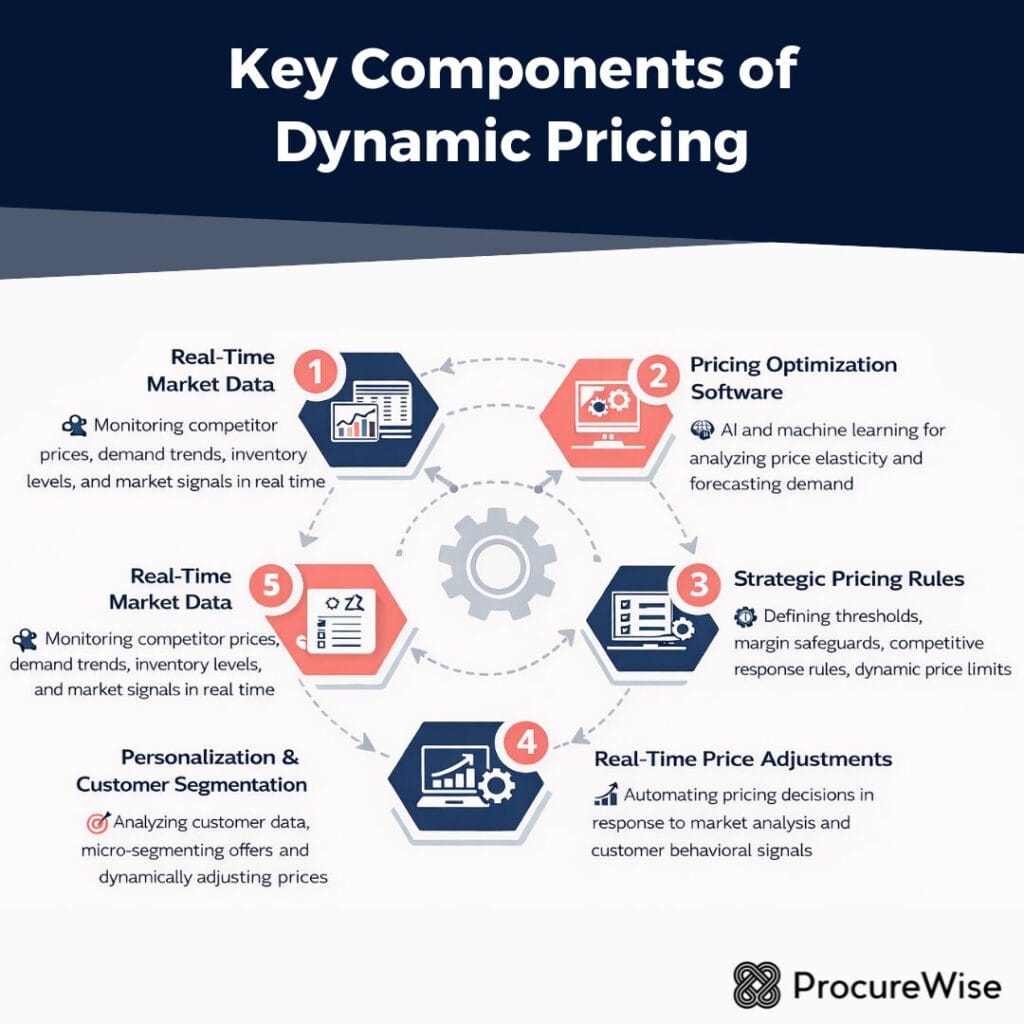
🏗️ Infrastructure & Technology Enablers for Real-Time Dynamic Pricing 🏗️
Building Scalable Pricing Architecture 🖥️
Advanced dynamic pricing optimization requires more than algorithms — it demands a scalable, real-time infrastructure capable of processing high-velocity market data.
Core components include:
- Centralized pricing engines
- AI-powered pricing optimization software
- Integrated data collection pipelines
- Cloud-based analytics platforms
- Automated real-time price adjustments modules
The system must continuously ingest:
- Competitor pricing updates
- Market demand signals
- Inventory levels
- Customer data streams
- Market environment indicators
Without seamless integration, even the most advanced machine learning algorithms cannot deliver reliable pricing decisions.
Data Integration & Governance Framework 🔗
Real-time pricing depends on structured, high-quality data flows.
Key requirements:
- API-based data ingestion
- ERP & CRM synchronization
- Clean and validated customer data
- Standardized market data formats
- Low-latency processing pipelines
Strong governance ensures:
- Compliance with privacy regulations
- Ethical use of personalized pricing
- Accuracy in demand trends modeling
- Protection of customer perception and trust
Data integrity directly influences the accuracy of price adjustments and profitability outcomes.
⚙️ Designing Advanced Pricing Rules & Control Mechanisms ⚙️
Strategic Pricing Rules Architecture 📐
Well-defined pricing rules act as guardrails for AI-driven systems.
Typical rule frameworks include:
- Minimum and maximum price thresholds
- Margin protection floors
- Competitive response triggers
- Inventory-based pricing limits
- Demand fluctuation thresholds
These rules prevent uncontrolled volatility while enabling flexible variable pricing strategies.
Automation without rule governance risks damaging customer satisfaction and long-term customer loyalty.
Real-Time Market Responsiveness Logic 🔄
Effective systems integrate:
- Automated competitor monitoring
- Elasticity-based recalibration
- Demand-driven pricing shifts
- Real-time scenario modeling
This enables businesses to respond instantly to:
- Sudden market changes
- Competitor pricing shocks
- Inventory shortages
- Demand surges
Advanced pricing tools transform raw signals into actionable price movements within seconds.
🚧 Overcoming Implementation Challenges 🚧
Organizational & Technical Barriers 🧩
Transitioning to advanced dynamic pricing often encounters:
- Resistance to automation
- Legacy system incompatibility
- Poor-quality historical data
- Limited internal AI expertise
- Misalignment between pricing and sales teams
Successful implementation requires cross-functional coordination between:
- Revenue management
- Data science teams
- IT infrastructure
- Marketing & customer segmentation specialists
Dynamic pricing must be positioned as a strategic growth initiative — not just a technical upgrade.
Ethical & Customer Perception Considerations ⚖️
One of the biggest risks in personalized pricing and price discrimination strategies is reputational damage.
To mitigate risk:
- Communicate transparently
- Avoid excessive surge pricing
- Protect vulnerable customer segments
- Align pricing with value perception
Maintaining fairness strengthens customer satisfaction, reinforces customer loyalty, and ensures sustainable adoption of AI-powered pricing engines.
🔄 Continuous Optimization & Adaptive Learning 🔄
AI Model Retraining & Performance Monitoring 📊
Markets evolve constantly. Therefore:
- Machine learning algorithms must be retrained regularly
- Demand forecasts must incorporate new demand trends
- Pricing rules should be periodically audited
- Competitive benchmarks must be recalibrated
Continuous learning ensures long-term dynamic pricing optimization effectiveness.
A/B Testing & Experimentation Framework 🧪
Advanced organizations deploy:
- Controlled pricing experiments
- Segment-based price testing
- Elasticity validation models
- Multi-variable pricing simulations
These experiments refine:
- Customer segmentation accuracy
- Demand elasticity curves
- Margin optimization thresholds
- Real-time price adjustment logic
Experimentation reduces uncertainty and increases pricing confidence.
📊 Measuring Strategic Success with Advanced KPIs 📊
Beyond Revenue: Holistic Performance Metrics 📈
Effective measurement extends beyond sales growth.
Critical KPIs include:
- Gross profit margin per SKU
- Contribution margin stability
- Conversion rate shifts
- Average order value (AOV)
- Customer lifetime value (CLV)
- Market share evolution
- Customer satisfaction indicators
Advanced real-time analytics dashboards allow leaders to monitor these metrics continuously.
Linking Market Insights to Strategic Decisions 🧠
The power of real-time analytics lies in interpretation.
Executives must analyze:
- How competitor pricing impacts elasticity
- How demand fluctuations influence profitability
- How personalized pricing affects loyalty
- How inventory-driven pricing improves turnover
Strategic alignment between market insights and pricing decisions ensures sustainable profit growth.
🎯 Positioning Dynamic Pricing as a Competitive Moat 🎯
Organizations that master:
- Real-time market data integration
- AI-driven pricing engines
- Advanced customer segmentation
- Variable pricing strategies
- Margin protection mechanisms
Create a durable competitive advantage.
Dynamic pricing evolves from a tactical tool into a strategic moat — protecting margins, enhancing agility, and strengthening market responsiveness.
🌍 Strategic Roadmap for Long-Term Dynamic Pricing Excellence 🌍
Executive Alignment & Strategic Ownership 🧭
For advanced dynamic pricing optimization to deliver sustainable results, it must be embedded at the executive level.
Key leadership priorities include:
- Positioning pricing as a strategic growth lever
- Aligning pricing decisions with corporate objectives
- Integrating market insights into board-level strategy
- Ensuring cross-functional collaboration (data, marketing, sales, IT)
Dynamic pricing should not operate in isolation. It must connect directly to:
- Revenue growth strategy
- Margin expansion plans
- Market share objectives
- Customer loyalty programs
Executive sponsorship accelerates adoption of AI-powered pricing engines and removes organizational friction.
📈 Scaling Profit Through Advanced Dynamic Pricing 📈
From Optimization to Continuous Profit Expansion 💰
Once infrastructure and pricing tools are operational, focus shifts to scaling profitability.
Organizations should:
- Expand real-time price adjustments across all SKUs
- Integrate predictive market demand forecasting globally
- Refine customer segmentation models
- Optimize pricing for each micro-market
When aligned with real-time elasticity signals, companies unlock:
- Higher conversion rates
- Stronger margin protection
- Reduced revenue leakage
- Increased average order value
Dynamic pricing becomes a compounding profit engine.
Integrating Market Data Into Enterprise Strategy 📊
Advanced companies embed market data into:
- Strategic planning cycles
- Product lifecycle pricing
- Promotion design
- Inventory allocation models
By linking market conditions, demand trends, and competitor pricing directly to pricing engines, organizations eliminate guesswork from decision-making.
Data-driven strategy replaces intuition-based pricing.
🤖 The Future of AI-Driven Dynamic Pricing 🤖
Artificial Intelligence as a Core Business Layer 🧠
The next generation of machine learning algorithms will:
- Predict demand shifts before they emerge
- Detect subtle competitor pricing patterns
- Automatically recalibrate pricing rules
- Adjust margins in response to real-time cost volatility
Artificial intelligence will increasingly operate autonomously, learning continuously from:
- Customer behavior
- Demand fluctuations
- Market environment shifts
- Customer perception trends
This evolution positions pricing as a self-optimizing ecosystem.
Hyper-Automation & Pricing Ecosystems ⚡
Future-ready businesses will integrate:
- AI-powered pricing optimization software
- Automated scenario modeling
- Real-time elasticity monitoring
- Dynamic margin protection systems
- Predictive inventory-driven pricing
These ecosystems will enable:
- Instant response to market changes
- Automated variable pricing strategies
- Intelligent surge pricing under strict governance
- Precision-based personalized pricing
Speed and accuracy will define competitive advantage.
⚖️ Sustainable & Ethical Dynamic Pricing Frameworks ⚖️
Balancing Profit and Customer Trust ❤️
Long-term success requires safeguarding:
- Customer satisfaction
- Customer loyalty
- Brand reputation
Responsible implementation of:
- Personalized pricing
- Price discrimination models
- Surge pricing logic
Must prioritize fairness, transparency, and value alignment.
Ethical governance ensures that dynamic pricing strategies strengthen — not weaken — customer relationships.
Governance, Compliance & Transparency 🔍
Advanced systems must include:
- Clear audit trails for pricing decisions
- Bias monitoring in machine learning algorithms
- Regulatory compliance checks
- Transparent pricing communication strategies
Strong governance protects both profitability and brand equity.
🔄 Continuous Evolution in a Dynamic Market 🔄
Monitoring Market Responsiveness & Performance 📡
Organizations must continuously assess:
- Market responsiveness speed
- Impact of competitor pricing reactions
- Elasticity shifts across segments
- Effectiveness of pricing optimization software
Ongoing refinement ensures that strategies remain aligned with:
- Changing market trends
- Demand trend volatility
- Customer data insights
Pricing agility becomes a permanent capability — not a temporary initiative.
🎯 Final Conclusion: Turning Real-Time Pricing Into Strategic Dominance 🎯
Mastering advanced dynamic pricing strategies leveraging real-time market data is no longer optional — it is a strategic imperative.
By integrating:
- Real-time data collection
- AI-powered pricing engines
- Sophisticated machine learning algorithms
- Automated real-time price adjustments
- Intelligent customer segmentation
- Adaptive pricing rules
Businesses transform pricing into a proactive growth system.
In markets defined by rapid market changes, intense competitor pricing pressure, and unpredictable demand fluctuations, only agile organizations will thrive.
Dynamic pricing — powered by artificial intelligence, governed by strategic rules, and optimized through real-time analytics — becomes the ultimate lever for:
- Sustainable profit optimization
- Margin expansion
- Market leadership
- Long-term customer loyalty
The future belongs to companies that treat pricing not as a number — but as a living, intelligent system driven by real-time market intelligence.