

In a dynamic market, pricing strategies are no longer static decisions — they are powerful growth levers. Every price point, discount, or promotional campaign directly impacts sales volume, profit margins, market share, and total revenue.
Relying solely on intuition or historical data when designing promotions is risky. Without structured price testing, businesses often:
- Erode profit margins
- Misjudge price sensitivity
- Damage brand reputation
- Lose competitive advantage
This is why testowe promocje (price promotion testing) are essential. They transform short-term discounts into structured experiments that validate your broader product pricing strategy and long-term profitability.
Instead of guessing, you measure. Instead of reacting, you optimize.
🔍 Beyond Guesswork: Why Price Promotion Testing Matters for Data-Driven Pricing 🔍
Promotional testing shifts decision-making from assumptions to measurable results.
Modern competitors leverage:
- A/B testing
- Split testing
- Price sensitivity analysis
- Customer behavior analytics tools
Without validation, promotions may increase sales volume but reduce conversion rates profitability or inflate Customer Acquisition Costs (CAC).
With proper price testing, you can:
- Identify the optimal price point
- Protect and improve profit margins
- Improve conversion rates
- Understand true market demand
- Optimize customer segments targeting
Promotion testing becomes a structured method of validating pricing strategies, not just a temporary boost in sales.
🧪 Defining Price Promotion Testing as a Core Pricing Strategy 🧪
Price promotion testing is a controlled experiment where different promotional mechanics are tested against a baseline.
You might test:
- 10% vs 20% discount
- Bundle vs Volume Discounts
- Limited-time offer vs ongoing reduced price
- Value-based pricing vs cost-plus pricing adjustments
The goal is to measure impact on:
- Sales volume
- Total revenue
- Conversion rates
- Profit margins
- Customer engagement
- Market share
This transforms promotions into a strategic tool for validating broader approaches like:
- Dynamic Pricing
- Value-based pricing
- Comparative pricing
- Psychological pricing
Each test becomes a data source for refining your entire pricing architecture.
🎯 From Tactical Discounts to Strategic Pricing Validation 🎯
Many companies use promotional pricing reactively — matching competitor pricing or clearing inventory.
But strategic businesses use promotions to answer critical questions:
- What is the optimal product price?
- How elastic is demand within specific customer segments?
- Which promotion improves total revenue without harming margins?
- How does pricing impact brand reputation and perceived value?
Instead of launching random campaigns, you form a clear hypothesis:
“A 15% discount will increase sales volume by 20% while maintaining a 35% profit margin.”
Then you validate it through structured A/B price testing.
Over time, this creates a feedback loop that strengthens:
- Market research
- Customer behavior insights
- Conversion rate optimization
- Customer Acquisition Cost control
- Sustainable profit growth
📈 Why This Matters for Long-Term Pricing Strategy 📈
Effective test promotions allow you to:
- Build evidence-based pricing strategies
- Reduce reliance on aggressive promotional pricing
- Protect brand perception
- Improve customer lifetime value
- Inform advanced models like Dynamic Pricing
When promotion testing becomes systematic, pricing stops being reactive and becomes predictive.
This is the foundation of scalable, data-driven growth.
🧩 Preparing Your Promotion Test: Solid Foundations for Pricing Validation 🧩
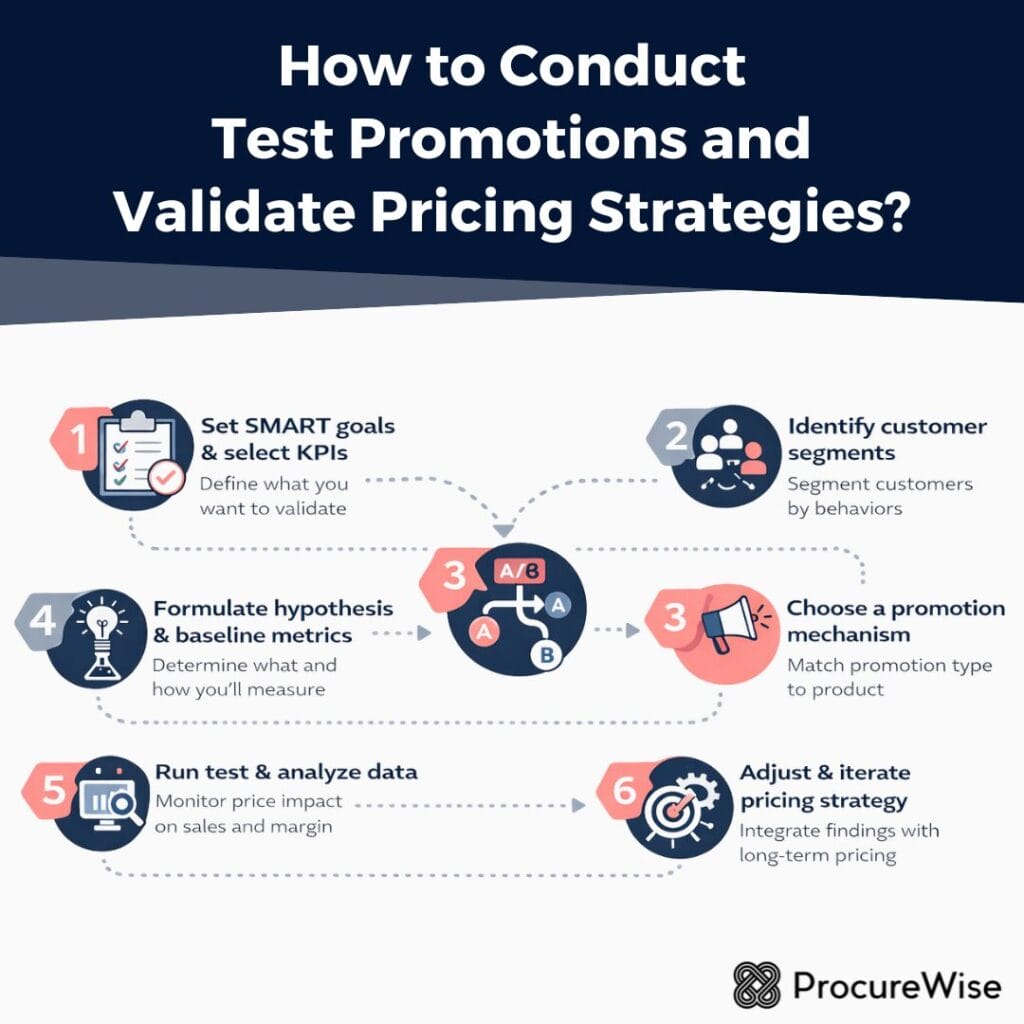
Define SMART Objectives and KPIs for Pricing Tests 📌
Before launching any testowe promocje, you must clearly define why you are testing. Every promotion should validate a specific element of your pricing strategy — not just increase short-term sales volume.
Use SMART goals:
- Specific – Increase conversion rates of Product X
- Measurable – +12% sales volume
- Achievable – Based on historical analytics tools data
- Relevant – Supports total revenue growth
- Time-bound – Within a 3-week campaign
Example objective:
Increase sales volume by 15% while maintaining a minimum 30% profit margin and improving conversion rates by 5%.
Key KPIs to monitor:
- Sales volume
- Total revenue
- Profit margins
- Conversion rates
- Customer Acquisition Costs (CAC)
- Market share impact
Without defined KPIs, price testing becomes guesswork instead of strategic validation.
Identify Customer Segments Before Testing 🎯
Not every customer reacts the same to promotional pricing. Testing without segmentation distorts insights about price sensitivity and customer behavior.
Segment by:
- New vs returning customers
- High vs low purchase frequency
- Price-sensitive vs premium buyers
- Different product categories
Why this matters:
- A 20% discount may increase sales in one segment
- The same discount may damage brand perception in another
Testing within defined customer segments allows you to refine:
- Value-based pricing
- Comparative pricing
- Psychological pricing
- Long-term customer engagement strategies
Segmentation improves the accuracy of market demand validation.
Choose the Right Promotional Mechanic to Test 🛍️
Different promotional tactics influence revenue and margins differently. Your goal is not just to boost sales but to validate the optimal price point.
Common mechanics to test:
- Percentage discount (10% vs 20%)
- Volume Discounts
- Bundle offers
- Limited-time price reduction
- Tiered promotional pricing
- Adjusted cost-plus pricing model
- Testing against competitor pricing
Each tactic affects:
- Sales volume
- Profit margins
- Conversion rates
- Market share
- Customer engagement
For example:
- A deep discount may increase total revenue but destroy margins.
- A moderate discount may produce lower sales volume but higher net profit.
The test must align with your broader pricing strategies, not operate in isolation.
Craft a Clear Pricing Hypothesis 🧪
Every promotion should start with a measurable hypothesis tied to pricing validation.
Example:
Offering a 15% discount will increase conversion rates by 10% and total revenue by 8% while maintaining a 35% profit margin.
Your test variables:
- Independent variable → Discount level / product price
- Dependent variables → Sales volume, profit margins, CAC, customer behavior
This structure ensures:
- Measurable validation
- Clear comparison baseline
- Actionable insights
Without a hypothesis, A/B price testing becomes random experimentation.
Define Baseline Metrics Before Launch 📊
Before starting the promotion, record:
- Current product price
- Current sales volume
- Current profit margins
- Conversion rates
- Customer Acquisition Costs
- Existing market share
This baseline allows you to calculate:
- Incremental revenue
- Margin erosion or improvement
- Real change in customer behavior
It also protects you from misinterpreting natural market fluctuations as promotional success.
Align Testing with Broader Strategic Pricing Models 🔄
Promotion testing should support long-term strategy, including:
- Transition toward Dynamic Pricing
- Validation of value-based pricing
- Adjustment of product pricing architecture
- Optimization of promotional pricing frequency
When promotions are aligned with strategic objectives, they improve:
- Brand reputation
- Customer lifetime value
- Sustainable profit growth
Preparation is what separates reactive discounting from true pricing strategy validation.
⚙️ Executing Price Promotion Tests: From Setup to Statistical Validation ⚙️
Choose Between A/B Testing and Split Testing 🧪
To properly validate pricing strategies, you must choose the right testing framework.
A/B testing (A/B price testing) compares two variations of the same offer:
- Version A → Product price without discount
- Version B → Product price with 15% promotional pricing
It works best when testing:
- A single price point
- Discount level differences
- Presentation of promotional pricing
- Conversion rate impact
Split Testing (often broader) compares two different promotional mechanics:
- 20% discount vs Volume Discounts
- Bundle pricing vs limited-time offer
- Value-based pricing vs cost-plus pricing adjustment
Use split testing when validating different pricing models, not just small adjustments.
The goal is to isolate variables so changes in:
- Sales volume
- Total revenue
- Profit margins
- Conversion rates
can be directly attributed to the tested price strategy.
Set Up a Controlled Test Environment 📊
Execution must ensure clean data and high integrity. Use:
- E-commerce platforms (Shopify, WooCommerce)
- Dedicated A/B testing tools
- Advanced analytics tools
- CRM systems for customer segments
Best practices:
- Randomly divide traffic
- Keep all other variables constant (ads, product description, timing)
- Avoid overlapping promotions
- Track competitor pricing during the test
A controlled setup ensures reliable validation of:
- Market demand
- Customer behavior
- Price sensitivity
- Market share dynamics
Ensure Statistical Significance Before Drawing Conclusions 📈
One of the biggest mistakes in price testing is stopping too early.
To validate results properly, you need:
- Adequate sample size
- Sufficient test duration
- Confidence level (usually 95%)
Without statistical significance:
- A spike in sales volume may be random
- Conversion rate improvements may be misleading
- Profit margin changes may be seasonal
Always test long enough to capture:
- Weekly purchasing cycles
- Customer engagement patterns
- Market demand fluctuations
This ensures your pricing strategy validation is data-driven — not emotional.
Monitor Core Metrics in Real Time 📉
During execution, track:
- Sales volume
- Total revenue
- Profit margins
- Conversion rates
- Customer Acquisition Costs (CAC)
- Customer engagement
- Early signals of market share shift
But remember:
High sales ≠ High profitability.
Sometimes a smaller discount produces:
- Lower sales volume
- Higher operating income
- Better long-term brand reputation
This is why profit analysis must accompany revenue analysis.
Measure Price Sensitivity and Elasticity 🔍
Promotion tests reveal real-world price sensitivity.
Ask:
- Did a 10% discount increase sales volume proportionally?
- Did a 20% discount double revenue — or just cannibalize margins?
- Did higher product pricing significantly reduce conversion rates?
This data helps determine price elasticity of demand, which is foundational for:
- Dynamic Pricing
- Value-based pricing
- Comparative pricing
- Long-term product pricing optimization
Understanding elasticity allows you to adjust price points strategically instead of reacting to competitors.
Watch for Hidden Side Effects ⚠️
During execution, monitor unintended consequences:
- Increased CAC
- Reduced brand reputation
- Customer expectation of permanent discounts
- Negative impact on loyal customer segments
- Competitor pricing reactions
A promotion that increases short-term revenue but harms brand perception or future pricing power is strategically dangerous.
This is why structured testing matters.
Use Iterative Testing for Strategic Pricing Evolution 🔄
Single tests provide insight. Continuous testing builds competitive advantage.
Repeated promotion experiments help you:
- Refine optimal price points
- Improve conversion rates systematically
- Reduce over-reliance on promotional pricing
- Increase long-term total revenue
- Build foundations for automated Dynamic Pricing models
Testing should become a permanent part of your market research and pricing architecture, not a one-time experiment.
📊 Measuring Results and Integrating Insights into Your Pricing Strategy 📊
Analyze Core Performance Metrics First 📈
After completing your testowe promocje, evaluation begins. Go beyond surface-level growth in sales volume and focus on strategic validation.
Start with:
- Sales volume
- Total revenue
- Conversion rates
- Market share changes
Then immediately compare them with:
- Profit margins
- Operating income
- Customer Acquisition Costs (CAC)
A promotion that increases revenue but reduces margins may damage long-term profitability. True pricing strategy validation requires balancing volume and profit.
Conduct Deep Profitability Analysis 💰
Revenue without margin analysis is misleading.
Evaluate:
- Gross profit margin (after COGS)
- Net profit impact
- Impact on cost-plus pricing assumptions
- Incremental profit vs baseline
Sometimes:
- A 10% discount generates slightly lower sales but higher total profit.
- A 25% discount increases sales volume but erodes operating income.
Your goal is optimization — not just growth.
This is where promotion testing separates tactical discounting from strategic product pricing management.
Calculate Return on Promotion (ROP) 🧮
Return on Promotion measures financial efficiency:
Incremental Profit – Promotion Cost
Promotion costs may include:
- Lost margin from discount
- Marketing spend
- Operational adjustments
- Increased CAC
Positive ROP means the campaign strengthened your pricing strategy. Negative ROP suggests pricing misalignment or incorrect assumptions about price sensitivity.
ROP should always connect to broader goals like:
- Sustainable profit margins
- Improved customer engagement
- Long-term total revenue growth
Segment Results for Strategic Insights 🎯
Now analyze results by customer segments:
- New vs returning customers
- High-LTV vs low-LTV buyers
- Price-sensitive vs premium-oriented segments
You may discover:
- Discounting mainly attracted low-margin buyers
- Loyal customers would have purchased without promotional pricing
- Conversion rates improved only within specific segments
This segmentation helps refine:
- Value-based pricing
- Comparative pricing
- Psychological pricing
- Dynamic Pricing readiness
Not all promotions scale equally across segments.
Measure Long-Term Impact, Not Just Immediate Gains 🔄
Short-term spikes can mask long-term damage.
Monitor:
- Repeat purchase rate
- Brand reputation indicators
- Customer lifetime value (CLV)
- Customer behavior after price normalization
If customers delay purchases waiting for discounts, your product pricing power weakens.
Strategic testing helps you avoid conditioning the market to expect permanent promotions.
Integrate Insights into Broader Pricing Strategies 🧠
The real value of test promotions lies in integration.
Use findings to:
- Adjust permanent price points
- Optimize promotional pricing frequency
- Refine cost-plus pricing models
- Improve value-based pricing logic
- Feed data into Dynamic Pricing algorithms
Continuous validation strengthens:
- Market demand forecasting
- Price sensitivity modeling
- Competitive positioning
- Market research capabilities
Pricing evolves from reactive discounting to predictive strategy.
🏁 Conclusion: From Promotional Experiments to Strategic Pricing Mastery 🏁
Testowe promocje are not about temporary discounts. They are about validating pricing strategies with real market data.
By systematically using:
- A/B testing
- Split Testing
- Customer segmentation
- Profit margin analysis
- Conversion rate monitoring
- Customer Acquisition Cost control
you create a self-optimizing pricing engine.
This approach:
- Protects profit margins
- Improves total revenue
- Strengthens brand reputation
- Enhances customer engagement
- Builds sustainable competitive advantage
The companies that win in dynamic markets are not those that discount the most — but those that test, measure, and adapt pricing with discipline.
Strategic price validation turns uncertainty into data — and data into long-term growth. 📊🚀