

The supply chain carries many potential risks that can affect a company’s financial performance and image. Effective supply chain risk management strategy involves identifying, measuring and controlling these risks. By implementing appropriate management strategies and creating contingency plans, risks can be minimised and the stability of the company’s operations can be maintained. Read more 5 ways to overcome supply chain disruptions.
📄 Supply chain risk – definition 📄
The definition of risk in a supply chain context can be described as a potential threat to the operation of processes within the global value chain. Risk is an inherent part of business that can have a negative impact on company performance. Today, with the increasing globalisation and fragmentation of supply chains, risk is even more prevalent and complex.
Risks exist at various levels throughout the supply chain. It can affect Suppliers of raw materials, Manufacturers of individual components, Final Manufacturers and even Customers. Each link in the supply chain has its own potential hazards and risks that can affect their operations. Identifying, assessing and responding to risks in the supply chain are key to maintaining a company’s stability, productivity and financial performance.
⚠️ The biggest risks in the supply chain ⚠️
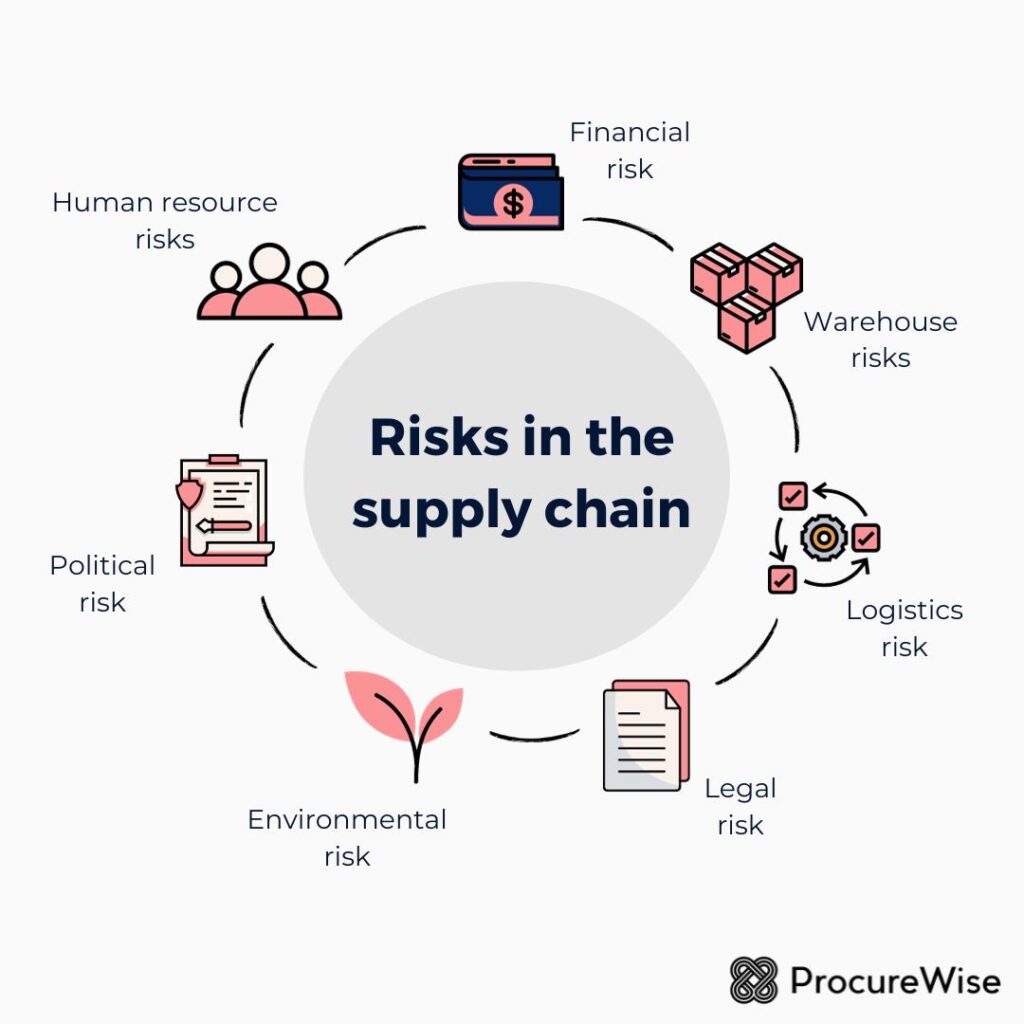
1. Financial risk 💰
It affects a company’s financial stability, financial performance and ability to sustain growth. There are several different types of financial risk that can affect the supply chain. Here are some financial internal risks:
➡️ Exchange rate risk: In international supply chains, companies deal with different currencies. Exchange rate fluctuations can affect the cost of supplying raw materials or manufactured goods. Sudden changes in exchange rates can lead to an increase in costs in the country where the company is based, which in turn can lead to a decrease in the profitability of the business.
➡️ Budgeting risks: budgets in the supply chain are crucial as they allow costs and resource allocation to be determined for each stage of the process. However, budgeting can be problematic and deviations from original plans can lead to budget surpluses. Bound budget surpluses can lead to reduced funding for other areas and potentially lead to delays or disruptions in the supply chain.
➡️ Price volatility: In the supply chain, prices of raw materials and inputs can fluctuate significantly. For example, the price of oil or metals can rise or fall sharply, affecting production costs. Such price volatility can lead to unpredictable costs and can affect a company’s profitability and ability to remain competitive.
➡️ Raw material risk: companies often rely on a steady supply of raw materials to produce their goods. However, the risk of a Supplier not being able to supply an adequate quantity or quality of raw materials can affect a company’s ability to continue production. Raw material risk can arise from a number of factors, such as the Supplier’s production problems, natural disasters or unpredictable political changes.
➡️ Credit risk: Companies may receive orders from Customers who are unable or unwilling to pay on time. Unpaid bills or long-term arrears can affect a company’s liquidity, which in turn makes it difficult to repay its own financial obligations. In such situations, the company may have to look for alternative Financial Suppliers or even shorten its operations.
➡️ Economic and inflationary risks: Economic growth and inflation can affect costs, the availability of raw materials and the supply of, and demand for, labour. This can lead to price increases, material shortages and supply chain disruptions. High inflation can result in higher costs for companies, making it difficult for them to maintain competitive prices and profitability. Imbalances between supply and demand in the labour market can also lead to higher wage costs and production delays. Monitoring inflation and forecasting labour market developments can help companies manage costs and labour availability.
In order to reduce financial risks, it is important to diversify the Supplier base and carry out thorough assessments of Suppliers. Ongoing monitoring of the market and industry situation is necessary.
2. Warehouse risks 📦
Warehouse risk is one of the main risks in supply chains. It refers to the possibility of shortages of raw materials, delays in receiving materials and components, as well as redundancies in transport.
➡️ Shortage of important components: If the availability of important components is limited or there is an inability to obtain them, a company may find itself in a situation where it is unable to complete production. There is then a lack of continuity of supply. This is especially true if the component in question is specifically tailored to the product or there are no alternatives available. A shortage of such a component can halt production and affect the efficiency of the supply chain network.
➡️ Production damages and delays: Companies must maintain adequate stocks of raw materials, components and finished products. Maintaining sufficient stock levels is crucial, especially if there are non-deterministic risks, i.e. risks that are not directly predictable and preventable. Adequate inventories are necessary to minimise the possible impact on production and supply in the event of availability problems or delays.
Companies should have Warehouse Manager, who monitor and manage warehouse risk by identifying potential sources of risk and implementing strategies to counteract them. For example, a company may choose to work with back-up Suppliers who are able to supply raw materials or components in the event of failures in the main Suppliers’ deliveries.
3. Logistics risk 🗂️
In the supply chain, logistical risk refers to the various risks associated with the transportation and distribution of goods. In recent years, we have witnessed a number of potential disruptions, such as shipping problems, sea congestion, port closures and strike action, which negatively affect deliveries around the world.
➡️ The malfunctioning of micro warehouses and the multiple distribution centre model: The use of micro warehouses and multiple distribution centres can be beneficial, but it also comes with logistical risks. If these centres malfunction or experience delays, this can result in orders not being fulfilled on time and reduced Customer satisfaction. Moving goods between centres can also lead to logistical difficulties. These risks can be mitigated through control and supervision processes and the use of advanced tracking technologies.
➡️ Delivery time risk: Delivery delays can be caused by various factors, such as bad weather, natural disasters and human error. These delays can lead to additional costs and a negative impact on the company’s reputation. To minimise delivery time risks, it is important to monitor risk factors and take timely action. Companies should also develop supply chain risk management plan and seek alternative solutions in case of delays.
In order to minimise logistical risks, transport and distribution networks should be improved, with appropriate technological solutions helping. It is also worthwhile to schedule deliveries well to minimise the time of late deliveries.
4. Legal risk 📄
Legal risk is one of the main risks that can occur in the supply chain. This includes various aspects such as disputes, contractual obligations, intellectual property rights and legal violations. The negative consequences of this type of risk include costs associated with court settlements, loss of reputation and appeals from Customers. There are four types of political risk.
➡️ Disputes: These can be disputes about the quality of the goods delivered, failure to meet agreed deadlines or differences in contract interpretation. Such disagreements can lead to litigation, which is costly in both time and money. For example, the Supplier may disagree on the quality of the delivered goods, forcing the recipient to take legal action to protect its interests.
➡️ Meeting the terms of the contract: In the supply chain, there are many contracts between Suppliers, Manufacturers and other Business Partners. Non-fulfilment of contracts or breach of contractual obligations can have legal consequences. For example, if a Supplier does not deliver goods according to the agreed deadlines, the Manufacturer may claim damages or hold the Supplier liable for lost profits.
➡️ Intellectual property rights: This may include infringements of patents, trademarks or copyrights. It may involve rights over product design or technology used in the supply chain. For example, if one Supplier infringes another Supplier’s patent, a patent litigation may arise, which could have serious financial consequences for all parties involved.
➡️ Violations: Quality, safety, environmental or labour liability regulations may be violated by Suppliers or other Partners in the supply chain. Such violations can result in sanctions and fines, as well as affecting the company’s reputation. For example, if a Supplier uses hazardous substances or poor working conditions, this can lead to serious legal and financial consequences.
Companies can minimise these legal risks by educating employees, adhering to contracts, monitoring Partner activities and using flexible conflict resolution procedures.

5. Environmental risk 🌱
Environmental risks are a significant threat to the supply chain, both for companies and for society as a whole. They affect different areas of the business such as raw material supply, production, distribution and Customer service. Here are some weather external risks:
➡️ Extreme weather conditions: Extreme weather conditions such as hurricanes, typhoons, floods or droughts can contribute to supply chain disruptions. For example, flooding can make it difficult to transport goods or damage warehouses, leading to delays in deliveries. Extreme weather conditions can also affect production, especially if natural resources such as water or solar energy are not available for an extended period of time. In addition, there is a risk of damage or destruction of warehouses and loss or damage to goods.
➡️ Hazardous working conditions: Unsafe working conditions pose a risk to workers throughout the supply chain. Companies must guarantee the safety and health of their workers, but this is not always adhered to. For example, working practices involving excessive physical exertion, inappropriate use of chemicals or lack of appropriate protective equipment can lead to accidents or serious health problems for workers.
➡️ Negative environmental impacts: Supply chain activities can lead to negative environmental impacts. The production of excessive waste, the misuse of natural resources or the emission of pollutants into the atmosphere can lead to environmental degradation. This can have serious consequences for society and future generations. Consumer choices are increasingly linked to environmental concerns, so companies exposed to these risks may face problems in maintaining their position in the market.
➡️ Cyber threats: Today, a cyber-attack is a major risk for all walks of life, including supply chains. Hackers can attack companies’ IT systems, affecting their operations, data and warehouses. An IT disruption can lead to delays in deliveries, loss of data or sensitive information and security risks for both the company and its Business Partners.
The consequences of environmental hazards in the supply chain can include delays, increased costs, loss of Customers and damage to the company’s image. Unsafe working conditions can put employees at risk and result in legal action. To minimise these risks, companies should invest in green technology, comply with regulations, prioritise safety and implement supply chain controls. Collaboration and raising environmental awareness can also help reduce risks.
6. Political risk ⚖️
Political risk is one of the main factors affecting supply chains. It consists of risks associated with uncertainty and potential risks associated with political instability, social unrest and changes in government policy. There are a number of different political risks that can affect the flow of goods and services in the supply chain.
➡️ Civil unrest and riots: Civil unrest, such as protests, strikes, street riots or uprisings, can seriously disrupt supply chains. In such cases, roads can be blocked, ports closed and even property or warehouses destroyed. All this leads to delays in deliveries and loss of goods.
➡️ Inability to meet contractual requirements: Political instability can lead to changes in government policy that may affect supply contracts. For example, a change in regulation or legislation can lead to restrictions on international trade, the introduction of customs duties or changes in their levy requirements, which in turn can lead to difficulties in the supply of raw materials or components, as well as the export of finished products.
➡️ Disruption to transport and logistics: Inadequate transport infrastructure, tighter border controls or border closures can lead to delays in deliveries and higher logistics costs. In addition, armed conflicts can lead to the destruction of roads, bridges or ports, making the movement of goods much more difficult.
➡️ Changes in trade policy: Governments may introduce changes in trade policy, such as the introduction of new tariffs, trade embargoes or restrictions on imports and exports. These changes can affect the availability of raw materials, commodity prices and the ability to do business in the international market.
In order to effectively manage political risk, companies need to be proactive in tracking and analysing the political situation and well prepared to act quickly in response to potential changes.
7. Human resource risks 👥
Human resource risks can have a serious impact on supply chains. Many factors can contribute to staff shortages or labour shortages, leading to disruptions in the supply process.
➡️ Labor shortage: High staff turnover, difficulty in recruiting and retaining staff, and increasing skill and knowledge requirements are all major risks. Lack of staff can lead to delays in order processing, inadequacies in production processes and deterioration in service quality.
➡️ Inadequately qualified staff: Lack of adequate staff training. Improperly trained staff can make mistakes in the delivery process, leading to delays, loss of goods and increased operational costs. Therefore, it is important to invest in proper training and development of staff to improve their effectiveness and efficiency in the supply chain area.
➡️ Health problems: employee illness or injury can have a direct impact on the smooth operation of the supply chain. Employees who are temporarily unable to work may not be able to fulfil their duties, leading to delays in production or deliveries. Therefore, it is important to ensure that adequate preventive and health measures are in place for employees and that contingency plans are in place for the absence of key personnel.
To mitigate HR risks, it is necessary to implement a robust staff recruitment and selection process, provide comprehensive training and development programmes and establish clear communication channels.
Summary
In order to minimise supply chain risk as much as possible, companies should do risk assessment, create contingency plans, collaborate with Business Partners and Suppliers and invest in human resource development. This is the only way to effectively and efficiently manage risks, minimise negative impacts and build a sustainable, resilient supply chain.
Minimise risks and find out more – contact us!