

Invoicing can be a tedious and time-consuming task for companies of all sizes. However, effective invoice management is crucial for maintaining cash flow and ensuring timely payments from Customers.
With the right tools and strategies, companies can streamline the invoice management process and reduce the risk of errors or delays. From creating and sending invoices to tracking payments and generating reports, there are various aspects of invoice management that can be automated and optimized.
In this article, we will discuss the importance of invoice management, common challenges faced by companies, and best practices and tools available to simplify this process. Whether you are a freelancer, a small business owner, or part of a larger organization, mastering invoice management can significantly improve financial operations. Check out Month-end closing tips and checklist.
❓ What is Invoice Management? ❓
Invoice management refers to the process of handling and organizing invoices within an organization. This includes tasks such as receiving and reviewing invoices, verifying their accuracy, processing payments, and maintaining proper documentation for audit and financial purposes. Effective invoice management helps ensure timely and accurate payments, reduces the risk of errors or fraud, and provides a transparent overview of financial transactions for the organization.
Take advantage of our procurement process review services now!
⚠️ Why is Invoice Management Important? ⚠️
Effective invoice management is a crucial element for any organization, offering numerous benefits that contribute to the smooth and efficient functioning of your business. Why does proper invoice management matter?
➡️ Precise financial data processing: Proper invoice management ensures accurate processing of financial data. This means that all information on the invoice is thoroughly checked and aligns with orders or agreements. This way, the organization can be confident it is paying only for products or services actually received.
➡️ Cost savings: Efficient invoice management can bring significant financial savings to a company. Correct invoice verification eliminates the risk of double payments or miscalculations. Additionally, the automation of processes reduces costs associated with handling paper invoices and manual data processing.
➡️ Compliance with expense policies: Invoice management also enables organizations to maintain compliance with expense policies. Thorough invoice checks allow monitoring and ensuring that all expenses align with established rules. This helps avoid unauthorized or unnecessary expenses and minimizes the risk of excessive costs.
➡️ Increased visibility of expenditures: Proper invoice management enhances the visibility of a company’s expenditures. With the right tools and systems, the organization gains full control over how much is spent and on what. This enables making more informed financial decisions and identifying areas where costs can be reduced.
➡️ Improved Supplier relationships: Effective invoice management contributes to better relationships with Suppliers. Timely payments and efficient resolution of any invoice-related issues help build strong business relationships. This, in turn, can lead to preferential trading terms or additional discounts.
❔ What are the types of invoices ❔
Various types of invoices are used in the financial management processes of companies. Depending on needs and transaction conditions, several types of invoices are commonly employed. Let’s take a closer look at them.
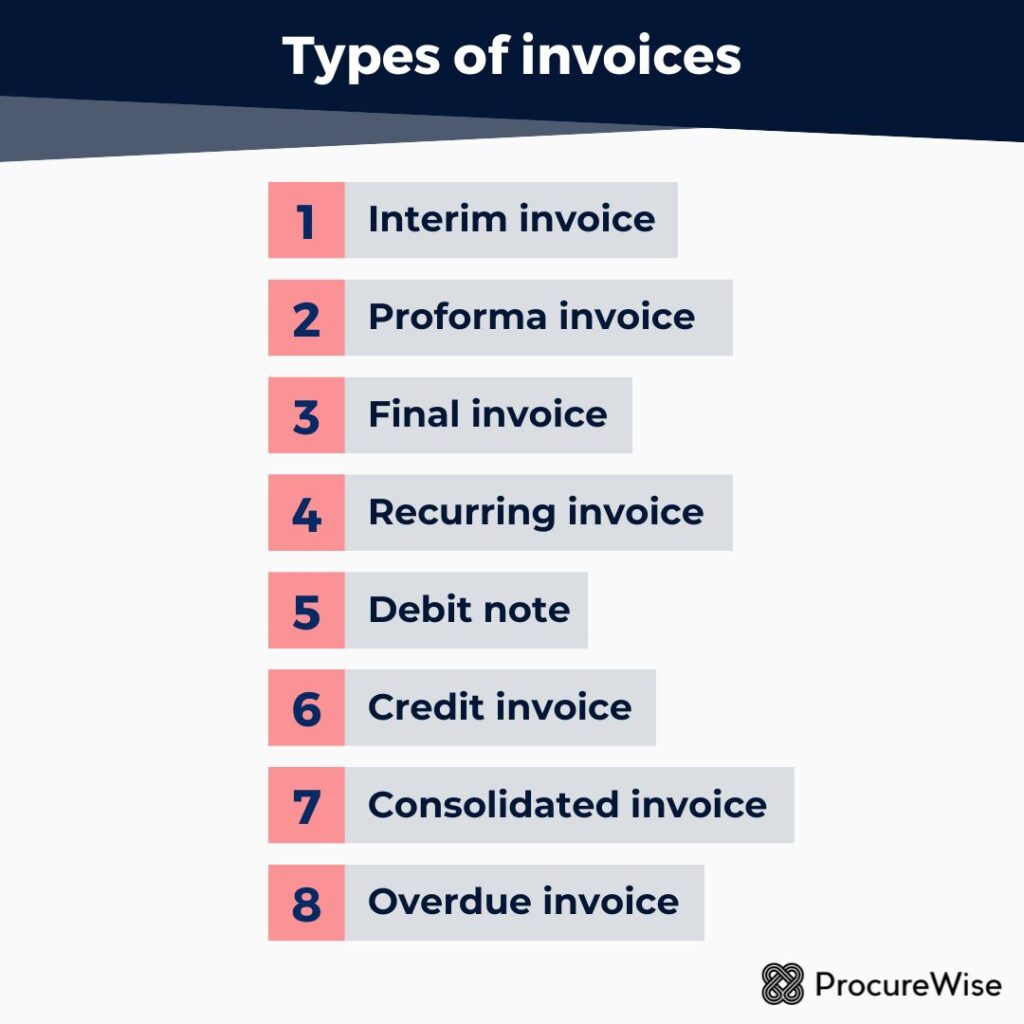
1️⃣ Interim invoice
An interim invoice, also known as a partial invoice, is a financial document issued during the execution of a project or order that spans a specific period. Interim invoices are sent by Suppliers to secure partial payment for work completed so far.
The purpose of interim invoices is to enable payments for stages of ongoing work. This allows Suppliers to receive some funds earlier, assisting in meeting ongoing financial needs. Sending partial invoices also facilitates monitoring the progress of a project or order.
The frequency of issuing interim invoices depends on individual agreements and agreed-upon payment terms. They may be issued every few weeks, months, or other predefined periods in coordination with the Customer. Partial invoices contain information about work completed to date and the partial amount to be paid.
For long-term projects or orders, interim invoices are an essential part of the payment process, enabling effective financial control for both Suppliers and Customers.
2️⃣ Proforma invoice
A proforma invoice aims to present the Customer with an estimated amount to be paid for the ordered goods or services. Importantly, a proforma invoice is not an official accounting document or a payment request.
The proforma invoice differs from other types of invoices, such as a VAT invoice, in that it lacks legal power to demand payment. It serves as an informative document, presenting the costs of the Customer’s order before issuing the actual invoice.
Typical situations where a proforma invoice is used include presenting an offer to the Customer before finalizing a transaction, providing an estimated cost for production or delivery, outlining approximate costs for services, or presenting price information for customs or insurance purposes.
A proforma invoice includes details such as the Supplier’s name and address, Customer details, invoice date, payment terms, a description of goods or services, estimated quantity and unit price, partial sum, and any additional terms or notes relevant to the Customer.
3️⃣ Final invoice
A final invoice, also known as a conclusive invoice, is a financial document that requests payment for delivered goods or services. It represents the last stage in the invoicing process, informing the Customer of the final costs of the transaction.
The final invoice differs from other types, such as the proforma invoice and interim invoice. Proforma invoices serve as informational documents presenting estimated costs before issuing the official invoice, while interim invoices are issued during ongoing projects to secure partial payments.
The final invoice includes detailed information, such as the Supplier’s name and address, Customer details, invoice date, payment terms, a description of delivered goods or services, quantity, unit price, partial sum, and information about discounts or additional charges. Its purpose is to settle payments for the provided goods or services and provide the Customer with a comprehensive overview of the completed transaction.
4️⃣ Recurring invoice
Recurring invoices are a significant element of invoice management and play a substantial role in the invoicing process. Recurring invoicing involves billing at specified intervals, such as monthly or quarterly, related to long-term projects.
Thanks to recurring invoicing, Suppliers can receive regular payments for services rendered or goods delivered. This is convenient for both Suppliers and Customers, as it eliminates the need to manually issue and process invoices each time.
Effective management of recurring invoices offers several benefits. Firstly, it allows Suppliers to maintain a stable cash flow, particularly crucial for long-term projects where payments are received regularly throughout the project’s duration. Secondly, systematic issuance of recurring invoices helps avoid payment delays and ensures that no invoice is overlooked or omitted.

5️⃣ Debit note
A debit note, also known as a credit memo, is a tool used to make adjustments to existing invoices. Typically, this occurs when a Supplier has issued an invoice for an amount lower than necessary.
A debit note includes detailed information about the balance due. It is an additional document describing the adjustments made and the changes required in the original invoice. As such, the debit note allows for the inclusion of missing or underestimated amounts, correcting any inaccuracies.
An important aspect of debit notes is that they are not new invoices but rather tools for corrections. Suppliers record these adjustments in the form of a debit note, and Customers use them for additional payments or reductions in outstanding payments. Debit notes are significant because they enable maintaining the accuracy of accounts and improving relationships with Suppliers by settling any errors or underestimations.
6️⃣ Credit invoice
The corrective invoice, also known as a debit note, is an important tool in the invoice management process. Unlike a standard invoice, a corrective invoice is used in situations where the Supplier has issued an invoice for an amount that is too low. The main purpose of the corrective invoice is to rectify inaccuracies and account for missing or underestimated amounts in the original invoice.
The corrective invoice contains detailed information about the balance due and describes which elements have been adjusted and what changes are necessary in the original document. As a result, the corrective invoice corrects the balance, eliminating errors and deficiencies associated with the invoice. In practice, corrective invoices are commonly used when the invoice recipient notices that the Supplier did not include certain costs or when the price was incorrectly determined.
In conclusion, the corrective invoice plays a significant role in the invoicing process, allowing for error correction and inclusion of missing amounts. It ensures accuracy and integrity of financial data and enables businesses to maintain transparency and effectively manage their obligations.
7️⃣ Consolidated invoice
In the context of invoice management, a consolidated invoice refers to the process of consolidating multiple individual invoices by the Supplier to streamline the payment process. Suppliers issue consolidated invoices when handling numerous orders or providing services to multiple Clients. Instead of sending multiple individual invoices, the Supplier gathers all orders or services and creates a single invoice that encompasses the sum of smaller invoices.
Consolidated invoices are crucial for streamlining payment processes. Firstly, they eliminate the need to process and monitor a large number of invoices, reducing the risk of human errors and duplicate payments. Secondly, Suppliers have an easier task since they only need to issue one invoice, saving them time and resources. Additionally, consolidated invoices aid in consolidating costs and enable more efficient cash management.
8️⃣ Overdue invoice
The concept of an overdue invoice is crucial in invoice management. An overdue invoice is an invoice that has not been paid by the established due date. This can be caused by various circumstances, such as delays in invoice processing, financial problems, or even forgetfulness. In any case, managing overdue invoices is essential for maintaining healthy relationships with Suppliers.
There are several consequences associated with unpaid invoices. Firstly, Suppliers may complain about payment delays, affecting their financial liquidity. They may also stop deliveries or restrict the provision of services if payments are excessively delayed.
Moreover, unpaid invoices can negatively impact relationships with Suppliers, leading to a loss of trust and reputation. It can also complicate negotiations for future agreements and negotiating more favorable payment terms.
Therefore, timely payment of invoices is crucial. Ensuring timely payments helps maintain healthy relationships with Suppliers and build good, long-lasting partnerships. Proper management of overdue invoices is key to avoiding financial problems and maintaining professionalism in business relationships.

🥊 What are the biggest challenges in invoice management? 🥊
In invoice management, several challenges can be encountered. Below are the major ones with a brief explanation:
📌 Time-consuming: The process of invoice management can be extremely time-consuming, especially for large organizations with multiple Suppliers. Searching, sorting, and processing thousands of invoices can take many hours, leading to payment delays and generating additional costs.
📌 Payment delays: Improper management of the invoice process can lead to payment delays. This, in turn, negatively affects relationships with Suppliers, increases the risk of losing trust and reputation, and may result in the loss of more favorable payment terms.
📌 Cash flow management: Effective cash flow management is crucial for any organization. However, a lack of proper invoice management can lead to issues with financial liquidity, especially when payment terms are inconsistent or delayed.
📌 Data extraction complexity: Many Suppliers still send invoices in paper form or as PDF files, making automatic data extraction challenging. Manual data entry takes a lot of time and carries the risk of errors, leading to additional costs and delays in invoice processing.
⚙️ How to effectively manage invoices? ⚙️
Invoice management is a crucial element of every organization’s operation. Improper management of this process can lead to payment delays, errors, and deterioration of relationships with Suppliers. To avoid these problems, it is advisable to apply best practices in invoice management.
Here is a step-by-step process for effective invoice management:
👉 Receiving invoices: It is important to establish a convenient method for receiving invoices from Suppliers. This can be through traditional mail, email, or a dedicated Supplier portal. It is crucial not to miss any invoices and know where to find them.
👉 Invoice verification: Upon receiving invoices, it is worthwhile to verify them. Check if all necessary information is included, if it is correct, and if the amount due aligns with the agreement. Verifying invoices during this stage helps avoid errors in future payment processes.
👉 Payment processing: After verifying invoices, it is time to process payments. Ensure you have access to the necessary information and tools to make payments on time and in accordance with the agreement.
👉 Recording invoices: It is valuable to maintain an accurate record of all invoices, whether in physical or electronic form. A well-organized record helps track payments, monitor financial obligations, and facilitates financial planning.
Managing invoices has many benefits. Proper invoice management allows avoiding payment delays, eliminating errors, tracking sales and deliveries, and facilitating financial planning. Additionally, maintaining good communication with Suppliers positively influences business relationships and builds trust.
One solution that can streamline the invoice management process is automation. This can reduce costs, minimize the risk of errors, and expedite the entire invoice management process. Solutions like invoice management software enable electronic processing of invoices, assigning them to the appropriate orders, generating reports, and tracking the invoice status.
If you are interested in such a solution, arrange a free consultation.
Summary
Invoice management is a crucial element of every organization. In the previous section, we discussed the importance of prioritizing invoices, the challenges encountered, and the benefits of using software to automate procurement processes.
Prioritizing invoices is essential to avoid payment delays, errors, and maintain good relationships with Suppliers. Challenges such as human errors and the costs of manual invoice processing can be easily overcome by using invoice management software. Automating procurement processes speeds up and simplifies the entire invoice management process, minimizing the risk of errors and generating cost savings.