

In the competitive landscape of retail, understanding and navigating MAP (Minimum Advertised Price) pricing can be the key to maintaining profitability while ensuring brand integrity. Retailers often find themselves at a crossroads when balancing pricing strategies with the need to attract customers in a crowded marketplace.
MAP pricing is designed to prevent price erosion and protect the perceived value of a brand. However, it can also present challenges for retailers who may feel constrained in their pricing freedom. So, how do you leverage MAP pricing to your advantage?
This guide will explore essential strategies to help retailers successfully navigate MAP pricing. We’ll cover best practices for compliance, tips for marketing under MAP, and how to foster relationships with suppliers to ensure mutual success. By mastering these strategies, you’ll not only uphold MAP pricing guidelines but also enhance your competitive edge and drive sales effectively. Get ready to explore actionable insights and techniques that can lead your retail business toward success while adhering to MAP pricing standards.
💡 Understanding Minimum Advertised Price (MAP) 💡
Minimum Advertised Price (MAP) is a pricing strategy established by manufacturers to set a baseline for how low retailers can publicly advertise their products. This policy aims to protect the brand’s integrity and ensure fair competition among retailers. Under a MAP policy, retailers may not display a price below the specified MAP, even during promotional sales. For example, if a manufacturer sets the MAP for a product at $99, retailers are prohibited from advertising that product for less than this amount.
The rationale behind MAP is to preserve the perceived value of products, prevent price wars, and foster a level playing field among sellers. By maintaining consistent pricing across different platforms, brands can enhance customer loyalty and support their retailers in achieving satisfactory profit margins. Understanding and implementing a MAP policy is crucial for brands looking to safeguard their market position and maximize their brand’s potential in both online and brick-and-mortar environments.
⚠️ Importance of MAP Pricing in Retail ⚠️
Minimum Advertised Price (MAP) pricing plays a crucial role in the retail landscape, serving multiple important functions for brands and retailers alike.
👉 Firstly, MAP pricing helps maintain brand image and value. By establishing a baseline for advertised prices, brands can ensure that their products are perceived as high-quality and valuable. Consistent pricing across various retailers reinforces customer trust and loyalty, as consumers often associate specific price points with the overall quality of a brand.
👉 Secondly, MAP policies promote fair competition among retailers. By preventing aggressive discounting and price wars, MAP pricing allows retailers to compete on factors other than price, such as customer service and product knowledge. This not only helps protect the profit margins of retailers but also fosters a healthier marketplace where brands can thrive without devaluation of their offerings.
👉 Moreover, MAP pricing can mitigate the risks associated with price erosion, which can occur when retailers continually undercut each other. By controlling how products are advertised, brands can safeguard their margins and maintain a stable retail environment, ultimately benefiting all parties involved in the sales process.
In essence, MAP pricing is a strategic tool that brands utilize to create a balanced and sustainable retail ecosystem, ensuring fair competition while preserving the integrity and perceived value of their products.
🔎 Differentiating MAP Pricing from MSRP 🔎
Understanding the distinction between Minimum Advertised Price (MAP) and Manufacturer Suggested Retail Price (MSRP) is essential for both manufacturers and retailers. MSRP, also known as Suggested Retail Price (SRP) or Recommended Retail Price (RRP), serves as a non-binding guideline for consumers on what they might expect to pay for a product. It represents an unofficial upper limit, often influenced by market dynamics, and retailers may choose to sell below this price based on competitive pressures and changing market conditions.
In contrast, MAP pricing establishes an official lower limit that retailers must adhere to when advertising a product. This policy is particularly vital for brands that prioritize their market positioning and brand identity, such as luxury goods. By enforcing MAP, manufacturers aim to maintain price integrity and protect their brand’s value in the marketplace. Violations of MAP policies can lead to significant consequences for retailers, including temporary bans on selling the product or even termination of the seller relationship, unlike the potential loss of sales associated with exceeding MSRP.
While MAP pricing is legal in the U.S., it is important to note that similar practices may not be permissible in the EU, highlighting the need for brands to tailor their pricing strategies based on regional regulations and market conditions. Understanding these distinctions allows brands to craft more effective pricing policies that align with their overarching business objectives.
⚖️ Legal Considerations for MAP Policies ⚖️
When implementing Minimum Advertised Price (MAP) policies, brands must navigate complex legal frameworks to ensure compliance with federal and regional laws. In the U.S., MAP policies are permissible under federal antitrust law as they regulate advertised prices, not final sales prices. However, variations in state laws may impact enforcement. Conversely, the EU and UK view minimum advertised pricing as a possible competition law infringement, although recent regulations allow MAP under specific conditions.
Brands must justify their MAP policies to prevent distributors from using products as loss leaders, especially if prices drop below wholesale costs. To avoid legal issues, brands should draft MAP policies that adhere to competition laws and avoid price-fixing. This includes defining enforcement mechanisms, penalties, and processes clearly, ensuring all authorized retailers are informed. While MAP policies can enhance brand value and maintain retailer relationships, their implementation requires careful legal consideration to mitigate risks. Brands should consult legal experts when developing MAP policies to guard against possible legal challenges.
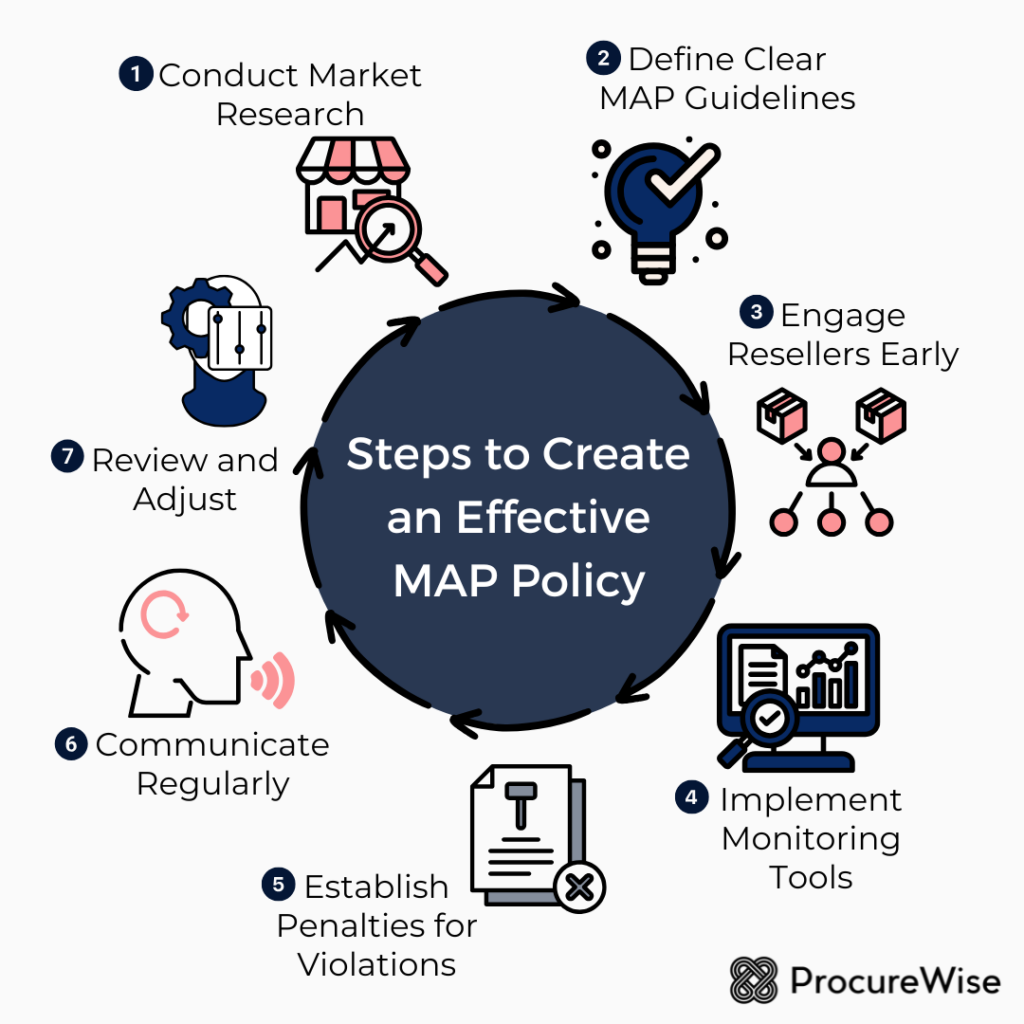
📚 Steps to Create an Effective MAP Policy 📚
Creating an effective Minimum Advertised Price (MAP) policy requires careful planning and execution. Here are the essential steps to develop a robust MAP policy that protects your brand while fostering positive relationships with retailers:
1️⃣ Conduct Market Research: Understand your competitive landscape, retail pricing norms, and the average profit margins for retailers in your industry. This knowledge will help you set a fair MAP that supports profitability for both you and your partners.
2️⃣ Define Clear MAP Guidelines: Develop precise and comprehensive MAP guidelines that outline the minimum advertised price, the scope of the policy, and any exceptions. Include specific terms regarding compliance, advertising mediums, and consequences for violations.
3️⃣ Engage Resellers Early: Before launching your MAP policy, engage with your authorized resellers to explain the rationale behind it and gather their feedback. This can lead to buy-in and increased adherence to the policy.
4️⃣ Implement Monitoring Tools: Utilize technology and tools, such as price monitoring platforms, to regularly track advertised prices across various sales channels. This will help you identify violations promptly and ensure compliance.
5️⃣ Establish Penalties for Violations: Clearly outline the repercussions for non-compliance in your policy. These may include written warnings, temporary suspension of sales rights, or even termination of the reseller agreement, depending on the severity of the violation.
6️⃣ Communicate Regularly: Maintain open lines of communication with your resellers regarding MAP compliance. Regular updates and training can help reinforce the importance of the policy and provide clarification on any doubts.
7️⃣ Review and Adjust: Periodically reassess your MAP policy to ensure it remains relevant and effective. Factor in changes in market conditions, competitive pricing, and retailer feedback to make necessary adjustments.
By following these steps, you can create a MAP policy that not only protects your brand’s integrity but also supports healthy partnerships with your retail partners.

✅ Benefits of Implementing MAP Pricing ✅
Implementing a Minimum Advertised Price (MAP) policy offers several advantages for brands and retailers alike. Here are the key benefits:
✔️ Ensures Price Consistency: MAP pricing helps maintain uniformity in product pricing across various retailers, both online and offline. This consistency reinforces brand value in consumers’ eyes and helps avoid the perception of price gouging or unfair discounts.
✔️ Protects Brand Integrity: By preventing retailers from advertising below the MAP, brands can safeguard their image and ensure that their products are perceived as high-quality and premium, enhancing customer loyalty.
✔️ Promotes Healthy Competition: MAP policies foster a competitive environment among retailers. By preventing price undercutting, brands encourage value-based competition rather than a race to the bottom on pricing, which can harm the overall market.
✔️ Strengthens Retailer Relationships: A fair MAP policy builds trust between manufacturers and retailers. Retailers feel more secure in their pricing strategies, knowing they won’t be undercut by competitors, leading to stronger partnerships and better collaboration.
✔️ Enhances Margins: By setting a floor price, brands can help ensure that retailers maintain healthy profit margins, which can lead to better service and support for the product, ultimately benefiting the end consumer.
✔️ Facilitates Strategic Marketing: MAP policies allow brands to focus on marketing efforts without the fear of price wars. Retailers can engage in value-driven promotions rather than simply competing on price, leading to more effective sales strategies.
In conclusion, implementing a MAP pricing strategy is vital for any brand looking to enhance its market presence and foster a loyal customer base while ensuring fair competition among retailers.
🥊 Challenges of MAP Pricing Implementation 🥊
Implementing a Minimum Advertised Price (MAP) policy presents several significant challenges that brands must navigate carefully.
📌 Firstly, retailer resistance is a common issue. Many retailers value pricing flexibility and may resist MAP policies that restrict their ability to attract customers with lower prices. This resistance can strain relationships, potentially limiting the brand’s presence across various retail channels.
📌 Secondly, there are enforcement challenges. Monitoring compliance with a MAP policy requires considerable resources, as brands must vigilantly track all retailers to ensure adherence. This task can be time-consuming and may divert attention from other strategic initiatives.
📌 Additionally, limited promotional opportunities can hinder retailers’ marketing efforts. The inability to freely advertise discounts restricts their capacity to engage price-sensitive consumers, which can ultimately impact sales.
📌 Moreover, brands must contend with the reality that larger retailers often have more resources to enhance customer experience, thereby somewhat mitigating the impact of MAP policies. Smaller retailers might struggle against these advantages, leading to a competitive imbalance.
📌 Lastly, MAP pricing can alienate price-conscious consumers. Bargain hunters may feel disillusioned if they cannot find standout prices, prompting them to turn to competitors who may not adhere to MAP guidelines.
In summary, while MAP pricing can protect brand value and ensure fair competition, the challenges of retailer resistance, enforcement, promotional limitations, competitive disparities, and consumer alienation must be carefully managed to foster a successful implementation.
🏆 Best Practices for Monitoring MAP Compliance 🏆
To effectively monitor Minimum Advertised Price (MAP) compliance, brands should adopt several best practices to ensure their pricing policies are upheld and brand value is protected:
🏅 Utilize Advanced Monitoring Tools: Implement automated price monitoring software, such as MAPP Trap or Visualping, to track advertised prices across various online retail platforms. These tools can provide real-time alerts for any pricing violations, allowing for quick responses.
🏅 Establish Clear Policies: Clearly define your MAP policy, outlining the consequences for non-compliance. Ensure that all retailers are aware of these guidelines, which will help in fostering mutual understanding and adherence.
🏅 Regular Audits: Conduct regular audits of retailer pricing to identify potential violations. This proactive approach can help detect issues early and prevent ongoing non-compliance.
🏅 Provide Training and Support: Educate your retail partners about the importance of MAP pricing and how it benefits them. Offering support and resources can promote adherence to your pricing policies.
🏅 Swift Corrective Actions: When violations are detected, take immediate corrective actions. This may include notifying the retailer of the violation, providing a warning, or implementing consequences as outlined in your policy.
🏅 Monitor Competitor Pricing: Keep an eye on competitor pricing strategies to understand market dynamics better. This insight can help adjust your MAP strategy to maintain a competitive edge without compromising your pricing integrity.
By following these best practices, brands can maintain effective oversight of MAP compliance, ensuring that their products are advertised responsibly and preserving the brand’s value in the marketplace.
🔥 Actionable Tips for Retailers 🔥
➡️ Understand Your Cost Structure: Familiarize yourself with the production costs and average markups in your industry. This knowledge allows you to set a Minimum Advertised Price (MAP) that enables all parties to maintain profitability.
➡️ Implement Robust Monitoring Systems: Invest in advanced price tracking tools that provide real-time insights into both authorized and unauthorized sellers. Regularly check compliance with your MAP policy and adapt your monitoring approach to evolving market conditions.
➡️ Engage with Authorized Retailers: Build strong relationships with your authorized retailers. Provide them with the necessary resources and training to understand the importance of MAP compliance, ensuring they are equipped to compete effectively without resorting to price undercutting.
➡️ Enforce Your MAP Policy: While enforcing MAP against unauthorized retailers can be challenging, it’s essential to take action against significant violators to protect your brand. Prioritize enforcement efforts on those who pose the greatest threat to your pricing integrity.
➡️ Adapt to Market Trends: Stay updated on the latest pricing strategies and market dynamics. Utilize platforms like BlackCurve to gain actionable insights and refine your pricing strategy in response to changing consumer behavior and competitor actions.
By following these actionable tips, retailers can effectively navigate the complexities of eCommerce pricing while maintaining brand value and ensuring fair competition.