

Artificial Intelligence (AI) has revolutionized the way businesses approach content marketing. With the ability to analyze data, predict trends, and personalize content, AI has become a valuable tool for marketers looking to create more targeted and engaging content.
In this comprehensive guide, we will explore the various ways in which AI can be used in content marketing, including content creation, optimization, distribution, and analysis. We will also discuss the benefits of using AI in content marketing, as well as some best practices for incorporating AI into your content strategy.
By the end of this guide, you will have a better understanding of how AI can help you create more effective and efficient content marketing campaigns. So, let’s dive in and explore the world of AI content marketing together! Read more Key content marketing metrics to track
❓What is AI in digital marketing❓
AI in digital marketing refers to the use of artificial intelligence technology to enhance marketing strategies and campaigns. It involves the application of machine learning and large-language models to analyze customer behavior, predict outcomes, automate tasks, and personalize marketing content.
📌 One of the key aspects of AI in digital marketing is its ability to analyze customer behavior. AI algorithms can process vast amounts of data to understand consumer preferences, buying patterns, and interests. This analysis helps marketers gain valuable insights into their target audience and tailor their campaigns accordingly.
📌 Predicting outcomes is another valuable application of AI in digital marketing. By utilizing machine learning algorithms, AI can forecast customer actions and behaviors based on past data. This predictive capability allows marketers to anticipate customer needs and deliver targeted marketing content at the right time to maximize engagement and conversions.
📌 AI also plays a crucial role in automating repetitive tasks in digital marketing. This includes tasks like data collection, content creation, and social media posting, which can be time-consuming for marketers. With AI-powered automation, these tasks can be executed more efficiently, enabling marketing teams to focus on strategy and creativity.
📌 Personalizing marketing content is another significant advantage of AI in digital marketing. By leveraging customer data and machine learning algorithms, AI enables marketers to create personalized experiences for each individual customer. This can be done through personalized product recommendations, customized email marketing, or tailored website experiences, leading to increased customer satisfaction and loyalty.
In conclusion, AI in digital marketing is a powerful tool that enables marketers to analyze customer behavior, predict outcomes, automate tasks, and personalize marketing content. By utilizing AI technology, marketers can enhance their strategies, improve customer engagement, and drive business growth.
Take advantage of our content marketing services now!
✨ Generative AI and content creation ✨
Generative AI is a branch of artificial intelligence that involves algorithms capable of producing original content, such as text, images, videos, and music, with little to no human intervention. It utilizes techniques like text generation, natural language processing, and machine learning to create content that resembles human creativity.
🌟 Generative AI has a significant impact on content creation. It allows for the automation of tasks that would otherwise require extensive human effort and time. For instance, instead of manually writing multiple versions of a text, generative AI algorithms can generate numerous variations promptly. This boosts efficiency and productivity for content creators.
🌟 Generative AI enables the exploration of new creative possibilities. It can generate content beyond human imagination and preferences, leading to innovative ideas and fresh perspectives. By leveraging a vast amount of already existing data, the algorithms learn patterns and styles, thus enhancing content creation.
However, concerns regarding the credibility of content generated by AI algorithms exist. It is crucial to ensure the accuracy and reliability of the information produced. Nonetheless, generative AI presents an exciting opportunity for content creators to streamline their processes, explore new realms of creativity, and ultimately enhance the overall content creation landscape.
🎤 Role of AI play in content strategy 🎤
AI plays a crucial role in content strategy by providing powerful tools and capabilities that enhance data analysis, SEO research, trend identification, and content brainstorming. AI-powered tools can summarize and analyze vast amounts of data, enabling content strategists to quickly identify key insights and trends. This helps in making informed decisions on content creation, distribution, and optimization.
🎛️ AI tools can conduct SEO research by analyzing keywords, competitors’ content, and user intent. By leveraging AI algorithms, content strategists can optimize their content to improve search engine rankings and drive organic traffic.
🎛️ AI’s ability to identify trends is invaluable in content strategy. By analyzing data from various sources, AI tools can identify emerging topics and themes, allowing content strategists to stay ahead of the curve and produce timely and relevant content.
🎛️ AI also plays a role in brainstorming content topics. By analyzing user behavior, preferences, and demographics, AI tools can suggest content ideas that resonate with the target audience and are likely to drive engagement.
🎛️ Specialized AI tools provide insights into content performance, engagement, and optimization. By analyzing metrics such as page views, bounce rates, click-through rates, and social shares, AI can help content strategists understand what content is resonating with the audience and make data-driven decisions to optimize future content.
AI offers a range of capabilities that significantly enhance content strategy. Its ability to summarize and analyze data, conduct SEO research, identify trends, and brainstorm content topics empowers content strategists to create and distribute impactful content while optimizing for engagement and performance.
❔Why you should use AI in content strategy❔
AI, or artificial intelligence, has revolutionized various industries, and content strategy is no exception. Incorporating AI into content strategy offers numerous benefits, ultimately improving content performance and increasing engagement.
🤖 Ability to enhance content performance: AI algorithms can analyze vast amounts of data to identify trends, preferences, and patterns among audiences. This enables content creators to tailor their content to meet the specific needs and interests of their target audience, resulting in higher quality and more relevant content.
🤖 Improvement of content performance: AI can also significantly boost engagement rates. AI-powered tools can automatically personalize content delivery based on user behavior, preferences, and demographics. By serving users with content that is most likely to resonate with them, AI enhances their overall experience and encourages them to engage further with the content. This personalized approach can lead to higher click-through rates, longer website visits, and increased conversions.
🤖 Ability to save time and money in the content creation process: AI-powered tools can automate repetitive and time-consuming tasks, such as content generation, editing, and optimization. This allows content creators to focus on more strategic activities that require human creativity and expertise. By reducing manual efforts, AI not only saves time but also lowers operational costs, making content creation more efficient and cost-effective.
In conclusion, the integration of AI into content strategy offers several compelling benefits, including improved content performance, increased engagement, time savings, and cost savings. By leveraging AI algorithms and tools, content creators can create more personalized and effective content, ultimately driving better results for their businesses.
✅ Pros and cons of AI marketing ❌
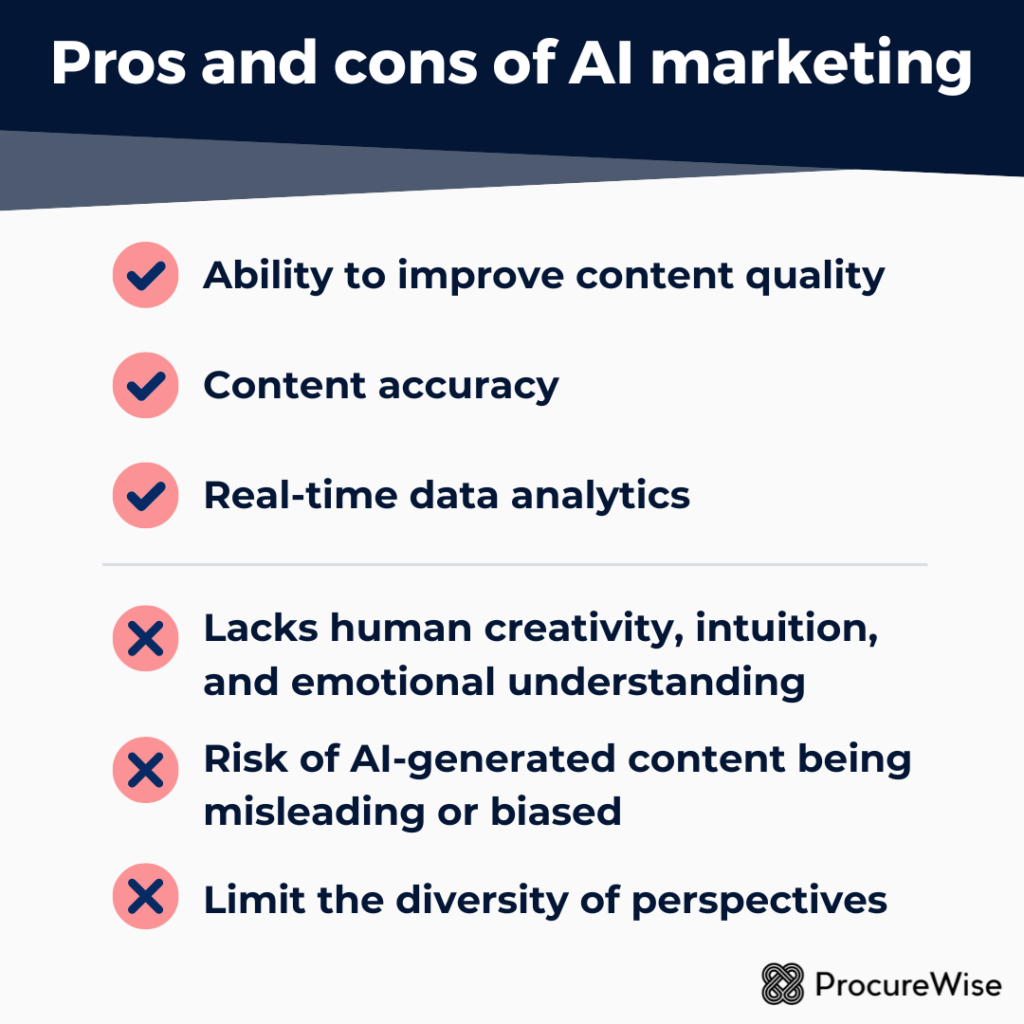
AI has made significant advancements in various industries, including digital marketing. It has the potential to enhance content quality, accuracy, and deliver real-time data analytics and insights for increased return on investment (ROI). However, relying solely on AI for content creation without human oversight can also have drawbacks.
✔️ Ability to improve content quality: AI algorithms can analyze vast amounts of data to identify patterns, preferences, and trends, allowing marketers to create personalized and engaging content. This can lead to increased customer satisfaction and loyalty.
✔️ Content accuracy: With natural language processing (NLP), AI can analyze and understand consumer sentiments, reviews, and feedback, enabling marketers to develop content that resonates with their target audience. This leads to better targeting and improved conversion rates.
✔️ Real-time data analytics: It provides valuable insights to marketers. AI algorithms can analyze user behavior, preferences, and interactions to offer personalized recommendations and optimize marketing campaigns in real-time. This helps marketers to make data-driven decisions, improve targeting, and achieve a higher ROI.
However, there are drawbacks to relying solely on AI for content creation.
✖️ Lacks human creativity, intuition, and emotional understanding: It can result in generic and impersonal content. Human oversight is necessary to ensure that the content resonates with the target audience and aligns with the brand’s values.
✖️ Risk of AI-generated content being misleading or biased: AI algorithms can inadvertently perpetuate stereotypes or make factual errors, which can harm a brand’s reputation. Human oversight is crucial to prevent such occurrences and ensure ethical content production.
✖️ Limit the diversity of perspectives: AI algorithms often learn from existing data, which may have inherent biases. Human creatives bring a diverse range of experiences and viewpoints, ensuring a more inclusive and diverse content strategy.
In conclusion, the pros of using AI in digital marketing include enhanced content quality, accuracy, and real-time data analytics leading to increased ROI. However, relying solely on AI for content creation without human oversight can result in generic content, potential biases, and limited diversity of perspectives. Striking a balance between AI and human creativity is essential to achieve the best results in digital marketing strategies.
💼 Ways to use AI in content strategy 💼
AI, or Artificial Intelligence, has revolutionized many industries, and content strategy is no exception. Leveraging the benefits of AI in content strategy can help businesses create more personalized, engaging, and effective content. Here are 8 ways to incorporate AI into content strategy:
1️⃣ Content creation: AI can generate high-quality content by analyzing vast amounts of data, enabling businesses to produce relevant and compelling articles, blog posts, and social media updates. For example, OpenAI’s GPT-3 can generate human-like text that is indistinguishable from content written by humans.
2️⃣ Content curation: AI algorithms can sort through vast amounts of content to find the most relevant and high-quality articles, videos, and images to curate for audiences. Applications like BuzzSumo use AI to identify trending and viral content, allowing content strategists to deliver the most valuable information to their target audience.
3️⃣ Audience segmentation: AI can analyze data points such as demographics, behavior, and past interactions to segment audiences efficiently. By understanding audience preferences and interests, businesses can tailor content to specific groups, increasing engagement and conversions. Netflix utilizes AI algorithms to analyze user behavior and recommend personalized content recommendations.
4️⃣ Content optimization: AI can analyze user interactions with content, including click-through rates, bounce rates, and time spent on page, to optimize content for better performance. Tools like Google Analytics and HubSpot leverage AI to provide insights on how to improve content and increase conversions.
5️⃣ Natural Language Processing (NLP): NLP enables AI to understand and process human language, making it possible to develop chatbots and virtual assistants that can engage with users, providing them with personalized content recommendations and assistance. IBM’s Watson Assistant is an example of such an AI-powered virtual assistant.
6️⃣ SEO optimization: AI can help content strategists optimize their content for search engines by analyzing keywords, competitor analysis, and user search patterns. Tools like SEMrush and Moz utilize AI algorithms to provide recommendations on keyword targeting and content optimization to improve search engine rankings.
7️⃣ Content translation: AI-powered language translation tools can automatically translate content into multiple languages, enabling businesses to reach a global audience. Google Translate is a popular example of an AI-based translation tool that offers accurate and real-time translation.
8️⃣ Content performance prediction: AI algorithms can analyze historical data to predict content performance, helping content strategists make data-driven decisions on what types of content to create and which distribution channels to focus on. This helps optimize resources and maximize ROI. Netflix utilizes AI to predict the success of its original shows before releasing them.
In conclusion, by incorporating AI into content strategy, businesses can enhance content creation, curation, audience segmentation, optimization, NLP, SEO, translation, and performance prediction. Utilizing AI’s capabilities in content strategy can lead to more personalized, engaging, and effective content, ultimately driving better business results.