
In the fast-moving world of eCommerce, price monitoring is no longer optional — it’s a core growth engine. As markets become saturated and consumers compare competitor prices in seconds, brands that rely on static pricing models simply fall behind.
In 2026, winning is about competitive intelligence, not guesswork. Modern businesses must track price changes, react with real-time alerts, and use machine learning to turn raw data into profit-driving decisions. The goal isn’t just to follow competitors — it’s to outmaneuver them.
This article series breaks down:
- why price tracking is now mission-critical,
- what separates basic tools from dominance-level platforms,
- and which monitoring tools truly deserve a place in your stack.
⚔️ Why Competitor Price Monitoring Is a Strategic Imperative? ⚔️
From “Nice to Have” to Survival Tool
In today’s digital economy, pricing is one of the fastest levers you can pull — and your competitors are pulling it constantly. Without continuous competitor analysis, brands risk being undercut, losing Buy Box visibility, and watching conversion rates erode.
Real-time price monitoring allows companies to:
- react instantly to competitor price changes,
- protect market share during promotions,
- and maintain perceived value in price-sensitive segments.
Failing to monitor pricing in real time means operating blind in a market that never sleeps.
Competitive Intelligence: From Raw Data to Market Control
Modern competitive intelligence tools do far more than collect prices. They transform data into context: who changed prices, how often, on which products, and why it matters.
Instead of manual checks or spreadsheets, leading brands now rely on:
- automated price tracking,
- historical trend analysis,
- and AI-driven insights that reveal competitor strategies before they fully unfold.
This shift — from passive tracking to strategic intelligence — is what separates followers from market leaders.
How Real-Time Pricing Impacts Market Share & Loyalty?
Customers compare prices instantly across marketplaces, brand stores, and comparison engines. If your offer isn’t competitive right now, the sale is gone.
That’s why real-time alerts are critical. They allow teams to:
- respond immediately to competitor price drops,
- adjust dynamic pricing rules,
- and stay visible where it matters most.
Consistently competitive pricing builds trust. Trust builds loyalty. Loyalty protects long-term revenue.
AI & Machine Learning: The Pricing Game-Changer
In 2026, pricing decisions are increasingly powered by machine learning. AI doesn’t just react — it predicts.
Advanced pricing platforms now use AI to:
- forecast future price changes,
- identify optimal pricing windows,
- and automate dynamic pricing at scale.
Instead of blanket discounts, businesses deploy precision pricing — adjusting offers based on demand, competition, inventory, and customer behavior in real time.
🧠 What Defines a Dominance-Driven Price Monitoring Tool? 🧠
More Than Price Scraping
A serious monitoring tool must go beyond basic scraping. True leaders track:
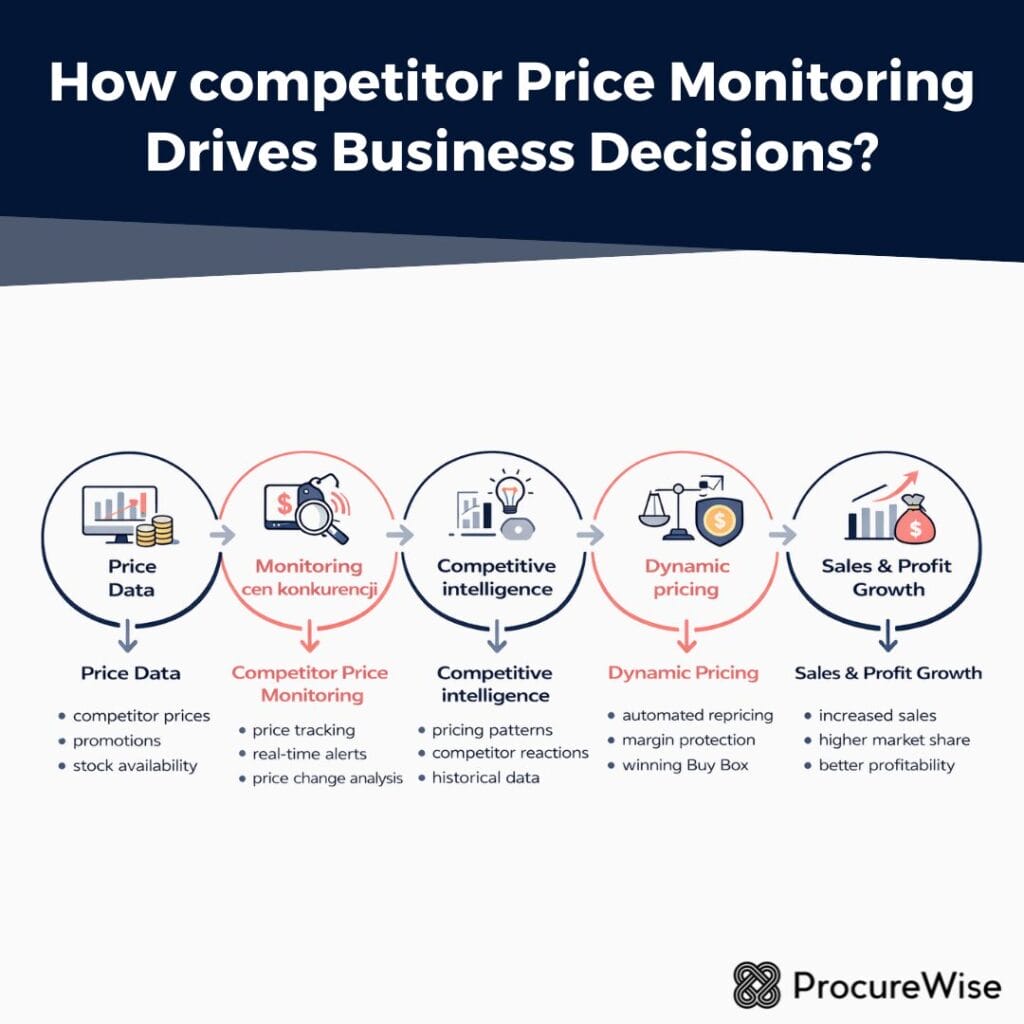
- competitor prices,
- stock availability,
- promotions,
- Buy Box ownership,
- and product visibility.
All of this feeds into a single source of truth for smarter decisions.
Speed, Automation & Actionability
The best tools combine:
- real-time alerts ⚡
- automated workflows 🤖
- and clear dashboards 📊
Data without action is useless. The winning platforms are built for speed, clarity, and execution.
🧩 Essential Features of Competitor Price Monitoring Tools in 2026 🧩
Not all price monitoring tools are created equal. In 2026, the difference between “having data” and winning the market lies in how deep, fast, and actionable that data is.
A dominance-driven solution must combine price tracking, competitive intelligence, machine learning, and automation into one coherent system. Below are the features that truly separate leaders from followers.
Advanced Web Scraping & Price Tracking ⚙️
At the foundation lies powerful web scraping. Top tools continuously extract:
- competitor prices,
- product variants & SKUs,
- stock availability,
- promotions and discounts,
- pricing pages and Buy Box data.
Modern platforms handle dynamic websites, JavaScript-heavy stores, and marketplace listings — ensuring accurate price tracking at scale.
Without reliable scraping, every other feature collapses.
Real-Time Alerts & Price Change Detection ⚡
Speed wins. The best tools deliver real-time alerts when:
- competitors change prices,
- products go out of stock,
- promotions launch or end,
- Buy Box ownership shifts.
These alerts allow teams to react before sales are lost — whether through matching prices, triggering dynamic pricing, or launching counter-promotions.
In volatile markets, minutes matter.
AI & Machine Learning–Driven Intelligence 🧠
In 2026, elite platforms use machine learning to go far beyond reporting. AI enables:
- detection of competitor pricing patterns,
- prediction of future price changes,
- identification of aggressive vs. defensive pricing strategies.
Instead of asking “What just happened?” you start asking “What’s about to happen?” — and acting first.
This is the core of modern competitive intelligence.
Dynamic Pricing & Automated Repricing Engines 🔄
A true market-leader tool integrates dynamic pricing directly into your workflow. Based on predefined rules and competitor data, prices can adjust automatically to:
- protect margins,
- win Buy Box,
- clear inventory,
- or defend market share.
Automated repricing eliminates manual work while ensuring your pricing is never outdated — even at 3 a.m.
Clear Dashboards & Actionable Insights 📊
Raw numbers don’t drive decisions — clarity does. The best tools provide dashboards showing:
- competitor price trends,
- historical price tracking,
- market positioning vs competitors,
- alerts and anomalies.
These interfaces turn complex datasets into immediate, actionable insights for pricing, sales, and strategy teams.
API Access & System Integrations 🔌
For scaling businesses, API access is critical. Leading tools integrate seamlessly with:
- eCommerce platforms,
- ERP systems,
- BI tools,
- dynamic pricing engines.
This ensures competitor pricing data flows directly into decision-making systems — powering automation, reporting, and advanced analytics.
Historical Data & Long-Term Market Intelligence 🕰️
Historical price tracking reveals:
- seasonal pricing patterns,
- long-term competitor strategies,
- reactions to promotions or economic shifts.
This context is essential for market research, strategic planning, and avoiding repeated pricing mistakes.
Beyond Price: Stock, Promotions & Buy Box Monitoring 🛒
Modern monitoring tools also track:
- stock levels,
- promotional mechanics,
- Buy Box eligibility,
- compliance issues like MAP violations.
Price alone never tells the full story. True competitor analysis requires understanding why prices move — not just that they moved.
🏆 Top 10 Competitor Price Monitoring Tools for 2026 🏆
Poniżej znajdziesz 10 najlepszych narzędzi do monitorowania cen konkurencji w 2026 roku. Każde z nich odpowiada na kluczowe potrzeby eCommerce: price tracking, real-time alerts, dynamic pricing, competitive intelligence i machine learning. Krótko, konkretnie i pod SEO 🔥
🚀 Enterprise & AI-Driven Leaders 🚀
Prisync 💡
Jedno z najpopularniejszych narzędzi do price monitoring w eCommerce.
- real-time alerts na price changes,
- automatyczne dynamic pricing,
- monitoring competitor prices i stocków. Idealne dla sklepów, które chcą szybko reagować i skalować sprzedaż.
Competera 🤖
Platforma oparta o machine learning i zaawansowaną analitykę.
- AI-driven price optimization,
- predykcja ruchów konkurencji,
- głęboka competitive intelligence. Dla firm celujących w maksymalizację marży i udziału w rynku.
Omnia Retail ⚙️
Enterprise’owe podejście do dynamic pricing.
- pełna automatyzacja cen,
- monitoring Buy Box,
- integracje API i omnichannel. Świetne dla dużych retailerów i marketplace’ów.
Solidne Narzędzia do Price Trackingu 📊
Price2Spy 📈
Klasyka competitor analysis.
- śledzenie cen, promocji i dostępności,
- alerty cenowe,
- dobre wsparcie market research. Sprawdzone rozwiązanie dla średnich firm.
Pricefx 🧠
Platforma pricingowa dla B2B i B2C.
- zaawansowane modele cenowe,
- analiza danych historycznych,
- wsparcie strategicznych decyzji cenowych. Dla firm złożonych struktur cenowych.
Pricefy ⚡
Lekki i prosty system price tracking.
- szybkie alerty,
- monitoring competitor prices,
- niski próg wejścia. Dobry wybór dla mniejszych eCommerce’ów.
Website & Change Monitoring Tools 🕵️
Skuuudle 🛒
Skupia się na price tracking i asortymencie.
- monitoring cen i promocji,
- analiza kategorii,
- wsparcie decyzji handlowych.
Visualping 👀
Nietypowe, ale potężne podejście wizualne.
- monitoruje zmiany na pricing pages,
- wykrywa zmiany cen, banerów i promocji,
- idealne uzupełnienie web scrapingu.
Fluxguard 🛡️
Nacisk na website change monitoring i compliance.
- śledzenie nagłych zmian cen,
- wykrywanie MAP violations,
- dowody zmian (evidence collection).
Market Intelligence Beyond Pricing 🌐
Similarweb 🌍
Nie klasyczne price monitoring, ale potężne tło strategiczne.
- analiza ruchu i market share,
- audience demographics,
- wsparcie competitive intelligence i strategii cenowej.
🧠 How to Turn Price Intelligence into Market Dominance in 2026? 🧠
Having the best competitor price monitoring tool is only half the battle. The real advantage comes from how you use price intelligence to make faster, smarter, and more confident decisions.
In this final part, we connect price tracking, competitive intelligence, and dynamic pricing into a clear execution framework.
Dynamic Pricing as a Competitive Weapon ⚡
In 2026, successful brands abandon fixed pricing in favor of dynamic pricing powered by:
- real-time price changes,
- competitor price tracking,
- demand and inventory signals.
With automated repricing, prices adapt continuously — protecting margins while staying competitive across channels.
Dynamic pricing isn’t about being cheapest. It’s about being correct.
Strategic Competitive Responses That Actually Work 🎯
Price matching makes sense when:
- Buy Box or ranking is at stake,
- products are highly commoditized,
- switching costs for customers are low.
Here, real-time alerts ensure you’re never late.
When to Underprice Aggressively 🔻
Underpricing is a tactical move — not a default strategy. Use it to:
- capture market share,
- break into new categories,
- liquidate overstock.
Without price intelligence, underpricing quickly destroys margins. With it, it becomes controlled and intentional.
When to Hold Your Price 🛡️
Sometimes the smartest move is doing nothing. Hold pricing when:
- brand value or differentiation is strong,
- demand exceeds supply,
- competitors race to the bottom.
Competitive intelligence gives you the confidence to resist unnecessary price wars.
Using Historical Data for Proactive Strategy 📊
Historical price tracking reveals:
- seasonal discount cycles,
- promotional habits of competitors,
- long-term market research insights.
Combined with machine learning, this data helps anticipate future price movements — allowing you to act before competitors do.
Finding Market Gaps with Competitor Data 🧩
By analyzing competitor prices, businesses often uncover:
- overpriced product categories,
- neglected customer segments,
- weak promotional strategies.
This is where competitive intelligence becomes a growth engine — not just a defensive tool.
Beyond Pricing: Full Competitive Visibility 🧠
Top-performing companies track more than prices:
- stock availability,
- Buy Box ownership,
- MAP violations,
- website changes and promotions.
This holistic view ensures pricing decisions are grounded in full market context.
🏁 Final Thoughts: Pricing as a Leadership Strategy 🏁
In 2026, competitor price monitoring is no longer about keeping up — it’s about setting the pace.
Businesses that combine:
- advanced price tracking,
- real-time alerts,
- AI-driven competitive intelligence,
- and automated dynamic pricing
don’t just survive. They dominate.
The tools you choose matter — but the strategies you execute with them matter more. When pricing becomes intelligent, proactive, and data-driven, it turns into one of the strongest levers for sustainable growth and market leadership.