

The modern retail landscape is evolving faster than ever. Customer behavior, market trends, and market conditions can shift within hours, influenced by social media, global events, and rapidly changing consumer expectations. Retailers relying solely on historical data and traditional planning cycles are increasingly unable to react quickly enough.
Today, success in retail depends on the ability to collect, analyze, and act on real-time market data. When companies monitor customer data, sales data, and market demand in real time, they gain a powerful advantage: the ability to make smarter assortment planning decisions, optimize inventory management, and significantly improve sales performance.
Retail analytics is becoming a critical part of this transformation. The global data analytics and advanced analytics market in retail is growing rapidly, with projections showing the industry expanding from $8.9 billion in 2024 to over $43 billion by 2034. This growth reflects a clear shift toward data-driven insights, machine learning, and artificial intelligence in retail decision-making.
In practice, real-time data collection and predictive analytics allow retailers to quickly detect market changes, demand forecasting signals, and emerging customer trends. Instead of reacting weeks later, companies can instantly adjust pricing strategies, product categories, and retail assortment planning to match what customers actually want.
The result is a retail strategy that is dynamic, responsive, and strongly aligned with real customer demand.
🚀 Speed and Precision in Modern Assortment Planning 🚀
Retailers today operate in a highly competitive environment where assortment strategy and assortment planning must be continuously optimized. Annual or quarterly planning cycles are no longer sufficient when market demand, customer preferences, and sales performance evolve daily.
Access to real-time customer data and sales data allows retailers to understand:
- What products customers want
- When demand is increasing
- Which product categories are trending
- How customer demographics and behavior influence purchases
With these insights, retailers can dynamically adapt their retail assortment planning strategy, ensuring the right products appear in the right place at the right time.
The Growing Importance of Customer-Centric Retail
Modern assortment planning increasingly revolves around customer experience and customer satisfaction. Retailers that analyze customer feedback, customer behavior, and customer loyalty data can design assortments that better match consumer expectations.
Real-time analytics helps retailers identify:
- changing customer preferences
- emerging market trends
- shifts in sales performance
- new product categories gaining traction
By integrating customer data with market data, companies can develop more accurate demand forecasting models and tailor assortments to different customer segments.
This approach supports a broader transformation toward data-driven retail strategies, where machine learning algorithms, predictive analytics, and advanced analytics tools continuously refine assortment decisions.
📉 Why Traditional Assortment Strategies No Longer Work 📉
For decades, retailers built their assortment strategies primarily using historical sales data, seasonal forecasts, and expert intuition. While these methods provided some stability, they are increasingly insufficient in today’s dynamic retail environment.
The key limitation is that traditional models rely on lagging data.
By the time historical sales data or market data is analyzed, market conditions and customer demand may have already changed. This delay creates several common retail challenges:
- stockouts of high-demand products
- excess inventory of slow-moving items
- missed opportunities tied to market trends
- inaccurate demand forecasting
In modern retail, where customer demand can change within days or hours, relying solely on past data means retailers are always reacting too late.
Reactive vs. Data-Driven Assortment Planning
Retailers operating without real-time analytics and predictive analytics tools often find themselves making reactive decisions based on outdated information.
For example:
- A viral social media trend suddenly increases demand for a product.
- Competitors launch new pricing strategies or promotions.
- External events influence market demand and customer purchasing behavior.
If retailers rely only on traditional reporting cycles, they may detect these changes after the peak demand has already passed.
In contrast, retailers using real-time data analytics, artificial intelligence, and machine learning can respond immediately by adjusting:
- inventory management
- product assortment
- pricing strategies
- sales and promotional campaigns
This shift from reactive to proactive retail decision-making is becoming one of the most important competitive advantages in modern retail.
⚡ What Is Real-Time Market Data in Retail? ⚡
In modern retail, real-time market data refers to information that is collected, processed, and analyzed almost instantly after it is generated. Instead of waiting days or weeks for reports, retailers gain immediate access to insights about sales performance, customer behavior, and market demand.
This type of data transforms how companies approach assortment planning, demand forecasting, and pricing strategies. Rather than relying only on historical sales data, retailers can continuously monitor the current retail landscape, detect market changes, and adjust their strategies instantly.
Real-time analytics helps businesses turn raw customer data and sales data into actionable insights, allowing them to react to trends while they are still developing.
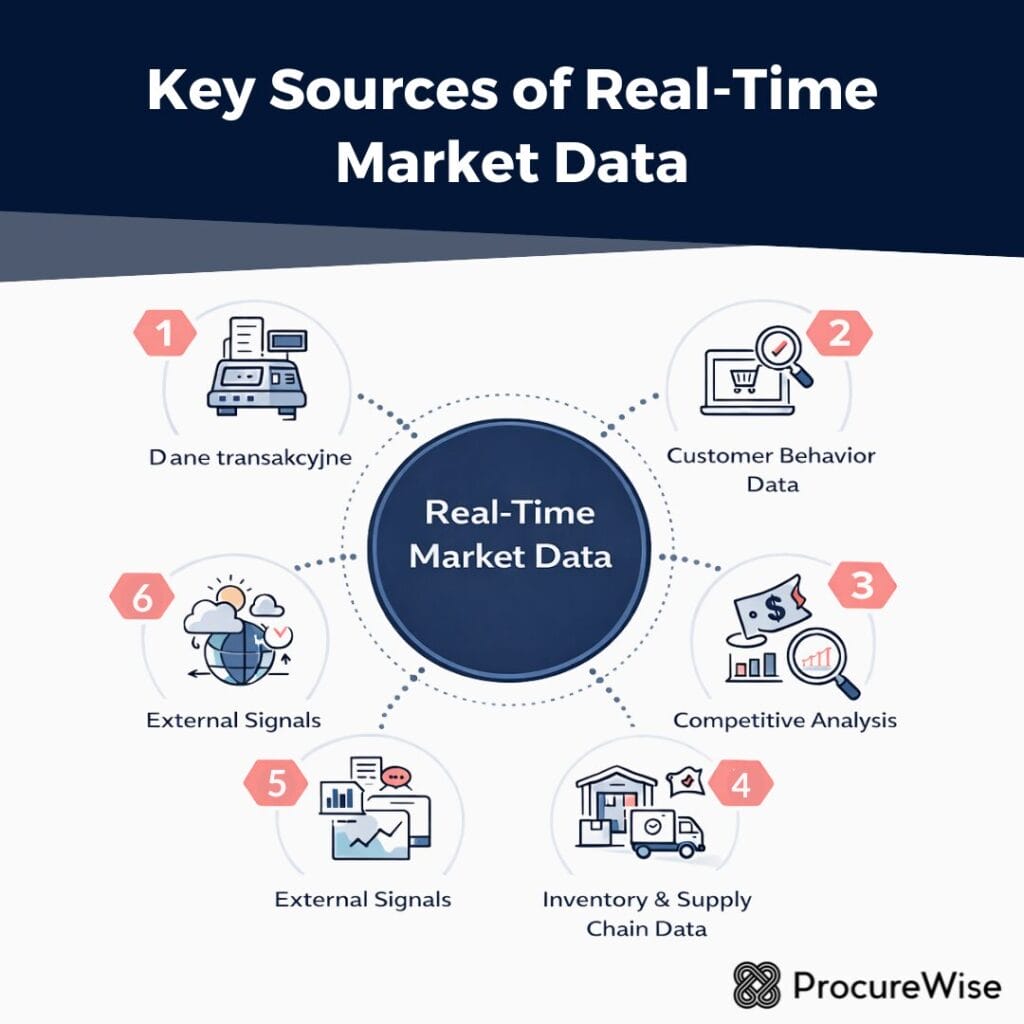
Key Sources of Real-Time Market Data in Retail 📡
Retailers gather real-time insights from multiple sources across the retail ecosystem. The most valuable data streams include:
1. Transactional Sales Data Point-of-sale systems and e-commerce platforms capture sales data in real time, allowing retailers to monitor:
- product performance
- changes in market demand
- sales velocity by product categories
This information plays a critical role in demand forecasting and assortment strategy.
2. Customer Behavior and Customer Data Real-time tracking tools collect insights about how customers interact with brands online and offline. These signals include:
- browsing patterns
- click-through rates
- cart abandonment
- purchase history
- in-store movement patterns
Analyzing customer behavior and customer demographics allows retailers to personalize assortments and improve customer experience.
3. Competitive Market Intelligence Monitoring competitors provides valuable data-driven insights into the broader market conditions. Retailers can track:
- competitor pricing strategies
- promotions and discounts
- new product launches
- availability of competing products
This data supports faster adjustments to assortment planning and sales strategy.
4. External Market Signals Not all retail trends originate inside a company’s own systems. Many are influenced by external factors such as:
- market trends and social media discussions
- weather conditions affecting demand
- economic news influencing consumer confidence
- seasonal changes in market demand
Combining internal customer data with external market data provides a much clearer view of the retail environment.
5. Inventory and Supply Chain Data Real-time visibility into inventory management and supply chain operations allows retailers to understand:
- stock levels across locations
- product availability
- replenishment timelines
This insight helps prevent stockouts, reduce excess inventory, and maintain optimal assortment availability.
📈 Why Real-Time Data Is Now Essential for Retail Decision-Making 📈
Retail decision-making has shifted dramatically toward data-driven strategies. Companies that rely on delayed reporting risk losing valuable opportunities in fast-changing markets.
Research shows that organizations with strong data analytics capabilities and advanced analytics teams are significantly more likely to achieve higher revenue growth and improved sales performance.
Real-time insights enable retailers to:
- react quickly to market changes
- detect emerging market trends
- improve demand forecasting accuracy
- optimize retail assortment planning
- enhance customer satisfaction and loyalty
Instead of relying on assumptions, retailers can base decisions on continuous streams of customer feedback, sales data, and predictive analytics models.
From Data Collection to Actionable Insights 🤖
Collecting data alone is not enough. Retailers must transform it into insights using technologies such as:
- advanced analytics
- machine learning algorithms
- predictive analytics
- artificial intelligence
These technologies process large volumes of customer data and market data, uncover patterns in customer demand, and generate recommendations for better assortment strategy and inventory management.
For example, machine learning models can analyze real-time signals to detect which product categories are gaining momentum. Retailers can then adjust retail assortment planning accordingly—expanding popular items while reducing low-performing SKUs.
🧠 Real-Time Insights as the Foundation of Data-Driven Retail 🧠
The growing importance of data analytics and machine learning in retail reflects a broader shift toward data-driven decision-making.
Retailers who effectively integrate real-time data collection, predictive analytics, and advanced analytics platforms gain the ability to continuously optimize:
- assortment planning
- inventory management
- pricing strategies
- sales performance
- customer experience
This capability creates a retail strategy that is not only reactive but proactive, allowing companies to anticipate customer demand and market changes before competitors do.
In the next section, we will explore how retailers apply real-time market data to optimize assortment strategy, SKU selection, and category management, leading directly to higher sales and stronger customer loyalty.
🧩 How Real-Time Market Data Optimizes Assortment Strategy 🧩
The biggest advantage of real-time market data in retail is its ability to transform assortment strategy from a static plan into a continuously optimized process. Instead of making decisions based only on past sales data, retailers can analyze current customer demand, market trends, and sales performance to adjust assortments dynamically.
This approach allows companies to align their retail assortment planning with real market signals. As a result, retailers can react faster to market changes, improve customer satisfaction, and maximize sales performance.
Real-time insights make it possible to optimize several critical areas of retail strategy simultaneously: demand forecasting, SKU performance, category management, and customer experience.
📊 Dynamic Demand Forecasting Using Real-Time Data 📊
One of the most important applications of real-time analytics is improving demand forecasting.
Traditional forecasting models rely on historical sales data, which often fails to capture sudden changes in market demand. In contrast, real-time systems analyze multiple live signals such as:
- current sales performance
- website search queries
- customer behavior patterns
- market trends and social media activity
- external factors like weather or events
By combining these signals, retailers can create more accurate predictive analytics models that detect demand shifts earlier.
This enables retailers to:
- increase stock of trending product categories
- adjust inventory management before stockouts occur
- respond faster to market demand spikes
More accurate demand forecasting directly improves sales performance and inventory efficiency.
🏷 SKU Optimization and Category Management 🏷
Real-time data analytics and machine learning algorithms allow retailers to evaluate the performance of every SKU within their assortment.
Using advanced analytics platforms, companies can monitor:
- product-level sales data
- profit margins by SKU
- product popularity within customer segments
- inventory turnover rates
These insights help retailers refine their assortment planning strategy by identifying:
High-performing products Items that generate strong sales performance and should receive more visibility or stock.
Underperforming products SKUs with low demand that may be removed or replaced with better-performing alternatives.
Emerging product categories New items gaining traction due to evolving customer behavior or market trends.
Through continuous SKU optimization, retailers can streamline their assortment while improving overall sales efficiency and category performance.
🎯 Personalized and Localized Retail Assortments 🎯
Modern retail increasingly focuses on customer-centric assortment planning. Real-time analysis of customer data and customer demographics allows retailers to create more personalized product offerings.
For example, retailers can use data-driven insights to adapt assortments based on:
- regional market demand
- local customer preferences
- store-level sales performance
- online customer behavior
This enables hyper-localized assortment planning, where product selections vary between locations depending on actual demand.
At the same time, digital retailers can personalize assortments for individual customers by analyzing:
- purchase history
- browsing behavior
- previous product interactions
Personalization improves both customer experience and customer loyalty, since shoppers are more likely to engage with brands that offer relevant products.
🏆 Real-Time Competitive Intelligence and Pricing Strategy 🏆
Real-time market data analytics also provides valuable insights into competitor activity. Retailers can monitor:
- competitor pricing strategies
- promotional campaigns
- product availability
- new product category launches
This information helps retailers adapt their own pricing strategies and assortment decisions quickly.
For example, if competitors lower prices or launch new products, companies can immediately adjust their product assortment or promotional strategy to remain competitive.
Combining competitive intelligence with predictive analytics strengthens a retailer’s position in the market and helps maintain strong sales performance.
🚚 Inventory Management and Supply Chain Optimization 🚚
Effective inventory management is closely connected with assortment planning. Without accurate inventory visibility, even the best assortment strategy cannot succeed.
Real-time data enables retailers to track:
- stock levels across stores and warehouses
- product availability in real time
- replenishment needs across the supply chain
By combining demand forecasting with real-time inventory data, retailers can reduce:
- stockouts that hurt sales performance
- overstocking that increases storage costs
- inefficiencies across the supply chain
Better inventory control not only improves operational efficiency but also ensures that customers consistently find the products they want.
💰 How Real-Time Market Data Boosts Sales and Retail Performance 💰
The true value of real-time market data becomes visible when retailers connect it directly to sales performance, assortment planning, and customer experience. When businesses analyze customer data, market trends, and sales data in real time, they can make faster and more accurate decisions that directly influence revenue.
Instead of relying on delayed reports, retailers can continuously adjust pricing strategies, product categories, and retail assortment planning according to current market demand and customer behavior.
This ability to respond instantly to market changes gives companies a powerful competitive advantage in the modern retail landscape.
📈 Driving Revenue Growth Through Data-Driven Assortment Decisions 📈
Retailers that integrate real-time analytics and advanced analytics platforms into their operations are significantly better positioned to increase revenue.
By monitoring sales data, customer demand, and market conditions, companies can quickly identify which products should be:
- expanded within the retail assortment
- promoted more aggressively
- replaced with better-performing alternatives
This continuous optimization allows retailers to align their assortment strategy with actual customer demand, leading to:
- higher conversion rates
- stronger sales performance
- better-performing product categories
Using predictive analytics and machine learning algorithms, retailers can also anticipate which products will become popular before demand peaks. This proactive strategy helps companies capture more revenue opportunities.
🤝 Improving Customer Experience and Customer Loyalty 🤝
A well-optimized assortment does more than increase sales—it also improves customer satisfaction and customer experience.
When retailers use customer data, customer feedback, and customer behavior analytics, they can better understand what shoppers truly want. This enables brands to offer more relevant products and improve the overall shopping experience.
Customers today expect:
- relevant product recommendations
- consistent product availability
- personalized shopping journeys
Retailers that analyze customer demographics, customer behavior, and market demand in real time can create highly personalized assortments that meet these expectations.
The result is stronger customer loyalty, higher repeat purchase rates, and improved long-term brand relationships.
📊 Maximizing Profit Margins Through Better Inventory Management 📊
Optimizing assortments using real-time market data also improves inventory management and supply chain efficiency.
When retailers combine demand forecasting, sales data, and real-time inventory tracking, they can significantly reduce common retail inefficiencies such as:
- overstocking slow-moving products
- stockouts of high-demand items
- unnecessary storage costs
- lost revenue opportunities
Efficient inventory management ensures that the right products are available at the right time, supporting both customer satisfaction and sales performance.
At the same time, better inventory control improves profit margins by minimizing markdowns and operational waste.
🤖 Technology Behind Real-Time Retail Analytics 🤖
The growth of data-driven retail strategies is largely powered by new technologies that allow companies to process large volumes of information quickly.
Key technologies enabling modern retail analytics and assortment optimization include:
- Artificial intelligence
- machine learning algorithms
- advanced analytics platforms
- predictive analytics tools
- real-time data collection systems
These technologies analyze massive datasets—including customer data, sales data, and market data—to uncover patterns and generate actionable data-driven insights.
For example, machine learning models can continuously improve demand forecasting, optimize pricing strategies, and recommend adjustments to retail assortment planning.
🔮 The Future of Retail: Real-Time, Data-Driven Decision Making 🔮
The retail industry is rapidly moving toward a future where real-time analytics, artificial intelligence, and predictive analytics play a central role in strategic decision-making.
Retailers that successfully adopt data-driven insights and advanced analytics tools will gain the ability to:
- react instantly to market trends
- anticipate customer demand
- optimize product categories and assortment planning
- improve sales performance and customer experience
As the retail landscape continues to evolve, the ability to leverage real-time market data will become not just a competitive advantage, but a fundamental requirement for success.
🧾 Conclusion: Real-Time Market Data as the Core of Modern Retail Strategy 🧾
In today’s fast-changing retail environment, relying solely on historical reports is no longer enough. Retailers must operate with real-time visibility into customer behavior, market trends, and sales performance.
By integrating real-time data analytics, machine learning, and predictive analytics, businesses can build smarter assortment strategies, improve inventory management, and better respond to market demand.
The impact is clear:
- stronger sales performance
- improved customer satisfaction and loyalty
- more efficient inventory and supply chain management
- higher long-term profitability
Retailers that embrace real-time market intelligence and data-driven decision-making will be best positioned to succeed in the increasingly dynamic retail landscape.